Traditional dashboards drown teams in data. Our platform unifies metrics, traces, and logs into a single AI-driven narrative, delivering automated root cause analysis and predictive alerts that reduce MTTR by up to 70%.

Service
Enterprise Observability AI Platform
We architect and deploy next-generation observability platforms that unify metrics, traces, and logs with AI-driven analytics, moving beyond dashboards to automated insights and narrative generation.
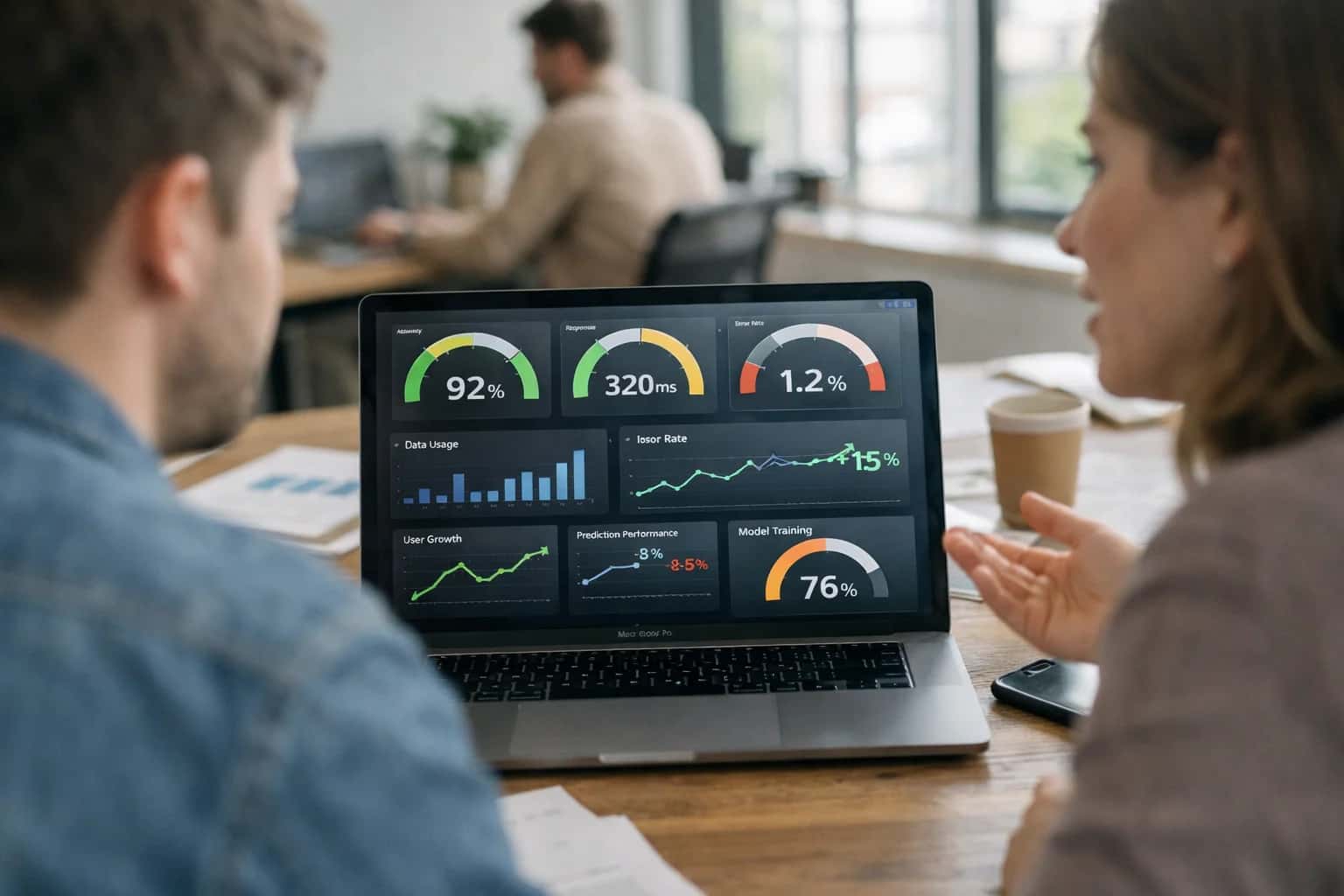
ENTERPRISE AIOPS
From Data Overload to Automated Insight
Transform raw telemetry into actionable narratives with an AI-native observability platform.
Move from reactive monitoring to proactive, autonomous operations.
- Automated Narrative Generation: AI correlates events across your stack to explain why an incident occurred, not just what happened.
- Predictive Intelligence: Models like
LSTMsandProphetforecast infrastructure failures and performance degradation weeks in advance. - Multi-Cloud & Kubernetes Native: Unified analysis across AWS, Azure, GCP, and on-prem
Kubernetesclusters. - Closed-Loop Remediation: Integrate with tools like ServiceNow and Ansible to enable self-healing for common failure patterns.
Deploy a unified observability layer in under 4 weeks. See how we engineer Predictive IT Incident Management and Automated Root Cause Analysis for global enterprises.
FROM DASHBOARDS TO AUTONOMY
Measurable Business Outcomes
Our Enterprise Observability AI Platform delivers concrete, quantifiable improvements to your IT operations, moving beyond dashboards to automated insights and proactive resolution.
02
Automated Root Cause Analysis
Implement causal inference and graph-based AI algorithms that automatically pinpoint the primary source of complex, multi-layer failures, drastically reducing manual investigation and mean time to resolution.
> 80%
Auto-Diagnosis Rate
Minutes
vs. Manual Hours
03
Unified Multi-Cloud Visibility
Architect a single AI-driven pane of glass that ingests, correlates, and analyzes metrics, traces, and logs across AWS, Azure, GCP, and private clouds, eliminating siloed tooling and blind spots.
Single Platform
for All Clouds
30%
Tool Consolidation
04
Intelligent Alert Noise Reduction
Deploy AI clustering and correlation to suppress duplicate alerts and identify the single actionable incident from hundreds of alarms, eliminating alert fatigue for your SRE and DevOps teams.
> 90%
Alert Reduction
Critical Only
Signal Focus
06
Cloud Cost Optimization (FinOps)
Integrate machine learning with your cloud billing data to identify waste, recommend right-sizing, and forecast spend, turning observability data into direct cost savings and efficient capacity planning.
20-35%
Cloud Spend Savings
Automated
Waste Detection
A structured, low-risk engagement model
Phased Implementation and Deliverables
Our proven 4-phase methodology delivers tangible value at each stage, from initial assessment to full-scale autonomous operations.
| Phase | Key Deliverables | Timeline | Outcome |
|---|---|---|---|
Phase 1: Assessment & Foundation | Current state observability audit Data pipeline architecture blueprint AI model selection & ROI projection | 2-3 weeks | Clear roadmap with prioritized use cases and defined success metrics. |
Phase 2: Core Platform Deployment | Unified data lake for metrics, logs, traces AI-powered anomaly detection baseline Executive dashboard v1.0 | 4-6 weeks | Single pane of glass with AI-driven alerting, reducing MTTR by 40-60%. |
Phase 3: Advanced Analytics & Automation | Automated root cause analysis engine Predictive failure models for critical systems Closed-loop remediation playbooks | 6-8 weeks | Proactive incident prevention and automated resolution for common failures. |
Phase 4: Full Autonomy & Scaling | Self-healing orchestration layer Multi-cloud AIOps agent deployment Comprehensive governance & reporting suite | Ongoing | Fully autonomous IT operations with continuous optimization and scaling. |
Ongoing Support & Evolution | Dedicated technical account manager Quarterly strategy reviews Access to latest model upgrades & features | Included | Guaranteed platform evolution and 99.9% uptime SLA for sustained ROI. |
ENTERPRISE AIOPS IN ACTION
Industry Applications and Use Cases
Our Enterprise Observability AI Platform delivers measurable outcomes across critical IT functions. See how we help technical leaders reduce downtime, cut costs, and automate operations.
Enabling Efficiency, Speed & Accuracy
Intelligent Analysis, Decision & Execution
We build AI systems for teams that need search across company data, workflow automation across tools, or AI features inside products and internal software.
Talk to Us
Search across company data
Give teams answers from docs, tickets, runbooks, and product data with sources and permissions.
Useful when people spend too long searching or get different answers from different systems.
Enterprise searchRAGPermissions
Read more
Automate internal workflows
Use AI to route work, draft outputs, trigger actions, and keep approvals and logs in place.
Useful when repetitive work moves across multiple tools and teams.
AI agentsWorkflow automationGovernance
Read more
Add AI to products and internal tools
Build assistants, guided actions, or decision support into the software your team or customers already use.
Useful when AI needs to be part of the product, not a separate tool.
AI integrationDecision supportModel routing
Read moreImplementation & Value
Frequently Asked Questions on Observability AI
Get clear answers on how our Enterprise Observability AI Platform delivers measurable ROI, integrates with your stack, and ensures security.
Standard deployments are completed in 2-4 weeks. This includes data pipeline integration, model fine-tuning on your telemetry, and team onboarding. Complex, multi-cloud environments with legacy systems may extend to 6-8 weeks. We follow a phased approach, delivering value incrementally, starting with core log and metric correlation in the first two weeks.

About the author
Prasad Kumkar
CEO & MD, Inference Systems
Prasad Kumkar is the CEO & MD of Inference Systems and writes about AI systems architecture, LLM infrastructure, model serving, evaluation, and production deployment. Over 5+ years, he has worked across computer vision models, L5 autonomous vehicle systems, and LLM research, with a focus on taking complex AI ideas into real-world engineering systems.
His work and writing cover AI systems, large language models, AI agents, multimodal systems, autonomous systems, inference optimization, RAG, evaluation, and production AI engineering.
LinkedIn
Limited slotsGet a Free AI Consultation
Partnered with leading AI, data, and software stack.





How We Work
Custom AI workflows for your Business
One-fit-all AI don't work for modern businesses. At Inferensys, we aim to understand your business & custom requirements; which we use to define most efficient agentic workflows, the data, and the tools for your business.
01
Review the use case
We understand the task, the users, and where AI can actually help.
Read more02
Pick the right approach
We define what needs search, automation, or product integration.
Read more03
Build the first useful version
We implement the part that proves the value first.
Read more04
Improve from there
We add the checks and visibility needed to keep it useful.
Read moreThe first call is a practical review of your use case and the right next step.
Talk to Us