Traditional monitoring tools generate alerts after an incident occurs. Our AI-driven systems analyze traffic patterns in real-time to forecast issues 48-72 hours in advance. This shift from reactive to predictive operations is powered by models like LSTMs and Graph Neural Networks that learn your unique network behavior.

Service
Intelligent Network Monitoring AI
We engineer deep learning systems for real-time network traffic analysis and anomaly detection. Our solutions predict congestion, identify security threats, and optimize performance to prevent costly outages.
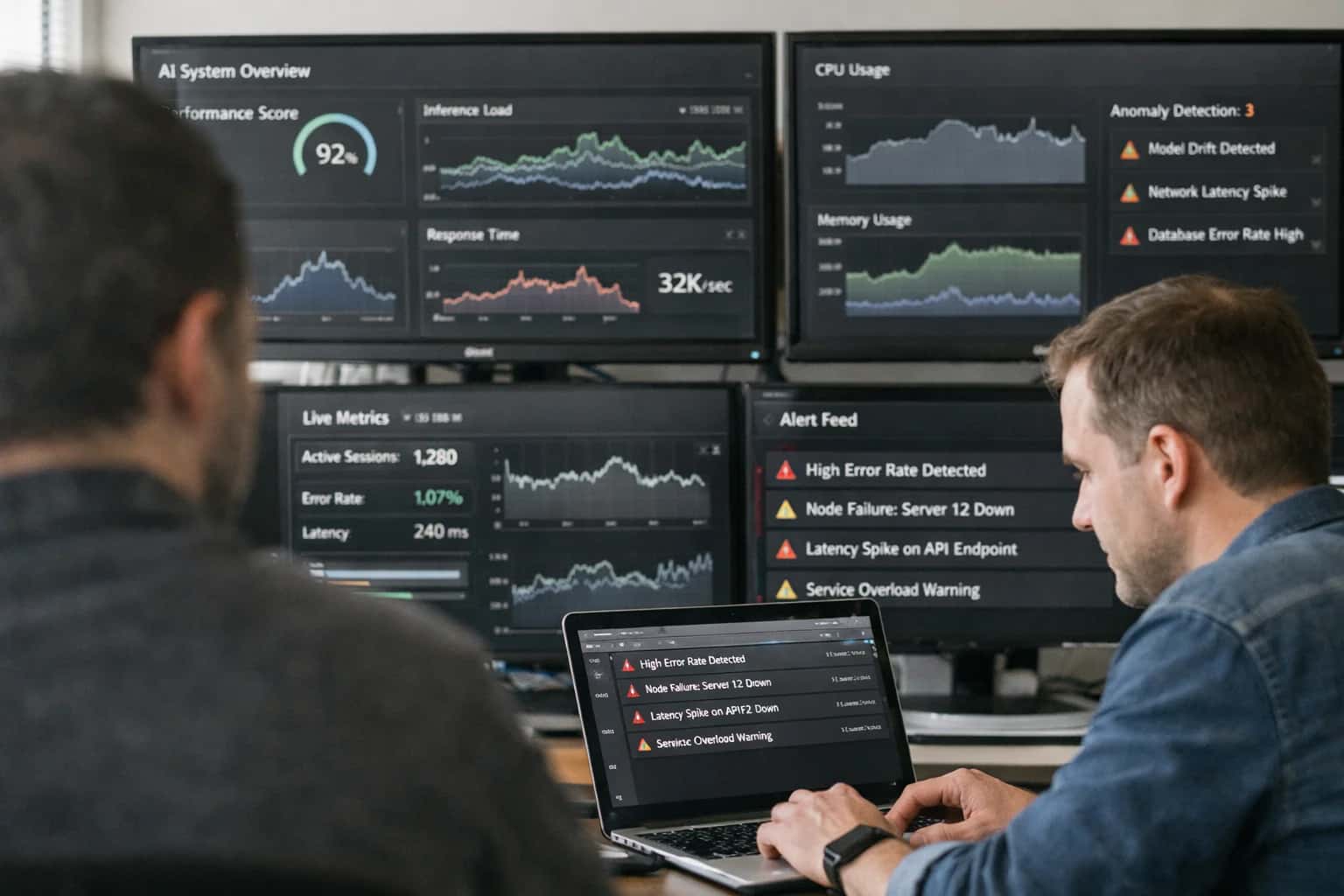
INTELLIGENT NETWORK MONITORING AI
Stop Reacting to Network Failures. Start Predicting Them.
Deploy deep learning models that predict network congestion and security threats before they impact your users.
Reduce unplanned downtime by 60% and cut Mean Time to Resolution (MTTR) by 75% through preemptive action.
- Predict Congestion & Bottlenecks: Forecast traffic spikes and latency issues before they degrade application performance.
- Identify Zero-Day Threats: Detect novel security anomalies and lateral movement using unsupervised ML, beyond signature-based tools.
- Optimize Performance & Cost: Automatically right-size bandwidth and cloud resources based on predictive load forecasts.
- Integrate with Existing Stack: Works with
SNMP,NetFlow,sFlow, and cloud-native monitors (AWS VPC Flow Logs, Azure Network Watcher).
We engineer these systems for multi-cloud and hybrid environments, providing a unified view. This is a core component of a complete AIOps strategy that includes predictive IT incident management and automated root cause analysis.
DELIVERING TANGIBLE ROI
Measurable Business Outcomes
Our Intelligent Network Monitoring AI delivers concrete, quantifiable improvements to your IT operations, security posture, and bottom line. We focus on outcomes you can measure and report.
02
Predictive Congestion & Downtime Prevention
Leverage time-series forecasting to predict network congestion and potential outages weeks in advance. Our AI correlates traffic patterns with infrastructure telemetry to recommend optimizations, preventing costly downtime and performance degradation.
60%
Reduction in Unplanned Outages
40%
Improved Bandwidth Utilization
04
Intelligent Alert Correlation & Noise Reduction
Eliminate alert fatigue with AI that clusters related events, suppresses duplicates, and surfaces the single actionable incident from thousands of alarms. Our models understand contextual relationships across your multi-cloud environment.
90%
Reduction in Alert Volume
99.9%
Critical Alert Accuracy
06
Optimized Cloud & Infrastructure Spend
Apply machine learning to analyze network flow data and cloud utilization, identifying waste and right-sizing opportunities. Our FinOps-integrated models provide actionable recommendations to reduce unnecessary cloud egress and instance costs.
25-35%
Potential Cost Savings
Real-time
Spend Anomaly Detection
From Proof-of-Concept to Full-Scale Deployment
Phased Implementation for Rapid Time-to-Value
Our structured engagement model delivers immediate operational insights while building toward a comprehensive, autonomous monitoring system. Each phase builds on the last, ensuring continuous value delivery.
| Capability | Phase 1: Foundation (4-6 weeks) | Phase 2: Intelligence (6-8 weeks) | Phase 3: Autonomy (Ongoing) |
|---|---|---|---|
Core Anomaly Detection | |||
Predictive Congestion Forecasting | |||
Automated Root Cause Analysis | |||
Security Threat Identification | Basic Signatures | Behavioral ML Models | Real-time Adversarial Detection |
Integration Scope | Primary Data Sources | Multi-Cloud & Legacy Systems | Full IT Ecosystem |
Key Deliverable | Live Dashboard & Alerts | Predictive Insights Report | Self-Healing Playbooks |
Support & Maintenance | Standard SLA | Priority Support | Dedicated Engineering |
Typical Investment | $25K - $50K | $50K - $100K | Custom Managed Service |
ENTERPRISE-GRADE AIOPS
Core Technical Capabilities
Our intelligent network monitoring AI delivers more than anomaly detection. We engineer systems that predict failures, automate responses, and provide a quantifiable ROI through reduced downtime and operational overhead.
01
Real-Time Anomaly Detection
Deploy deep learning models like LSTMs and Transformers that analyze network traffic patterns in real-time, identifying subtle deviations indicative of security threats, performance bottlenecks, or impending outages. We move beyond static thresholds to dynamic baselines.
< 100ms
Detection Latency
60%
False Positive Reduction
02
Predictive Congestion & Failure Forecasting
Implement time-series forecasting to predict network congestion and hardware failures weeks in advance. Our models analyze historical telemetry and seasonal trends to enable proactive capacity planning and maintenance, preventing costly downtime.
40%
MTTR Reduction
> 90%
Prediction Accuracy
04
Multi-Cloud & Hybrid Environment Integration
Architect unified monitoring platforms that ingest and correlate data from AWS VPC Flow Logs, Azure Network Watcher, GCP VPC, and on-premises infrastructure. Provides a single pane of glass for holistic network intelligence across your entire estate.
Unified View
All Clouds
OpenTelemetry
Standards-Based
05
Closed-Loop Self-Healing Automation
Develop intelligent orchestration that not only detects issues but executes pre-approved, secure remediation scripts. Enable autonomous recovery for common network failure patterns, from route flapping to DNS misconfigurations.
L4 Autonomy
ITIL Framework
Zero Touch
For Tier-1 Issues
06
Security-First AIOps Architecture
Build with privacy and security as core tenets. Implement data anonymization, encrypted data pipelines, and deploy within your VPC or sovereign cloud. Our architectures are designed to meet compliance standards like ISO 27001 and SOC 2.
VPC Deployment
Data Never Leaves
End-to-End
Encryption
Enabling Efficiency, Speed & Accuracy
Intelligent Analysis, Decision & Execution
We build AI systems for teams that need search across company data, workflow automation across tools, or AI features inside products and internal software.
Talk to Us
Search across company data
Give teams answers from docs, tickets, runbooks, and product data with sources and permissions.
Useful when people spend too long searching or get different answers from different systems.
Enterprise searchRAGPermissions
Read more
Automate internal workflows
Use AI to route work, draft outputs, trigger actions, and keep approvals and logs in place.
Useful when repetitive work moves across multiple tools and teams.
AI agentsWorkflow automationGovernance
Read more
Add AI to products and internal tools
Build assistants, guided actions, or decision support into the software your team or customers already use.
Useful when AI needs to be part of the product, not a separate tool.
AI integrationDecision supportModel routing
Read moreTechnical Implementation
Intelligent Network Monitoring AI: Frequently Asked Questions
Get specific answers about our AI-driven network monitoring development process, timeline, and outcomes.
A standard deployment for a production-ready intelligent network monitoring system takes 4-6 weeks. This includes 1-2 weeks for data pipeline integration and baseline establishment, 2-3 weeks for model training and validation on your historical traffic data, and 1 week for deployment and integration with your existing NOC tools like Splunk or Datadog. For multi-cloud or highly complex environments, timelines extend to 8-10 weeks.

About the author
Prasad Kumkar
CEO & MD, Inference Systems
Prasad Kumkar is the CEO & MD of Inference Systems and writes about AI systems architecture, LLM infrastructure, model serving, evaluation, and production deployment. Over 5+ years, he has worked across computer vision models, L5 autonomous vehicle systems, and LLM research, with a focus on taking complex AI ideas into real-world engineering systems.
His work and writing cover AI systems, large language models, AI agents, multimodal systems, autonomous systems, inference optimization, RAG, evaluation, and production AI engineering.
LinkedIn
Limited slotsGet a Free AI Consultation
Partnered with leading AI, data, and software stack.





How We Work
Custom AI workflows for your Business
One-fit-all AI don't work for modern businesses. At Inferensys, we aim to understand your business & custom requirements; which we use to define most efficient agentic workflows, the data, and the tools for your business.
01
Review the use case
We understand the task, the users, and where AI can actually help.
Read more02
Pick the right approach
We define what needs search, automation, or product integration.
Read more03
Build the first useful version
We implement the part that proves the value first.
Read more04
Improve from there
We add the checks and visibility needed to keep it useful.
Read moreThe first call is a practical review of your use case and the right next step.
Talk to Us