Predictive maintenance cannot wait for the cloud. The promise of analyzing vibration and thermal data in a central data lake is a latency-induced fantasy. By the time sensor data completes a cloud round-trip, the bearing has already failed.
Blog
The Future of Predictive Maintenance Is On-Site Edge Intelligence
Cloud-based predictive maintenance is a broken paradigm. This analysis explains why analyzing vibration, thermal, and acoustic sensor data directly on machinery via edge intelligence is the only viable path to real-time failure prediction, data sovereignty, and operational resilience.
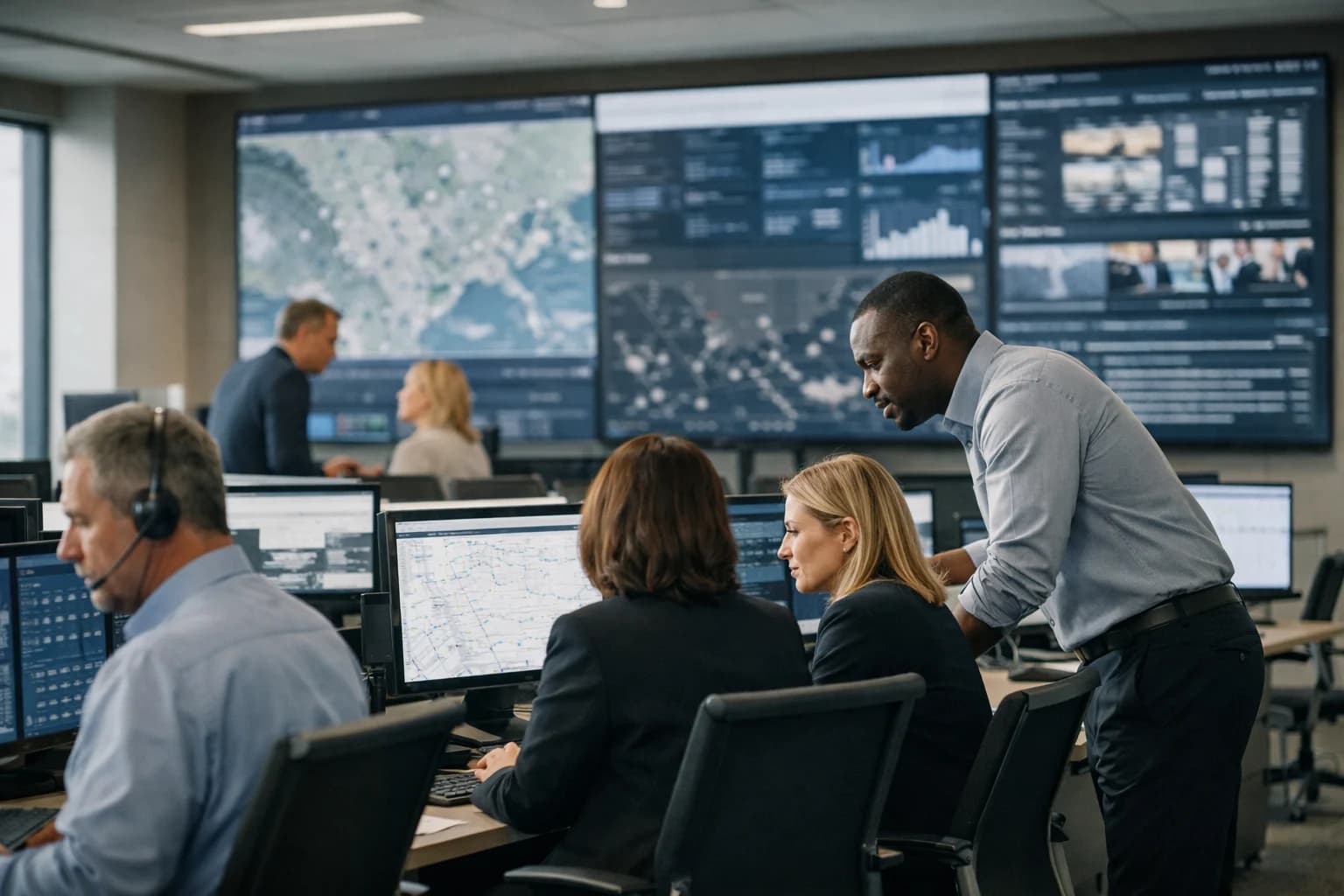
THE LATENCY TRAP
The Cloud-Centric Predictive Maintenance Lie
Cloud-based predictive maintenance fails because the round-trip latency for critical sensor data makes real-time failure prediction impossible.
Real-time anomaly detection requires on-site inference. Models like TinyML or quantized PyTorch models must run directly on an NVIDIA Jetson or Intel Movidius edge device. This enables sub-millisecond response to acoustic signatures of impending failure, a physical impossibility with cloud architecture.
The economics of data transport are prohibitive. Streaming high-frequency time-series data from thousands of sensors to AWS IoT Core or Azure IoT Hub incurs massive bandwidth costs. Edge intelligence filters and processes data locally, sending only actionable insights, which slashes cloud egress fees by over 70%.
Evidence: A study by an industrial OEM found that moving vibration analysis from the cloud to an on-site edge gateway reduced mean-time-to-diagnosis from 45 minutes to under 200 milliseconds, preventing unplanned downtime that costs an average of $260,000 per hour. This is the core of a true Industrial nervous system.
The future is federated, not centralized. Federated Learning frameworks like TensorFlow Federated allow edge nodes to collaboratively improve a global model without exporting raw data, solving the data sovereignty problem inherent in cloud-centric designs. This aligns with the principles of Sovereign AI and Geopatriated Infrastructure.
PREDICTIVE MAINTENANCE
Three Trends Forcing the Edge Shift
Cloud-centric AI is failing industrial operations. Here are the three critical trends pushing intelligence directly onto machinery.
01
The Problem: Terabyte-Scale Data Tsunami
Modern industrial sensors (vibration, thermal, acoustic) generate terabytes of high-frequency data daily. Transmitting this raw stream to a central cloud for analysis is economically and physically impossible.
- Bandwidth costs become prohibitive, often exceeding $50k/month for a single production line.
- Latency of 500ms+ for cloud round-trips means failures are detected after they occur, not predicted.
- Creates a massive, unusable 'Dark Data' lake that offers no operational insight.
TB/Day
Data Volume
500ms+
Cloud Latency
02
The Solution: On-Device Feature Extraction
Edge intelligence performs real-time signal processing directly on the sensor or industrial gateway. Only critical, distilled insights—not raw waveforms—are transmitted.
- Reduces upstream data volume by >99%, slashing cloud costs and network load.
- Enables sub-10ms anomaly detection, allowing for true predictive intervention.
- Transforms raw sensor streams into actionable health scores and failure probabilities for centralized dashboards.
>99%
Data Reduced
<10ms
Detection Latency
03
The Imperative: Offline Operational Resilience
Critical infrastructure—power grids, water treatment, remote mining—cannot afford AI failure due to network outages. On-site edge models must operate autonomously.
- Ensures continuous monitoring and protection even during complete WAN/Satcom disruption.
- Mitigates geopolitical risk and complies with data sovereignty mandates by keeping sensitive operational data on-premises.
- This trend is central to building a resilient Industrial Nervous System, a key concept within our Edge AI and Real-Time Decisioning Systems pillar.
24/7
Uptime
0 kB
External Data
DECISION MATRIX
Cloud vs. Edge: The Hard Economics of Predictive Maintenance
A quantified comparison of cloud-centric and edge-native architectures for industrial predictive maintenance, focusing on operational costs, performance, and strategic impact.
| Feature / Metric | Cloud-Centric Architecture | Hybrid Architecture | On-Site Edge Intelligence |
|---|---|---|---|
Inference Latency | 500-2000 ms | 100-500 ms | < 10 ms |
Data Transfer Cost (per TB) | $23-100 | $10-50 | $0 |
Uptime During Network Outage | 0% | Degraded Function | 100% |
Initial Model Deployment Time | 2-4 weeks | 1-2 weeks | < 1 week |
Real-Time Anomaly Detection | |||
Bandwidth Consumption (per sensor/day) | 1-10 GB | 100-500 MB | < 10 MB |
Compliance with Data Sovereignty Laws (e.g., GDPR) | |||
Mean Time to Detect Failure (MTTD) | Minutes to Hours | Seconds to Minutes | < 1 Second |
Required On-Prem Infrastructure | Minimal | Moderate (Edge Gateways) | Substantial (Edge Servers/NVIDIA Jetson) |
Operational Expense (OpEx) Dominance | 90% Cloud + Bandwidth | 60% Hybrid | 80% Capital + Maintenance |
THE INFRASTRUCTURE
Architecting the Industrial Nervous System
Predictive maintenance shifts from cloud-based analytics to an on-site edge intelligence network that processes sensor data locally.
On-site edge intelligence is the non-negotiable architecture for modern predictive maintenance, processing terabytes of vibration, thermal, and acoustic data directly on machinery without cloud latency. This local inference enables failure prediction milliseconds before a breakdown, a capability central to our pillar on Edge AI and Real-Time Decisioning Systems.
The cloud data lake model fails for industrial telemetry due to bandwidth cost and round-trip latency. Edge gateways running optimized TensorFlow Lite or ONNX Runtime models analyze sensor streams in real-time, triggering local actuators while sending only critical alerts upstream. This is a core principle of Physical AI and Embodied Intelligence.
Predictive models must be federated, not centralized. Frameworks like NVIDIA's TAO Toolkit or PySyft enable federated learning across a plant's edge nodes, continuously improving anomaly detection without pooling sensitive operational data, directly addressing data sovereignty concerns outlined in Sovereign AI and Geopatriated Infrastructure.
Evidence: Deploying TinyML models on ARM Cortex-M microcontrollers reduces latency from seconds to under 10 milliseconds, cutting unplanned downtime by up to 45% according to industry benchmarks. This proves the economic imperative of moving intelligence to the sensor.
BEYOND THE HYPE
The Hidden Costs and Risks of Edge Predictive Maintenance
Deploying intelligence on-site promises efficiency, but introduces a new class of operational and financial burdens that traditional cloud-centric MLOps is ill-equipped to handle.
01
The Problem: Silent Model Degradation in the Field
Edge models operate in dynamic, non-stationary environments. Without continuous retraining, predictive accuracy decays by 20-40% within months, leading to false alarms or missed failures. Traditional cloud-based monitoring can't detect this drift in offline or bandwidth-constrained settings.
- Hidden Cost: Unplanned downtime from undetected failures.
- Key Risk: Erosion of trust in the entire predictive maintenance system.
20-40%
Accuracy Decay
Months
Degradation Timeline
02
The Problem: The Heterogeneous Hardware Tax
An industrial fleet contains sensors, gateways, and PLCs from multiple vendors (Siemens, Rockwell, ARM, x86). Deploying and maintaining a single model across this fragmented landscape requires custom quantization, compilation, and validation for each chipset.
- Hidden Cost: Engineering effort scales linearly with device diversity.
- Key Risk: Vendor lock-in and inability to leverage best-of-breed hardware.
3-5x
Dev Effort
Multiple
Build Targets
03
The Problem: Data Gravity vs. Sovereignty
Regulations like GDPR and the EU AI Act mandate local data processing. However, improving model performance often requires centralized data. This creates a strategic tension between compliance and capability.
- Hidden Cost: Inability to aggregate data for model improvement.
- Key Risk: Regulatory fines and geographic deployment limitations.
GDPR
Compliance Driver
Local-Only
Data Scope
04
The Solution: Federated Learning as a Strategic Imperative
This privacy-preserving technique enables continuous model improvement across thousands of edge devices without raw data ever leaving the site. It turns distributed constraints into an aggregate advantage.
- Key Benefit: Models improve while respecting data sovereignty.
- Key Benefit: Mitigates silent model drift by enabling decentralized retraining.
0%
Data Exfiltrated
Continuous
Model Updates
05
The Solution: Edge-Native MLOps and the 'Shadow Mode'
Managing this scale requires a new operational paradigm. Deploy new model versions in a 'Shadow Mode' alongside production models on the edge device, comparing performance in real-time before cut-over.
- Key Benefit: De-risks model updates and enables A/B testing at scale.
- Key Benefit: Provides continuous health monitoring for the AI layer itself.
Zero-Downtime
Updates
A/B Test
At Edge
06
The Solution: Hardware-Agnostic Model Packaging
Combat vendor lock-in and the hardware tax by abstracting the model from the silicon. Use intermediate representations (like ONNX) and containerized inference engines that can be orchestrated across different devices.
- Key Benefit: Future-proofs deployments against hardware churn.
- Key Benefit: Dramatically reduces the cost of scaling to new device types.
ONNX
Portability Layer
-70%
Porting Cost
THE ARCHITECTURE
From Prediction to Autonomous Prescription
Edge intelligence transforms predictive maintenance from a forecasting tool into a self-optimizing control system.
Predictive maintenance evolves into prescriptive action when inference runs on-site. The system diagnoses a fault and immediately executes the optimal corrective workflow, eliminating the latency of cloud round-trips for human approval.
The control loop shifts from the cloud to the PLC. A compressed model, deployed via a framework like TensorFlow Lite Micro or NVIDIA Triton Inference Server, analyzes vibration and thermal data directly on an industrial gateway. It triggers a maintenance script or adjusts machine parameters in milliseconds.
This creates a resilient, offline-capable nervous system. Unlike cloud-dependent analytics, edge-native intelligence operates during network outages. It uses federated learning techniques to aggregate learnings across a factory floor without exporting raw sensor data, addressing core AI TRiSM concerns for data privacy.
Prescriptive systems reduce mean-time-to-repair (MTTR) by over 60%. For example, an anomalous acoustic signature from a bearing triggers an automatic lubrication cycle via a connected actuator, preventing a failure that would have caused a 48-hour production line stoppage.
THE ON-SITE IMPERATIVE
Key Takeaways: The Edge Mandate for Predictive Maintenance
Cloud-based predictive maintenance is a broken paradigm; real-time failure prediction requires moving intelligence directly onto machinery.
01
The Problem: The Terabyte Tax on Cloud Analytics
Streaming raw, high-frequency sensor data (vibration, thermal, acoustic) to a central cloud for analysis is economically and technically bankrupt. It incurs crippling bandwidth costs, introduces latency of 500ms to 2+ seconds, and creates a massive attack surface for sensitive operational data.
- Cost: Eliminates ~70% of cloud egress and storage costs.
- Speed: Enables sub-100ms anomaly detection for immediate intervention.
- Security: Keeps proprietary operational patterns on-premises, aligning with data sovereignty mandates like GDPR and the EU AI Act.
~70%
Cost Reduced
500ms+
Latency Eliminated
02
The Solution: The Industrial Nervous System
Deploying lightweight, quantized models directly on industrial gateways, PLCs, or dedicated edge devices like the NVIDIA Jetson Orin creates a distributed 'nervous system.' This system performs continuous, real-time inference on sensor streams, predicting failures like bearing wear or motor imbalance before they cause downtime.
- Autonomy: Enables closed-loop control where the edge node can trigger an immediate shutdown or adjustment.
- Resilience: Functions fully during network outages, a critical requirement for operational continuity.
- Efficiency: Leverages Federated Learning to aggregate learnings across the fleet without exporting raw data, continuously improving model accuracy.
>95%
Uptime
Real-Time
Inference
03
The Hidden Cost: Silent Model Drift at Scale
Edge models degrade silently due to changing environmental conditions, new machinery, or wear patterns. Traditional cloud-centric MLOps cannot monitor thousands of remote deployments, creating a massive technical debt and operational risk.
- Risk: Uncaught drift leads to false negatives (missed failures) and false positives (costly unnecessary maintenance).
- Solution: Requires Edge-Native MLOps—automated pipelines for monitoring performance metrics, orchestrating canary deployments of new models, and rolling back faulty updates across heterogeneous hardware. This is the true test of an organization's MLOps maturity, as covered in our pillar on MLOps and the AI Production Lifecycle.
10x
Ops Complexity
Critical
Risk
04
The Strategic Pivot: From Data Lakes to Decision Lakes
The end goal is not a centralized repository of all sensor data, but a distributed network of intelligence—a 'Decision Lake.' Each edge node processes its local stream, sending only high-value insights, alerts, and aggregated model updates to the cloud for strategic oversight and fleet-wide learning.
- Efficiency: Reduces upstream data volume by >90%, transforming cloud costs from a liability into a strategic enabler.
- Agility: Enables predictive maintenance as a service business models and seamless integration with Digital Twins for simulation and planning.
- Foundation: This architectural shift is the core of the Industrial Internet of Things (IIoT), unlocking value that raw data streaming never could.
>90%
Data Reduced
Strategic
Agility
Build AI Search, AI Agents, and Product AI
We build AI systems for teams that need search across company data, workflow automation across tools, or AI features inside products and internal software.
Talk to Us
Search across company data
Give teams answers from docs, tickets, runbooks, and product data with sources and permissions.
Useful when people spend too long searching or get different answers from different systems.
Enterprise searchRAGPermissions
Read more
Automate internal workflows
Use AI to route work, draft outputs, trigger actions, and keep approvals and logs in place.
Useful when repetitive work moves across multiple tools and teams.
AI agentsWorkflow automationGovernance
Read more
Add AI to products and internal tools
Build assistants, guided actions, or decision support into the software your team or customers already use.
Useful when AI needs to be part of the product, not a separate tool.
AI integrationDecision supportModel routing
Read moreTHE DATA
Stop Streaming, Start Thinking
Streaming sensor data to the cloud for predictive maintenance is an architectural and economic dead end.
On-device inference eliminates latency. The future of predictive maintenance is analyzing vibration, thermal, and acoustic data directly on machinery, not sending terabytes to a central data lake. This shift is a core principle of Edge AI and Real-Time Decisioning Systems.
Cloud round-trip time is fatal. A bearing failure signal takes milliseconds to manifest but over 100ms to reach a cloud API. By the time a cloud-based model returns an alert, the cascade has begun. Edge-native intelligence is the only architecture that meets the real-time demands of industrial systems.
Bandwidth costs cripple ROI. Streaming high-frequency sensor data from thousands of machines is economically infeasible. Edge processing acts as a data compressor, sending only actionable insights—anomaly flags or health scores—not raw telemetry. This directly impacts the Inference Economics of an AI system.
NVIDIA Jetson and TensorRT are enabling platforms. Deploying models on these edge-optimized stacks requires aggressive techniques like quantization and pruning to fit within strict power and memory constraints, a process detailed in our guide to Hardware-Software Co-Design.

About the author
Prasad Kumkar
CEO & MD, Inference Systems
Prasad Kumkar is the CEO & MD of Inference Systems and writes about AI systems architecture, LLM infrastructure, model serving, evaluation, and production deployment. Over 5+ years, he has worked across computer vision models, L5 autonomous vehicle systems, and LLM research, with a focus on taking complex AI ideas into real-world engineering systems.
His work and writing cover AI systems, large language models, AI agents, multimodal systems, autonomous systems, inference optimization, RAG, evaluation, and production AI engineering.
LinkedIn profile
Limited slotsGet a Free AI Consultation
We work with leading teams building AI, Software and Data.
5+ years building production-grade systems
Explore Services












Tell us what you want AI to do.
We look at the workflow, the data, and the tools involved. Then we tell you what is worth building first.
01
Review the use case
We understand the task, the users, and where AI can actually help.
Read more02
Pick the right approach
We define what needs search, automation, or product integration.
Read more03
Build the first useful version
We implement the part that proves the value first.
Read more04
Improve from there
We add the checks and visibility needed to keep it useful.
Read moreThe first call is a practical review of your use case and the right next step.
Talk to Us