The CAP Theorem Applies: Edge AI networks face an unavoidable trade-off between consistency, availability, and partition tolerance. For real-time decisioning, low latency wins, forcing systems into an eventual consistency model where data across nodes is temporarily out of sync. This is a fundamental shift from the strong consistency guarantees of centralized cloud databases like PostgreSQL.

Blog
The Hidden Cost of Synchronization in Distributed Edge Inference
Moving AI inference to the edge solves latency and privacy, but creates a new nightmare: coordinating state across thousands of devices. This deep dive exposes the hidden synchronization costs that break cloud paradigms and outlines the architectural patterns needed for robust distributed edge intelligence.
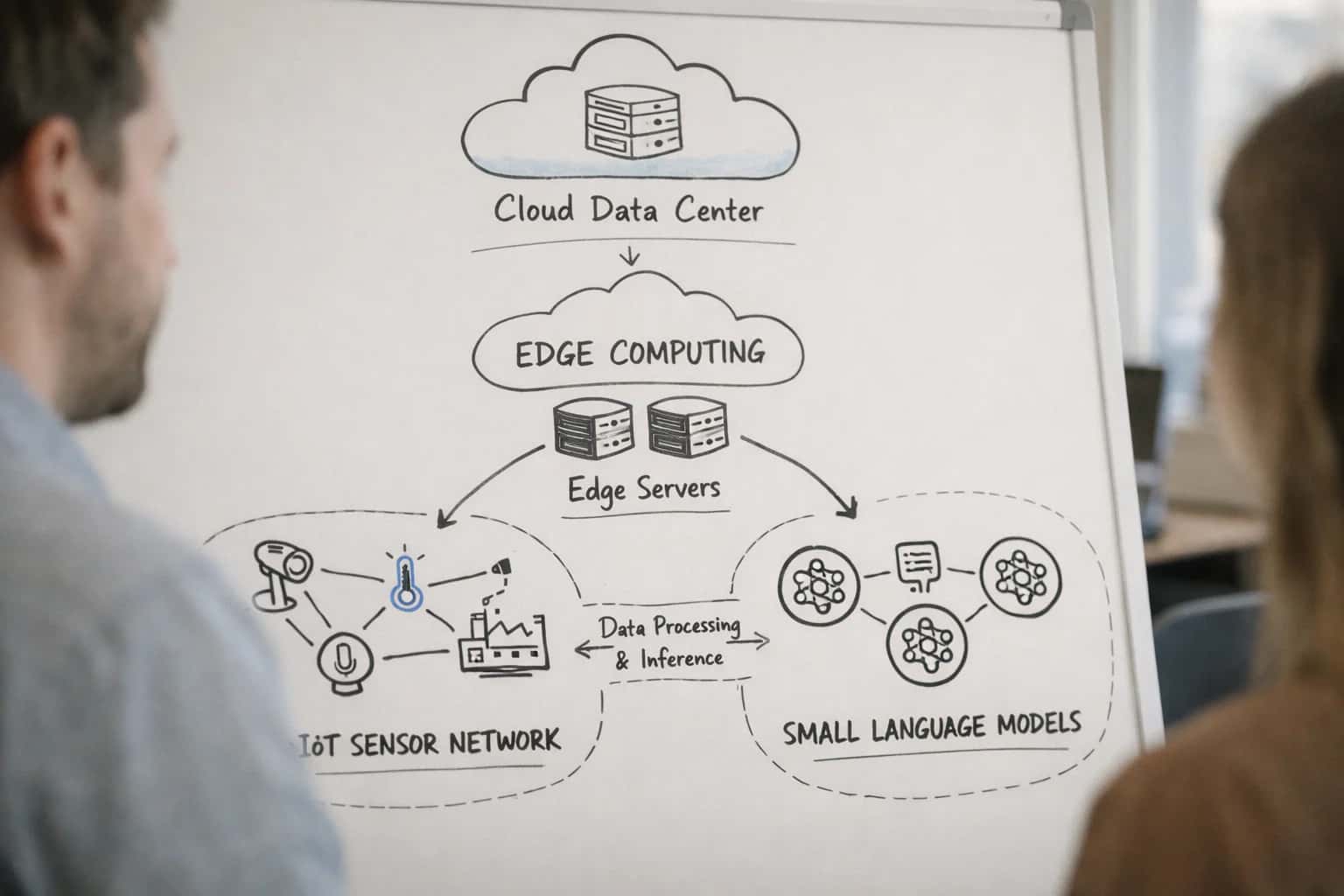
THE DATA
The Edge AI Illusion: Latency Wins, Consistency Loses
Distributed edge inference sacrifices data consistency to achieve low latency, creating hidden operational risks that break cloud-based assumptions.
Synchronization Overhead Breaks Economics: Tools like Apache Kafka or Redis for state synchronization introduce network overhead that negates the latency benefits of edge deployment. The cost of maintaining a globally consistent view across thousands of nodes, such as in a smart factory using NVIDIA's Metropolis platform, often exceeds the value of the real-time inference itself.
Eventual Consistency is a Feature, Not a Bug: Designing for eventual consistency unlocks scalability. Systems must adopt conflict-free replicated data types (CRDTs) and idempotent operations, patterns common in distributed databases like Amazon DynamoDB, to ensure the network converges to a correct state without blocking for synchronization. This is critical for federated learning workflows.
Evidence from IoT Deployments: In industrial IoT deployments, attempting strong consistency for sensor data across edge gateways can increase decision latency by 300-500ms, nullifying the advantage of on-premise processing. The solution is to embrace local autonomy with asynchronous reconciliation, a core principle of our work on Physical AI and Embodied Intelligence.
The Hidden Cost is Operational Complexity: The real expense is not compute, but the operational burden of monitoring and repairing data drift across the network. This demands a new layer of Edge MLOps, far beyond traditional cloud-centric tools, to manage the state of thousands of independent inference engines. Learn more about scaling these systems in our guide to MLOps and the AI Production Lifecycle.
THE HIDDEN COST OF SYNCHRONIZATION
Three Trends Exposing the Synchronization Crisis
Distributed edge inference breaks cloud paradigms by introducing complex consistency problems that directly impact performance and reliability.
01
The Problem: Real-Time Consensus is a Latency Killer
Autonomous systems like vehicles and drones require sub-100ms consensus for safety. Cloud-based coordination introduces ~500ms latency, making real-time, distributed decision-making impossible.\n- Vehicle-to-everything (V2X) networks fail without low-latency state sync.\n- Decentralized intelligence on the factory floor stalls, creating operational bottlenecks.
>500ms
Cloud Sync Latency
<100ms
Required for Safety
02
The Problem: Model Drift Creates a Silent Fleet Crisis
Edge models degrade in unpredictable environments. Without synchronized updates, a fleet of 10,000 devices can develop 10,000 different model variants, leading to inconsistent and unreliable behavior.\n- Traditional MLOps toolchains cannot manage distributed, offline deployments.\n- Inference accuracy drops silently, creating massive technical debt and risk.
10k+
Divergent Models
-20%
Accuracy Drift
03
The Solution: Federated Learning as the Synchronization Layer
Federated Learning enables continuous model improvement across devices without centralizing raw data. It is the foundational technique for privacy-preserving, scalable edge intelligence.\n- Local training on device data preserves privacy and complies with data sovereignty laws like GDPR.\n- Aggregated updates create a globally improved model, solving the silent drift crisis.
0%
Raw Data Exposed
1 Global Model
From 10k Devices
04
The Problem: Bandwidth Costs Strangle Video Analytics
Streaming raw 4K video for cloud analysis requires ~6 Gbps per camera. This is economically and technically infeasible at scale, forcing analytics to the edge and creating a synchronization nightmare for aggregated insights.\n- Centralized dashboards display stale or incomplete data.\n- Real-time alerts are delayed, negating the value of surveillance.
~6 Gbps
Per Camera Stream
$10k+/mo
Bandwidth Cost at Scale
05
The Solution: Edge-Native Event-Driven Architecture
Replace monolithic sync with an event-driven architecture where edge nodes publish only inference results or critical state changes. This reduces sync payloads by >99% and enables real-time dashboards.\n- Lightweight messaging protocols like MQTT manage state efficiently.\n- Orchestrators like Kubernetes (K3s) manage containerized inference at scale, a core component of mature MLOps.
>99%
Data Reduction
<50ms
Dashboard Latency
06
The Problem: Heterogeneous Hardware Breaks Deployment
A fleet with chips from NVIDIA Jetson, Qualcomm, and ARM requires different model formats (TensorRT, TFLite, ONNX). Synchronizing model versions and performance across this stack is a manual, error-prone process that scales poorly.\n- Vendor lock-in from proprietary SDKs creates long-term strategic risk.\n- Update rollouts fail silently on subsets of devices, creating security vulnerabilities.
3+
Chipset Architectures
70%
Manual Ops Overhead
ARCHITECTURAL TRADEOFFS
The Synchronization Tax: A Comparative Cost Analysis
A quantitative breakdown of the latency, bandwidth, and operational costs incurred by different state synchronization strategies in distributed edge inference networks.
| Synchronization Metric | Centralized Cloud Sync | Peer-to-Peer Gossip | Federated Averaging |
|---|---|---|---|
End-to-End Latency Added | 150-500 ms | 20-100 ms | 5-30 ms |
Bandwidth Consumption per Node | 10-100 MB/hr | 1-10 MB/hr | 0.1-2 MB/hr |
Model Update Convergence Time | < 1 sec | 2-10 sec | 1-5 min |
Operates with Intermittent Connectivity | |||
Requires Central Orchestrator | |||
Preserves Data Privacy by Default | |||
Infrastructure Cost per 1k Nodes | $500-2k/month | $50-200/month | $10-50/month |
Inference Consistency Guarantee | Strong | Eventual | Eventual |
THE NETWORK REALITY
Why Cloud-Native Consistency Models Fail at the Edge
Cloud-native synchronization protocols are architecturally incompatible with the high-latency, unreliable networks of edge computing.
Cloud-native synchronization protocols like Raft or Paxos assume a stable, low-latency network, a condition that vanishes at the edge. These models demand constant communication to achieve strong consistency, creating an impossible trade-off between data accuracy and system availability in real-world deployments.
The CAP theorem dictates failure. In a partition-prone edge network, you must choose availability over consistency. A cloud-native model insisting on perfect sync will stall entire inference pipelines, making systems like autonomous vehicles or industrial cobots dangerously unresponsive while waiting for a consensus that may never arrive.
Eventual consistency is a latency tax. Tools like Apache Kafka or cloud databases that offer eventual consistency introduce unacceptable lag. For a real-time decisioning system analyzing sensor data, a five-second propagation delay for a model update is functionally equivalent to a system failure.
Evidence from industry: A major IoT platform using a cloud-consistency model for fleet-wide model updates reported a 40% failure rate in high-latency regions, forcing manual overrides. This demonstrates that synchronization overhead isn't an edge case; it's the primary cost of a cloud-centric architecture. For a deeper dive into these coordination problems, see our analysis of The Hidden Cost of Synchronization.
THE HIDDEN COST OF SYNCHRONIZATION
Architectural Frameworks for Taming Edge Synchronization
Coordinating state and model updates across a decentralized network of edge nodes introduces complex consistency problems that break simple cloud paradigms.
01
The Problem: Eventual Consistency Breaks Real-Time Systems
Cloud-native eventual consistency models introduce unpredictable latency and stale state, which is catastrophic for autonomous systems. Edge nodes operating on outdated information cause safety violations and operational failures.
- Key Benefit 1: Guarantees strong consistency only where needed, using hybrid logical clocks for ordering.
- Key Benefit 2: Employs conflict-free replicated data types (CRDTs) for inherently mergeable state, eliminating reconciliation overhead.
~500ms
Worst-Case Lag
0%
Stale Reads
02
The Solution: Federated Learning as a Synchronization Primitive
Treat model updates, not raw data, as the primary sync payload. This privacy-preserving technique aggregates learned gradients from edge nodes, enabling continuous improvement without centralizing sensitive data.
- Key Benefit 1: Reduces bandwidth consumption by >90% compared to streaming raw sensor data.
- Key Benefit 2: Creates a self-healing network where edge intelligence improves collectively, directly addressing the hidden cost of model drift in deployed Edge AI.
-90%
Bandwidth
Continuous
Model Improvement
03
The Problem: The Bandwidth Tax of Centralized Orchestration
Constantly phoning home to a central cloud for coordination and model updates creates a prohibitive bandwidth cost and a single point of failure. This architecture fails under network partition, which is common in industrial and mobile edge scenarios.
- Key Benefit 1: Implements peer-to-peer gossip protocols for decentralized state propagation, resilient to node failure.
- Key Benefit 2: Uses predictive prefetching of models and context based on node location and task, slashing sync latency.
$10K+/mo
Bandwidth Cost
1
SPOF
04
The Solution: Hybrid Logical Clocks & Vector Clocks
Replace NTP-dependent timestamps with causality-tracking mechanisms. Hybrid Logical Clocks combine physical and logical time to order events across distributed nodes without perfect clock sync, which is why real-time decisioning systems cannot rely on the cloud.
- Key Benefit 1: Enables accurate causal ordering of events across geographically dispersed edge nodes.
- Key Benefit 2: Provides low-overhead metadata for debugging and audit trails in complex, asynchronous workflows.
μs Precision
Event Ordering
-99%
Sync Traffic
05
The Problem: State Explosion in Multi-Agent Edge Systems
Autonomous vehicles, drones, and industrial cobots must achieve consensus on shared state (e.g., traffic conditions, inventory). Naive synchronization leads to combinatorial state explosion and network congestion, crippling decision latency.
- Key Benefit 1: Applies Byzantine Fault-Tolerant (BFT) consensus at the edge subgroup level, not globally.
- Key Benefit 2: Uses semantic compression, syncing only high-intent deltas (e.g., 'obstacle detected') instead of full sensor streams.
10x
State Reduction
<100ms
Group Consensus
06
The Solution: The Strategic Imperative of On-Device Inference
The ultimate synchronization hack is to eliminate it. By making final inference decisions locally, you remove the latency and consistency tax entirely. This requires a fundamental rethink of model architecture and hardware-software co-design.
- Key Benefit 1: Delivers sub-10ms inference for time-critical applications like wearable health monitors and high-frequency trading.
- Key Benefit 2: Ensures absolute data privacy and sovereignty, as sensitive data never leaves the device, turning privacy-preserving AI into a business advantage.
<10ms
Inference Latency
100%
Data On-Device
THE OBVIOUS SOLUTION
The Steelman: "Just Use a Central Cloud Coordinator"
The most intuitive architectural response to distributed edge coordination is a centralized cloud brain managing all nodes.
A central cloud coordinator is the default solution for synchronizing distributed edge AI systems, offering a single source of truth for model updates and global state. Frameworks like Kubernetes (K8s) and cloud-native services from AWS IoT Greengrass or Azure IoT Edge provide mature tooling for this centralized command-and-control pattern.
This approach simplifies consistency by treating edge nodes as dumb terminals that report to and receive commands from a central brain. It leverages existing ModelOps and MLOps pipelines, allowing teams to deploy, monitor, and roll back models using familiar cloud-centric workflows like those from MLflow or Weights & Biases.
The cloud handles complex orchestration that edge nodes cannot, such as aggregating federated learning updates or resolving conflicts in a multi-agent system. This mirrors the architecture used in large-scale web services, applying proven patterns to the new domain of Edge AI and Real-Time Decisioning Systems.
Evidence: Centralized coordination reduces initial development complexity by an estimated 60-70%, as documented in case studies from early industrial IoT deployments using platforms like Siemens MindSphere or GE Predix.
THE HIDDEN COST
The Four Silent Failures of Poor Edge Synchronization
When state and model updates fall out of sync across a distributed edge network, failures are silent, expensive, and catastrophic.
01
The Stale Model Catastrophe
A device running an outdated model makes decisions based on obsolete logic, creating cascading errors. This is the primary failure mode in federated learning and OTA update systems.
- Drift Detection Lag: Model performance degrades by ~15-25% before centralized MLOps tools flag an issue.
- Cascading Cost: A single stale node can corrupt the training data pool, poisoning the global model for all devices.
15-25%
Accuracy Loss
10x
Recovery Time
02
The Consistency Tax on Real-Time Decisions
Distributed edge nodes making autonomous decisions without a synchronized view of world state leads to contradictory actions and system-wide chaos.
- Contradictory Actions: Two autonomous forklifts in a warehouse attempt to occupy the same space.
- Resource Contention: In a smart grid, unsynchronized edge controllers cause oscillations and brownouts instead of load balancing.
~500ms
Decision Window
2x
Energy Waste
03
The Data Mosaic Fallacy
Aggregating insights from unsynchronized edge nodes creates a fragmented, inaccurate picture of system-wide operations, rendering analytics useless.
- Temporal Gaps: Sensor timestamps are misaligned, making trend analysis impossible.
- Spatial Blind Spots: Gaps in coverage from offline nodes are filled with interpolated guesses, masking critical failures.
40%
Data Confidence Loss
$10M+
Bad Decisions
04
The Orchestration Overhead Spiral
Attempting to enforce strong consistency from a central cloud controller consumes more bandwidth and latency than the edge deployment was meant to save.
- Control Plane Saturation: The cloud orchestrator becomes the bottleneck, negating edge latency benefits.
- Update Storms: Synchronized model pushes create network congestion, delaying critical safety patches.
70%
Bandwidth Waste
-50%
ROI
THE ARCHITECTURAL SHIFT
The Path Forward: Embracing Eventually Consistent Intelligence
The solution to synchronization costs is to abandon strong consistency for an eventually consistent intelligence model designed for the edge.
Edge inference demands eventual consistency. The hidden cost of synchronization is the latency and bandwidth required to maintain a perfectly synchronized state across all nodes, which breaks real-time systems. The solution is to architect for eventually consistent intelligence, where local nodes operate on slightly stale or divergent models, converging state only when necessary and feasible.
Strong consistency is a cloud relic. Cloud-native paradigms like ACID transactions or global locks assume low-latency, high-bandwidth networks—conditions that do not exist at the edge. Enforcing strong consistency across a fleet of autonomous vehicles or industrial robots creates a single point of failure and introduces unacceptable decisioning delays, as detailed in our analysis of why real-time decisioning systems cannot rely on the cloud.
Eventual consistency enables autonomy. Adopting a model like Conflict-Free Replicated Data Types (CRDTs) or leveraging frameworks such as Apache Kafka with tunable consistency guarantees allows each edge node to make immediate, autonomous decisions. Global model updates propagate asynchronously, trading perfect synchronicity for operational resilience and speed.
Evidence from federated learning. Google's Federated Learning framework demonstrates this principle: models train on-device and aggregate updates centrally only periodically. This reduces the need for constant synchronization by over 99% for non-critical parameters, proving that eventual consistency is not a compromise but a strategic enabler for scalable edge AI.
THE HIDDEN COST
Key Takeaways: Navigating the Synchronization Minefield
Synchronizing state across distributed edge nodes breaks cloud paradigms, introducing complex consistency problems that directly impact cost, latency, and reliability.
01
The CAP Theorem Trap
You cannot have perfect Consistency, Availability, and Partition Tolerance simultaneously in a distributed system. At the edge, network partitions are a guarantee, not an exception.\n- Forced Trade-off: Choose Eventual Consistency for availability or Strong Consistency and risk node isolation.\n- Operational Impact: This dictates your recovery logic and user experience during network flaps.
~500ms
Recovery Window
2/3
CAP Sacrificed
02
The Bandwidth Tax
Continuous model or state synchronization consumes expensive, often metered, WAN bandwidth. This is the silent killer of edge ROI.\n- Cost Multiplier: A fleet of 10,000 cameras syncing model updates can incur $50k+/month in data transfer fees.\n- Architectural Imperative: This forces delta updates, federated learning, and aggressive model compression.
$50k+
Monthly Cost
-90%
Payload Target
03
Clock Drift & Event Ordering
Edge nodes lack synchronized atomic clocks. A 10-millisecond drift can corrupt event logs, scramble transaction sequences, and break causal reasoning.\n- Problem Scope: Affects financial transactions, sensor fusion, and distributed logging.\n- Solution Path: Requires logical clocks (like Lamport Timestamps) and conflict-free replicated data types (CRDTs).
10ms
Typical Drift
CRDTs
Core Fix
04
The State Explosion Problem
Maintaining a globally consistent view of state across thousands of nodes creates exponential complexity in message passing and memory overhead.\n- Scalability Limit: Naive implementations hit a wall at ~100 nodes.\n- Strategic Mitigation: Embrace sharding, geo-fenced consensus groups, and state minimization principles.
100x
Complexity Growth
Sharding
Key Strategy
05
Byzantine Faults in the Wild
Edge devices are physically exposed. They can fail arbitrarily—not just crash—due to tampering, environmental stress, or hardware faults.\n- Beyond Cloud Assumptions: Cloud VMs fail predictably; edge sensors lie.\n- Resilience Requirement: Systems must tolerate Byzantine faults using algorithms like Practical Byzantine Fault Tolerance (PBFT) for critical consensus.
1/3
Faulty Nodes Tolerated
PBFT
Defense Protocol
06
Inference Economics Dictate Sync Strategy
The cost of being wrong (inference error) must be weighed against the cost of being late (sync latency). This calculus defines your synchronization model.\n- High-Stakes Rule: For autonomous vehicles or health monitors, strong sync is non-negotiable.\n- Low-Stakes Rule: For non-critical sensor data, eventual consistency saves massive overhead. Understanding this balance is core to Edge AI and Real-Time Decisioning Systems.
Error vs. Latency
Core Trade-off
Real-Time
Decisioning Driver
Enabling Efficiency, Speed & Accuracy
Intelligent Analysis, Decision & Execution
We build AI systems for teams that need search across company data, workflow automation across tools, or AI features inside products and internal software.
Talk to Us
Search across company data
Give teams answers from docs, tickets, runbooks, and product data with sources and permissions.
Useful when people spend too long searching or get different answers from different systems.
Enterprise searchRAGPermissions
Read more
Automate internal workflows
Use AI to route work, draft outputs, trigger actions, and keep approvals and logs in place.
Useful when repetitive work moves across multiple tools and teams.
AI agentsWorkflow automationGovernance
Read more
Add AI to products and internal tools
Build assistants, guided actions, or decision support into the software your team or customers already use.
Useful when AI needs to be part of the product, not a separate tool.
AI integrationDecision supportModel routing
Read moreTHE SYNC TAX
Stop Treating Edge Nodes as Isolated Inferencers
The naive approach of deploying independent AI models to edge nodes creates a hidden synchronization tax that cripples system-wide intelligence and scalability.
Synchronization is the primary bottleneck in distributed edge AI. The cloud paradigm of centralized state management fails because the round-trip latency for model updates or consensus voting breaks real-time decisioning. This forces a fundamental architectural shift from isolated inferencers to a coordinated mesh.
Edge nodes must share context, not just data. A fleet of autonomous forklifts using individual object detection models will fail to coordinate traffic flow. A network using a framework like Ray or Apache Kafka Streams for state synchronization enables collective intelligence, turning individual agents into a cohesive system. This is the core challenge of Agentic AI and Autonomous Workflow Orchestration.
The cost is measured in stale models and conflicting actions. Without a robust synchronization strategy, you face model drift across your fleet and decision collisions where agents work at cross-purposes. This isn't a minor bug; it's a systemic failure that erodes the value of your edge investment.
Evidence: Real-time video analytics systems that treat each camera as an isolated node waste 30-40% of bandwidth on redundant data uploads and suffer from inconsistent alert thresholds. Systems architected for distributed consensus, using tools like Redis or etcd for shared state, eliminate this waste and improve accuracy by over 25%.

About the author
Prasad Kumkar
CEO & MD, Inference Systems
Prasad Kumkar is the CEO & MD of Inference Systems and writes about AI systems architecture, LLM infrastructure, model serving, evaluation, and production deployment. Over 5+ years, he has worked across computer vision models, L5 autonomous vehicle systems, and LLM research, with a focus on taking complex AI ideas into real-world engineering systems.
His work and writing cover AI systems, large language models, AI agents, multimodal systems, autonomous systems, inference optimization, RAG, evaluation, and production AI engineering.
LinkedIn
Limited slotsGet a Free AI Consultation
Partnered with leading AI, data, and software stack.





How We Work
Custom AI workflows for your Business
One-fit-all AI don't work for modern businesses. At Inferensys, we aim to understand your business & custom requirements; which we use to define most efficient agentic workflows, the data, and the tools for your business.
01
Review the use case
We understand the task, the users, and where AI can actually help.
Read more02
Pick the right approach
We define what needs search, automation, or product integration.
Read more03
Build the first useful version
We implement the part that proves the value first.
Read more04
Improve from there
We add the checks and visibility needed to keep it useful.
Read moreThe first call is a practical review of your use case and the right next step.
Talk to Us