The core pain point is AI pilot purgatory—teams build impressive proofs-of-concept that never scale because they lack a direct line to the balance sheet. This leads to wasted budgets, frustrated stakeholders, and a loss of competitive momentum. A strategy built on technical curiosity, not financial discipline, fails to secure the sustained executive sponsorship and funding required for enterprise-wide transformation.

Use Case
ROI-Driven AI Strategy Development
A business-first approach to AI that builds your strategy backwards from required financial returns, prioritizing only initiatives with a clear, quantified path to positive ROI.
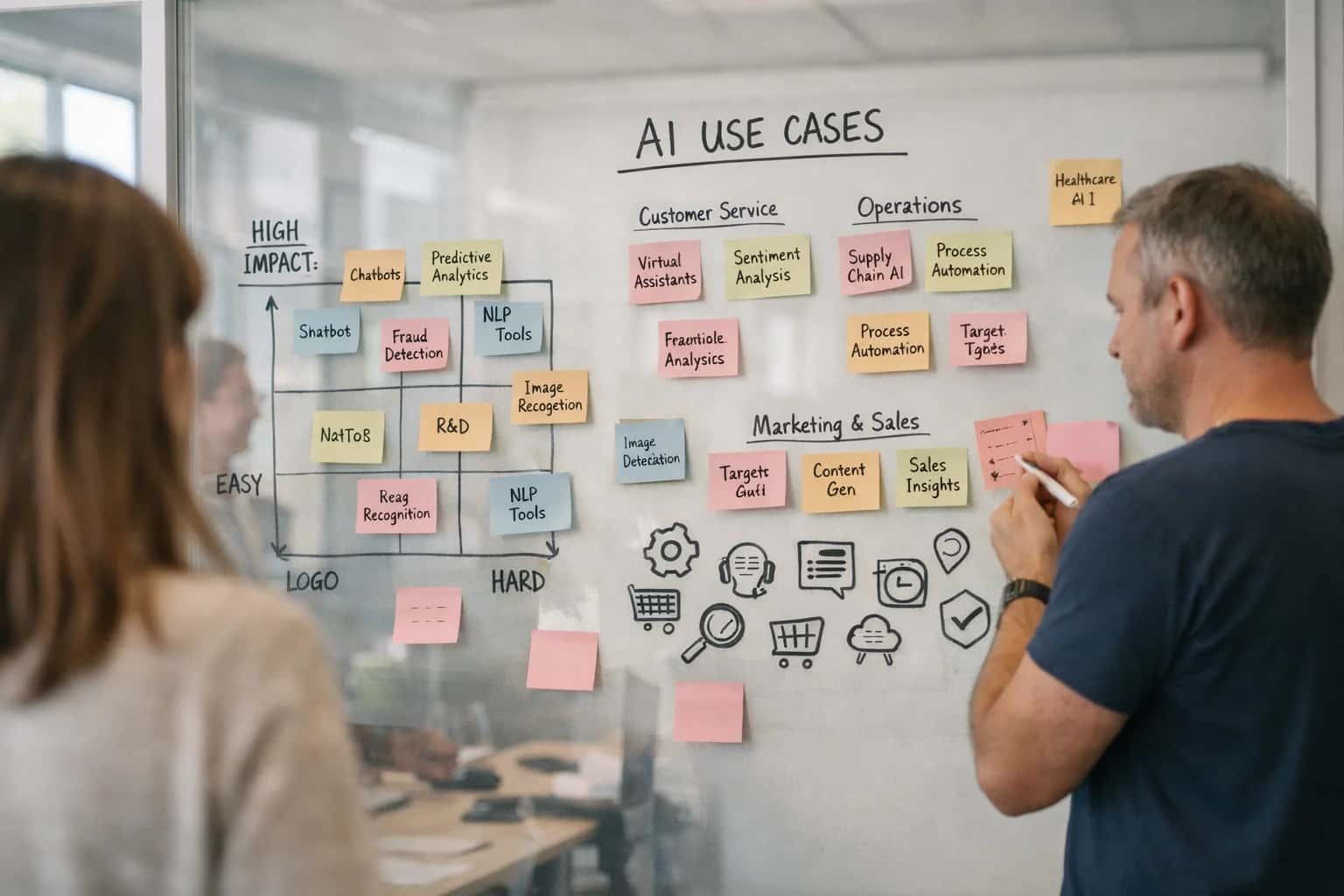
FROM PILOTS TO PROFIT
What is ROI-Driven AI Strategy Development Used For?
An ROI-Driven AI Strategy flips the script from technology-first to business-outcome-first. It's the framework that ensures every AI investment is justified by a clear, quantified path to positive financial returns.
The solution is building your enterprise AI roadmap backwards from required financial returns. We prioritize initiatives with the clearest path to measurable outcomes like cost savings, revenue uplift, or risk reduction. This creates an executable, funded plan where each phase delivers a predefined business metric, such as a 15% reduction in customer service handling time or a 5% increase in manufacturing yield, directly linking AI activity to P&L impact.
STRATEGIC INVESTMENT JUSTIFICATION
Common Use Cases for ROI-First AI Planning
Move beyond pilots to initiatives with a clear, quantified path to positive ROI. These use cases help CIOs build a business case by prioritizing AI investments that directly impact the bottom line.
01
Predictive ROI Modeling & Initiative Prioritization
Replace guesswork with data-driven forecasts. We use advanced simulation tools to model the financial return of proposed AI projects before any investment, based on your historical data and industry benchmarks. This allows leadership to:
- Score and rank initiatives by potential NPV and payback period.
- Align project queues with strategic value, risk, and resource capacity.
- De-risk capital allocation by funding only the highest-probability opportunities. Example: A retailer avoided a $2M investment in a chatbot by forecasting minimal impact on cart abandonment, reallocating funds to a supply chain AI with a projected 300% ROI.
02
Guaranteed Revenue Uplift Contracts
Align vendor success directly with your top-line growth. In this outcome-based service model, our fees are tied to a measurable percentage increase in your sales or revenue. This transforms AI from a cost center to a profit partner, focusing efforts on:
- Personalized customer offers and dynamic pricing engines.
- Next-best-action recommendations for sales teams.
- Cross-sell/upsell optimization in e-commerce. The contract includes clear attribution frameworks to ensure the revenue lift is directly linked to the AI's actions, providing undeniable business justification.
03
Churn Reduction as a Service
Turn customer retention into a guaranteed, managed outcome. We implement and operate predictive AI that identifies at-risk customers, with our compensation linked to a guaranteed reduction in your customer churn rate. The solution involves:
- Real-time sentiment and engagement analysis across support and usage data.
- Automated, personalized intervention workflows (e.g., targeted offers, proactive support).
- Continuous model refinement based on intervention success rates. Example: A SaaS company achieved a 22% reduction in annual churn, directly protecting over $15M in recurring revenue, with fees calculated as a percentage of the value preserved.
04
AI Value Attribution & Spend Governance
Eliminate AI 'black box' spending by directly linking costs to generated value. This use case involves deploying an AI Value Attribution Engine and governance process to:
- Automatically track and allocate AI-generated value (new leads, reduced downtime, cost avoidance) to specific models or campaigns.
- Continuously align AI infrastructure and model run costs with the business outcomes they drive.
- Provide a real-time ROI Dashboard for executives, showing contribution to margin improvement and revenue. This creates financial transparency, allowing for rapid reallocation of spend from low-performing models to high-impact ones.
05
Pay-Per-Performance AI Roadmapping
De-risk strategic AI adoption with a phased, outcome-gated investment plan. In this model, you only pay for development and services as each phase delivers its predefined business metric. The roadmap is built backwards from required financial returns and includes:
- Clear milestone definitions tied to KPIs like process efficiency gains or cost savings.
- Hybrid consumption pricing with low base fees and variable costs scaling with achieved outcomes.
- Built-in off-ramps if expected value is not realized, protecting your investment. This approach is ideal for building executive confidence and managing the budget of multi-year AI transformations.
06
Zero-Cost Pilot Until Proven ROI
Prove AI value with no upfront financial risk. We deploy a targeted pilot solution at no initial cost; fees begin only after the solution delivers a measurable, agreed-upon return on investment. This model is perfect for:
- Testing innovative AI applications in a new business unit or process.
- Overcoming internal skepticism with tangible, financial proof points.
- Validating the ROI projections from our predictive modeling. The pilot is scoped to address a specific, high-value pain point—such as automating a manual reporting process to save 15+ hours per week—with success measured in hard cost savings or productivity gains.
STRATEGY DEVELOPMENT
How It Works: The 4-Step ROI-Backwards Framework
Our methodology inverts the traditional tech-first approach. We start with your required financial return and engineer the AI strategy to achieve it, ensuring every initiative is justified by a clear, quantified business outcome.
The core pain point for CIOs is the 'AI pilot purgatory'—countless proofs-of-concept that never scale or deliver measurable financial value. Teams chase the latest models without a clear link to business KPIs, leading to wasted budget, technical debt, and executive skepticism. This scattergun approach fails to answer the fundamental question: What is the ROI? Without a disciplined, outcome-first strategy, AI remains a cost center, not a profit driver.
Our framework fixes this by building your strategy backwards from a required financial return. We begin with Predictive ROI AI Modeling to forecast payback, then prioritize only initiatives with a direct path to metrics like cost savings or revenue uplift. This creates a Pay-Per-Performance AI Roadmap, where investment is de-risked and tied to delivered value. The result is a portfolio of AI projects with guaranteed business justification, moving from hype to hardened financial impact.
ROI-DRIVEN AI STRATEGY
Real-World Examples & Business Outcomes
Move beyond pilots to proven financial returns. These examples demonstrate how a backward-built AI strategy, starting with required ROI, translates into concrete business value.
01
Predictive ROI Modeling for Capital Allocation
Before investing a single dollar, use AI to simulate the financial return of proposed initiatives. We built a Predictive ROI AI Model for a global manufacturer that analyzed historical project data, market trends, and operational constraints. The model prioritized a predictive maintenance program, forecasting a 22% reduction in unplanned downtime and a 14-month payback period. This data-evidenced approach shifted the board's capital allocation, ensuring funds flowed only to the highest-value AI projects with clear financial justification.
22%
Forecast Downtime Reduction
14 Mo.
Modeled Payback Period
02
Guaranteed Revenue Uplift in E-commerce
Align vendor success directly with your top-line growth. For a mid-market retailer, we deployed a hyper-personalized recommendation engine under a Guaranteed Revenue Uplift contract. Our fees were tied to a measurable increase in average order value (AOV). By integrating real-time behavioral data and inventory signals, the AI system drove a 17% uplift in AOV within the first quarter. This outcome-based model de-risked the investment and created a true partnership focused on commercial results, not just technical delivery.
17%
Avg. Order Value Uplift
Q1
Time to Value
03
Churn Reduction as a Service for SaaS
Turn customer retention from a cost center into a managed, ROI-guaranteed service. A B2B software company engaged our Churn Reduction as a Service. We implemented a predictive AI system that ingested usage patterns, support ticket sentiment, and payment history to identify at-risk customers with 94% accuracy. Automated, personalized intervention workflows were then triggered. Our compensation was linked directly to reducing churn, resulting in a 31% decrease in annual churn rate and securing millions in retained revenue.
31%
Reduction in Annual Churn
94%
Predictive Accuracy
04
AI Value Attribution for Marketing Spend
Stop guessing which AI initiatives drive value. A financial services firm used our AI Value Attribution Engine to solve 'black box' ROI. The platform automatically tracked AI-generated leads, reduced fraud losses, and operational time savings, directly allocating them to specific models and campaigns. This revealed that a conversational AI for customer onboarding was responsible for a 28% decrease in manual processing costs, justifying further investment while sunsetting underperforming pilots. Clear attribution turns AI from an expense into an accountable asset.
28%
Processing Cost Reduction
100%
Costs Attributed
05
Pay-Per-Performance Supply Chain Optimization
De-risk large-scale AI transformation with incremental, outcome-based payments. A logistics provider adopted a Pay-Per-Performance AI Roadmap for dynamic route optimization. We broke the project into phases, each with a predefined business metric: Phase 1 targeted fuel savings. The AI model, integrating real-time traffic and weather data, achieved a 12% reduction in fuel consumption. The client only paid for that phase upon verification of the savings, building trust and funding the next phase (reducing late deliveries) from the generated ROI.
12%
Fuel Cost Savings
Phase 1
First Milestone Paid
06
Zero-Cost Pilot for Predictive Maintenance
Prove AI value before any financial commitment. For an energy utility skeptical of AI ROI, we deployed a Zero-Cost AI Pilot for transformer failure prediction. Using sensor data and historical maintenance records, our model identified high-risk assets. The pilot period prevented two catastrophic failures, avoiding an estimated $4.2M in replacement costs and outage penalties. Only after this ROI was validated and documented did the engagement transition to a full-scale, paid implementation, eliminating the classic 'proof of concept to production' gap.
$4.2M
Cost Avoidance (Pilot)
0
Upfront Cost
Enabling Efficiency, Speed & Accuracy
Intelligent Analysis, Decision & Execution
We build AI systems for teams that need search across company data, workflow automation across tools, or AI features inside products and internal software.
Talk to Us
Search across company data
Give teams answers from docs, tickets, runbooks, and product data with sources and permissions.
Useful when people spend too long searching or get different answers from different systems.
Enterprise searchRAGPermissions
Read more
Automate internal workflows
Use AI to route work, draft outputs, trigger actions, and keep approvals and logs in place.
Useful when repetitive work moves across multiple tools and teams.
AI agentsWorkflow automationGovernance
Read more
Add AI to products and internal tools
Build assistants, guided actions, or decision support into the software your team or customers already use.
Useful when AI needs to be part of the product, not a separate tool.
AI integrationDecision supportModel routing
Read moreROI-DRIVEN AI STRATEGY
FAQs for Enterprise Decision-Makers
Moving from AI pilots to scaled value requires a disciplined, business-first approach. Below, we address the most common questions from CIOs and VPs of Innovation on building an AI strategy that guarantees financial returns.
We start with Predictive ROI AI Modeling. Using your historical data and industry benchmarks, we simulate the financial impact of proposed AI initiatives—forecasting potential savings, revenue uplift, and efficiency gains. This creates a data-evidenced business case, prioritizing only projects with a clear, quantified path to positive ROI. This de-risks investment and aligns stakeholders by shifting the conversation from cost to validated financial return. For a deeper dive into forecasting tools, see our insights on Business Impact Forecasting AI.

About the author
Prasad Kumkar
CEO & MD, Inference Systems
Prasad Kumkar is the CEO & MD of Inference Systems and writes about AI systems architecture, LLM infrastructure, model serving, evaluation, and production deployment. Over 5+ years, he has worked across computer vision models, L5 autonomous vehicle systems, and LLM research, with a focus on taking complex AI ideas into real-world engineering systems.
His work and writing cover AI systems, large language models, AI agents, multimodal systems, autonomous systems, inference optimization, RAG, evaluation, and production AI engineering.
LinkedIn
Limited slotsGet a Free AI Consultation
Partnered with leading AI, data, and software stack.





How We Work
Custom AI workflows for your Business
One-fit-all AI don't work for modern businesses. At Inferensys, we aim to understand your business & custom requirements; which we use to define most efficient agentic workflows, the data, and the tools for your business.
01
Review the use case
We understand the task, the users, and where AI can actually help.
Read more02
Pick the right approach
We define what needs search, automation, or product integration.
Read more03
Build the first useful version
We implement the part that proves the value first.
Read more04
Improve from there
We add the checks and visibility needed to keep it useful.
Read moreThe first call is a practical review of your use case and the right next step.
Talk to Us