The primary pain point is the high failure rate of AI initiatives, where significant capital is spent on development with no guarantee of business value. This creates budget waste, stakeholder skepticism, and strategic paralysis. A Pay-Per-Performance roadmap directly addresses this by shifting financial risk. You only invest in the next phase of your AI Strategy and Roadmap Development after the previous phase has demonstrably delivered on its promised outcome, such as a 15% reduction in processing time or a 5-point increase in customer satisfaction.

Use Case
Pay-Per-Performance AI Roadmap
A strategic AI implementation plan where you only pay for development and services as each phase delivers its predefined business metric, de-risking your investment.
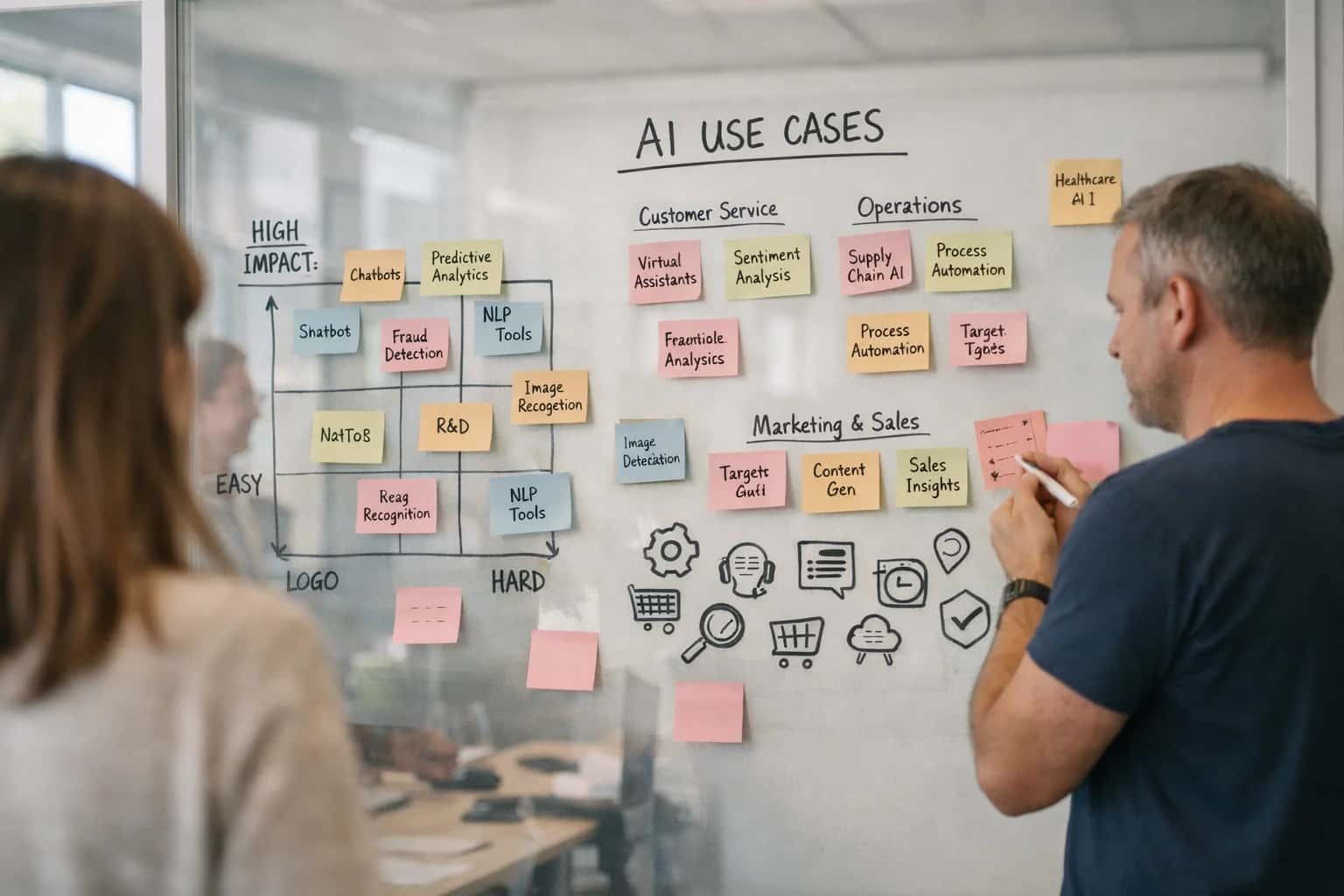
DE-RISKING STRATEGIC INVESTMENT
What is a Pay-Per-Performance AI Roadmap Used For?
A Pay-Per-Performance AI Roadmap transforms AI from a speculative cost center into a de-risked, outcome-driven investment. It structures your AI journey into discrete phases, each with a clear business metric and payment trigger.
The concrete solution is a phased implementation contract. For example, Phase 1 targets automated document processing with payment tied to a 40% reduction in manual labor hours. Only upon achieving this verified metric does Phase 2—integrating predictive analytics for supply chain—commence. This model ensures every dollar spent is justified by a tangible result, creating a clear, accountable path to scaling AI and achieving the long-term value promised by robust MLOps and Production-Scale Lifecycle Management.
STRATEGIC AI INVESTMENT
Common Use Cases: Where Pay-Per-Performance AI Delivers Value
Move beyond speculative AI pilots. These proven use cases tie our fees directly to the business outcomes you need to see, de-risking your investment and guaranteeing ROI.
01
Predictive Customer Churn Reduction
Replace reactive retention efforts with AI that identifies at-risk customers before they leave. We deploy models that analyze transaction history, support interactions, and product usage to flag high-risk accounts. Our compensation is tied to a guaranteed reduction in your annual churn rate.
- Real Example: A SaaS provider reduced churn by 22% within two quarters, directly protecting $4.5M in annual recurring revenue.
- The AI Fix: Proactive, personalized retention campaigns triggered by predictive scores, improving customer lifetime value.
02
Guaranteed Supply Chain Cost Savings
Volatile logistics and inventory costs erode margins. Our AI orchestrates dynamic routing, demand forecasting, and autonomous procurement. You pay based on a percentage of the hard cost savings achieved in freight, warehousing, and inventory carrying costs.
- Real Example: A manufacturer cut logistics costs by 18% and reduced inventory levels by 30% through AI-driven dynamic orchestration.
- The AI Fix: A Logistics Control Tower that integrates real-time data from carriers, weather, and sales to optimize decisions, paying only for the savings delivered.
03
ROI-Backed Marketing Campaign Optimization
End wasted ad spend. Our AI manages cross-channel media buying, creative testing, and audience targeting with compensation linked directly to Cost Per Acquisition (CPA) or Return on Ad Spend (ROAS). We assume the performance risk.
- Real Example: An e-commerce brand increased ROAS by 35% while decreasing customer acquisition cost by 28% using agentic AI for media planning.
- The AI Fix: Agentic workflows that autonomously adjust bids, allocate budget, and personalize creatives in real-time to hit your specific revenue targets.
04
Automated Claims Processing with SLA Guarantees
Manual insurance or invoice processing is slow and error-prone. We implement Intelligent Document Processing (IDP) and agentic workflows to automate extraction, validation, and approval. Fees are based on a per-claim cost reduction and tied to processing time Service Level Agreements (SLAs).
- Real Example: An insurer reduced claims processing time from 5 days to 4 hours and cut operational costs by 40%.
- The AI Fix: AI that reads documents, validates against rules, and routes exceptions, with our success measured by your throughput and cost savings.
05
Predictive Maintenance for Downtime Reduction
Unplanned equipment failure is a massive cost center. We deploy AI models on sensor data to predict failures weeks in advance. Our fees are calculated based on the downtime hours avoided and the associated maintenance cost savings.
- Real Example: A utility company avoided $2.1M in forced outage costs and extended asset life by 15% using AI-powered digital twin simulations.
- The AI Fix: Continuous analysis of vibration, thermal, and acoustic data to schedule maintenance just-in-time, converting capex into predictable opex.
06
AI-Driven Sales Lead Qualification & Uplift
Increase sales team productivity by focusing only on high-intent leads. Our AI scores and prioritizes inbound leads based on propensity to buy, and can even initiate personalized outreach. Compensation is linked to the incremental revenue generated from AI-qualified leads.
- Real Example: A B2B software firm saw a 50% increase in lead-to-opportunity conversion and a 20% uplift in deal size from AI-prioritized leads.
- The AI Fix: Conversational AI and predictive scoring that engages, nurtures, and hands off sales-ready leads, ensuring your team spends time on what closes.
DE-RISKED IMPLEMENTATION
Pay-Per-Performance AI Roadmap
A strategic framework where you only pay for development and services as each phase delivers its predefined business metric, transforming AI from a capital expense into a value-driven investment.
The primary pain point for CIOs is the high-risk, high-cost nature of traditional AI projects. You invest significant capital upfront with no guarantee of business impact, often resulting in expensive pilots that fail to scale or deliver measurable ROI. This uncertainty stalls innovation and ties up resources in speculative ventures, making it difficult to justify continued investment to the board. Our ROI-Driven AI Strategy Development directly addresses this by building your plan backwards from required financial returns.
Our 5-phase framework de-risks this journey. Each phase—from discovery to scaling—has a clear, pre-agreed business outcome (e.g., 15% reduction in manual processing time). You only pay for a phase once its success metric is validated. This aligns our incentives with your operational and financial goals, ensuring every dollar spent drives tangible value. This model is complemented by tools like our AI Investment Payback Calculator for clear financial justification from day one.
Enabling Efficiency, Speed & Accuracy
Intelligent Analysis, Decision & Execution
We build AI systems for teams that need search across company data, workflow automation across tools, or AI features inside products and internal software.
Talk to Us
Search across company data
Give teams answers from docs, tickets, runbooks, and product data with sources and permissions.
Useful when people spend too long searching or get different answers from different systems.
Enterprise searchRAGPermissions
Read more
Automate internal workflows
Use AI to route work, draft outputs, trigger actions, and keep approvals and logs in place.
Useful when repetitive work moves across multiple tools and teams.
AI agentsWorkflow automationGovernance
Read more
Add AI to products and internal tools
Build assistants, guided actions, or decision support into the software your team or customers already use.
Useful when AI needs to be part of the product, not a separate tool.
AI integrationDecision supportModel routing
Read morePAY-PER-PERFORMANCE MODEL
Sample 12-Month Implementation Roadmap
A phased, de-risked approach where your investment is directly tied to the delivery of measurable business outcomes at each milestone.
01
Months 1-3: Foundation & Pilot ROI
We begin with a high-impact, low-complexity use case to prove value fast. This phase focuses on data readiness, defining the precise business metric for the pilot, and establishing the baseline. You pay only for the scoped development, with the first success fee triggered upon hitting the pilot's KPI.
- Example: A retail client targets a 5% reduction in cart abandonment via a personalized recommendation engine. Fees are due only after the 5% target is verified.
8-12 Weeks
Time to First ROI
02
Months 4-6: Scale & Operationalize
With the pilot's ROI validated, we scale the solution and integrate it into core workflows. This phase establishes the MLOps/LLMOps foundation for monitoring, retraining, and governance. Payments are structured around achieving scaled efficiency gains or revenue targets.
- Example: Expanding the pilot engine to the entire e-commerce platform, with fees tied to achieving a 2% uplift in average order value across the segment.
03
Months 7-9: Portfolio Expansion
Leveraging the established infrastructure and trust, we identify and launch 1-2 additional high-ROI initiatives from your roadmap. The AI Value Attribution Engine is deployed to track cross-initiative impact. Success fees are now multi-dimensional, based on a basket of outcomes like cost savings and customer satisfaction.
- Example: A manufacturer adds a predictive maintenance model for critical assets. Fees are linked to a guaranteed 10% reduction in unplanned downtime and associated maintenance costs.
04
Months 10-12: Optimization & Strategic Handover
The focus shifts to continuous optimization and financially aligning your AI spend. We implement the AI Spend-to-Value Alignment governance process, ensuring every dollar of inference cost links to business value. The final phase includes knowledge transfer, ensuring your team can sustain and evolve the outcome-based AI portfolio independently.
- Example: Implementing automated model performance and cost dashboards, with a final success milestone payment for achieving the annual aggregate ROI target across all deployed initiatives.
05
The CIO's Justification Toolkit
This roadmap is built to provide clear, quarterly justification for investment.
- De-risked Budgeting: Capital is released against delivered value, not hopeful projections.
- Vendor Accountability: Our compensation is contractually aligned with your business KPIs.
- Transparent ROI: Each phase delivers a discrete, measurable financial outcome documented in the AI Service ROI Dashboard.
06
Real-World Outcome Examples
Financial Services: A 12-month engagement to reduce fraud losses. Phase 1 (Months 1-3) targeted new account fraud, with fees due after a 15% reduction was achieved. Manufacturing: A roadmap for supply chain resilience. The first success fee was paid after the AI-driven orchestration agent reduced premium freight costs by 20% in the pilot lane.

About the author
Prasad Kumkar
CEO & MD, Inference Systems
Prasad Kumkar is the CEO & MD of Inference Systems and writes about AI systems architecture, LLM infrastructure, model serving, evaluation, and production deployment. Over 5+ years, he has worked across computer vision models, L5 autonomous vehicle systems, and LLM research, with a focus on taking complex AI ideas into real-world engineering systems.
His work and writing cover AI systems, large language models, AI agents, multimodal systems, autonomous systems, inference optimization, RAG, evaluation, and production AI engineering.
LinkedIn
Limited slotsGet a Free AI Consultation
Partnered with leading AI, data, and software stack.





How We Work
Custom AI workflows for your Business
One-fit-all AI don't work for modern businesses. At Inferensys, we aim to understand your business & custom requirements; which we use to define most efficient agentic workflows, the data, and the tools for your business.
01
Review the use case
We understand the task, the users, and where AI can actually help.
Read more02
Pick the right approach
We define what needs search, automation, or product integration.
Read more03
Build the first useful version
We implement the part that proves the value first.
Read more04
Improve from there
We add the checks and visibility needed to keep it useful.
Read moreThe first call is a practical review of your use case and the right next step.
Talk to Us