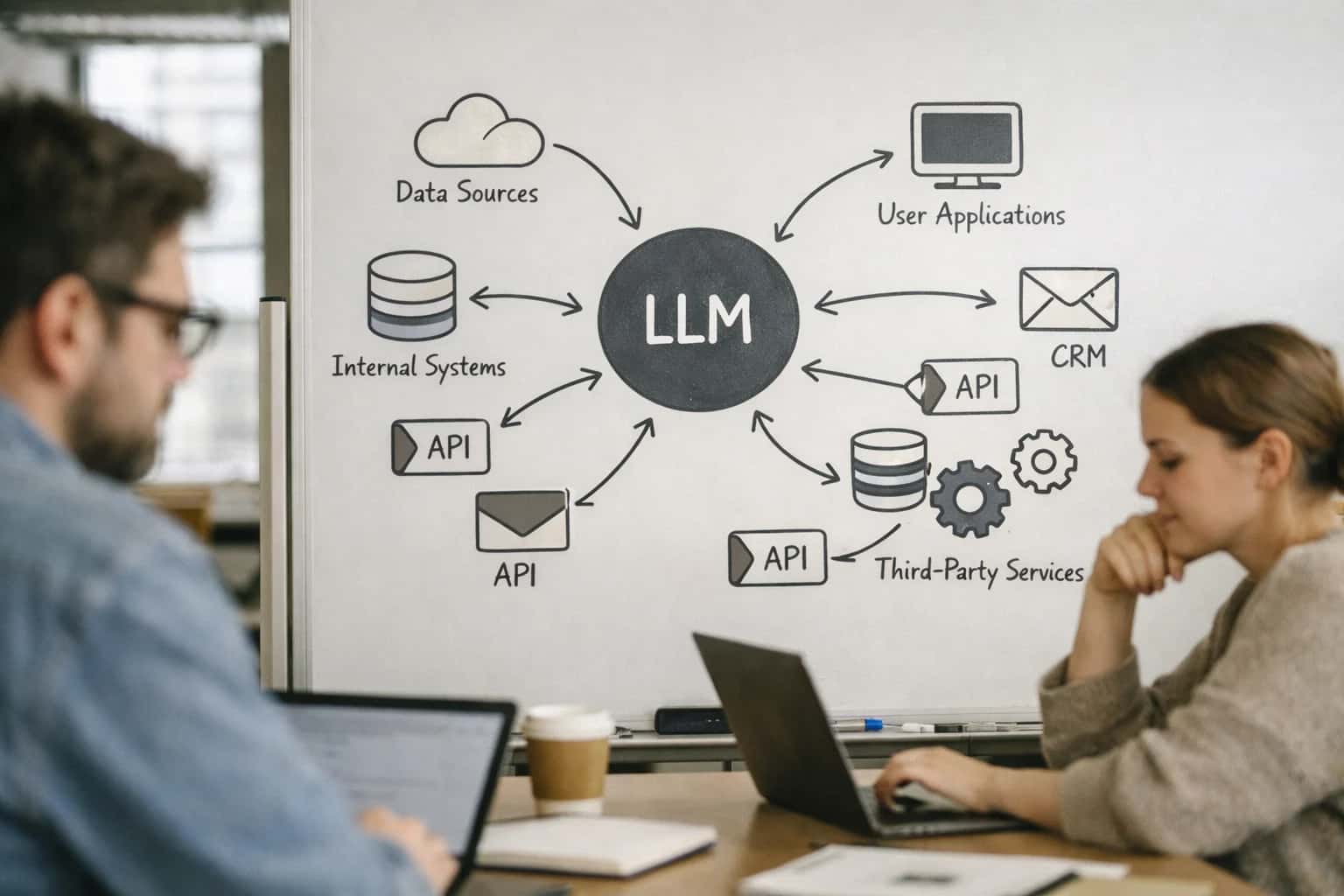
AI-driven replenishment acts as a proactive layer on top of your WMS's standard min/max or wave-based logic. It integrates at three key points: 1) Data Ingestion, pulling forward-looking signals (e.g., sales forecasts, promotional calendars, seasonal trends) and real-time WMS data (current pick activity, on-hand levels, work-in-progress). 2) The Decision Engine, where AI models analyze this data against lead times and constraints to generate suggested replenishment tasks. 3) The Execution Interface, where these tasks are pushed as standard replenishment orders or pick-to-replenish tasks via the WMS's native APIs (e.g., Manhattan's TaskService, SAP EWM's ReplenishmentRequest BAPI, Blue Yonder's Labor Management APIs).

Integration
AI for Predictive Replenishment in WMS
A technical blueprint for integrating AI-driven replenishment triggers into Warehouse Management Systems, using forward demand signals, pick activity, and lead times to suggest and execute tasks before stockouts occur.
ARCHITECTURE AND ROLLOUT
Where AI Fits into WMS Replenishment
A practical blueprint for integrating predictive AI triggers into your WMS replenishment workflows.
The core workflow begins with the AI engine monitoring pick faces and bulk storage locations. Instead of waiting for a stock-out alert, it predicts depletion based on the velocity of recent picks and scheduled outbound orders. For example, if SKU A100 in fast-pick zone PZ-01 is being picked at an accelerating rate, the system can queue a replenishment task from its reserve location RS-10 before the pick face hits zero, ensuring the next wave of orders isn't delayed. This logic is particularly powerful for high-velocity SKUs and during peak periods, where manual oversight is most strained.
A successful rollout starts with a pilot zone. Select a high-volume pick area and a subset of SKUs. The AI's replenishment suggestions should initially flow into a supervisor approval queue within the WMS interface or a separate dashboard. This allows the warehouse team to validate the AI's logic, build trust, and refine the model's parameters (like safety stock buffers). Governance is critical: all AI-generated tasks must be logged with a traceable audit trail—linking the predictive trigger, the data inputs, the suggested action, and the final human or system approval. Over 4-6 weeks, as confidence grows, the system can be configured to auto-execute a growing percentage of tasks, shifting human focus to exception handling and strategy.
AI FOR PREDICTIVE REPLENISHMENT
Integration Surfaces in Major WMS Platforms
The Replenishment Task Queue
Predictive replenishment requires direct integration with the WMS task management engine. This is the primary surface for triggering and executing AI-generated work.
Key Integration Points:
- Task Creation APIs: Inject AI-generated replenishment tasks (e.g.,
REPLENISH_PICKFACE) into the same queue used for system-generated tasks. This ensures tasks are dispatched to RF guns and voice systems. - Queue Priority Overrides: Use AI scores (e.g., stockout probability, pick velocity) to dynamically set task priority, ensuring critical replenishments jump the queue.
- Status Callbacks: Monitor task completion via webhooks to close the feedback loop, allowing the AI model to learn from execution times and success rates.
Implementation typically involves a middleware service that polls AI recommendations and uses the WMS REST or SOAP APIs to create tasks with specific source/destination locations, quantities, and priority codes.
PREDICTIVE OPERATIONS
High-Value Use Cases for AI-Driven Replenishment
Move from reactive, schedule-based replenishment to a predictive, demand-driven model. These AI integration patterns connect forward-looking signals with real-time WMS data to trigger replenishment tasks before pick faces run dry, balancing service levels with labor and space efficiency.
01
Dynamic Forward Pick Replenishment
AI analyzes real-time pick activity from RF guns and conveyor sensors, combined with short-term order forecasts, to predict depletion of forward pick locations. It generates and prioritizes replenishment tasks in the WMS task queue hours before a stockout, ensuring pickers are never delayed.
Batch -> Real-time
Trigger cadence
02
Seasonal & Promotional Buffer Optimization
Integrates promotional calendars and historical lift data with WMS inventory levels. AI dynamically calculates and adjusts safety stock and min/max levels for forward pick locations, then creates bulk replenishment waves in the WMS to stage inventory ahead of demand spikes, avoiding manual overrides.
1-2 Weeks
Lead time for planning
03
Putaway-to-Replenishment Direct Routing
For received pallets destined for forward pick, AI bypasses bulk storage. It analyzes item velocity, pick face capacity, and receiving schedules to instruct the WMS to route inbound pallets directly to decant/replenishment stations via the putaway module, reducing touches and accelerating inventory availability.
1 Touch Eliminated
Per pallet
04
Replenishment Labor Forecasting & Scheduling
AI predicts daily and intraday replenishment task volumes by SKU and zone. This forecast is integrated with the WMS labor management module (or external scheduling tools) to optimally schedule replenishment associates, balancing workload with picking teams and minimizing MHE congestion.
Hours -> Minutes
Schedule generation
05
Multi-Echelon Replenishment for MHE
Coordinates replenishment between bulk storage (e.g., AS/RS, pallet rack) and forward pick zones. AI considers equipment availability (forklifts, pallet jacks), travel distances, and task urgency to generate an optimized, interleaved sequence of putaway and replenishment tasks within the WMS execution engine.
Travel -15%
Typical reduction
06
Exception-Driven Replenishment Triggers
Monitors WMS transaction logs and IoT feeds for anomalies like unexpected high pick volume or mis-scans. AI automatically creates high-priority replenishment tasks and alerts supervisors via the WMS console when actual depletion deviates from the plan, enabling rapid response to operational surprises.
Same Day
Response to variance
PRACTICAL IMPLEMENTATION PATTERNS
Example AI Replenishment Workflows
These workflows illustrate how AI-driven replenishment triggers are integrated into a WMS, moving from reactive to proactive inventory moves. Each pattern combines WMS data, external signals, and predictive models to generate and execute replenishment tasks before pick faces run dry.
This workflow uses forward-looking demand signals to trigger replenishment before daily picking begins.
- Trigger: Scheduled job runs 2 hours before first shift, or upon receipt of a new sales order batch.
- Context Pulled: The AI agent queries:
- WMS for current pick face quantities and minimum/maximum levels.
- The Order Management System (OMS) for confirmed orders for the next 24-48 hours, aggregated by SKU.
- Historical WMS data for average picks per order line for each SKU.
- Agent Action: A model calculates the projected inventory drawdown for each pick face. For SKUs where
(Current Qty - Projected Demand) < Safety Stock, it generates a replenishment suggestion. - System Update: Suggestions are posted to a replenishment queue via the WMS REST API (e.g.,
POST /api/v1/replenishment-tasks). Each task includes:json{ "taskType": "REPLENISH", "sku": "ITEM-12345", "fromLocation": "BULK-A-12-34", "toLocation": "PICK-B-05-01", "quantity": 24, "priority": "HIGH", "reasonCode": "FORWARD_DEMAND" } - Human Review Point: The warehouse supervisor's dashboard displays the batch of suggested tasks. They can approve all, modify quantities based on known constraints (e.g., broken pallet), or reject outliers before tasks are released to RF guns.
FROM FORECAST TO TASK
Implementation Architecture & Data Flow
A production-ready AI replenishment system integrates with your WMS's core data models and automation layer to create a closed-loop workflow.
The integration architecture typically involves three core components: a data extraction layer that pulls real-time inventory levels, forward-looking demand signals, and historical lead times from the WMS (e.g., from INVENTORY, ITEM_MASTER, and PURCHASE_ORDER tables or APIs); a predictive scoring engine that runs on this unified dataset to generate replenishment suggestions; and an action orchestration layer that converts approved suggestions into executable WMS tasks. For platforms like SAP EWM, this often means writing suggested quantities and source/destination storage bins to custom Z-tables or using BAdIs to inject recommendations into the native replenishment control cycle. For cloud-native systems like Manhattan Active, the pattern leverages its event-driven APIs to listen for pick transactions and low-stock alerts, triggering the AI model via webhook.
A practical data flow for a single SKU might look like: 1) The AI model consumes a daily feed of planned orders from the ERP and real-time pick activity from the WMS. 2) It calculates a dynamic safety stock level and a recommended replenishment quantity, considering current pallet locations in the pick module and available space in the forward pick area. 3) This recommendation is pushed to a supervisor dashboard or an automated approval queue within the WMS interface. 4) Upon approval, the system creates a replenishment task (e.g., a REPLENISHMENT_REQUEST in Blue Yonder) with precise source and destination locations, which is then dispatched to a warehouse associate via RF or voice directive. The loop closes as the task completion transaction updates inventory counts, providing immediate feedback to the model.
Rollout should be phased, starting with a pilot in a single pick zone or for a class of fast-moving A-items. Governance is critical: all AI-generated suggestions must be logged with a rationale (e.g., 'triggered by 20% increase in 7-day pick velocity') and tied to a user ID for audit. Implement a human-in-the-loop approval step for the first few months, allowing supervisors to accept, modify, or reject suggestions, which also creates a valuable training dataset for model refinement. This approach de-risks the integration and builds operational trust before moving to fully automated, exception-based execution.
IMPLEMENTATION PATTERNS
Code & Payload Examples
Ingesting Forward-Looking Signals
Predictive replenishment requires blending real-time WMS data with external demand signals. This typically involves subscribing to WMS event streams (e.g., pick completions) and pulling forecast data from an ERP or OMS.
Below is a Python example using a message queue (Redis) to listen for WMS pick events and enrich them with a 7-day demand forecast from an external service. The combined payload is then sent to a scoring service.
pythonimport redis import requests import json # Connect to WMS event stream (example using Redis Pub/Sub) r = redis.Redis(host='wms-events.internal', port=6379, decode_responses=True) pubsub = r.pubsub() pubsub.subscribe('wms.pick.completed') for message in pubsub.listen(): if message['type'] == 'message': pick_event = json.loads(message['data']) sku = pick_event['sku'] location = pick_event['fromLocation'] # Fetch forward demand forecast from OMS forecast_response = requests.get( f'https://oms-api.internal/forecast/{sku}?days=7', headers={'Authorization': 'Bearer API_KEY'} ) forecast = forecast_response.json() # Build enriched payload for scoring scoring_payload = { "sku": sku, "current_location": location, "on_hand_qty": pick_event.get('onHandAfterPick'), "forecast_demand": forecast['dailyDemand'], "lead_time_days": forecast['supplierLeadTime'], "timestamp": pick_event['timestamp'] } # Send to AI scoring service requests.post('https://ai-scoring.internal/replenishment', json=scoring_payload)
PREDICTIVE REPLENISHMENT
Realistic Operational Impact & Time Savings
This table illustrates the operational impact of integrating AI-driven predictive replenishment into a Warehouse Management System (WMS). It compares manual, reactive processes against AI-assisted workflows, showing realistic time savings and efficiency gains.
| Workflow / Metric | Before AI (Reactive) | After AI (Predictive) | Implementation Notes |
|---|---|---|---|
Replenishment Trigger | Manual review of pick-face empty alerts or cycle counts | Automated alerts based on forward demand, pick velocity, and lead time models | AI monitors WMS transaction logs and external demand signals to generate proactive tasks |
Replenishment Task Creation | Planner manually creates tasks in WMS after verifying stock in reserve | AI suggests and pre-populates replenishment tasks in the WMS queue | Tasks include suggested source location, quantity, and priority; require planner or supervisor approval |
Time from Empty Pick-Face to Replenishment Start | 2-4 hours (next available planner cycle) | 15-30 minutes (automated alerting and task generation) | Reduces picker wait time and prevents order stoppages |
Daily Planner Time on Replenishment | 2-3 hours reviewing reports and creating tasks | 30-60 minutes reviewing/approving AI-generated task lists | Frees planner capacity for exception management and process improvement |
Replenishment Wave Planning | Static schedules (e.g., nightly waves) based on historical averages | Dynamic, continuous waves triggered by real-time pick activity and forecast | Integrates with WMS wave management to optimize labor and equipment use |
Stockout Prevention for Fast-Moving SKUs | Relies on safety stock buffers; frequent expedited 'hot' replenishments | Proactive moves before pick-face depletion; reduces 'hot' replenishments by 60-80% | AI factors in seasonality, promotions, and supplier lead time variability |
Integration with Other Systems | Manual coordination between WMS, demand planning, and procurement | AI layer automatically ingests forecasts from ERP/OMS and updates WMS logic | Built on event-driven architecture; uses WMS APIs for seamless task injection |
Pilot to Full Rollout Timeline | N/A (manual process) | Pilot: 4-6 weeks for 1-2 zones; Full rollout: 3-4 months for entire facility | Phased approach allows for model tuning, user feedback, and change management |
IMPLEMENTING AI-DRIVEN REPLENISHMENT
Governance, Security, and Phased Rollout
A production-ready AI integration for predictive replenishment requires a secure, governed architecture and a phased rollout to manage risk and prove value.
A secure integration architecture connects your WMS (e.g., Manhattan Active, SAP EWM) to AI models via a dedicated middleware layer. This layer, often deployed within your cloud VPC, handles authentication using your WMS's existing API credentials (OAuth, service accounts) and securely pulls required data: current on-hand and allocated inventory from INV tables, real-time pick transaction logs, forward demand signals from your ERP or OMS, and item master data including lead times and storage attributes. All data flows are encrypted in transit, and the AI service never stores sensitive business logic or customer data long-term. Predictions—like suggested replenishment tasks for fast-moving SKUs from bulk storage to forward pick locations—are written back to the WMS via its task management API (TASK_CREATE), with a full audit trail linking the AI-suggested action to the underlying data inputs.
Governance is built into the workflow. Before any task is created in the WMS, the AI's recommendation can be routed through an approval queue in a system like ServiceNow or a custom dashboard for supervisor review. This is critical for high-value items or during initial rollout. The system also enforces business rules: for example, it will not suggest a replenishment if the suggested location is already reserved for an outbound wave, or if the item is on a quality hold. All actions are logged with a source: ai_replenishment flag, allowing for performance tracking and rollback if needed. This controlled integration ensures the WMS remains the system of record, with AI acting as an intelligent assistant to the planner or automated rule engine.
A phased rollout minimizes operational disruption. Phase 1 (Pilot): Connect the AI to a single warehouse or a specific zone (e.g., the 'A' fast-pick zone). Run the model in 'shadow mode' for 2-4 weeks, where it generates recommendations but does not create WMS tasks. Compare its suggestions against planner decisions to calibrate accuracy and build trust. Phase 2 (Assisted): Enable the system to create low-risk replenishment tasks for a narrow set of high-velocity, stable-demand SKUs, requiring a planner's one-click approval in a daily digest email. Phase 3 (Automated): Expand to broader SKU sets and enable fully automated task creation for predefined, high-confidence scenarios, with real-time alerts for any recommendations that fall outside of configured tolerance thresholds (e.g., an unusually large move suggestion). This crawl-walk-run approach, coupled with clear KPIs like 'replenishment lead time reduction' and 'stock-out events in forward pick locations,' ensures the AI integration delivers tangible, measured improvement to warehouse operations.
Enabling Efficiency, Speed & Accuracy
Intelligent Analysis, Decision & Execution
We build AI systems for teams that need search across company data, workflow automation across tools, or AI features inside products and internal software.
Talk to Us
Search across company data
Give teams answers from docs, tickets, runbooks, and product data with sources and permissions.
Useful when people spend too long searching or get different answers from different systems.
Enterprise searchRAGPermissions
Read more
Automate internal workflows
Use AI to route work, draft outputs, trigger actions, and keep approvals and logs in place.
Useful when repetitive work moves across multiple tools and teams.
AI agentsWorkflow automationGovernance
Read more
Add AI to products and internal tools
Build assistants, guided actions, or decision support into the software your team or customers already use.
Useful when AI needs to be part of the product, not a separate tool.
AI integrationDecision supportModel routing
Read moreIMPLEMENTATION GUIDE
Frequently Asked Questions
Practical questions for teams planning AI-driven predictive replenishment in their Warehouse Management System.
A robust predictive model requires both historical and real-time data streams from your WMS. Key data sources include:
Historical Data (for training):
Item Master: SKU, dimensions, ABC classification, storage type constraints.Transaction History: Detailed logs of picks, putaways, and adjustments over 12-24 months.Order History: Daily order volume by SKU, including seasonality and promotional spikes.Replenishment Task History: Timing, quantities, and source/destination locations for past replenishments.Lead Time Data: Supplier lead times and variability.
Real-Time Feeds (for inference):
Current Inventory Levels: Per location (pick face and reserve) via WMS APIs (e.g.,/api/inventory/snapshot).Active Pick Waves: SKUs and quantities in current and upcoming waves.Open Replenishment Tasks: To avoid double-scheduling.Warehouse Capacity: Available space in forward pick locations.
External Signals (for enhanced accuracy):
- Forward demand forecasts from ERP or OMS.
- Planned production schedules (for manufacturing warehouses).
- Supplier shipment statuses (ASN feeds).
The integration typically involves setting up a nightly batch job to sync historical data to a data lake and establishing event-driven webhooks or API polling for real-time state.

About the author
Prasad Kumkar
CEO & MD, Inference Systems
Prasad Kumkar is the CEO & MD of Inference Systems and writes about AI systems architecture, LLM infrastructure, model serving, evaluation, and production deployment. Over 5+ years, he has worked across computer vision models, L5 autonomous vehicle systems, and LLM research, with a focus on taking complex AI ideas into real-world engineering systems.
His work and writing cover AI systems, large language models, AI agents, multimodal systems, autonomous systems, inference optimization, RAG, evaluation, and production AI engineering.
LinkedIn
Limited slotsGet a Free AI Consultation
Partnered with leading AI, data, and software stack.





How We Work
Custom AI workflows for your Business
One-fit-all AI don't work for modern businesses. At Inferensys, we aim to understand your business & custom requirements; which we use to define most efficient agentic workflows, the data, and the tools for your business.
01
Review the use case
We understand the task, the users, and where AI can actually help.
Read more02
Pick the right approach
We define what needs search, automation, or product integration.
Read more03
Build the first useful version
We implement the part that proves the value first.
Read more04
Improve from there
We add the checks and visibility needed to keep it useful.
Read moreThe first call is a practical review of your use case and the right next step.
Talk to Us