The integration surface is defined by three critical data flows: appointment scheduling, trailer status, and cross-dock instructions. AI consumes real-time feeds from YMS platforms like Kaleris or FourKites (gate events, trailer spotting, dwell times) and WMS platforms like SAP EWM or Manhattan Active (dock door status, putaway backlog, labor availability). It processes this data to make prescriptive decisions, such as dynamically reassigning an inbound load from a congested receiving door to an available one, or prioritizing outbound loads for staging based on carrier cut-off times and pick completion status.

Integration
AI for Yard Management Integration with WMS
A technical guide for integrating AI-powered yard management with Warehouse Management Systems (WMS) to automate dock scheduling, trailer spotting, and cross-dock workflows based on real-time warehouse capacity and inbound/outbound load plans.
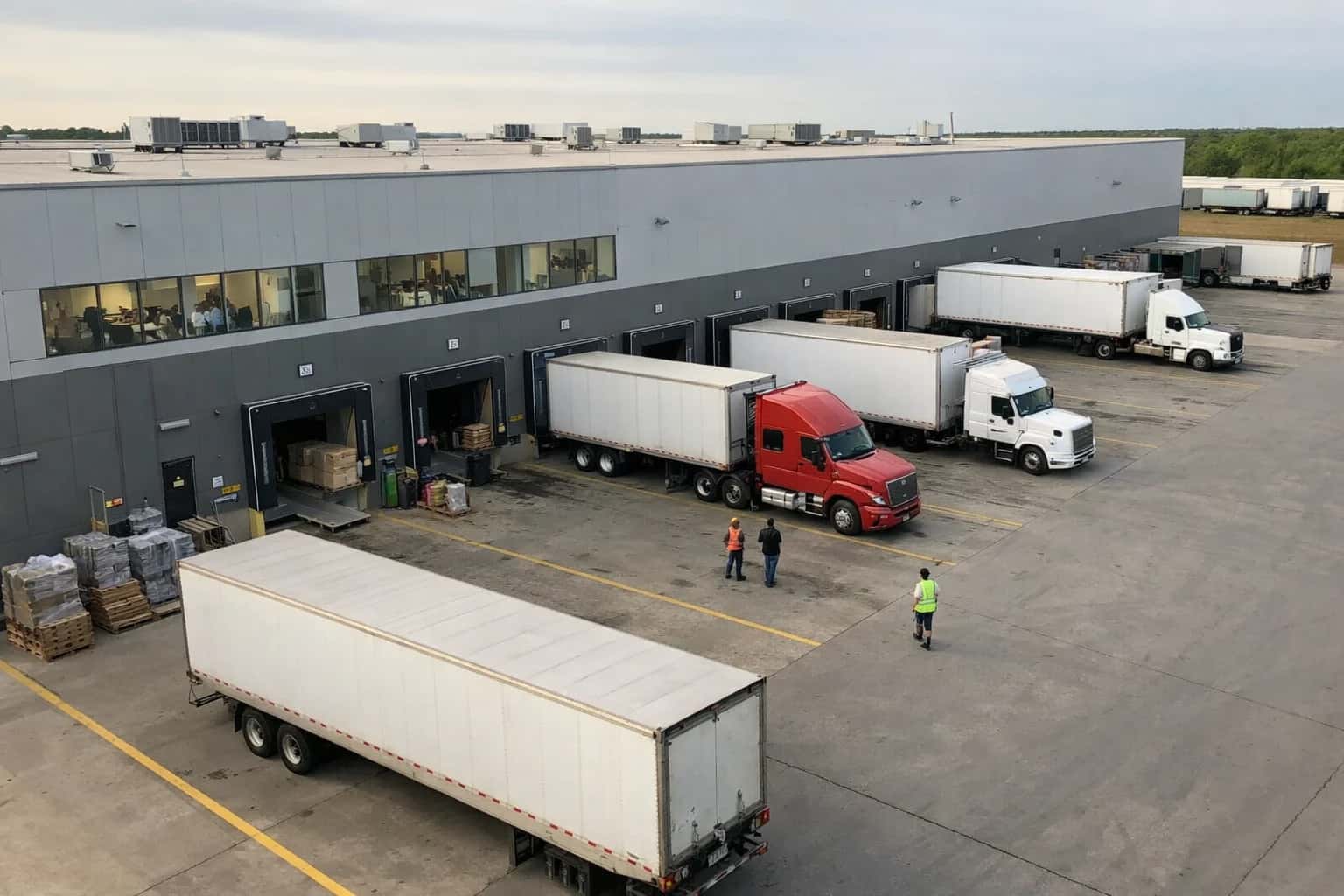
ARCHITECTURE FOR REAL-TIME ORCHESTRATION
Where AI Fits Between Yard and Warehouse Management
AI acts as the intelligent bridge between yard management systems (YMS) and warehouse management systems (WMS), synchronizing dock operations with real-time warehouse capacity.
Implementation typically involves an AI orchestration layer with event listeners on both systems. Key integration points include:
- YMS APIs for live trailer location and appointment details.
- WMS APIs for dock door status, warehouse task queues, and real-time storage location capacity.
- A message queue (e.g., Kafka, RabbitMQ) to handle event-driven triggers, like a
TRAILER_AT_GATEevent from the YMS prompting the AI to check WMS for the optimal door and generate aSPOT_TO_DOORdirective. The AI model scores each potential action—considering travel distance for forklifts, current labor in the receiving zone, and downstream putaway congestion—before issuing a workflow command back to the relevant system.
Rollout focuses on closed-loop automation for high-volume, rule-based decisions, while keeping complex exceptions in a human-in-the-loop approval queue. Governance is critical: all AI-generated directives should be logged with a full audit trail (input data, model score, final command) in a separate system of record. Start by automating a single, high-impact workflow like dynamic dock door scheduling where the business logic is complex but the data is available, measure the reduction in trailer dwell time and door turnover, then expand to cross-dock optimization.
AI FOR YARD MANAGEMENT INTEGRATION WITH WMS
Integration Surfaces: WMS and YMS Touchpoints
Synchronizing Warehouse Capacity with Yard Flow
This integration surface connects the WMS's real-time dock door status and warehouse labor plans with the YMS's appointment scheduling and carrier ETAs. AI acts as the orchestration layer, analyzing inbound ASN details from the WMS (e.g., pallet count, item dimensions) against live yard visibility of trailer locations and warehouse staging congestion.
Key Integration Points:
- WMS APIs for
dock_doorandlabor_zoneutilization. - YMS APIs for
appointment_slotsandtrailer_status. - Real-time event streams for
receiving_completeorputaway_start.
AI Workflow: An AI agent continuously scores incoming loads. A high-priority cross-dock shipment with a tight outbound cutoff triggers the system to dynamically reassign a door and prioritize spotting, updating both systems simultaneously.
YARD-WMS INTEGRATION PATTERNS
High-Value AI Use Cases for Yard-WMS Integration
Integrating AI between your Yard Management System (YMS) and Warehouse Management System (WMS) moves yard operations from reactive to predictive. These cards detail specific workflows where AI agents and models can optimize dock scheduling, trailer spotting, and cross-docking by leveraging real-time warehouse capacity and load data.
01
Dynamic Dock Door Scheduling
AI analyzes real-time WMS data—including current warehouse capacity, active pick waves, and outbound load staging—alongside YMS carrier ETAs to dynamically assign and sequence inbound/outbound doors. This reduces trailer dwell time and prevents dock congestion by aligning yard flow with internal warehouse throughput.
Hours -> Minutes
Schedule optimization
02
Predictive Trailer Spotting & Pre-Staging
An AI agent uses inbound ASN data from the WMS and historical unload times to predict which trailers should be spotted at which doors and when. It sends optimized move instructions to yard jockeys via the YMS, pre-staging loads for faster receiving and putaway workflows.
Batch -> Real-time
Spotting decisions
03
AI-Driven Cross-Dock Orchestration
For high-velocity freight, AI evaluates inbound ASN details against outbound order priorities in the WMS in real-time. It determines optimal flow-through paths, generates cross-dock work orders, and updates both YMS (for trailer location) and WMS (for inventory status) to minimize touches and staging.
Same day
Flow-through enablement
04
Carrier & Door Performance Analytics
An AI analytics layer ingests timestamp data from both YMS (gate-in, spot, depart) and WMS (dock door scan, task completion). It generates predictive scorecards for carrier on-time performance and door throughput, identifying bottlenecks and recommending operational changes.
1 sprint
Insight deployment
05
Exception Triage & Resolution Agent
A conversational AI agent monitors for mismatches between systems—like a trailer spotted at a door not scheduled in the WMS, or a load missing an ASN. It alerts supervisors, suggests corrective actions (e.g., check-in at alternate door, create manual receipt), and logs the resolution for audit.
Hours -> Minutes
Exception resolution
06
Integrated Capacity Forecasting
AI models forecast short-term warehouse receiving capacity by analyzing WMS putaway task backlog, labor schedules, and storage location utilization. These forecasts are fed into the YMS appointment scheduling module to intelligently throttle or prioritize inbound appointments, smoothing workload.
Batch -> Real-time
Capacity signals
IMPLEMENTATION PATTERNS
Example AI-Powered Yard-WMS Workflows
These workflows illustrate how AI agents and models connect real-time yard operations with core WMS data to automate scheduling, spotting, and cross-docking decisions. Each pattern is triggered by WMS events and executes via secure API calls between the AI orchestration layer, the YMS, and the WMS.
Trigger: An Advanced Shipment Notice (ASN) is confirmed in the WMS, creating a planned inbound receipt.
AI Agent Action:
- The agent ingests the ASN details (items, quantities, handling requirements) and queries the WMS for:
- Real-time putaway location availability in the staging/primary storage zones.
- Current labor capacity in the receiving area.
- Simultaneously, it queries the YMS for:
- Trailer ETA from carrier telematics.
- Current yard congestion and door status (occupied, scheduled, available).
- An optimization model scores all available dock doors based on:
- Proximity to the destined putaway location (minimizing internal travel).
- Labor availability at that door.
- Sequencing to prevent trailer pile-up.
- Special requirements (e.g., refrigerated doors, ramp availability).
System Update: The AI system pushes the optimal door assignment and scheduled appointment time back to the YMS. It also creates a pre-advised receiving task in the WMS, linked to the door and expected arrival window, priming the warehouse management system for the load.
CONNECTING YARD INTELLIGENCE TO WAREHOUSE EXECUTION
Implementation Architecture: Data Flow and System Design
A practical blueprint for integrating AI-powered yard management with your core Warehouse Management System (WMS) to automate dock scheduling and cross-dock workflows.
The integration architecture establishes a real-time, event-driven bridge between the Yard Management System (YMS) and the WMS. Core data flows include:
- YMS → WMS: Inbound trailer ETAs, carrier details, and load contents (via ASN/EDI 856) are pushed to the WMS receiving module to pre-build putaway tasks and reserve dock doors.
- WMS → YMS: Real-time warehouse capacity signals—like current dock door utilization, staging area congestion, and labor availability—are fed back to the YMS to dynamically adjust spotting sequences and appointment schedules.
- Bidirectional Orchestration: An AI decisioning layer, often deployed as a middleware service, consumes both streams. It uses optimization models to assign the optimal dock door and time slot for each trailer, balancing yard flow with internal warehouse throughput.
Implementation typically leverages the WMS's open APIs (e.g., REST/SOAP for systems like SAP EWM, Manhattan Active, or Blue Yonder) and the YMS's webhook or event system. The AI service subscribes to key events:
Trailer.ArrivedAtGatefrom the YMSDockDoor.Releasedfrom the WMSWave.Completedfrom the WMS Upon an event, the service evaluates the current state, runs its optimization logic (minimizing dwell time, maximizing cross-dock potential), and issues instructions via API calls back to each system. For example, it might:
- Instruct the YMS to spot trailer
TRK-123at doorDOCK-05. - Simultaneously, create a
Cross-Docktransfer order in the WMS for specific SKUs from that trailer, routing them directly to an outbound staging lane based on matching ship orders.
Rollout requires a phased approach, starting with a single shift or door cluster. Governance is critical: the AI's recommendations should initially flow through a human-in-the-loop approval step within the WMS or YMS console, with clear audit logs. Over time, as confidence grows, rules can be set for auto-acceptance of high-confidence decisions. This architecture not only reduces trailer dwell time and yard congestion but directly impacts warehouse labor efficiency by creating predictable, optimized work bursts for receiving and shipping teams. For a deeper dive on integrating with specific platforms, see our guides for AI Integration for SAP EWM or AI for Dock Door Scheduling Optimization.
AI + YARD MANAGEMENT + WMS INTEGRATION PATTERNS
Code and Payload Examples
Real-Time Dock Assignment Logic
This Python example calls an AI service to score and assign inbound trailers to dock doors. It ingests real-time data from the WMS (inventory levels, labor plans) and the Yard Management System (YMS) (trailer ETA, contents) to minimize congestion and staging. The AI model returns a prioritized door list, which is then pushed back to the YMS for gate instruction and to the WMS for resource planning.
pythonimport requests import json # Payload combining WMS capacity and YMS trailer data assignment_payload = { "timestamp": "2024-05-15T10:30:00Z", "warehouse_id": "WH_EAST_01", "trailers": [ { "trailer_id": "TRL-78910", "carrier": "CARRIER_A", "eta_minutes": 45, "contents": [ {"sku": "SKU-1001", "qty": 120, "putaway_zone": "BULK-A"}, {"sku": "SKU-2045", "qty": 80, "putaway_zone": "RACK-B"} ], "door_requirements": {"type": "dock_high", "temp_control": false} } ], "dock_doors": [ {"door_id": "DOCK-01", "type": "dock_high", "current_occupancy": "TRL-12345", "completion_eta_minutes": 30}, {"door_id": "DOCK-05", "type": "dock_high", "current_occupancy": null, "assigned_labor_crew": "CREW-BRAVO"} ], "wms_context": { "zone_congestion": {"BULK-A": "medium", "RACK-B": "low"}, "available_labor": {"CREW-ALPHA": 4, "CREW-BRAVO": 3}, "pending_outbound_loads": ["LOAD-8899", "LOAD-9900"] } } # Call AI orchestration service for door scoring response = requests.post( "https://api.inferencesystems.ai/v1/yard/dock-scheduling", json=assignment_payload, headers={"Authorization": "Bearer YOUR_API_KEY"} ) # AI response with scored assignments ai_recommendation = response.json() print(json.dumps(ai_recommendation["assignments"], indent=2)) # Expected output: # [ # { # "trailer_id": "TRL-78910", # "recommended_door": "DOCK-05", # "score": 0.92, # "rationale": "Matches labor crew, avoids congested putaway zone." # } # ]
This pattern replaces static appointment schedules with dynamic, AI-driven assignments that adapt to real-time warehouse conditions.
AI-POWERED YARD MANAGEMENT INTEGRATION
Realistic Operational Impact and Time Savings
This table illustrates the tangible operational improvements when integrating an AI-driven yard management layer with your core Warehouse Management System (WMS). The focus is on reducing manual coordination, minimizing dwell time, and optimizing dock-to-stock and stock-to-dock flows.
| Workflow / Metric | Before AI Integration | After AI Integration | Implementation Notes |
|---|---|---|---|
Dock Door Scheduling | Manual spreadsheet or phone calls, next-day assignments | Dynamic, real-time scheduling based on WMS capacity and load priority | Integrates WMS inbound/outbound plans with carrier ETAs via API |
Trailer Spotting Instructions | Radio dispatch with manual yard checks | Automated, optimized spotting list sent to yard jockey mobile device | Uses real-time yard map and WMS dock status; reduces travel by 15-25% |
Cross-Dock Decision Time | Supervisor review of ASN and orders, 30+ minutes per load | AI recommends flow-through path in <2 minutes, human approves | Analyzes WMS ASN details and outbound order profiles in real-time |
Gate Check-In / Check-Out | Paperwork exchange, manual data entry into WMS | OCR/AI scans BOL, auto-updates WMS appointment status, <90 seconds | Reduces data entry errors and driver wait time at gate |
Exception Resolution (e.g., No Dock Available) | Reactive phone calls, manual carrier rescheduling | Proactive alert with alternative time slots or nearby facility suggestions | AI monitors WMS dock schedules and predicts congestion 4-6 hours out |
Dwell Time Reporting & Analytics | Weekly manual report compilation from multiple systems | Real-time dashboard with root-cause analysis (carrier, product, door) | AI correlates WMS transaction times with yard management system events |
Carrier & Driver Communications | Manual emails and phone calls for updates and instructions | Automated SMS/portal updates with ETA, door assignment, and documents | Triggered by status changes in the integrated WMS/Yard system |
ARCHITECTING FOR PRODUCTION
Governance, Security, and Phased Rollout
A practical guide to deploying AI-powered yard management with enterprise-grade controls and measurable impact.
A production integration between an AI yard management layer and your core WMS (like Manhattan, SAP EWM, or Blue Yonder) requires a clear data governance model. The AI system acts as a real-time decision engine, consuming events from the WMS (e.g., APPOINTMENT_CREATED, TRAILER_ARRIVED, DOOR_STATUS_CHANGED) and external telematics (FourKites, Geotab). It must write back actionable recommendations—such as optimized dock assignments or spotting sequences—as structured updates to specific WMS objects, typically via REST APIs or message queues. All recommendations should be logged with a full audit trail, linking the AI's suggestion to the underlying data snapshot (warehouse capacity, carrier ETA, load priority) for traceability and model feedback.
Security is paramount when bridging operational systems. Implement API authentication (OAuth 2.0, API keys) and enforce strict role-based access control (RBAC) to ensure yard planners can approve AI suggestions, while gate clerks only see final dispatch instructions. Data in transit should be encrypted, and sensitive data (like carrier rates) should be masked or excluded from AI training datasets. For containerized AI agents, runtime security scanning and network policies should isolate the AI orchestration layer from core WMS databases, allowing only whitelisted communications through defined integration points.
A phased rollout de-risks implementation and builds operational trust. Start with a monitoring and advisory phase, where the AI analyzes yard data and surfaces recommendations in a separate dashboard without taking action in the WMS. This validates the model's logic against planner intuition. Next, move to a human-in-the-loop phase, where high-confidence recommendations (e.g., 'Assign Trailer 1234 to Door 5') are pushed as pending tasks into the WMS work queue for planner review and one-click approval. Finally, enable closed-loop automation for specific, rule-bound workflows—like automatically rescheduling a door appointment when a carrier delay exceeds 30 minutes—while maintaining override capabilities and alerting for any anomaly outside trained parameters.
Enabling Efficiency, Speed & Accuracy
Intelligent Analysis, Decision & Execution
We build AI systems for teams that need search across company data, workflow automation across tools, or AI features inside products and internal software.
Talk to Us
Search across company data
Give teams answers from docs, tickets, runbooks, and product data with sources and permissions.
Useful when people spend too long searching or get different answers from different systems.
Enterprise searchRAGPermissions
Read more
Automate internal workflows
Use AI to route work, draft outputs, trigger actions, and keep approvals and logs in place.
Useful when repetitive work moves across multiple tools and teams.
AI agentsWorkflow automationGovernance
Read more
Add AI to products and internal tools
Build assistants, guided actions, or decision support into the software your team or customers already use.
Useful when AI needs to be part of the product, not a separate tool.
AI integrationDecision supportModel routing
Read moreIMPLEMENTATION BLUEPRINT
Frequently Asked Questions
Common technical and operational questions for integrating AI-powered yard management with your Warehouse Management System (WMS).
The integration is API-first and event-driven, acting as an intelligent orchestration layer between systems.
Typical Architecture:
- Event Ingestion: The AI platform listens to WMS events (e.g.,
ASN_CREATED,OUTBOUND_WAVE_RELEASED) and YMS events (e.g.,CHECK_IN_COMPLETE,DOOR_ASSIGNED) via webhooks or by polling REST APIs. - Context Enrichment: For each event, the system pulls related data—like warehouse zone capacity from the WMS, trailer contents from the YMS, and carrier ETAs from a TMS—to build a real-time operational picture.
- AI Decisioning: A rules engine combined with ML models processes this context. For example, when an inbound trailer checks in, a model scores available dock doors based on:
- The putaway zone for the inbound SKUs (from the WMS ASN).
- Current congestion and labor availability in that zone.
- Proximity to outbound loads staged for the same carrier.
- System Update: The AI layer calls the YMS API to assign the optimal door and updates the WMS task queue with a predicted putaway start time, or suggests a cross-dock transfer.
Key Integration Points: WMS Inbound/Outbound APIs, YMS Appointment & Door Scheduling APIs, and often a TMS for carrier visibility.

About the author
Prasad Kumkar
CEO & MD, Inference Systems
Prasad Kumkar is the CEO & MD of Inference Systems and writes about AI systems architecture, LLM infrastructure, model serving, evaluation, and production deployment. Over 5+ years, he has worked across computer vision models, L5 autonomous vehicle systems, and LLM research, with a focus on taking complex AI ideas into real-world engineering systems.
His work and writing cover AI systems, large language models, AI agents, multimodal systems, autonomous systems, inference optimization, RAG, evaluation, and production AI engineering.
LinkedIn
Limited slotsGet a Free AI Consultation
Partnered with leading AI, data, and software stack.





How We Work
Custom AI workflows for your Business
One-fit-all AI don't work for modern businesses. At Inferensys, we aim to understand your business & custom requirements; which we use to define most efficient agentic workflows, the data, and the tools for your business.
01
Review the use case
We understand the task, the users, and where AI can actually help.
Read more02
Pick the right approach
We define what needs search, automation, or product integration.
Read more03
Build the first useful version
We implement the part that proves the value first.
Read more04
Improve from there
We add the checks and visibility needed to keep it useful.
Read moreThe first call is a practical review of your use case and the right next step.
Talk to Us