The integration connects at two primary surfaces: FareHarbor's webhook events (like booking.created, booking.updated) and its REST API for customer and booking detail retrieval. This data flows into a middleware layer where AI models process the raw payloads—extracting booking attributes (activity type, party size, date, total value), customer tags, and historical patterns. The output is a structured profile used to update Mailchimp audience fields and tags via its API, enabling dynamic segmentation for campaigns.

Integration
AI Integration for FareHarbor and Mailchimp
Automate audience segmentation and campaign creation in Mailchimp using AI to analyze FareHarbor booking history, predict content preferences, and drive re-engagement and upsell.
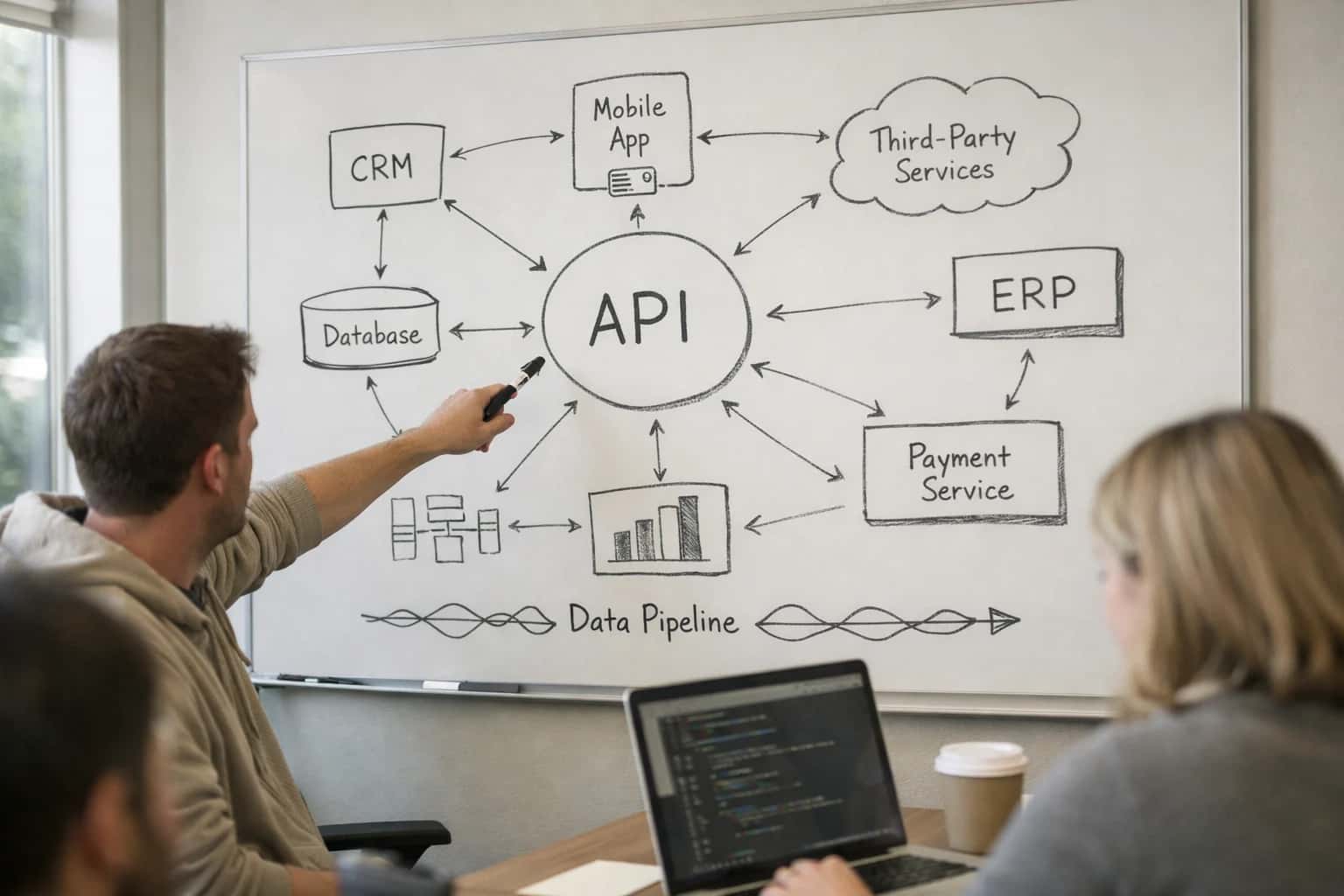
ARCHITECTURE BLUEPRINT
Where AI Connects FareHarbor Booking Data to Mailchimp Campaigns
A technical guide to automating audience segmentation and campaign creation by connecting FareHarbor's booking API to Mailchimp's marketing automation engine.
Implementation centers on an orchestration service that listens for FareHarbor events, enriches them with AI, and executes Mailchimp operations. Key workflows include: 1) Post-booking welcome series triggered by a new booking, where AI selects the most relevant content block (e.g., "what to pack" for a snorkel tour vs. hiking tips); 2) Re-engagement campaigns for customers with lapsed bookings, where AI scores recency, frequency, and monetary value to predict the best offer; and 3) Upsell automation before a scheduled trip, where AI analyzes the booked activity to recommend add-ons (like photo packages or gear rentals) and personalizes the email copy.
Rollout requires mapping FareHarbor's customer and booking objects to Mailchimp's merge_fields and setting up a governed approval layer for AI-generated content. We recommend starting with a single high-volume tour category, using a human-in-the-loop review for the first 100 campaigns to tune the AI's content selection. Audit logs should track which FareHarbor booking triggered which Mailchimp campaign and the AI's reasoning, ensuring transparency for marketing and compliance teams. This pattern moves campaign management from manual list building and generic blasts to a personalized, booking-driven automation engine.
AUTOMATED AUDIENCE SEGMENTATION & CAMPAIGN CREATION
Key Integration Surfaces in FareHarbor and Mailchimp
Booking & Customer Data for Segmentation
The integration pulls from three primary surfaces within FareHarbor to build rich customer profiles in Mailchimp.
Booking Records API: This is the core source. Each booking contains customer contact details, the specific activity booked, date/time, party size, and total price. This data allows segmentation by product interest, booking value, and seasonality.
Customer Tags & Custom Fields: Operators often manually tag customers in FareHarbor (e.g., repeat-customer, corporate-group, interested-in-private-tours). These tags are gold for segmentation. Custom fields on bookings can capture dietary needs, special requests, or how they heard about you, providing further personalization hooks.
Webhook Events: Real-time triggers like booking.created, booking.updated, or booking.canceled initiate immediate workflows in Mailchimp, enabling timely "welcome" or "we-miss-you" campaigns.
AUTOMATED AUDIENCE SEGMENTATION & CAMPAIGN CREATION
High-Value AI Use Cases for FareHarbor + Mailchimp
Connect FareHarbor booking data to Mailchimp to automate hyper-personalized marketing. Use AI to segment customers, predict engagement, and generate targeted content for rebooking and upsell campaigns.
01
Post-Tour Re-engagement Campaigns
Trigger automated Mailchimp flows when a FareHarbor booking status changes to Completed. AI analyzes the tour type, customer group size, and guide feedback to generate personalized follow-up emails with relevant content—like photo galleries from similar adventures or offers for seasonal activities—driving repeat bookings.
Batch → Real-time
Campaign trigger
02
Dynamic Audience Segmentation
Use AI to evaluate FareHarbor customer tags, booking frequency, and average order value. Automatically create and update Mailchimp segments (e.g., High-Value Family Bookers, Solo Adventure Seekers) for targeted campaign orchestration without manual list management.
1 sprint
Setup time
03
Personalized Upsell & Cross-Sell
Integrate FareHarbor's product catalog with Mailchimp. AI reviews a customer's booked activities and suggests complementary add-ons (e.g., photography packages, gear rentals) within automated email or SMS sequences, increasing average booking value.
Hours → Minutes
Content generation
04
Weather & Cancellation Remarketing
Connect FareHarbor booking dates to weather APIs. If poor weather is forecasted, AI triggers a pre-emptive Mailchimp campaign offering rescheduling options or indoor alternative tours, reducing no-shows and maintaining customer satisfaction.
Same day
Response time
05
Lapsed Customer Win-Back
AI identifies customers in FareHarbor with no bookings in the last 12+ months. Automates a tailored win-back sequence in Mailchimp, generating personalized subject lines and content highlighting new tours or exclusive loyalty discounts based on their past interests.
06
Campaign Performance & Attribution
Sync Mailchimp campaign engagement data back to FareHarbor customer records. Use AI to attribute new bookings to specific marketing efforts, providing clear ROI analysis and informing future budget allocation for tour marketing.
FAREHARBOR + MAILCHIMP
Example AI-Enhanced Workflow Automations
These workflows illustrate how to automate audience segmentation and campaign creation by connecting FareHarbor's booking data to Mailchimp's marketing engine, using AI to predict the best content for re-engagement and upsell.
Trigger: A booking's status in FareHarbor changes to 'Completed' via webhook.
Context/Data Pulled:
- Pull the customer's booking details (tour name, date, guide, party size).
- Fetch their historical booking data from FareHarbor API.
- Retrieve any customer tags (e.g., 'first-time', 'family', 'adventure-seeker').
Model or Agent Action: An AI agent analyzes the booking and customer history to:
- Predict the customer's likely interest category (e.g., 'water activities', 'cultural tours', 'multi-day trips').
- Generate a personalized email subject line and opening paragraph referencing their specific guide or a memorable tour detail.
- Select the top 2-3 most relevant upcoming tours from FareHarbor's inventory for a cross-sell recommendation.
System Update or Next Step: The agent uses the Mailchimp API to:
- Add/update the customer in a Mailchimp audience with predicted interest tags.
- Add them to a 'Post-Tour: [Interest Category]' automation workflow.
- Populate merge tags with the personalized content and recommendations.
Human Review Point: The initial AI-generated campaign templates and interest prediction logic are reviewed and approved by marketing before the automation is activated.
AUTOMATED SEGMENTATION AND CAMPAIGN CREATION
Implementation Architecture: Data Flow, APIs, and Guardrails
A technical blueprint for connecting FareHarbor's booking data to Mailchimp's marketing engine using AI to predict and personalize re-engagement.
The integration is built on a secure middleware layer that listens for FareHarbor webhooks (e.g., booking.created, customer.updated) and polls its REST API for booking history and customer tags. This data—including tour type, booking value, frequency, and custom tags like "family-tour" or "adventure-seeker"—is normalized and enriched. An AI model processes this dataset to predict customer segments and optimal content themes, outputting structured attributes like predicted_segment: "high-value-repeat" and recommended_upsell: "private-guide-upgrade". These attributes are then mapped to Mailchimp via its API, creating or updating audience members and syncing the predicted segment to a Merge Field like AI_SEGMENT.
Key implementation details include:
- Orchestration: A workflow engine (e.g., n8n or a custom service) handles the sequence: webhook receipt, data fetch from FareHarbor, AI inference, and Mailchimp API calls.
- AI Inference Point: A dedicated service hosts a lightweight model (or calls a managed LLM) trained on historical booking and email engagement data. Its job is to score each customer for re-engagement propensity and product affinity, determining the best campaign archetype (e.g., "win-back," "cross-sell," "loyalty").
- Campaign Automation: Using the synced
AI_SEGMENTfield, Mailchimp automations are triggered. For example, a customer tagged withpredicted_churn_risk: highis automatically added to a "Special Offer" workflow with a personalized subject line and upsell generated by AI.
Governance and rollout require a phased approach. Start with a pilot segment, using FareHarbor's test mode and a Mailchimp test list. Implement audit logs for all data transformations and API calls to ensure compliance and debug sync issues. Critical guardrails include:
- Rate Limiting: Respecting Mailchimp's API rate limits and implementing retry logic with exponential backoff.
- Data Freshness: Scheduling periodic batch updates to refresh AI predictions based on new bookings, preventing stale segments.
- Human-in-the-Loop: For high-stakes campaigns (e.g., large discount offers), configure the system to require manager approval in a tool like Slack before the AI-triggered audience is finalized. This architecture turns static booking data into a dynamic, predictive marketing engine, enabling operators to move from broad blasts to personalized, behavior-driven journeys. For related patterns, see our guides on AI Integration for Tour Operator Platforms and Marketing Automation and AI Integration with Peek Pro and Klaviyo.
AI-DRIVEN SEGMENTATION AND CAMPAIGN AUTOMATION
Code and Payload Examples
Capturing Booking Events from FareHarbor
When a booking is created or updated in FareHarbor, a webhook payload is sent to your middleware. This payload contains the core booking data, but often lacks the enriched customer context needed for effective segmentation. The first step is to use an AI agent to analyze this data and append predictive tags.
python# Example: Python Flask endpoint to receive FareHarbor webhook from flask import Flask, request, jsonify import requests app = Flask(__name__) @app.route('/fareharbor-webhook', methods=['POST']) def handle_booking(): payload = request.json booking_id = payload.get('booking', {}).get('pk') customer_email = payload.get('booking', {}).get('contact_email') # Enrich booking data with AI for segmentation ai_segmentation_payload = { "booking_id": booking_id, "customer_email": customer_email, "tour_type": payload.get('booking', {}).get('item', {}).get('name'), "party_size": payload.get('booking', {}).get('customers'), "booking_value": payload.get('booking', {}).get('total'), "days_until_tour": calculate_days_until(payload.get('booking', {}).get('date')) } # Call internal AI service to predict customer segment & content affinity ai_response = requests.post('https://ai-service.internal/segment', json=ai_segmentation_payload) predicted_tags = ai_response.json().get('tags', []) # e.g., ["high_value", "family", "adventure_seeker"] # Forward enriched event to workflow orchestrator forward_to_orchestrator({ **payload, "ai_tags": predicted_tags }) return jsonify({"status": "processed"}), 200
AUTOMATED SEGMENTATION & CAMPAIGN CREATION
Realistic Time Savings and Business Impact
How AI integration between FareHarbor and Mailchimp transforms manual, reactive marketing into a personalized, proactive growth engine.
| Marketing Workflow | Before AI | After AI | Operational Notes |
|---|---|---|---|
Audience Segmentation | Manual export, pivot tables, and list creation (2-4 hours weekly) | AI-driven dynamic segments update daily (15 minutes weekly review) | Segments based on booking value, frequency, recency, activity tags, and predicted churn risk |
Campaign Content Creation | Generic email templates with manual product insertion | Personalized draft generation for each segment (80% first draft) | AI uses booking history, weather, local events, and upsell logic; human edits final copy |
Re-engagement Trigger Logic | Basic rules (e.g., 'not booked in 6 months') | Predictive scoring for re-engagement priority and content | AI scores likelihood to rebook and suggests optimal offer (discount vs. new activity) |
Upsell/Cross-sell Campaigns | Broad 'you might also like' blasts post-booking | Sequenced, behavior-triggered recommendations | Example: After a kayak tour, AI triggers a sunset cruise offer to the same group |
Performance Analysis & Optimization | Monthly review of open/click rates | Weekly AI insights on content resonance and segment performance | AI identifies top-performing subject lines, content blocks, and optimal send times for each segment |
List Hygiene & Compliance | Quarterly manual review for unsubscribes/bounces | Automated suppression list sync and GDPR/CCPA preference management | AI flags inactive contacts for re-permission campaigns before automatic archiving |
Multi-Channel Orchestration | Email-only campaigns | AI recommends channel mix (email vs. SMS) based on customer profile and message urgency | High-priority weather alerts sent via SMS; post-trip review requests via email |
ARCHITECTING A CONTROLLED INTEGRATION
Governance, Security, and Phased Rollout
A secure, governed approach to connecting FareHarbor booking intelligence with Mailchimp's campaign engine.
This integration operates by syncing key FareHarbor data objects—bookings, customers, and product tags—to a secure intermediary layer. Here, AI models process this data to predict optimal audience segments and generate campaign content. The system uses FareHarbor's webhooks for real-time booking events and its REST API for batch customer history pulls. All PII is tokenized or pseudonymized before analysis, and generated Mailchimp campaigns are staged in a draft state, requiring marketing approval before sending via the Mailchimp API. Audit logs track every data sync, model prediction, and campaign action, linking back to the source FareHarbor booking ID for full traceability.
A phased rollout is critical for managing risk and measuring impact. Start with a pilot segment, such as customers who booked a specific high-value tour category in the last 90 days. In Phase 1, deploy a simple AI model to tag these customers in a dedicated Mailchimp audience and generate a single re-engagement email draft. This limits scope while validating the data pipeline and content quality. Phase 2 expands to predictive segmentation—using booking frequency, spend, and product mix to score customers for upsell potential—and automates the creation of a three-email nurture sequence. The final phase introduces dynamic content generation, where AI personalizes email body copy and subject lines based on individual booking history and inferred preferences.
Governance is enforced through a combination of technical and human checkpoints. A content approval workflow ensures all AI-generated email copy is reviewed by a marketing manager before deployment. Role-based access control (RBAC) limits who can configure the AI models or approve campaigns. The system is designed for explainability: for any campaign, you can query which FareHarbor data points and model logic drove the segmentation and content decisions. This controlled approach ensures the integration enhances marketing agility without compromising brand voice or customer trust. For related architectural patterns on connecting tour operator data to other systems, see our guide on AI Integration for Tour Operator Platforms and Marketing Automation.
Enabling Efficiency, Speed & Accuracy
Intelligent Analysis, Decision & Execution
We build AI systems for teams that need search across company data, workflow automation across tools, or AI features inside products and internal software.
Talk to Us
Search across company data
Give teams answers from docs, tickets, runbooks, and product data with sources and permissions.
Useful when people spend too long searching or get different answers from different systems.
Enterprise searchRAGPermissions
Read more
Automate internal workflows
Use AI to route work, draft outputs, trigger actions, and keep approvals and logs in place.
Useful when repetitive work moves across multiple tools and teams.
AI agentsWorkflow automationGovernance
Read more
Add AI to products and internal tools
Build assistants, guided actions, or decision support into the software your team or customers already use.
Useful when AI needs to be part of the product, not a separate tool.
AI integrationDecision supportModel routing
Read moreIMPLEMENTATION BLUEPRINT
Frequently Asked Questions
Common technical and strategic questions for integrating AI between FareHarbor and Mailchimp to automate audience segmentation and campaign creation.
The most valuable data for AI-driven segmentation lives in FareHarbor's booking and customer objects via its API. Key fields include:
- Booking History: Total spend, frequency, last booking date, booked activity types (e.g., "snorkeling tour", "sunset cruise").
- Customer Tags: Tags applied manually or via automation (e.g., "repeat_customer", "group_leader", "interested_in_photography").
- Temporal Data: Seasonality, day-of-week booking patterns, lead time between booking and tour date.
- Party Details: Group size, participant ages (for family vs. adult segmentation).
- Upsell/Add-on Data: Which extras (e.g., "photo package", "equipment rental") were purchased.
An AI model can analyze this combined dataset to predict customer clusters for re-engagement, such as "high-value repeaters likely to book a private tour" or "first-time customers at risk of churn." These predicted segments are then synced to Mailchimp as tags or list memberships via the Mailchimp API for targeted campaign execution.

About the author
Prasad Kumkar
CEO & MD, Inference Systems
Prasad Kumkar is the CEO & MD of Inference Systems and writes about AI systems architecture, LLM infrastructure, model serving, evaluation, and production deployment. Over 5+ years, he has worked across computer vision models, L5 autonomous vehicle systems, and LLM research, with a focus on taking complex AI ideas into real-world engineering systems.
His work and writing cover AI systems, large language models, AI agents, multimodal systems, autonomous systems, inference optimization, RAG, evaluation, and production AI engineering.
LinkedIn
Limited slotsGet a Free AI Consultation
Partnered with leading AI, data, and software stack.





How We Work
Custom AI workflows for your Business
One-fit-all AI don't work for modern businesses. At Inferensys, we aim to understand your business & custom requirements; which we use to define most efficient agentic workflows, the data, and the tools for your business.
01
Review the use case
We understand the task, the users, and where AI can actually help.
Read more02
Pick the right approach
We define what needs search, automation, or product integration.
Read more03
Build the first useful version
We implement the part that proves the value first.
Read more04
Improve from there
We add the checks and visibility needed to keep it useful.
Read moreThe first call is a practical review of your use case and the right next step.
Talk to Us