
Inferensys

Integration

AI Integration for Asana OKRs

A technical blueprint for connecting AI to Asana's Goals (OKRs) to automate progress measurement, predict outcomes, and generate strategic alignment insights across projects and portfolios.
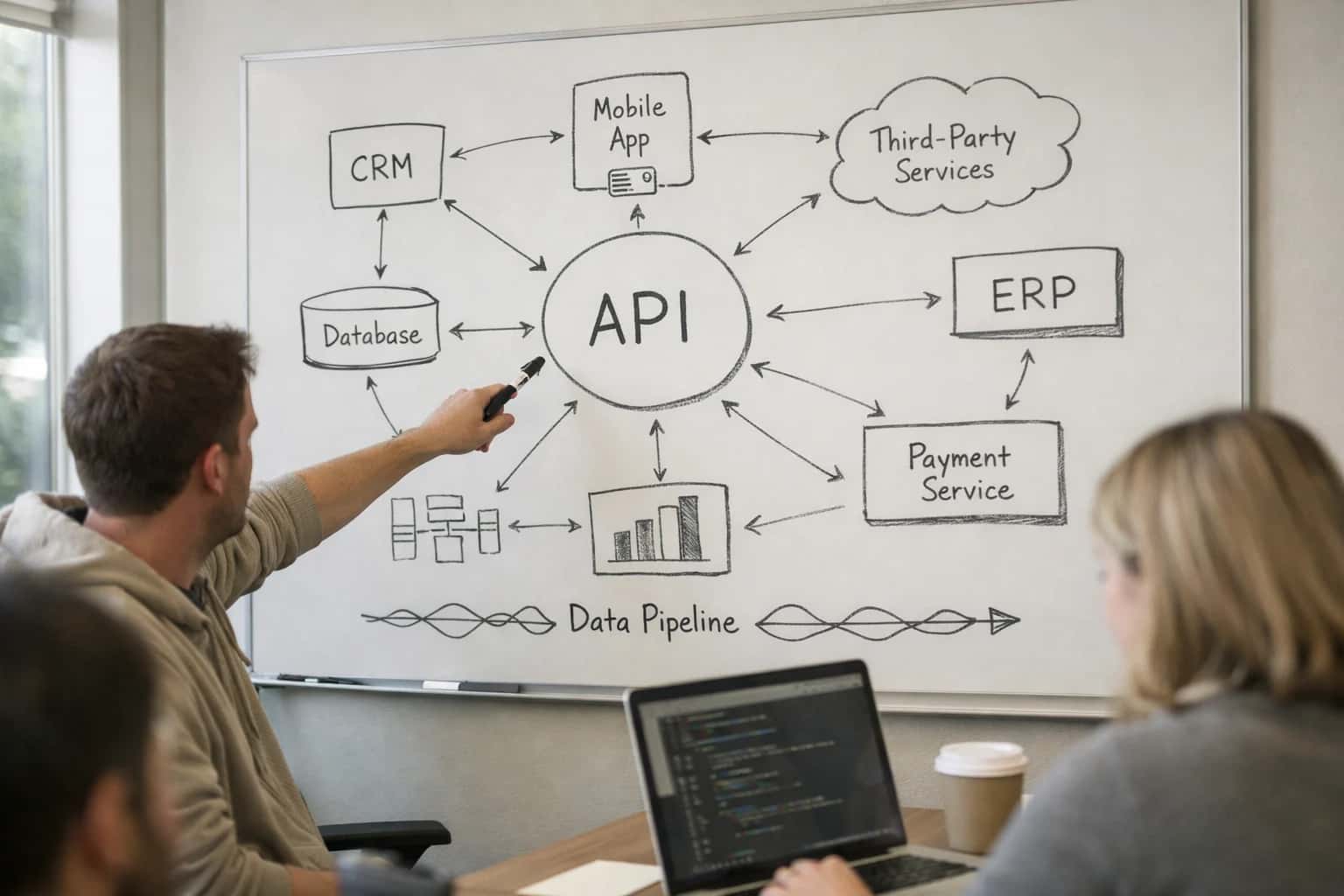
Enterprise integration architect reviewing API connections on laptop, diagram showing systems connecting, modern office setup.
ARCHITECTURE FOR INTELLIGENT GOAL MANAGEMENT

Where AI Fits into Asana's OKR Workflow

A technical blueprint for connecting AI agents to Asana's Goals (OKRs) to automate progress measurement, predict outcomes, and generate strategic alignment insights.

The integration surface for AI in Asana's OKR workflow is primarily the Goals API, custom fields on linked projects and tasks, and the Portfolios data model. AI agents operate by:

  • Reading goal definitions, current progress metrics (current_number_value, current_notes), and the hierarchy of linked projects and tasks.
  • Analyzing task completion rates, timeline updates in linked projects, and comment sentiment to assess momentum.
  • Writing back predictive confidence scores, automated progress updates, and alignment insights as custom fields or notes on the Goal record itself.


A production implementation typically involves a middleware service that polls the Asana API or listens via webhooks for changes to linked tasks. This service runs AI models that:

  1. Calculate Predictive Metrics: Use historical completion data from similar tasks to forecast the likelihood of achieving a goal's target by its due date.
  2. Generate Alignment Insights: Analyze the descriptions and statuses of all linked work to detect if effort is drifting from the stated objective, flagging misalignment for review.
  3. Automate Status Synthesis: At scheduled intervals, compile updates from dozens of linked tasks into a coherent narrative progress note, saving managers hours of manual synthesis.

Key Integration Point: The goal object's metric and status fields are the primary write targets for AI-generated confidence scores and summarized updates.

Rollout and governance are critical. Start with a pilot on a single portfolio's OKRs, using a human-in-the-loop approval step where AI suggestions are reviewed before being posted to Asana. Implement audit logging for all AI-generated writes to the Goals API to ensure traceability. This controlled approach allows teams to calibrate the AI's predictions against real-world outcomes, building trust before scaling to organization-wide goal management.

AI FOR OKRS

Key Integration Surfaces in Asana's Goals API

The Goal Object and Metric Tracking

The core Goal object in Asana's API contains the essential fields for AI analysis: current_value, initial_value, target_value, progress_source, and status. AI models can be triggered via webhook on goal.progress_updated events to analyze the delta between current and target values.

This surface is ideal for:

  • Predictive Attainment: Using historical progress rates (e.g., weekly current_value snapshots) to forecast the likelihood of achieving the goal by its due_on date.
  • Anomaly Detection: Flagging goals where progress has stalled or accelerated unexpectedly, prompting investigation.
  • Automated Updates: An AI agent can periodically fetch linked project or task completion data (via the projects and tasks relationships) to calculate and push a new current_value to the API, automating progress tracking.
python
# Example: Fetch goal for AI analysis
response = requests.get(
    'https://app.asana.com/api/1.0/goals/12345',
    headers={'Authorization': 'Bearer <TOKEN>'}
)
goal_data = response.json()['data']
# AI logic to predict attainment
predicted_end_value = forecast_model.predict(goal_data['current_value'], goal_data['due_on'])
confidence = calculate_confidence(predicted_end_value, goal_data['target_value'])
ARCHITECTURAL BLUEPRINTS

High-Value AI Use Cases for Asana OKRs

Connect AI directly to Asana's Goals (OKRs) to automate progress measurement, predict outcomes, and generate strategic alignment insights across your project portfolio.

01

Automated Progress Synthesis & Narrative Reporting

An AI agent monitors all projects and tasks linked to an Asana Goal via custom fields or portfolios. It synthesizes status updates, completed work, and blocker comments to generate a narrative progress summary and update the Goal's progress percentage. This replaces manual weekly roll-ups.

Hours -> Minutes
Reporting time
02

Predictive Attainment Scoring & Risk Flagging

Using historical velocity from linked tasks and current progress, an AI model calculates a confidence score for each OKR's on-time completion. It writes this score to a custom field and automatically creates subtasks or comments in the Goal to flag specific at-risk projects, enabling proactive intervention.

Proactive → Reactive
Risk management
03

Strategic Alignment & Workload Impact Analysis

AI analyzes the web of projects connected to multiple OKRs across portfolios. It identifies resource conflicts and strategic misalignments, such as a single team being critical to two high-priority Goals. Insights are posted as a summary in the parent Portfolio or sent via automation to leadership.

04

Intelligent OKR Drafting & Refinement

During planning cycles, an AI copilot assists in drafting new OKRs. It analyzes past Goal performance, suggests measurable key results based on available project data, and recommends realistic target metrics by referencing historical completion rates in similar initiatives.

1 sprint
Planning cycle
05

Cross-Functional Dependency Mapping

For OKRs requiring coordination across departments, AI maps task dependencies that span different Asana teams or projects. It visualizes critical cross-team handoffs and automatically updates relevant Goal stakeholders when a dependency is at risk, ensuring seamless execution.

06

Quarterly Review & Retrospective Automation

At the end of a quarter, an AI workflow aggregates all data from completed and missed OKRs. It generates a structured retrospective report highlighting common themes, root causes for misses, and data-backed recommendations for improving the next quarter's OKR process, posted as a Doc in the relevant Asana project.

ARCHITECTURAL PATTERNS

Example AI-Powered OKR Workflows

These are production-ready workflows that connect AI models to Asana's Goals (OKRs) via its API and webhooks. Each pattern shows how to move from manual tracking to automated measurement, prediction, and insight generation.

Trigger: Scheduled cron job (e.g., every Monday 6 AM).

Context Pulled: AI agent fetches all active Asana Goals via the API, including their current_number_value, start_on, due_on, and notes. It then retrieves all tasks and projects linked to each goal via the projects and tasks relationships.

Agent Action: For each OKR, the model analyzes:

  • Progress delta from the previous week.
  • Activity volume and status changes in linked work.
  • Sentiment and urgency signals from recent task comments. It generates a concise, narrative progress summary (2-3 sentences) and calculates a confidence score (0-100%) for on-time completion based on the current trajectory.

System Update: The agent writes back to each Goal:

  1. Updates the notes field with the new weekly summary, appending to history.
  2. Sets a custom field (e.g., AI Confidence Score) with the calculated percentage.
  3. Creates a subtask under the Goal for the responsible owner if the confidence score drops below 70%, prompting a review.

Human Review Point: Goal owners receive an automated Asana notification about the updated note and any newly created review subtask.

CONNECTING AI TO ASANA'S GOALS API

Implementation Architecture: Data Flow & System Design

A technical blueprint for integrating AI with Asana's Goals (OKRs) to automate progress analysis, predict outcomes, and generate strategic insights.

The integration connects to Asana's Goals API and Portfolios API to establish a real-time data pipeline. The core flow begins by syncing Goal objects—including their current_value, target_value, status, due_date, and linked projects or tasks. This data, combined with metadata from linked work in Asana (e.g., task completion rates, custom field updates, timeline changes), forms the raw input for AI analysis. A middleware service, often deployed as a secure cloud function, handles authentication via OAuth, manages API rate limits, and structures the payload for the AI model. Key integration surfaces include:

  • Goal Metrics & Progress: Reading current_value updates and calculating attainment velocity.
  • Linked Work Analysis: Aggregating status from connected projects and tasks to assess contributing factors.
  • Custom Field Mapping: Using Asana custom fields on linked items (e.g., confidence_score, blocker_status) to provide nuanced context to the AI.

The AI processing layer performs three core functions on this structured data: predictive scoring, narrative synthesis, and anomaly detection. A model analyzes historical progress patterns against the goal's due_date to predict the likelihood of on-time completion, outputting a predicted_attainment_score. Simultaneously, a separate agent synthesizes updates from linked work items and comments to generate a concise progress_narrative, highlighting key achievements and risks. Any significant deviation from expected progress velocity or a drop in linked task completion rates triggers an anomaly flag. These outputs are written back to Asana via the API, typically populating custom fields on the Goal (e.g., AI_Confidence, AI_Summary) or creating follow-up tasks in a dedicated "OKR Actions" project for owner review. This closed-loop system enables portfolio managers to move from manual check-ins to a continuously updated, intelligence-driven view of OKR health.

Rollout should follow a phased approach, starting with a single portfolio or department's Goals in a sandbox environment. Governance is critical: implement RBAC on the integration service to control which Goals are accessed, maintain an audit log of all AI-generated writes back to Asana, and establish a human-in-the-loop step for the first 30 days where AI-generated summaries and scores are posted as comments for manager approval before updating official fields. This mitigates risk and builds trust. The final architecture should be resilient, using message queues to handle Asana webhooks for real-time Goal updates and ensuring idempotent operations to prevent duplicate AI analysis from triggering on the same data change.

ASANA GOALS API INTEGRATION PATTERNS

Code & Payload Examples

Analyzing OKR Progress with AI

This pattern uses the Asana API to fetch Goal data, including its current progress, linked projects, and followers. An AI model analyzes the delta between current_value and target_value, reviews progress notes, and assesses the health of linked projects to generate a predictive confidence score and narrative summary.

Typical Payload to AI Model:

json
{
  "goal_gid": "1202467801234567",
  "goal_name": "Increase Q3 Product Adoption by 15%",
  "metric": "adoption_rate",
  "current_value": 10.2,
  "target_value": 15.0,
  "status": "on_track",
  "notes": "Launched feature X; awaiting analytics from cohort B.",
  "linked_projects": [
    {"gid": "1102467801234567", "name": "Feature X Launch", "completed": true},
    {"gid": "1102467801234568", "name": "Cohort B Analysis", "completed": false}
  ],
  "owner_name": "Alex Chen"
}

The AI returns a structured analysis including a confidence_score (0-1), predicted_attainment_date, key_blockers, and a summary_for_stakeholders.

AI-POWERED OKR OPERATIONS

Realistic Time Savings & Operational Impact

This table illustrates the tangible workflow improvements and time savings when AI is integrated into Asana's Goals (OKRs) module, focusing on the core activities of portfolio managers and operations leaders.

MetricBefore AIAfter AINotes

OKR Progress Synthesis

Manual review of 50+ linked projects

Automated weekly summary in <5 minutes

AI analyzes task completion, custom fields, and comments across the portfolio

Confidence Score Updates

Bi-weekly team lead check-ins

Real-time predictive scoring

Model updates scores based on project velocity, risks, and milestone attainment

Alignment Gap Detection

Quarterly portfolio review workshops

Continuous monitoring with weekly alerts

AI flags projects drifting from strategic themes using goal descriptions and tags

Stakeholder Report Generation

4-6 hours per report, manual data pull

1-hour review of AI-drafted narrative

Report includes synthesized progress, predictive insights, and recommended actions

Initiative Prioritization Support

Manual scoring against static criteria

Dynamic scoring with scenario modeling

AI evaluates new requests against current OKR load and resource capacity

Risk to OKR Identification

Reactive identification in status meetings

Proactive alerts 2-3 weeks in advance

Monitors task dependencies, delays, and sentiment in project updates

Cross-Portfolio Dependency Mapping

Manual spreadsheet maintained monthly

Automated visualization updated daily

AI maps task and resource dependencies between projects linked to different OKRs

ARCHITECTING FOR CONTROL AND CONFIDENCE

Governance, Security, and Phased Rollout

A production-ready AI integration for Asana OKRs requires deliberate governance, secure data handling, and a phased rollout to ensure adoption and value.

Governance starts with the data model. Define clear ownership for the AI-generated fields in your Asana Goals, such as AI Confidence Score, Predicted Completion Date, or Top Blocking Project. Use Asana's custom field settings and permissions to control who can view or edit these fields. Establish an audit trail by having the AI agent log its actions—like updating a confidence score or posting an insight comment—in a dedicated Asana task or an external system. This creates transparency and allows for manual review or correction if the AI's analysis drifts.

Security is non-negotiable when connecting to your goal data. The integration should use Asana's OAuth 2.0 with the minimal necessary scopes (e.g., goals:read, goals:write, projects:read). All API calls and data processing should occur within your secure cloud environment, not in client-side code. Never store Asana access tokens or sensitive goal details in plaintext. If using a retrieval-augmented generation (RAG) approach to ground insights in past project data, ensure your vector store is isolated and access-controlled, pulling only from authorized Asana portfolios and projects.

A phased rollout mitigates risk and builds trust. Start with a pilot in a single portfolio or department:

  1. Phase 1 (Read-Only Analysis): Connect the AI to analyze Goals and linked projects, generating insights and predictions in a separate dashboard or report. No writes back to Asana.
  2. Phase 2 (Controlled Writes): Enable the AI to post summary comments to Goals or update non-critical custom fields (e.g., a Last Analyzed timestamp). Implement a simple human-in-the-loop step for any predictive field changes.
  3. Phase 3 (Automated Orchestration): After validation, allow the AI to automate workflows, such as creating follow-up tasks in linked projects when a goal's confidence score drops below a threshold, or triggering a Slack alert to the goal owner. Continuously monitor the AI's output quality against manual reviews and adjust prompts or data sources as needed. This crawl-walk-run approach ensures the integration delivers consistent, actionable intelligence without disrupting your OKR process.
IMPLEMENTATION BLUEPRINT

Frequently Asked Questions

Practical questions for technical teams planning to connect AI models to Asana's Goals (OKRs) for predictive analytics and automated insights.

The primary integration method is via the Asana API using a dedicated service account with OAuth 2.0. The architecture typically involves:

  1. Service Account & Scopes: Create an Asana service account with scopes for goals:read, goals:write, projects:read, and tasks:read to access Goals and their linked projects/tasks.
  2. Data Pipeline: A middleware service (e.g., in Python/Node.js) calls the Asana API to fetch Goal objects, including:
    • current_value, target_value, status
    • metric and progress_source (if using numeric tracking)
    • Linked projects and tasks via the followers or custom fields
    • Timeline (start_on, due_on)
  3. Context Enrichment: The service enriches this data by fetching recent updates, comments, and status changes from linked projects to provide context for the AI model.
  4. Secure AI Call: The enriched payload is sent to your AI provider (e.g., OpenAI, Anthropic) via a secure, zero-data-retention API using your managed keys. Never expose Asana API tokens to client-side code.
  5. Write-Back: Insights (e.g., predicted completion, risk flags) are written back to Asana as a note on the Goal or by updating a dedicated custom field (e.g., 'AI Confidence Score').

Key Security Note: All tokens and keys are managed via a secrets manager (e.g., AWS Secrets Manager, Azure Key Vault). The integration service should log all data access for auditability.

Prasad Kumkar

About the author

Prasad Kumkar

CEO & MD, Inference Systems

Prasad Kumkar is the CEO & MD of Inference Systems and writes about AI systems architecture, LLM infrastructure, model serving, evaluation, and production deployment. Over 5+ years, he has worked across computer vision models, L5 autonomous vehicle systems, and LLM research, with a focus on taking complex AI ideas into real-world engineering systems.

His work and writing cover AI systems, large language models, AI agents, multimodal systems, autonomous systems, inference optimization, RAG, evaluation, and production AI engineering.


