
Inferensys

Integration

AI Integration for HR Compliance Automation

Automate high-risk, manual compliance tracking for I-9s, required training, licensure, and policy acknowledgments using AI agents that integrate directly with your HRIS (Workday, UKG, ADP, BambooHR).
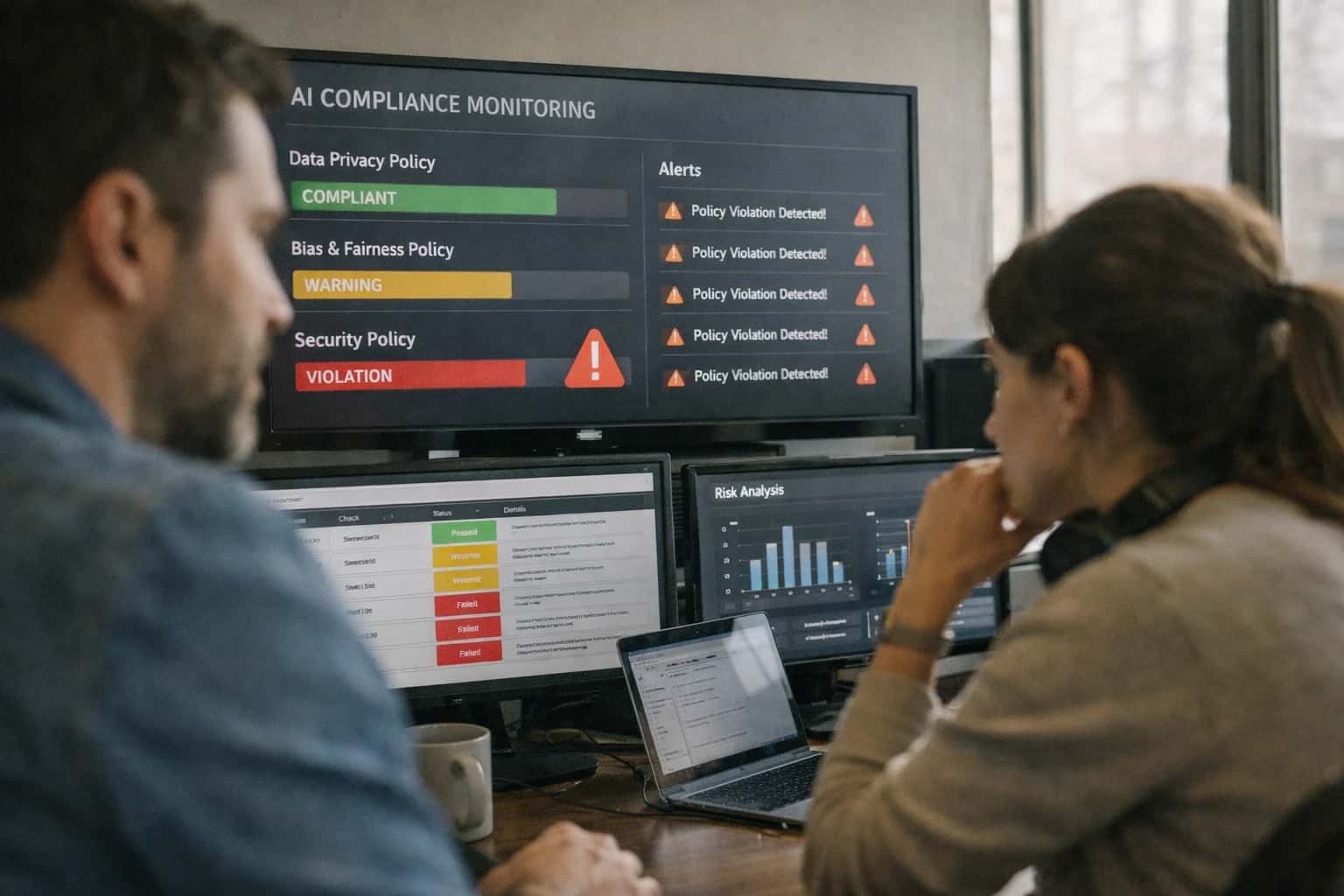
Compliance officer monitoring AI compliance agent on laptop, policy dashboards visible, modern WeWork desk setup.
ARCHITECTURE AND ROLLOUT

Where AI Fits in HR Compliance

A technical blueprint for automating I-9, training, licensure, and policy tracking by connecting AI agents to HRIS records and workflows.

AI integrates into HR compliance by acting as a continuous monitoring and workflow agent on top of your HRIS data layer. It connects to core objects like Employee, Document, Training Record, and Certification via the platform's APIs (e.g., Workday Web Services, UKG Pro API, BambooHR API). The agent's primary functions are to:

  • Monitor Expirations: Poll for upcoming I-9 reverification dates, license expirations, or required training deadlines.
  • Trigger Actions: Automatically generate and route tasks in the HRIS case management module, send compliance nudges via email or Slack, or create tickets in a service management tool.
  • Validate Documents: Use document intelligence to check I-9 Sections 1 & 2 for completeness or scan uploaded certificates for key dates and issuing bodies.
  • Maintain Audit Trails: Log all AI-initiated actions, status changes, and employee interactions back to the HRIS audit log or a dedicated compliance ledger.


Implementation requires mapping the compliance rulebook to executable logic. For example, an AI agent for mandatory training would:

  1. Query the HRIS Training_Assignment object nightly to identify employees with overdue or upcoming requirements.
  2. For each employee, check their Job_Profile and Location to apply the correct regulatory jurisdiction (e.g., California-specific harassment training).
  3. Initiate a multi-step workflow: send a reminder, escalate to the manager after 7 days, and finally create an HR case for intervention.
  4. Upon completion, receive a webhook from the LMS, validate the completion certificate, and update the HRIS Training_Status.

This moves compliance from a monthly manual report run by HR to a real-time, closed-loop system where exceptions are handled in days, not weeks.

Rollout should be phased, starting with a single, high-volume compliance area like policy acknowledgments. Governance is critical: the AI agent must operate with a clearly defined RBAC scope, only accessing employee data pertinent to its compliance domain. All automated communications should be reviewed by legal/HR and include an opt-out path to a human. Start by deploying the agent in a monitor-only mode for a pilot group, logging the actions it would take before enabling automated task creation. This controlled approach de-risks the integration and builds trust in the AI's decision-making before full automation.

ARCHITECTURAL BLUEPRINT

HRIS Touchpoints for Compliance AI

Data Hubs for Compliance Monitoring

AI agents for HR compliance need direct, secure access to specific HRIS modules where regulated data resides. The primary touchpoints are:

  • Employee Profile & Job Data: The system of record for I-9 eligibility, work authorization expiration dates, job titles, and licensure requirements. AI can monitor these fields for upcoming expirations.
  • Learning Management (LMS) Integrations: Tracks completion status for mandatory training (e.g., safety, harassment prevention). AI can identify non-compliant employees and trigger follow-up workflows.
  • Onboarding & Offboarding Workflows: Critical for ensuring required documents (I-9, policy acknowledgments) are collected. AI can verify completeness and flag missing items to HR admins.
  • Custom Objects (via Extend/API): Many compliance processes, like annual policy attestations, are managed in custom tables or objects. AI can be configured to read from and write to these via platform APIs.

Integrating at the module level allows AI to act on the most current, authoritative data without creating sync delays or data integrity issues.

HRIS INTEGRATION PATTERNS

High-Value AI Compliance Use Cases

Automate high-risk, manual compliance processes by connecting AI agents directly to your HRIS (Workday, UKG, ADP, BambooHR) for real-time monitoring, document review, and workflow execution.

01

I-9 & Work Authorization Tracking

AI agents monitor HRIS employee records for expiring work authorizations (E-Verify, visas, I-9 Section 2 reverification). The system automatically flags at-risk employees 90 days in advance, drafts manager notifications, and initiates the HR case workflow in the service delivery platform.

Batch -> Real-time
Monitoring cadence
02

Required Training & Certification Compliance

Integrate AI with your HRIS and LMS to track mandatory training (safety, harassment prevention, role-specific certifications). Agents identify non-compliant employees, trigger enrollment workflows, and escalate to managers after grace periods, ensuring audit readiness.

Same day
Escalation trigger
03

Policy Acknowledgment & Audit Trail

Automate the distribution, tracking, and enforcement of policy updates (handbook, code of conduct, data security). AI syncs with HRIS user lists, manages acknowledgment campaigns via email or portal, and provides a real-time audit report with non-compliant employee lists for follow-up.

Hours -> Minutes
Audit report generation
04

Licensure & Credential Expiry Management

For roles requiring active licenses (nurses, engineers, drivers), AI extracts and monitors credential expiration dates from uploaded documents in the HRIS. It creates proactive renewal tasks in the employee's workflow, alerts managers, and can restrict system access upon expiry via integration with IAM platforms.

1 sprint
Typical implementation
05

Leave & Accommodation Law Compliance

AI analyzes leave requests (FMLA, ADA, state-specific) against HRIS tenure and historical data to ensure regulatory compliance. It guides managers through interactive questionnaires, recommends approval/denial reasoning based on policy, and auto-generates required documentation for the employee file.

Reduce manual triage
Primary benefit
06

Multi-Jurisdiction Wage & Hour Monitoring

Integrate AI with time & attendance data (UKG Dimensions, ADP Time) to detect potential wage/hour violations. Agents analyze schedules, breaks, and overtime against complex, location-specific rules, flagging exceptions for HR review before payroll runs, mitigating compliance risk.

Pre-payroll
Review window
HR COMPLIANCE AUTOMATION

Example AI Agent Workflows

These workflows illustrate how AI agents can be integrated with HRIS platforms like Workday, UKG, or ADP to automate high-volume, high-risk compliance tasks. Each flow connects to specific HRIS APIs, data objects, and approval surfaces to reduce manual effort and audit exposure.

Trigger: A new hire's Employment record is created in the HRIS, or a scheduled daily batch job runs to check for upcoming expirations.

Context/Data Pulled: The AI agent queries the HRIS API for:

  • Employee Person data (name, hire date, work authorization type).
  • Attached Document records (scanned I-9 forms, supporting documents).
  • Work Authorization object fields (expiration date, status).

Model/Agent Action:

  1. For new hires: The agent checks if a completed I-9 form is attached within the 3-day deadline. If missing, it triggers a reminder workflow to the employee and manager via the HRIS's notification system.
  2. For expirations: The agent identifies employees with work authorizations expiring in the next 90, 60, and 30 days.
  3. It drafts a personalized, compliant communication (email/Slack) for HR review, outlining required next steps and documentation.

System Update/Next Step: The agent creates a Case or Task in the HRIS's service delivery module (e.g., Workday Help, UKG HR Service Delivery) for the HR business partner, tagged with the relevant deadline and employee context.

Human Review Point: All outbound communications are queued in a moderation dashboard for HR approval before sending. The agent logs all actions to an audit trail linked to the employee record.

A PRACTICAL BLUEPRINT FOR PRODUCTION

Implementation Architecture: Data Flow & Guardrails

A secure, governed architecture for connecting AI agents to HRIS data to automate compliance tracking.

A production-ready integration connects AI agents to the HRIS via its REST APIs and webhook subscriptions. The core data flow begins with the agent querying key objects like Employee, Document, TrainingRecord, and ComplianceEvent. For proactive monitoring, webhooks on these objects trigger the agent to analyze new or updated records—such as a submitted I-9 form or an updated professional license—against configured rules. The agent's reasoning and any required actions (e.g., 'flag for manager review' or 'initiate recertification workflow') are posted back to the HRIS, typically by creating a Task or Case record or updating a custom ComplianceStatus field. This keeps all system-of-record data and audit trails within the HRIS.

Critical guardrails are implemented at the API and agent layers. The AI agent operates with strictly scoped API permissions, often using a service account with read access to employee data and write access only to specific compliance objects. A human-in-the-loop approval step is configured for any agent-recommended action that could impact employment status or trigger legal review. All agent interactions are logged to a separate audit system, capturing the prompt, data retrieved, reasoning chain, and final action for compliance and model evaluation. For sensitive Personally Identifiable Information (PII), data is often pseudonymized before being sent to the LLM, or the integration uses a retrieval-augmented generation (RAG) pattern where the agent pulls only the necessary data snippets into its context.

Rollout follows a phased approach, starting with a single, high-volume compliance workflow like tracking required training completion. The agent is initially deployed in a 'copilot' mode, where it suggests actions for an HR administrator to review and approve within the HRIS interface. After validating accuracy and building trust, workflows can be expanded and automated. Governance is maintained through a regular review cycle of the agent's audit logs and decision accuracy, with the ability to quickly deactivate specific automations via a feature flag in the integration layer without disrupting the core HRIS.

HR COMPLIANCE AUTOMATION

Code & Payload Examples

Automating Form I-9 and E-Verify Compliance

An AI agent can monitor the HRIS for new hires and trigger the I-9 collection workflow. It uses the HRIS API to retrieve new hire data, then interacts with a document management system to request, validate, and store Section 1 and 2 documents. For E-Verify, the agent can prepare and submit the case payload after Section 2 is complete, checking for Tentative Nonconfirmations (TNCs) and alerting HR.

Example Python logic for triggering the workflow:

python
# Webhook listener for new hire event from HRIS (e.g., BambooHR)
def handle_new_hire_webhook(payload):
    employee_id = payload['employeeId']
    hire_date = payload['hireDate']
    
    # Check if I-9 is required (e.g., re-hires may not need)
    if is_i9_required(employee_id):
        # Create a compliance task in the HRIS or case system
        task_payload = {
            'type': 'i9_collection',
            'employeeId': employee_id,
            'dueDate': calculate_i9_deadline(hire_date),
            'status': 'pending'
        }
        create_compliance_task(HRIS_API, task_payload)
        
        # Initiate document request via email or portal
        initiate_document_request(employee_id, 'i9')
HR COMPLIANCE AUTOMATION

Realistic Time Savings & Operational Impact

This table illustrates the operational impact of integrating AI agents with your HRIS to automate compliance tracking for I-9s, required training, licensure, and policy acknowledgments.

Compliance WorkflowBefore AI IntegrationAfter AI IntegrationImplementation Notes

I-9 Form Verification & Expiry Tracking

Manual calendar checks and email follow-ups

Automated daily scans with alerts 90/30/7 days prior

Agent queries HRIS employee records and sends alerts via existing channels

Required Training Completion Audits

Monthly spreadsheet exports and manual reconciliation

Weekly automated reports of non-completion sent to managers

AI cross-references LMS completion data with HRIS role assignments

Professional Licensure & Certification Renewals

Employee self-reporting; HR audits quarterly

Continuous monitoring with renewal workflow triggers

Agent validates external license databases and creates HRIS case for action

Policy Acknowledgment Campaigns

Bulk email blasts with manual tracking of responses

Targeted, sequenced nudges with non-compliance escalated after 3 attempts

Workflow integrates with HRIS comms API and updates acknowledgment status

Compliance Reporting for Audits

1-2 days to gather and format data from multiple systems

Audit-ready reports generated on-demand in under 2 hours

Pre-built connectors to HRIS, LMS, and document storage; human review still required

New Hire Compliance Onboarding

Checklist sent to HR admin; follow-up is manual

Automated task generation in HRIS for I-9, policy, and training based on hire type

Triggered from HRIS hire event; reduces administrative oversight by ~70%

Employee Life Event Compliance (e.g., role change, location transfer)

HRBP manually reviews required trainings and documents

AI generates a personalized compliance checklist triggered by the HRIS transaction

Leverages HRIS business process framework; checklist routes for manager approval

ARCHITECTING CONTROLLED, AUDITABLE AUTOMATION

Governance, Security & Phased Rollout

Deploying AI for HR compliance requires a deliberate approach that prioritizes data security, maintains a clear audit trail, and mitigates operational risk through phased adoption.

A production architecture for HR compliance automation typically involves an AI orchestration layer that sits between your HRIS (Workday, UKG, BambooHR, ADP) and downstream compliance systems. This layer uses secure APIs and service accounts with role-based access control (RBAC) scoped to read-only or specific transactional endpoints. For instance, an agent checking I-9 completion status would only need access to the Employee Documents API object, not full employee records. All agent actions—data queries, status updates, case creations—are logged with a user/system context (e.g., "action": "flagged_expiring_license", "initiator": "compliance_agent_v1", "employee_id": "masked") to your SIEM or a dedicated audit log, creating an immutable record for compliance officers.

Rollout follows a phased, risk-based approach. Phase 1 focuses on read-only monitoring and alerting. Agents are deployed to scan for missing policy acknowledgments or expiring certifications, generating alerts in a dedicated dashboard or creating low-priority tickets in your HR service management system without taking autonomous action. Phase 2 introduces assisted remediation, where agents suggest corrective actions (e.g., "Send reminder to Employee X for required training Y") for HR admin approval before execution via the HRIS API. Phase 3 enables fully automated workflows for low-risk, high-volume tasks, such as auto-assigning annual compliance training based on job code, but always with a defined human-in-the-loop escalation path for exceptions.

Governance is maintained through regular drift checks and policy reviews. The prompts and logic governing agent decisions (e.g., "What constitutes an 'expired' license with a grace period?") are version-controlled and reviewed by Legal and HR stakeholders quarterly. Furthermore, all AI-generated communications (reminder emails, policy summaries) are templated and reviewed before deployment to ensure consistent, compliant messaging. This structured approach ensures the integration enhances compliance posture without introducing new regulatory or operational risks. For related architectural patterns, see our guide on AI Integration for HR Operations Automation.

IMPLEMENTATION AND OPERATIONS

FAQ: AI for HR Compliance Automation

Practical answers to common technical and operational questions about integrating AI agents with HRIS platforms like Workday, UKG, ADP, and BambooHR to automate I-9 tracking, training compliance, licensure renewals, and policy attestations.

AI agents interact with HRIS platforms via secure, scoped API connections and service accounts, never storing raw employee data. The implementation pattern involves:

  1. Authentication & RBAC: Using OAuth 2.0 service principals with permissions scoped exclusively to the necessary objects (e.g., Worker_Document, Certification, Training_Completion).
  2. API Layer: Agents call official HRIS REST APIs (e.g., Workday Web Services, UKG Pro API, ADP Workforce Now API) for read and write operations. For updates, they follow the platform's business process framework (like Workday's Submit_Event).
  3. Data Minimization: The agent's prompt context includes only the specific fields needed for the task (e.g., employee_id, certification_expiry_date). Full records are not passed to the LLM.
  4. Audit Trail: All agent actions are logged with a correlation ID, recording the API call, payload, and the business rule or human approval that triggered it, ensuring full traceability within the HRIS audit logs.

This architecture ensures the AI operates within the existing HRIS security and governance model.

Prasad Kumkar

About the author

Prasad Kumkar

CEO & MD, Inference Systems

Prasad Kumkar is the CEO & MD of Inference Systems and writes about AI systems architecture, LLM infrastructure, model serving, evaluation, and production deployment. Over 5+ years, he has worked across computer vision models, L5 autonomous vehicle systems, and LLM research, with a focus on taking complex AI ideas into real-world engineering systems.

His work and writing cover AI systems, large language models, AI agents, multimodal systems, autonomous systems, inference optimization, RAG, evaluation, and production AI engineering.


