
Inferensys

Integration

Predictive Maintenance for ERP

Integrate IoT sensor data with ERP maintenance modules (SAP PM, Oracle EAM, Infor EAM, NetSuite) to predict equipment failures, recommend spare parts, and automatically generate preventive maintenance work orders.
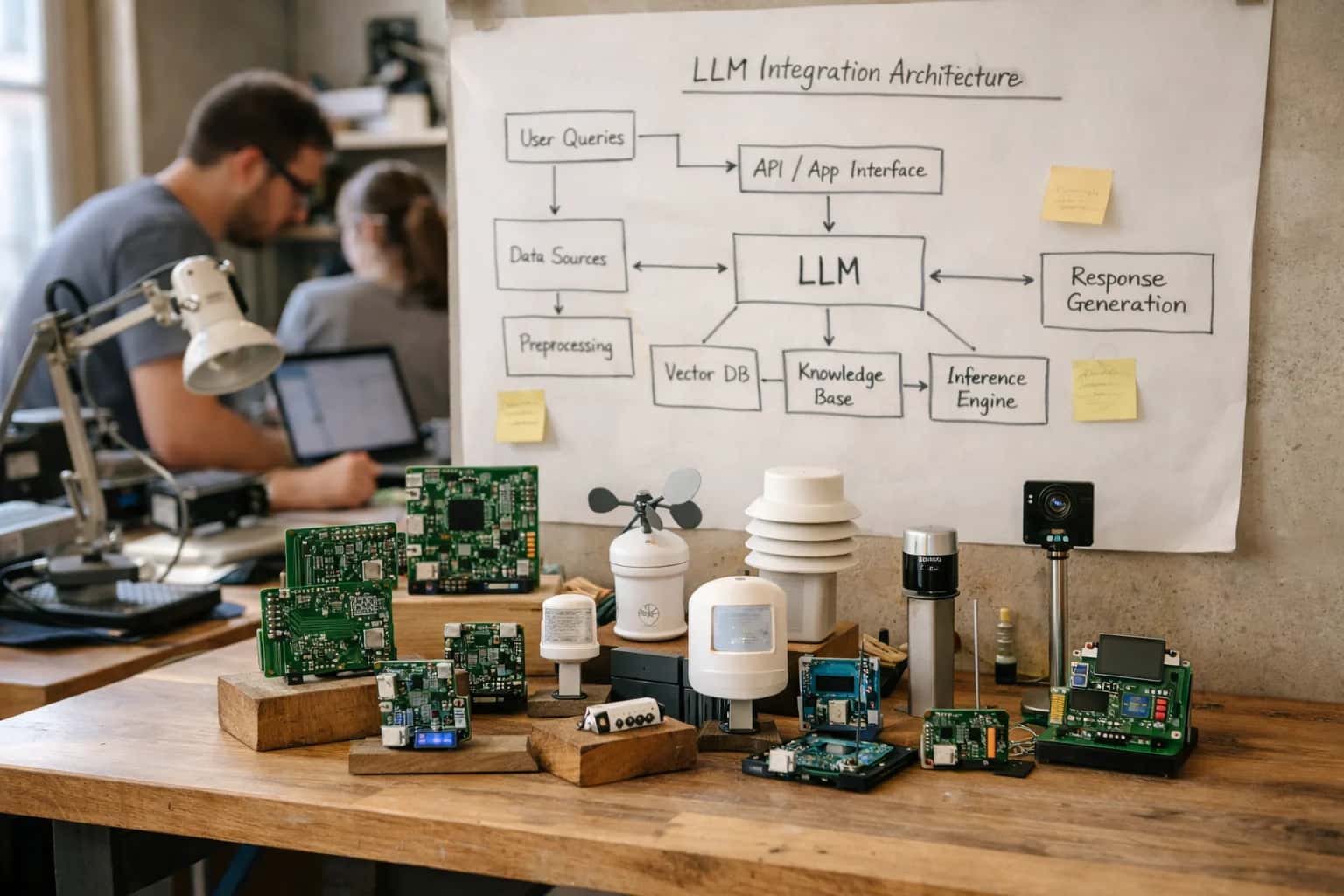
Hardware engineer integrating LLM with IoT sensors, circuit boards on desk, soldering iron nearby, maker lab aesthetic.
ARCHITECTURE AND ROLLOUT

Where AI Fits into ERP-Based Maintenance

Integrating predictive AI with ERP maintenance modules transforms reactive work orders into a reliability-first operation.

AI for predictive maintenance connects at three key layers within an ERP like SAP PM, Oracle EAM, or Infor EAM:

  • Data Ingestion Layer: IoT sensor streams, historical work orders, and equipment manuals are ingested via APIs or event buses (e.g., SAP Event Mesh, Infor ION).
  • Prediction & Recommendation Layer: ML models analyze sensor telemetry against failure histories to predict faults, while LLMs interpret maintenance manuals to recommend procedures and required spare parts (from the ERP material master).
  • Action Orchestration Layer: Approved predictions automatically generate preventive maintenance work orders in the ERP, reserve parts from inventory, and schedule technicians—all while updating the asset health score in the master record.


A typical workflow begins with an anomaly detection model flagging a vibration spike on a critical pump. The system cross-references the pump's equipment record (EQUI in SAP) and service history, then uses a fine-tuned model to predict a bearing failure within 14 days. It drafts a work order with the recommended procedure, links the necessary BOM items, and routes it for review by the reliability engineer. Upon approval, the ERP's standard maintenance order (IW31) is created, triggering parts reservation and labor scheduling, with all decisions logged to the asset's history (IH01) for audit.

Rollout requires a phased, asset-criticality approach. Start with a pilot on 5-10 high-value pieces of equipment where sensor data is clean and failure modes are well-documented. Integrate predictions into the existing planner's daily workflow via a Fiori app or embedded dashboard, not a separate system. Governance is crucial: establish a review board for model accuracy (Mean Time to Failure predictions vs. actuals) and maintain a human-in-the-loop for all work order creation initially. This ensures the AI augments the planner's expertise, reducing unplanned downtime without introducing unpredictable automation into regulated maintenance protocols.

PREDICTIVE MAINTENANCE INTEGRATION

ERP Maintenance Module Touchpoints for AI

Automating Work Order Creation

The core of predictive maintenance is converting a failure prediction into a scheduled action. AI integration targets the ERP's maintenance work order object (e.g., SAP PM's IW33, Oracle EAM's WorkOrder).

Integration Pattern: A background service consumes real-time IoT sensor data and ML model scores. When a failure probability crosses a threshold, the service calls the ERP's REST API (e.g., SAP's /sap/opu/odata/sap/API_MAINTENANCEWORKORDER) to create a draft preventive work order. The payload includes:

  • Predicted failure component mapped to the ERP's equipment master.
  • Recommended spare parts from the Bill of Materials (BOM).
  • Priority and estimated duration based on historical repair data.
  • Supporting sensor data snapshot attached as a note for technicians.

This pre-population reduces planner workload from hours to minutes and ensures work orders are generated with the context needed for efficient execution.

FOR ERP & EAM MODULES

High-Value Predictive Maintenance Use Cases

Integrate IoT sensor data and AI models directly into your ERP's maintenance modules (SAP PM, Oracle EAM, Infor EAM) to predict failures, automate work orders, and optimize spare parts inventory.

01

Automated Work Order Generation

AI analyzes real-time IoT sensor data (vibration, temperature, pressure) against asset health models. When a failure is predicted, it automatically creates a preventive maintenance work order in the ERP's EAM module, complete with recommended procedures, tools, and linked asset history.

Days -> Minutes
Lead Time
02

Intelligent Spare Parts Recommendation

For each predicted failure, the AI cross-references the ERP's Bill of Materials (BOM) and inventory management module to check part availability. It recommends specific part numbers, suggests alternative parts from approved vendors, and can automatically generate a purchase requisition if stock is low.

Reduce Downtime
Primary Impact
03

Dynamic Maintenance Scheduling

AI evaluates predicted work orders against the ERP's maintenance calendar, technician skills matrix, and production schedule. It optimizes the schedule to minimize disruption, assigns the right technician, and ensures parts and tools are staged—all within the ERP's planning interface.

Optimize Utilization
Resource Focus
04

Root Cause Analysis & Knowledge Capture

When a work order is closed, AI analyzes the technician's notes, parts used, and sensor data to suggest a root cause. This insight is appended to the asset's master record in the ERP, building a searchable knowledge base that improves future predictions and technician guidance.

Continuous Improvement
Outcome
05

Regulatory Compliance & Audit Trail

Every AI-driven prediction and automated action is logged as a transaction within the ERP, creating a complete audit trail. This automates compliance reporting for regulated industries (e.g., FDA, FAA) by linking predictive alerts to executed maintenance and part traceability records.

Automated Evidence
For Audits
06

Condition-Based Budget Forecasting

AI aggregates predicted failure rates and part costs to generate condition-based budget forecasts within the ERP's financial planning module. This moves budgeting from calendar-based to asset-health-based, providing finance and operations with a data-driven view of future CapEx and OpEx needs.

Proactive Planning
Financial Impact
ERP INTEGRATION PATTERNS

Example Predictive Maintenance Workflows

These concrete workflows illustrate how AI integrates with ERP maintenance modules (like SAP PM, Oracle EAM, or Infor EAM) to transform sensor data and work history into predictive actions. Each pattern connects IoT platforms, AI models, and the ERP's master data to automate work order creation, parts planning, and technician guidance.

Trigger: A streaming inference service flags an anomaly in real-time telemetry from a critical asset (e.g., a pump's vibration exceeds a dynamic threshold).

Context Pulled: The AI service queries the ERP via its Asset Management API using the asset tag to retrieve:

  • Maintenance history (last work order, recurring issues)
  • Bill of Materials (BOM) for recommended spare parts
  • Downtime cost and priority from the equipment master
  • Assigned maintenance planner and technician team

Agent Action: A lightweight orchestration agent uses this context to:

  1. Classify the predicted failure mode (e.g., bearing wear, imbalance).
  2. Determine the recommended maintenance type (corrective or urgent preventive).
  3. Draft a work order description with the anomaly signature and probable cause.
  4. Propose a due date based on remaining useful life (RUL) estimates.
  5. Suggest a parts list from the BOM, checking real-time inventory levels via the ERP's inventory API.

System Update: The agent calls the ERP's Work Order REST API (e.g., SAP PM's BAPI_ALM_ORDER_MAINTAIN) to create a work order with status CRTD (Created). It attaches the anomaly report as a document.

Human Review Point: The work order is routed to the maintenance planner's queue in the ERP for final review, scheduling, and release. The planner can adjust priority, parts, or assign a technician before releasing it to the shop floor.

FROM SENSORS TO WORK ORDERS

Implementation Architecture: Data Flow & System Wiring

A production-ready predictive maintenance system integrates IoT data streams with ERP maintenance modules to automate failure prediction and work order generation.

The core architecture establishes a real-time data pipeline from IoT gateways and sensor platforms (e.g., Samsara, PTC Kepware) into a central event stream. This raw telemetry—vibration, temperature, pressure, runtime hours—is enriched with static asset metadata from the ERP's Enterprise Asset Management (EAM) or Plant Maintenance (PM) module, such as equipment ID, location, and maintenance history. A processing layer normalizes this data, calculates derived metrics (e.g., mean time between failures), and feeds it into a time-series database alongside the ERP's historical work order and failure data.

At the heart of the system, machine learning models—often gradient boosting or LSTM networks—run inference on this unified dataset to predict Time-To-Failure (TTF) and Probable Failure Mode. When a prediction crosses a configured confidence threshold, the integration layer executes via the ERP's APIs:

  • For SAP EAM/PM, this is typically a BAdI enhancement or a direct call to the BAPI_ALM_ORDER_MAINTAIN function module.
  • For Oracle Cloud EAM, it uses the MaintenanceWorkOrder REST API.
  • For NetSuite, it creates a custom record via SuiteTalk or a scripted record in the Work Order table.
  • For Infor EAM, it leverages ION events or Ming.le workflows. The generated work order is pre-populated with the predicted fault, recommended spare parts (pulled from the ERP's Bill of Materials), required tools, and estimated duration, and routed to the appropriate planner or reliability engineer for review.

Governance is critical. Each AI-generated recommendation is logged with a full audit trail: the sensor data snapshot, model version, confidence score, and the business user who approved or modified the work order. A feedback loop is established where the eventual work order completion and actual findings are fed back into the model training pipeline to improve accuracy. Rollout typically starts with a pilot on non-critical assets, using a human-in-the-loop approval step before any work order is auto-created, gradually moving to fully automated generation for high-confidence, routine predictions. This architecture turns predictive insights into closed-loop, executable maintenance operations within the system of record.

PREDICTIVE MAINTENANCE INTEGRATION PATTERNS

Code & Payload Examples

Ingesting & Structuring Sensor Telemetry

Predictive maintenance starts with streaming IoT data into a format your ERP's maintenance module can consume. This typically involves an event ingestion layer that normalizes payloads from diverse sensors (vibration, temperature, pressure) and maps them to specific asset IDs in your ERP's Equipment or Functional Location master.

A common pattern is to use a message queue (e.g., AWS Kinesis, Azure Event Hubs) to handle high-volume telemetry, with a lightweight processor that enriches raw readings with asset context from the ERP via API before writing to a time-series database. The payload must include the ERP's internal asset identifier, timestamp, sensor type, and reading value.

json
// Example normalized sensor event payload
{
  "erp_asset_id": "EQ-4892-7A",
  "timestamp": "2024-05-15T14:32:18Z",
  "sensor_type": "vibration_axial",
  "reading_value": 7.82,
  "reading_unit": "mm/s",
  "source_sensor_id": "VIB-SENSOR-22",
  "plant_code": "US-MFG-01"
}

This structured feed becomes the primary input for your AI model, enabling correlation of real-time sensor states with historical failure data from the ERP's maintenance history.

PREDICTIVE MAINTENANCE FOR ERP

Realistic Operational Impact & Time Savings

This table illustrates the tangible operational improvements when integrating IoT sensor data and AI with ERP maintenance modules, moving from reactive to predictive workflows.

Workflow / MetricBefore AI (Reactive)After AI (Predictive)Implementation Notes

Equipment Failure Detection

Manual inspection or breakdown

Automated alerts 7-30 days prior

AI analyzes sensor trends (vibration, temp) against ERP maintenance history

Maintenance Work Order Creation

Manual entry after failure

Auto-generated from prediction

WO includes predicted failure cause, recommended parts, and linked procedures

Spare Parts Recommendation & Reservation

Manual lookup in inventory; stockouts common

Automated suggestion with parts reservation

AI cross-references BOM, lead times, and current stock levels in ERP

Maintenance Schedule Optimization

Fixed calendar-based or run-to-failure

Dynamic, condition-based scheduling

AI prioritizes assets by criticality and predicted failure window to optimize technician routes

Mean Time to Repair (MTTR)

Extended due to diagnosis and parts delays

Reduced via pre-diagnosis and kitted parts

Technicians arrive with known issue and required parts, sourced from ERP

Unplanned Downtime

High and unpredictable

Significantly reduced

Shift from emergency repairs to planned, off-peak maintenance windows

Maintenance Cost Analysis & Justification

Manual review of historical spend

Automated ROI reports per asset/line

AI correlates maintenance spend with uptime and output data from ERP for CAPEX planning

IMPLEMENTING AI FOR PREDICTIVE MAINTENANCE

Governance, Security & Phased Rollout

A practical guide to deploying AI-driven predictive maintenance in ERP systems with controlled risk and measurable impact.

Integrating AI for predictive maintenance touches critical operational data—asset master records, sensor IoT streams, maintenance work orders, and spare parts inventory—within modules like SAP PM, Oracle EAM, or Infor EAM. A production-ready architecture typically involves:

  • A secure data pipeline ingesting IoT telemetry into a time-series database, separate from the transactional ERP.
  • An inference service that runs trained models on this data, generating failure probability scores and recommended actions.
  • An orchestration layer (often using the ERP's native workflow engine or an external agent platform) that consumes these scores to automatically create preventive maintenance orders, reserve parts from inventory, and assign technicians, all via the ERP's REST or SOAP APIs.
  • A human-in-the-loop approval step for high-cost or safety-critical recommendations before system posting.

Rollout should follow a phased, asset-class-first approach to build trust and refine models. Start with a pilot on non-critical, high-data-volume equipment (e.g., HVAC units, pumps) where false positives have minimal operational impact.

  1. Phase 1: Monitoring & Alerting. Deploy models in a "shadow mode" for 4-6 weeks. AI generates predictions and suggested work orders, but they are routed to a dashboard for reliability engineer review instead of auto-creating ERP transactions. This phase validates model accuracy and establishes a baseline for mean time between failure (MTBF) improvements.
  2. Phase 2: Assisted Creation. Integrate AI predictions directly into the maintenance planner's workflow within the ERP. The system surfaces "recommended work orders" with reasoning (e.g., vibration trend exceeds threshold, bearing likely to fail within 14 days) and pre-populates required fields—equipment ID, task list, estimated duration, required spare parts—allowing the planner to review and post with one click.
  3. Phase 3: Conditional Automation. For asset classes with proven model accuracy (>90% precision), implement rules-based auto-creation for low-risk, routine preventive work. Governance is maintained through exception queues: any recommendation with a confidence score below a set threshold or for a high-criticality asset is flagged for manual review.

Governance and security are paramount. Implement:

  • API-level access controls using the ERP's native RBAC to ensure the AI service only has permissions to read asset/sensor data and create work orders in specific functional areas.
  • A full audit trail linking every AI-generated work order back to the source sensor data, model version, inference timestamp, and business rule that triggered it.
  • Regular model performance reviews against key operational metrics (e.g., reduction in unplanned downtime, cost of maintenance vs. replacement) to ensure business value is being realized. Drift detection should trigger retraining workflows.
  • Data lineage and privacy controls, especially if sensor data is processed externally, requiring clear data residency agreements and encryption in transit/at rest.

This structured approach de-risks the integration, aligns AI outputs with existing maintenance planning rhythms, and delivers incremental value that scales from single equipment lines to plant-wide reliability programs.

PREDICTIVE MAINTENANCE IMPLEMENTATION

Frequently Asked Questions

Practical questions for engineering, maintenance, and IT leaders planning to integrate AI-driven predictive maintenance with their ERP system.

The integration typically follows a three-tier architecture:

  1. Ingestion Layer: IoT data from PLCs, SCADA systems, or cloud IoT platforms (like AWS IoT, Azure IoT Hub) is streamed via MQTT or REST APIs.
  2. Processing & AI Layer: A dedicated service (often in your cloud) consumes this stream. It runs the predictive model, which could be a pre-trained model for vibration analysis or a custom model trained on your historical failure data. The service outputs a prediction (e.g., asset_id: P-101, predicted_failure: bearing_wear, confidence: 92%, estimated_time_to_failure: 14 days).
  3. ERP Integration Layer: This prediction payload is sent to the ERP via its native APIs to create a preventive maintenance work order.

Example API Call to SAP PM:

http
POST /sap/opu/odata/sap/API_MAINTENANCEORDER
Authorization: Bearer <token>
Content-Type: application/json

{
  "MaintenanceOrderType": "PM01",
  "NotificationReference": "AI-PRED-2024-001",
  "Equipment": "P-101",
  "MaintenanceActivity": "Replace bearings",
  "Priority": "1",
  "BasicStartDate": "2024-10-28",
  "BasicEndDate": "2024-10-28",
  "LongText": "AI prediction indicates bearing wear with 92% confidence. Estimated time to failure: 14 days. Recommended spare part: BEARING-7A."
}

A human planner would then review and schedule this order.

Prasad Kumkar

About the author

Prasad Kumkar

CEO & MD, Inference Systems

Prasad Kumkar is the CEO & MD of Inference Systems and writes about AI systems architecture, LLM infrastructure, model serving, evaluation, and production deployment. Over 5+ years, he has worked across computer vision models, L5 autonomous vehicle systems, and LLM research, with a focus on taking complex AI ideas into real-world engineering systems.

His work and writing cover AI systems, large language models, AI agents, multimodal systems, autonomous systems, inference optimization, RAG, evaluation, and production AI engineering.


