When AI suggests a redline in Ironclad, extracts an obligation in Icertis, or flags a risk in DocuSign CLM, that action must be logged with the same rigor as a human decision. An AI audit trail captures the model input (the contract text and prompt), the model output (the extracted clause or suggested edit), the confidence score, any human override or approval, and the final system state. This creates a verifiable chain of custody for every AI-assisted decision, which is critical for regulated industries, internal audits, and legal defensibility. Without it, you cannot explain why a clause was missed, a liability was under-scored, or a renewal date was incorrectly parsed.

Integration
AI Integration for Contract AI Audit Trail
Build a production-grade audit trail for every AI action in your Contract Lifecycle Management platform. Log model inputs, outputs, human overrides, and decisions for compliance, debugging, and continuous improvement.
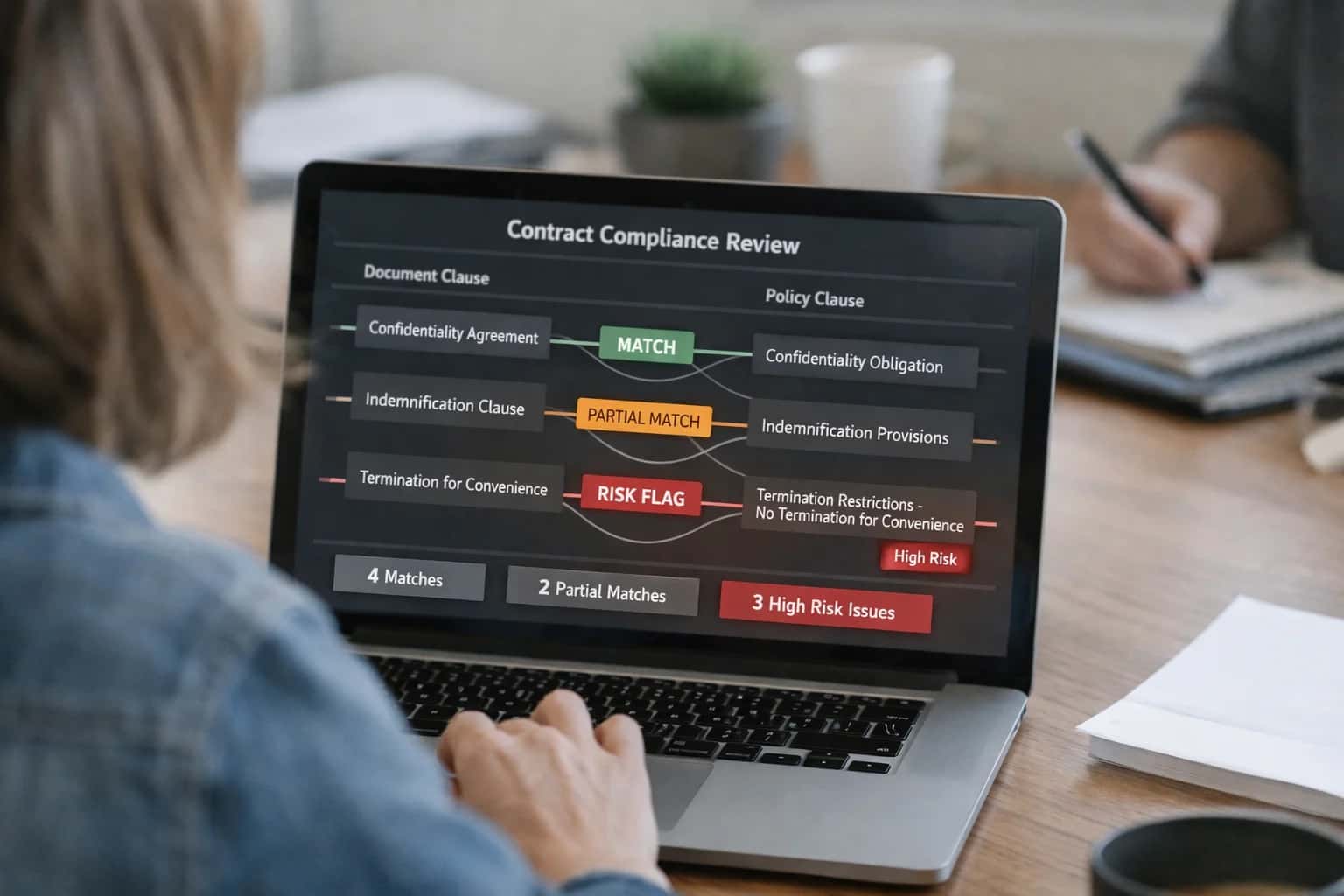
COMPLIANCE & GOVERNANCE
Why an AI Audit Trail is Non-Negotiable for CLM
A comprehensive audit log for every AI action is the foundation of trustworthy, defensible, and improvable contract intelligence.
Implementing this requires instrumenting your AI integration at key touchpoints: the CLM workflow engine (to log AI-triggered routing), the review interface (to capture user interactions with AI suggestions), and the data extraction pipeline (to record source text and extracted metadata). This log should be written to a secure, immutable datastore—often separate from the core CLM database—and linked back to the contract record via the CLM's API. This architecture supports three core operations: compliance reporting (proving AI actions followed policy), model debugging (identifying why errors occurred), and continuous training (using logged overrides to improve future model performance).
Rollout must be phased. Start by auditing AI actions in low-risk, high-volume workflows like NDA intake or metadata tagging, where the audit log provides immediate value for quality control. Then, expand to complex contract review and obligation management, where the stakes—and the need for explainability—are higher. Governance policies must define who can access the audit logs, how long they are retained, and the process for reviewing AI performance anomalies. This isn't just a technical feature; it's the control plane that allows legal, procurement, and compliance teams to confidently scale AI across the contract portfolio. For a deeper look at governing these integrations, see our guide on AI Governance for CLM Platforms.
AI INTEGRATION FOR CONTRACT AI AUDIT TRAIL
Where to Capture Audit Events in Your CLM Platform
Core Process Logging
Capture audit events where AI interacts with the contract lifecycle. In platforms like Ironclad or Agiloft, this means instrumenting the workflow engine. Log every AI-initiated action: when a contract is auto-classified, when a risk score triggers a routing rule, or when an AI redlining suggestion is presented to a user.
Key events to log include:
- Model Invocation: Timestamp, user/process ID, and the specific workflow or approval task that called the AI service.
- Input/Output Snapshots: The exact contract text or metadata sent to the model and the full JSON response received (e.g., extracted clauses, suggested edits, risk score).
- Human Interaction: Record when a user accepts, modifies, or rejects an AI suggestion, linking the human action back to the original AI output.
This creates a traceable chain from AI analysis to business outcome, essential for debugging and proving process integrity during compliance audits.
COMPLIANCE & GOVERNANCE
High-Value Use Cases for AI Audit Trails in CLM
A comprehensive AI audit trail is non-negotiable for regulated industries and responsible AI adoption. These cards outline where to log AI actions within your CLM to meet compliance demands, enable debugging, and drive model improvement.
01
Regulatory Compliance & eDiscovery
Log every AI-generated clause suggestion, redline, and risk score with timestamps, user IDs, and model versions. Creates an immutable chain of custody for audits (SOC2, ISO, GDPR) and legal eDiscovery requests, proving due diligence in automated contract processes.
Days -> Hours
Audit response time
02
Model Performance & Drift Detection
Track AI extraction accuracy (e.g., for dates, parties, obligations) against human-validated results stored in CLM metadata. Use audit logs to identify clauses or jurisdictions where model performance degrades, triggering retraining workflows. Connect to your LLMOps platform via /integrations/ai-governance-and-llmops-platforms.
Proactive
Accuracy management
03
Human-in-the-Loop Review & Override Logging
When a legal reviewer rejects an AI-suggested redline or corrects an extracted term, the audit trail captures the original AI output, the human action, and the rationale. This gold-standard data is critical for supervised fine-tuning and demonstrating human oversight.
Training Data
For model improvement
04
Prompt & Playbook Version Control
Associate each AI action with the specific version of the prompt template, RAG context, and legal playbook used. Enables precise rollback if a prompt change causes undesired outputs and ensures all contracts reviewed in a period used the same governing rules.
1 Sprint
Issue root-cause analysis
05
Bias Detection & Fairness Audits
Log contextual metadata (counterparty size, region, product type) alongside AI outputs like risk scores or fallback language suggestions. Enables periodic analysis to detect and correct for unintended bias in automated contract treatment across your portfolio.
06
Integration Chain of Custody
When AI in your CLM triggers an action in a connected system—like creating a renewal task in Salesforce or a purchase order in SAP—log the full chain: source contract, AI decision, API call, and external system response. Essential for debugging cross-platform workflows covered in /integrations/contract-lifecycle-management-platforms/clm-and-crm-integration.
End-to-End
Workflow visibility
IMPLEMENTATION PATTERNS
Example Workflows: From AI Action to Immutable Log
For compliance, debugging, and model improvement, every AI action within your CLM must be logged. These workflows illustrate how to capture the full context—inputs, outputs, human decisions, and system state—creating a defensible audit trail.
Trigger: A new vendor contract is uploaded to the CLM (e.g., Ironclad) via an API or intake form.
Context Pulled: The AI system retrieves the contract text, associated metadata (vendor name, type), and the relevant procurement playbook from the CLM's clause library.
AI Action: A fine-tuned model or RAG-powered agent analyzes the contract against the playbook. It flags non-standard liability clauses, identifies missing insurance requirements, and generates a risk score.
System Update & Log: The system:
- Creates a review task in the CLM workflow, attaching the AI's risk summary and flagged clauses.
- Logs to Audit Trail: Stores a immutable record containing:
input_hash: SHA-256 of the original contract file.playbook_version_id: The exact version of the rules used.model_id & prompt_version: Identifiers for the AI model and review instructions.raw_findings: The complete JSON output from the AI before formatting.timestampandinitiating_user/service.
Human Review Point: A procurement manager reviews the AI's findings in the CLM interface. Their decision to accept, reject, or override each finding is captured as a new log entry linked to the original AI action, creating a complete decision chain.
COMPLIANCE & GOVERNANCE
Implementation Architecture: Building the Audit Pipeline
A production-ready AI audit trail for CLM platforms requires a secure, event-driven pipeline that logs every AI action for compliance, debugging, and model improvement.
The audit pipeline is built as a sidecar service that listens to events from your CLM platform (Ironclad, Icertis, Agiloft, DocuSign CLM) via webhooks or API polling. For every AI interaction—such as a clause extraction request, a risk score generation, or a redline suggestion—the pipeline captures a structured log entry containing the model input (document hash, prompt, user context), the model output (extracted text, confidence scores, suggested edits), the model metadata (provider, version, temperature), and the human action (accept, reject, modify). This log is immediately written to a secure, immutable datastore separate from the CLM's primary database to ensure integrity.
Governance is enforced through role-based access controls (RBAC) on the audit logs themselves. Legal and compliance teams can query the pipeline via a separate interface to trace any AI-influenced contract decision back to its source, while model ops teams use the logs for continuous evaluation—tracking accuracy drift on clause extraction or measuring hallucination rates in summaries. The pipeline also supports configurable retention policies and can trigger alerts for anomalous activity, such as a high volume of human overrides on a specific AI task, indicating a potential model performance issue.
Rollout follows a phased approach, starting with logging for a single, high-value use case like NDA review before expanding to the full contract lifecycle. The architecture is designed to be CLM-agnostic, using the platform's native webhook system or REST APIs, ensuring the audit trail functions across Ironclad's workflow engine, Icertis's AI Studio, Agiloft's configurable objects, and DocuSign CLM's Agreement Cloud. This decoupled design means the AI's operational intelligence can be monitored and improved without impacting the performance or stability of the core CLM application.
IMPLEMENTATION PATTERNS
Code & Payload Examples for Key Audit Events
Logging Model Inputs & Outputs
Every AI action in the CLM workflow must be logged with a complete, immutable record. This includes the raw document text or clause sent to the model, the exact prompt used, the model's full response, and the final action taken (e.g., clause extracted, risk score assigned). Logs should be written to a dedicated audit table or external system like a data warehouse for long-term retention and analysis.
Example Payload for a Clause Extraction Event:
json{ "audit_event_id": "clx_7f83b165d2a42", "timestamp": "2024-05-15T10:30:00Z", "clm_platform": "Ironclad", "contract_id": "CT-2024-5678", "user_id": "legal_ops_01", "ai_action": "clause_extraction", "model_used": "gpt-4-turbo", "model_input": { "document_section": "Section 5. Termination", "raw_text": "This Agreement may be terminated by either party upon thirty (30) days written notice..." }, "prompt_fingerprint": "v2_clause_id_termination", "model_raw_output": "Clause Type: Termination for Convenience. Notice Period: 30 days. Initiating Party: Either Party.", "system_action": { "extracted_data": { "clause_type": "Termination", "subtype": "For Convenience", "notice_days": 30, "initiating_party": "Either" }, "target_field": "custom_metadata.termination_terms" }, "confidence_score": 0.92 }
AUDIT TRAIL MATURITY
Operational Impact: From Reactive to Proactive Governance
How AI-powered audit trails transform contract governance from a manual, reactive process to an automated, proactive system of record.
| Governance Activity | Manual / Reactive Process | AI-Augmented / Proactive Process | Key Mechanism |
|---|---|---|---|
Audit Log Creation | Manual note-taking in CLM comments or spreadsheets | Automated, immutable log of every AI action, input, and output | API-driven event capture to a secure data store |
Compliance Evidence Gathering | Days of manual document collection for audits | Pre-packaged, queryable evidence reports generated in hours | Structured audit trail linked to contract records and policy IDs |
Model Drift Detection | Quarterly manual review of AI output samples | Continuous monitoring with alerts on accuracy or behavior shifts | Automated scoring against golden sets and trend analysis |
Root Cause Analysis for Errors | Tedious manual tracing through logs and user interviews | Instant trace from final output back to source data and prompt | End-to-end lineage with timestamps, user IDs, and data versions |
Approval & Override Tracking | Email threads and manual status updates | Systematic logging of all human reviews, edits, and approvals | Workflow engine integration with RBAC and digital signatures |
Regulatory Reporting | Custom SQL queries and manual report assembly | Automated generation of standardized reports (e.g., for AI Act) | Pre-built report templates fed by the structured audit data |
Playbook Adherence Verification | Spot-check sampling of contract reviews | Continuous measurement of AI suggestions against legal playbooks | Automated clause-by-clause comparison and compliance scoring |
Training Data Improvement | Ad-hoc collection of problematic examples | Systematic identification of edge cases for model retraining | Flagged low-confidence predictions and user corrections fed to feedback loop |
CONTROLLED AI OPERATIONS FOR LEGAL AND COMPLIANCE TEAMS
Governance, Security, and Phased Rollout
A production-ready AI integration for contract audit trails is built on immutable logging, role-based access, and a phased rollout that prioritizes low-risk agreements.
Every AI action—clause extraction, risk scoring, summarization, or suggested redline—must be logged to an immutable audit table within the CLM or a linked system like a data warehouse. This log should capture the model version, prompt, raw input text snippet (with PII/PHI hashed), the generated output, the user who approved or overrode it, and a timestamp. This creates a defensible chain of custody for compliance audits (SOC2, GDPR) and is essential for debugging model performance and meeting legal professional responsibility standards.
Security is enforced at the API gateway and data layer. The AI service should never receive full, raw contract documents in a single payload. Instead, implement a chunking strategy where only relevant sections are sent for analysis, and all data in transit is encrypted. Access to the AI audit logs themselves should be governed by the CLM's existing Role-Based Access Control (RBAC), ensuring only authorized legal ops, compliance officers, or system administrators can view the full trace of AI decisions.
A phased rollout mitigates risk and builds trust. Start with a pilot on a single, low-risk contract type like NDAs or simple order forms. In this phase, the AI operates in a 'human-in-the-loop' mode where all outputs are suggestions requiring explicit reviewer approval, and the audit trail is actively monitored. After validating accuracy and workflow fit, expand to more complex agreements (MSAs, SOWs) and introduce 'auto-approve' rules for high-confidence, low-risk actions, such as populating standard metadata fields. This controlled approach allows you to tune prompts, refine your RAG retrieval from the clause library, and demonstrate clear ROI before scaling across the entire contract portfolio.
Enabling Efficiency, Speed & Accuracy
Intelligent Analysis, Decision & Execution
We build AI systems for teams that need search across company data, workflow automation across tools, or AI features inside products and internal software.
Talk to Us
Search across company data
Give teams answers from docs, tickets, runbooks, and product data with sources and permissions.
Useful when people spend too long searching or get different answers from different systems.
Enterprise searchRAGPermissions
Read more
Automate internal workflows
Use AI to route work, draft outputs, trigger actions, and keep approvals and logs in place.
Useful when repetitive work moves across multiple tools and teams.
AI agentsWorkflow automationGovernance
Read more
Add AI to products and internal tools
Build assistants, guided actions, or decision support into the software your team or customers already use.
Useful when AI needs to be part of the product, not a separate tool.
AI integrationDecision supportModel routing
Read moreIMPLEMENTATION AND GOVERNANCE
FAQ: AI Audit Trails for Contract Management
Building a comprehensive, compliant audit trail for AI actions within your Contract Lifecycle Management (CLM) platform is a foundational requirement for production use. Below are the key technical and operational questions for teams implementing this capability.
A robust audit trail must capture the full context of every AI interaction to support debugging, compliance, and model improvement. For each AI action (e.g., clause extraction, risk scoring, summarization), log:
- Trigger & Context: The API call or user action that initiated the AI task, including user ID, timestamp, and source contract ID/version.
- Input Data: The exact text chunk, document segment, or metadata sent to the model. For privacy, you may log a hashed reference or redacted version, but the raw data must be retrievable from a secure store.
- Model Details: Model name, version, provider (e.g., GPT-4, Claude 3, custom fine-tune), and parameters used (temperature, top_p).
- Prompt & Instructions: The full system prompt and any retrieved context (e.g., RAG chunks from your clause library) used for grounding.
- Raw Output: The model's complete, unaltered response.
- Post-Processing: Any parsing, validation, or transformation logic applied to the raw output before presenting it to the user or writing to the CLM.
- Final Action: The resulting CLM system update—e.g., new metadata field value, created obligation record, suggested redline edit.
- Human Interaction: Any user approval, rejection, or modification of the AI's suggestion, with the user's identity and timestamp.
- Confidence & Metrics: Model-provided confidence scores, token counts, latency, and any custom evaluation scores run post-hoc.
This log should be immutable and stored separately from the CLM's primary database, ideally in a dedicated audit service with strict access controls.

About the author
Prasad Kumkar
CEO & MD, Inference Systems
Prasad Kumkar is the CEO & MD of Inference Systems and writes about AI systems architecture, LLM infrastructure, model serving, evaluation, and production deployment. Over 5+ years, he has worked across computer vision models, L5 autonomous vehicle systems, and LLM research, with a focus on taking complex AI ideas into real-world engineering systems.
His work and writing cover AI systems, large language models, AI agents, multimodal systems, autonomous systems, inference optimization, RAG, evaluation, and production AI engineering.
LinkedIn
Limited slotsGet a Free AI Consultation
Partnered with leading AI, data, and software stack.





How We Work
Custom AI workflows for your Business
One-fit-all AI don't work for modern businesses. At Inferensys, we aim to understand your business & custom requirements; which we use to define most efficient agentic workflows, the data, and the tools for your business.
01
Review the use case
We understand the task, the users, and where AI can actually help.
Read more02
Pick the right approach
We define what needs search, automation, or product integration.
Read more03
Build the first useful version
We implement the part that proves the value first.
Read more04
Improve from there
We add the checks and visibility needed to keep it useful.
Read moreThe first call is a practical review of your use case and the right next step.
Talk to Us