AI integrates into Microsoft Teams chat through three primary surfaces: channel bots, group chat agents, and message extension workflows. This involves connecting to the Microsoft Graph API for chats and messages endpoints, and often the Teams Bot Framework for interactive experiences. The core data objects are Teams channels, group chats, individual messages, and attached files (stored in SharePoint). AI can be triggered via @mentions, specific keywords, scheduled tasks, or by monitoring new messages in designated channels for real-time intervention.

Integration
AI Integration for Microsoft Teams Chat
Build AI agents and copilots that operate within Microsoft Teams channels and group chats to answer questions, summarize threads, and retrieve information from connected systems.
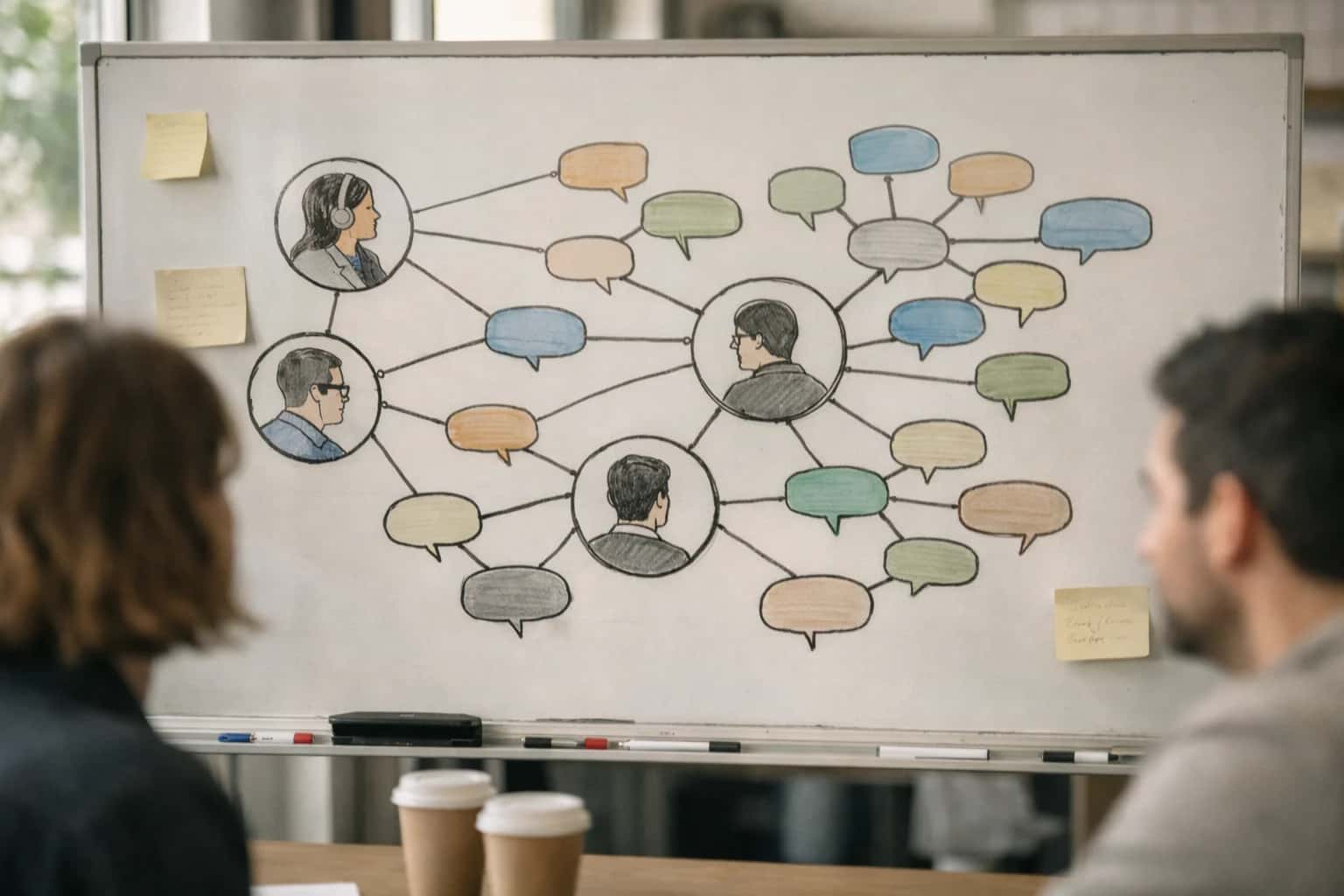
ARCHITECTURE AND IMPLEMENTATION PATTERNS
Where AI Fits into Microsoft Teams Chat
A practical guide to embedding AI agents, copilots, and automation directly into Microsoft Teams channels and group chats.
High-value implementations focus on reducing manual lookup and summarization work. For example, an AI agent can be @mentioned in a sales channel to pull the latest pipeline numbers from Salesforce and summarize them in-thread. In a support team chat, an AI copilot can monitor for escalated issues, automatically retrieve relevant knowledge base articles or past ticket resolutions from ServiceNow, and post a concise summary. For project teams, an agent can digest long conversation threads, extract decisions and action items, and update corresponding tasks in Azure DevOps or Asana, linking back to the original chat.
Rollout requires careful governance. Start with a pilot in a single team or channel, using Azure AD for RBAC to control which users can invoke or train the agent. Implement audit logging for all AI-generated messages and data retrievals to maintain a lineage of automated actions. For production, design around the Teams API rate limits and implement a queuing system (like Azure Service Bus) to handle peak chat volumes. Use a RAG (Retrieval-Augmented Generation) architecture with a vector store like Pinecone or Azure AI Search to ground responses in your internal documentation, ensuring the AI provides accurate, company-specific answers instead of generic hallucinations.
The business impact is operational speed: turning hours of manual research into seconds of automated retrieval, or converting days-long email threads into instantly searchable summaries posted back into Teams. This keeps critical context within the collaboration flow where work actually happens, reducing context-switching to other systems. For a deeper dive into orchestrating these multi-step AI workflows, see our guide on AI Agent Builder and Workflow Platforms.
ARCHITECTURE BLUEPOINT
Teams Chat Integration Surfaces and APIs
Bots for Group Chats and Channels
Bots are the primary surface for persistent AI agents in Teams. They can be added to any team, channel, or group chat, listening for @mentions or specific keywords. The Microsoft Bot Framework and Teams Toolkit provide the SDKs for building, authenticating, and deploying these interactive agents.
Key Integration Points:
- Activity Handler: Processes messages, reactions, and file uploads sent to the bot.
- Adaptive Cards: Renders interactive UI for data display and user input within the chat.
- Proactive Messaging: Allows the bot to send unscheduled notifications, such as alert summaries or daily digests, via the
ConversationReference.
Example Workflow: An AI agent is @mentioned in a sales channel with the question, "What's the latest on Acme Corp?" The bot calls its logic, retrieves the account's latest activity from Salesforce via a secure API, and posts a formatted summary back to the channel.
INTEGRATION PATTERNS
High-Value AI Use Cases for Teams Chat
Microsoft Teams Chat is a primary workflow surface for millions of users. Integrating AI directly into channels and group chats transforms reactive conversations into proactive, data-driven operations. Below are practical patterns for embedding AI agents and copilots that answer questions, automate follow-ups, and connect chat to core business systems.
01
Channel & Thread Summarization Agent
Deploy an AI agent that monitors designated Teams channels, summarizing long discussion threads at scheduled intervals or on-demand. It extracts key decisions, action items, and open questions, posting concise digests to keep distributed teams aligned. Integrates with /integrations/unified-communications-platforms/ai-powered-meeting-notes-for-microsoft-teams for a unified comms strategy.
Hours -> Minutes
Catch-up time
02
Cross-System Query Copilot
Build a secure copilot that answers natural language questions about data in connected systems (e.g., Salesforce, ServiceNow, SharePoint) directly within a Teams chat. Using RAG over approved data sources, it provides grounded answers with citations, eliminating constant tab-switching for sales, support, and ops teams.
Real-time
Data access
03
Automated Workflow Trigger from Chat
Use AI to parse chat conversations for specific intent—like a user requesting IT help, a manager approving a request, or a sales rep logging a call. The AI identifies the trigger, extracts relevant entities (user, asset, date), and automatically creates a ticket in ServiceNow, a task in Planner, or a log in CRM via webhooks, turning talk into tracked work.
Batch -> Real-time
Process initiation
04
IT Support & FAQ Triage Bot
Implement a proactive IT support bot in general or help channels. It listens for common issues ("VPN not connecting", "printer setup"), provides immediate step-by-step guidance from knowledge bases, and can escalate to a human by creating a ticket in Jira Service Management with the full conversation context attached, reducing tier-1 ticket volume.
Same day
Resolution for common issues
05
Meeting Follow-Up & Action Item Orchestrator
After a Teams meeting, an AI agent reviews the transcript and chat, identifies decisions and assigned action items, and drafts follow-up messages in the relevant project channel. It can tag owners, suggest due dates, and even update tasks in connected /integrations/project-and-portfolio-management-platforms like Asana or Azure DevOps, ensuring accountability.
1 sprint
Time to implement
06
Compliance & Sentiment Monitoring Agent
For regulated industries, deploy a monitoring agent that analyzes chat content in real-time for policy violations, sensitive data leaks, or negative sentiment spikes. It can alert compliance officers via secure channels, archive flagged messages, and provide dashboards, helping maintain governance in collaborative spaces. Complements our /integrations/ai-governance-and-llmops-platforms services.
PRACTICAL IMPLEMENTATION PATTERNS
Example AI Agent Workflows for Teams
These workflows illustrate how AI agents can be embedded into Microsoft Teams channels and chats to automate tasks, retrieve information, and support teams without switching context. Each pattern is built using the Microsoft Graph API, Bot Framework, and secure AI orchestration.
Trigger: A user tags @SummaryBot in a channel thread or the thread reaches a configurable message threshold (e.g., 50 messages).
Context/Data Pulled:
- The agent uses the Microsoft Graph API's
/teams/{id}/channels/{id}/messagesendpoint to fetch the full message history of the tagged thread, including nested replies. - It extracts user display names, timestamps, and any file attachments (links to SharePoint documents).
Model or Agent Action:
- The conversation history is sent to a summarization LLM (e.g., GPT-4) with a system prompt to:
- Identify key decisions, action items (with owners), and open questions.
- Maintain a neutral, factual tone.
- Format the output with clear headings and bullet points.
System Update or Next Step:
- The generated summary is posted as a new reply in the same thread, attributed to the bot.
- Optionally, the summary is also saved as a note in a connected project management tool (e.g., creates a task in Azure DevOps) via a webhook.
Human Review Point: For sensitive channels (e.g., Legal, Finance), the agent can be configured to post the summary as a draft in a private channel for a manager to review and approve before broadcasting.
SECURE, SCALABLE, AND GOVERNED
Implementation Architecture: Data Flow and Guardrails
A production-ready AI integration for Microsoft Teams Chat requires a clear data flow, robust security, and operational guardrails.
A typical architecture connects to the Microsoft Graph API (specifically the /teams/{id}/channels/{id}/messages and /chats/{id}/messages endpoints) via a secure, registered Azure AD application. This service principal authenticates using OAuth 2.0 client credentials and is granted the least-privilege permissions (ChannelMessage.Read.All, Chat.Read.All). The integration service, often deployed as an Azure Function or containerized app, listens for new messages via change notifications (webhooks) or polls channels on a schedule. Incoming messages, along with user context and metadata, are queued (e.g., Azure Service Bus) for asynchronous processing by the AI agent layer.
The AI agent, built on frameworks like CrewAI or AutoGen, retrieves relevant context before acting. This involves a RAG (Retrieval-Augmented Generation) pipeline: the message and conversation history are embedded and used to query a vector database (e.g., Pinecone, Weaviate) containing indexed knowledge from connected systems like SharePoint, Confluence, or your CRM. The grounded response is generated using a configured LLM (e.g., GPT-4, Claude), with the agent's toolset allowing it to fetch live data via REST APIs, create Planner tasks, or update records in Dynamics 365. All agent actions are logged with a full audit trail, including the user ID, timestamp, source message, retrieved context, and the final generated response.
Critical guardrails are enforced at multiple layers: Data Loss Prevention (DLP) filters scan outbound AI responses for sensitive information (PII, financial data) before posting back to Teams. A human-in-the-loop approval step can be configured for high-risk actions or specific channels. Role-Based Access Control (RBAC) ensures the agent only accesses data and performs actions permissible for the requesting user's role, enforced by passing the user's Azure AD token for downstream system calls. Finally, a rollout strategy typically starts with a pilot in a single, low-risk team channel, monitored for latency, accuracy, and user feedback, before a phased deployment across the organization.
MICROSOFT TEAMS CHAT INTEGRATION
Code and Payload Examples
Bot Registration and Message Payload
To build an AI agent in Teams, you first register a Bot via the Microsoft Azure Bot Service or the Teams Developer Portal. The bot receives activity payloads via HTTP POST to your configured endpoint. A typical incoming message payload includes the conversation context, user ID, and channel details.
json{ "type": "message", "id": "f:123456", "timestamp": "2024-01-15T10:00:00.000Z", "serviceUrl": "https://smba.trafficmanager.net/amer/", "channelId": "msteams", "from": { "id": "29:1abc123", "name": "John Doe", "aadObjectId": "11111111-2222-3333-4444-555555555555" }, "conversation": { "id": "a:1XYZ789", "name": "Project Alpha Discussion", "conversationType": "channel" }, "text": "@AI Assistant What were the action items from last week's standup?", "entities": [{ "type": "mention", "mentioned": { "id": "28:bot-id" }, "text": "<at>AI Assistant</at>" }] }
Your AI service processes this payload, extracts the query, retrieves context from connected systems (e.g., a vector store of past meeting summaries), and constructs a reply.
AI AGENTS FOR MICROSOFT TEAMS CHAT
Realistic Time Savings and Operational Impact
How AI agents integrated into Microsoft Teams channels and group chats reduce manual work and improve information flow. Metrics are based on typical pilot deployments for teams of 50-200 users.
| Workflow | Before AI | After AI | Implementation Notes |
|---|---|---|---|
Channel Thread Summarization | Manual reading of 50+ messages | AI-generated summary in 30 seconds | Agent posts summary at user request or scheduled intervals |
Cross-System Information Retrieval | Switch apps, run queries, copy-paste | Natural language question answered in-channel | Agent uses approved APIs (CRM, ERP, wiki) with RBAC |
Common Question Triage | Repetitive answers by team members | AI agent provides consistent first response | Human escalation path remains via @mention |
Meeting Prep Brief Generation | Manual review of past threads and docs | AI drafts briefing from channel history in 2 mins | Pulls from last 7 days of chat and linked files |
Action Item and Decision Tracking | Scrolling to find agreed items | AI extracts and logs to Planner/To Do automatically | Requires initial prompt tuning for business jargon |
New Hire Onboarding Q&A | Multiple team members interrupted for basics | AI agent answers policy and process questions 24/7 | Knowledge base seeded from HR docs and past Q&A |
Incident or Priority Alert Routing | Manual tagging and @mentioning experts | AI analyzes message urgency and routes to correct group | Integrates with ServiceNow or PagerDuty for ticket creation |
ENTERPRISE-GRADE AI DEPLOYMENT
Governance, Security, and Phased Rollout
A secure, controlled approach to integrating AI agents into Microsoft Teams chat workflows.
Deploying AI within Microsoft Teams requires careful consideration of data boundaries, user permissions, and operational control. Your implementation should authenticate via Microsoft Entra ID, respecting existing role-based access controls (RBAC) and conditional access policies. The AI agent should only access data from channels and chats where it is explicitly added as an application user, and all API calls should be logged to the Microsoft 365 unified audit log for compliance. For sensitive workflows, you can implement data filtering at the API layer to redact or exclude specific message types, attachments, or channels before processing by the AI model.
A phased rollout is critical for user adoption and risk management. Start with a pilot in a single, non-critical team channel focused on a high-value, low-risk use case like meeting recap generation or FAQ answering. Use Microsoft Teams' app permission policies and setup policies to control which users and teams can install the AI agent. Implement a human-in-the-loop approval step for any AI-generated action that modifies external systems (like creating a CRM task or updating a project board). This allows the team to validate the agent's suggestions before execution, building trust and providing immediate feedback for prompt tuning.
Govern the AI's behavior through a centralized prompt management system that enforces organizational guidelines on tone, data sourcing, and disclaimer language. For example, prompts can be configured to instruct the agent to cite its sources (e.g., "Based on the project documentation shared in the 'Q3 Planning' channel") and to defer to human experts for specific, sensitive topics. Establish a regular review cycle to audit the agent's interactions, measure its impact on reducing manual query resolution, and refine its access and capabilities based on user feedback and evolving business needs.
Enabling Efficiency, Speed & Accuracy
Intelligent Analysis, Decision & Execution
We build AI systems for teams that need search across company data, workflow automation across tools, or AI features inside products and internal software.
Talk to Us
Search across company data
Give teams answers from docs, tickets, runbooks, and product data with sources and permissions.
Useful when people spend too long searching or get different answers from different systems.
Enterprise searchRAGPermissions
Read more
Automate internal workflows
Use AI to route work, draft outputs, trigger actions, and keep approvals and logs in place.
Useful when repetitive work moves across multiple tools and teams.
AI agentsWorkflow automationGovernance
Read more
Add AI to products and internal tools
Build assistants, guided actions, or decision support into the software your team or customers already use.
Useful when AI needs to be part of the product, not a separate tool.
AI integrationDecision supportModel routing
Read moreCOMMON AI AGENT PATTERNS
Implementation Workflows
These workflows illustrate how AI agents can be integrated into Microsoft Teams chat to automate tasks, retrieve information, and support teams. Each pattern connects to your existing systems via APIs and webhooks.
An AI agent monitors a designated Teams channel (e.g., #it-support or #sales-questions) and answers employee questions by searching connected knowledge bases.
Trigger: A user @mentions the AI agent bot in a Teams channel message.
Context/Data Pulled:
- The agent extracts the user's question and conversation history.
- It performs a semantic search (via a vector database like Pinecone) over indexed internal documents (Confluence, SharePoint, policy PDFs).
- It may call a REST API to fetch real-time data (e.g., system status from a dashboard).
Agent Action: An LLM (like GPT-4) synthesizes the retrieved context into a concise, sourced answer.
System Update: The agent posts the answer as a reply in the Teams thread, citing its sources with links.
Human Review Point: If confidence is low, the agent can tag a human expert (@admin) in its reply for verification.

About the author
Prasad Kumkar
CEO & MD, Inference Systems
Prasad Kumkar is the CEO & MD of Inference Systems and writes about AI systems architecture, LLM infrastructure, model serving, evaluation, and production deployment. Over 5+ years, he has worked across computer vision models, L5 autonomous vehicle systems, and LLM research, with a focus on taking complex AI ideas into real-world engineering systems.
His work and writing cover AI systems, large language models, AI agents, multimodal systems, autonomous systems, inference optimization, RAG, evaluation, and production AI engineering.
LinkedIn
Limited slotsGet a Free AI Consultation
Partnered with leading AI, data, and software stack.





How We Work
Custom AI workflows for your Business
One-fit-all AI don't work for modern businesses. At Inferensys, we aim to understand your business & custom requirements; which we use to define most efficient agentic workflows, the data, and the tools for your business.
01
Review the use case
We understand the task, the users, and where AI can actually help.
Read more02
Pick the right approach
We define what needs search, automation, or product integration.
Read more03
Build the first useful version
We implement the part that proves the value first.
Read more04
Improve from there
We add the checks and visibility needed to keep it useful.
Read moreThe first call is a practical review of your use case and the right next step.
Talk to Us