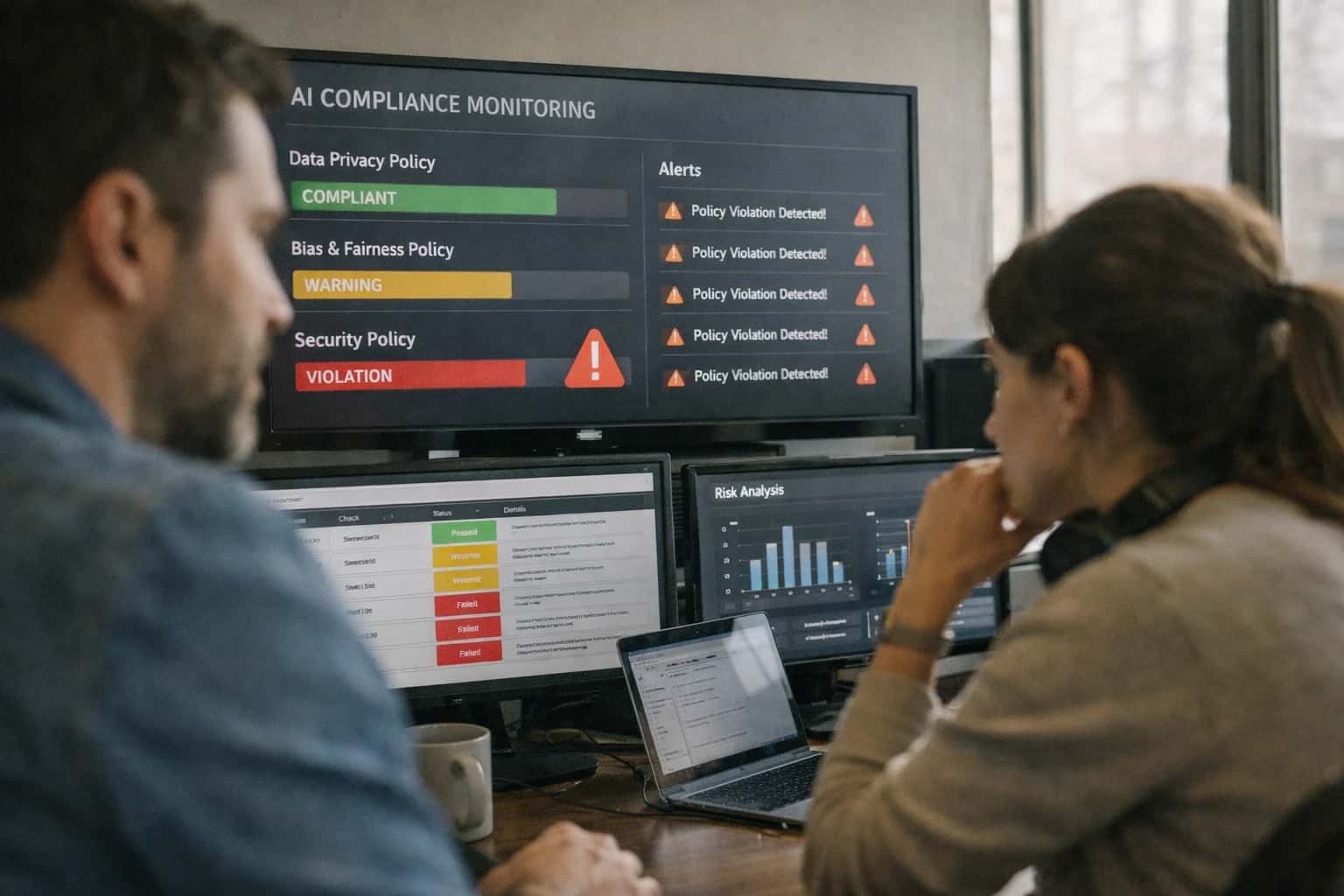
AI compliance monitoring for Zoom connects at three key data surfaces: the Zoom Meeting API for real-time or post-meeting transcripts, the Zoom Chat API for persistent team and channel messages, and the Zoom Reporting API for audit logs and user activity. The integration ingests this communication data, applies natural language processing models trained on regulatory frameworks (e.g., FINRA, HIPAA, GDPR), and flags potential violations—such as discussing unapproved financial products, sharing PHI, or making misleading claims—within a governed workflow queue.

Integration
AI Compliance Monitoring for Zoom Communications
Implement AI to automatically monitor Zoom meeting transcripts and chat for potential regulatory violations (FINRA, HIPAA, etc.), trigger real-time alerts, and automate secure archiving workflows.
ARCHITECTURE & GOVERNANCE
Where AI Fits into Zoom Compliance Workflows
A practical blueprint for integrating AI monitoring into Zoom's data streams to automate regulatory oversight.
A production implementation typically involves a middleware layer that subscribes to Zoom webhooks for new recordings and messages. Transcripts are processed through a pipeline that performs entity recognition, sentiment analysis, and keyword/phrase pattern matching against a managed library of compliance rules. High-confidence alerts are routed to a compliance officer dashboard in a system like ServiceNow or Jira, while lower-confidence signals may be queued for human review. All flagged interactions are automatically archived with tamper-evident logging to a secure repository like Box or SharePoint, preserving the chain of custody for audits.
Rollout requires careful governance: start with a pilot group and a narrow set of high-risk rules, using the Zoom Role Management API to scope monitoring. Implement strict RBAC for the alert dashboard and ensure all data processing adheres to Zoom's data residency requirements. The system should be tuned to minimize false positives, as alert fatigue can undermine the program. This is not a "set and forget" tool; it's an augmentation layer that allows compliance teams to shift from manual, sample-based reviews to automated, continuous monitoring of 100% of governed communications.
PLATFORM INTEGRATION POINTS
Key Zoom Surfaces for AI Compliance Monitoring
The Primary Data Source for Monitoring
Zoom's Cloud Recording API provides programmatic access to meeting audio, video, and generated transcripts. This is the foundational surface for AI compliance monitoring. Transcripts can be retrieved in JSON or VTT format, containing speaker-segmented text with timestamps.
For compliance workflows, you typically:
- Subscribe to webhooks (
recording.completed) to trigger analysis as soon as a regulated meeting ends. - Fetch the transcript via the API and pass it through an AI model trained to detect potential violations (e.g., insider trading keywords, improper healthcare disclosures).
- Enrich with metadata like participant list, meeting topic, and host to provide context for the alert.
- Route findings to a compliance officer dashboard or a case management system like ServiceNow for review.
This automated pipeline replaces manual sampling, enabling continuous monitoring of 100% of recorded communications.
FOR ZOOM COMMUNICATIONS
High-Value Compliance Monitoring Use Cases
Implement AI to automatically monitor Zoom meeting transcripts and chat logs for potential regulatory violations, triggering real-time alerts and automated archiving workflows to reduce compliance risk and manual review burden.
01
Real-Time Keyword & Phrase Detection
Monitor live meeting audio or chat for specific restricted terms (e.g., 'guaranteed return', 'off-label use', 'material non-public information'). AI flags potential violations in real-time, allowing a designated compliance officer to receive an alert and optionally join the call. This shifts monitoring from post-meeting batch review to live intervention.
Batch -> Real-time
Detection speed
02
Automated Post-Meeting Transcript Review
After each meeting, AI scans the full transcript against a library of compliance rules (FINRA, HIPAA, GDPR, internal policies). It generates a risk summary report highlighting flagged sections, context, and speaker attribution. Reports are automatically filed to a secure archive like a DMS or compliance platform, creating a searchable audit trail.
Hours -> Minutes
Review time per meeting
03
Contextual Sentiment & Pressure Analysis
Go beyond keyword matching. AI analyzes conversation flow to detect high-pressure sales tactics, coercion, or misleading statements—common red flags in financial services and healthcare. This identifies subtle compliance risks that simple scripts miss, providing nuanced insights for supervisor coaching and regulatory readiness.
04
Secure Archiving & Legal Hold Workflows
Integrate AI detection with retention policies. When a meeting is flagged as high-risk (e.g., discusses a pending litigation matter), AI can automatically trigger a legal hold workflow: moving the recording/transcript to a WORM storage, notifying legal via ServiceNow, and preventing deletion. This ensures chain of custody for e-discovery.
Same day
Hold enforcement
05
Role-Based Anomaly Detection
Configure AI to monitor for anomalous behavior based on participant roles. Example: A junior analyst discussing merger details with an external counterparty without a supervisor present. AI detects the role/context mismatch, alerts compliance, and can be integrated with pre-meeting approval systems to prevent future violations.
06
Regulatory Change & Policy Updates
Maintain an agile rule set. When new regulations or internal policies are published, compliance teams can update the AI's detection rules (e.g., new prohibited terms, updated disclosure requirements). The system immediately applies these to all new and, if needed, historical Zoom recordings, ensuring continuous coverage without manual re-screening.
ZOOM INTEGRATION PATTERNS
Example AI Compliance Monitoring Workflows
These workflows illustrate how AI can be integrated with Zoom's APIs and webhooks to automate compliance monitoring for regulated industries like finance and healthcare. Each pattern connects detection to a specific alerting, archiving, or review action.
Trigger: A participant sends a message in a Zoom Team Chat channel or during a meeting.
Context/Data Pulled: The chat message payload is sent via Zoom's Chatbot webhook to a secure ingestion endpoint.
Model/Agent Action: A lightweight classifier model (e.g., fine-tuned BERT) scans the message text against a configured rule set (e.g., FINRA restricted terms like "guarantee," "no risk," or HIPAA identifiers). Low-confidence matches are logged; high-confidence matches trigger an immediate alert.
System Update/Next Step: For high-confidence violations:
- An alert is posted to a designated compliance channel in Slack or Microsoft Teams via webhook.
- The original message metadata (message ID, user, timestamp) and flagged content are written to a secure audit log (e.g., Amazon S3 with object lock).
- Optionally, a real-time notification can be sent to the meeting host via in-meeting chat (using the Zoom API) if the violation occurs during a live session.
Human Review Point: All alerts are routed to a compliance dashboard (custom or integrated with a platform like ServiceNow) where an officer can review context, confirm the violation, and initiate disciplinary or corrective workflows.
BUILDING A CONTROLLED, AUDITABLE PIPELINE
Implementation Architecture: Data Flow & Guardrails
A production-ready AI compliance monitoring system for Zoom requires a secure, multi-stage architecture that ingests, analyzes, and acts on communications data while enforcing strict governance.
The core data flow begins with Zoom's Event Subscriptions API and Cloud Recording APIs. Webhooks are configured to push events for ended meetings and chat messages to a secure ingestion endpoint. For meetings, the system automatically retrieves the recording and transcript files from Zoom's cloud storage. All data is immediately encrypted in transit and at rest. The pipeline then performs speaker diarization and text normalization to prepare clean, structured input for the compliance AI models.
Analysis occurs in a dedicated, isolated processing layer. Custom NLP models—trained on regulatory frameworks like FINRA Rule 3110 or HIPAA privacy rules—scan transcripts and chat logs for potential violations, such as unsolicited financial advice, improper health information disclosure, or insider trading keywords. Each detection is logged with a confidence score, relevant text snippet, timestamp, and speaker ID. High-confidence alerts are queued for immediate review, while lower-confidence signals are batched for periodic audit. The system can be configured to trigger automated workflows, such as flagging the recording for legal hold in Zoom's native archiving system or creating a case in a GRC platform like ServiceNow.
Critical guardrails are implemented at every stage. Role-Based Access Control (RBAC) ensures only authorized compliance officers can view raw alerts and transcripts. All data access and model inferences are written to an immutable audit log. A human-in-the-loop approval step is mandatory before any automated corrective action (e.g., deleting a chat) is taken. The system is designed for explainability: every alert can be traced back to the specific rule and data that triggered it, supporting internal reviews and regulatory examinations. Rollout follows a phased approach, starting with a pilot group and non-critical communications, allowing for model tuning and workflow refinement before enterprise-wide deployment.
AI COMPLIANCE MONITORING FOR ZOOM
Code & Configuration Examples
Real-Time Alerting for Policy Violations
To detect compliance keywords in Zoom meeting transcripts as they are generated, configure a webhook endpoint that receives the meeting.ended or recording.transcript_completed event from Zoom. The payload contains the transcript text, which you can send to an AI model for classification.
This example uses a Python FastAPI endpoint to receive the webhook, call an OpenAI moderation or custom classification endpoint, and then trigger a compliance workflow in ServiceNow if a violation is detected.
pythonfrom fastapi import FastAPI, Request, HTTPException import httpx import os from pydantic import BaseModel app = FastAPI() class ZoomWebhook(BaseModel): event: str payload: dict @app.post("/webhooks/zoom-compliance") async def handle_zoom_webhook(request: Request): data = await request.json() # Validate Zoom webhook signature here if data.get('event') == 'recording.transcript_completed': transcript_text = data['payload']['object']['transcript_url'] # Fetch from URL # Call AI classification service violation_result = await classify_for_compliance(transcript_text) if violation_result.get('risk_level') == 'HIGH': # Trigger alerting workflow await create_compliance_alert( meeting_id=data['payload']['object']['id'], host_email=data['payload']['object']['host_email'], violations=violation_result['flagged_phrases'], transcript_snippet=transcript_text[:500] ) return {"status": "processed"} async def classify_for_compliance(text: str): """Call OpenAI Moderation or a fine-tuned model for FINRA/HIPAA phrases.""" async with httpx.AsyncClient() as client: response = await client.post( "https://api.openai.com/v1/moderations", headers={"Authorization": f"Bearer {os.getenv('OPENAI_API_KEY')}"}, json={"input": text} ) # Add custom logic for regulatory keyword lists return parse_moderation_result(response.json(), text)
AI-ASSISTED COMPLIANCE MONITORING
Realistic Time Savings & Operational Impact
How AI monitoring for Zoom transcripts and chat transforms manual, reactive compliance reviews into a proactive, scalable workflow.
| Workflow | Before AI | After AI | Notes |
|---|---|---|---|
Potential violation detection | Manual review of sample recordings | Continuous, automated scanning of 100% of meetings | Shifts from audit-based sampling to comprehensive coverage |
Alert generation time | Hours to days post-meeting | Near real-time (minutes) | Enables immediate corrective action before issues escalate |
Regulatory keyword search | Basic platform search for exact terms | Context-aware detection of phrases, intent, and patterns | Reduces false positives from casual conversation |
Evidence compilation | Manual extraction and clipping of recordings | Auto-generated clips with timestamps and transcripts | Cuts evidence gathering for investigations from hours to minutes |
Archival for audits | Manual filing based on flagged meetings | Automated, policy-driven archiving to secure storage | Ensures consistent, tamper-proof record-keeping |
Compliance reporting | Monthly manual report compilation | Dashboard with real-time metrics and trend analysis | Provides ongoing visibility vs. periodic snapshots |
Policy update workflow | Reactive updates after incidents | Proactive insights from detected near-misses | AI identifies emerging risk patterns to inform policy |
CONTROLLED DEPLOYMENT FOR REGULATED COMMUNICATIONS
Governance, Security & Phased Rollout
A practical approach to deploying AI compliance monitoring on Zoom with security-first architecture and incremental rollout.
A production deployment for compliance monitoring begins by connecting to Zoom's Cloud Recording API and Report APIs to access meeting transcripts and chat logs. Data flows through a secure, isolated processing pipeline where personally identifiable information (PII) and protected health information (PHI) can be redacted or tokenized before analysis. The AI models—trained to detect patterns indicative of FINRA, HIPAA, or internal policy violations—run inference on this sanitized data. All processing activities, from data ingestion to alert generation, are logged to an immutable audit trail, linking each action to a specific meeting ID, user, and timestamp for forensic review.
Rollout follows a phased, risk-managed approach. Phase 1 targets a pilot group—such as the legal or compliance team's own meetings—in monitor-only mode. Alerts are generated but trigger no external actions, allowing for model tuning and false-positive analysis. Phase 2 expands to high-risk departments (e.g., trading desks, clinical teams) and introduces human-in-the-loop workflows, where alerts are routed to a designated compliance officer's dashboard in your GRC platform for review and approval before any archival or reporting action is taken. Phase 3 enables automated, policy-driven actions, such as moving a recording to a designated legal hold repository in Box or NetDocuments, or creating a case in ServiceNow, but only for high-confidence violations and with mandatory weekly audit reviews.
Governance is maintained through a centralized policy engine that defines which detection rules are active for which user groups and meeting types. Access to the monitoring system and its alerts is controlled via role-based access control (RBAC), ensuring only authorized personnel can view or act on flagged content. Regular model performance reviews check for drift in detection accuracy, and any changes to the AI models or policies undergo a change management review. This structured approach ensures the integration enhances compliance posture without disrupting legitimate business communication on Zoom.
Enabling Efficiency, Speed & Accuracy
Intelligent Analysis, Decision & Execution
We build AI systems for teams that need search across company data, workflow automation across tools, or AI features inside products and internal software.
Talk to Us
Search across company data
Give teams answers from docs, tickets, runbooks, and product data with sources and permissions.
Useful when people spend too long searching or get different answers from different systems.
Enterprise searchRAGPermissions
Read more
Automate internal workflows
Use AI to route work, draft outputs, trigger actions, and keep approvals and logs in place.
Useful when repetitive work moves across multiple tools and teams.
AI agentsWorkflow automationGovernance
Read more
Add AI to products and internal tools
Build assistants, guided actions, or decision support into the software your team or customers already use.
Useful when AI needs to be part of the product, not a separate tool.
AI integrationDecision supportModel routing
Read moreAI COMPLIANCE MONITORING IMPLEMENTATION
Frequently Asked Questions
Practical questions for teams architecting AI-driven compliance monitoring for Zoom Communications, covering data handling, workflow design, and rollout.
Access is secured via Zoom's OAuth 2.0 APIs and webhooks, following a zero-trust data pipeline model.
Typical Architecture:
- API Integration: A secure middleware service (often deployed in your VPC) authenticates with Zoom using a service account with scoped permissions (
meeting:read:admin,chat_channel:read,chat_message:read). - Webhook Subscription: The service subscribes to Zoom's
recording.completedandchat_message.createdevents. - Data Retrieval: On trigger, the service fetches the transcript (VTT/TXT) via the
GET /meetings/{meetingId}/recordingsendpoint or the chat message via the Chat API. - Secure Processing: Data is immediately encrypted in transit and at rest. Transcripts are chunked and sent to the AI model (e.g., hosted on Azure OpenAI, Anthropic, or a private endpoint) for analysis. Chat messages are processed in near real-time.
Key Permission Scopes:
meeting:read:adminrecording:read:adminchat_channel:read(for channel monitoring)chat_message:read(for 1:1 and group chat monitoring, requires legal consent notice)
Data never persists in third-party AI training datasets unless explicitly contractually permitted.

About the author
Prasad Kumkar
CEO & MD, Inference Systems
Prasad Kumkar is the CEO & MD of Inference Systems and writes about AI systems architecture, LLM infrastructure, model serving, evaluation, and production deployment. Over 5+ years, he has worked across computer vision models, L5 autonomous vehicle systems, and LLM research, with a focus on taking complex AI ideas into real-world engineering systems.
His work and writing cover AI systems, large language models, AI agents, multimodal systems, autonomous systems, inference optimization, RAG, evaluation, and production AI engineering.
LinkedIn
Limited slotsGet a Free AI Consultation
Partnered with leading AI, data, and software stack.





How We Work
Custom AI workflows for your Business
One-fit-all AI don't work for modern businesses. At Inferensys, we aim to understand your business & custom requirements; which we use to define most efficient agentic workflows, the data, and the tools for your business.
01
Review the use case
We understand the task, the users, and where AI can actually help.
Read more02
Pick the right approach
We define what needs search, automation, or product integration.
Read more03
Build the first useful version
We implement the part that proves the value first.
Read more04
Improve from there
We add the checks and visibility needed to keep it useful.
Read moreThe first call is a practical review of your use case and the right next step.
Talk to Us