AI integration for Omnitracs focuses on three core workflow surfaces: the in-cab navigation interface, the driver log and HOS module, and the dispatch and messaging queue. By connecting to Omnitracs' APIs and telematics streams, AI can analyze real-time driver behavior, vehicle diagnostics, and external data (traffic, weather, rest stop availability) to provide proactive, context-aware guidance. This moves the system from passive recording to active co-piloting for the driver.

Integration
AI Integration for Omnitracs Routing and Navigation
A technical guide to embedding AI into Omnitracs' driver workflow and navigation systems for proactive compliance, intelligent rest planning, and specialized equipment routing.
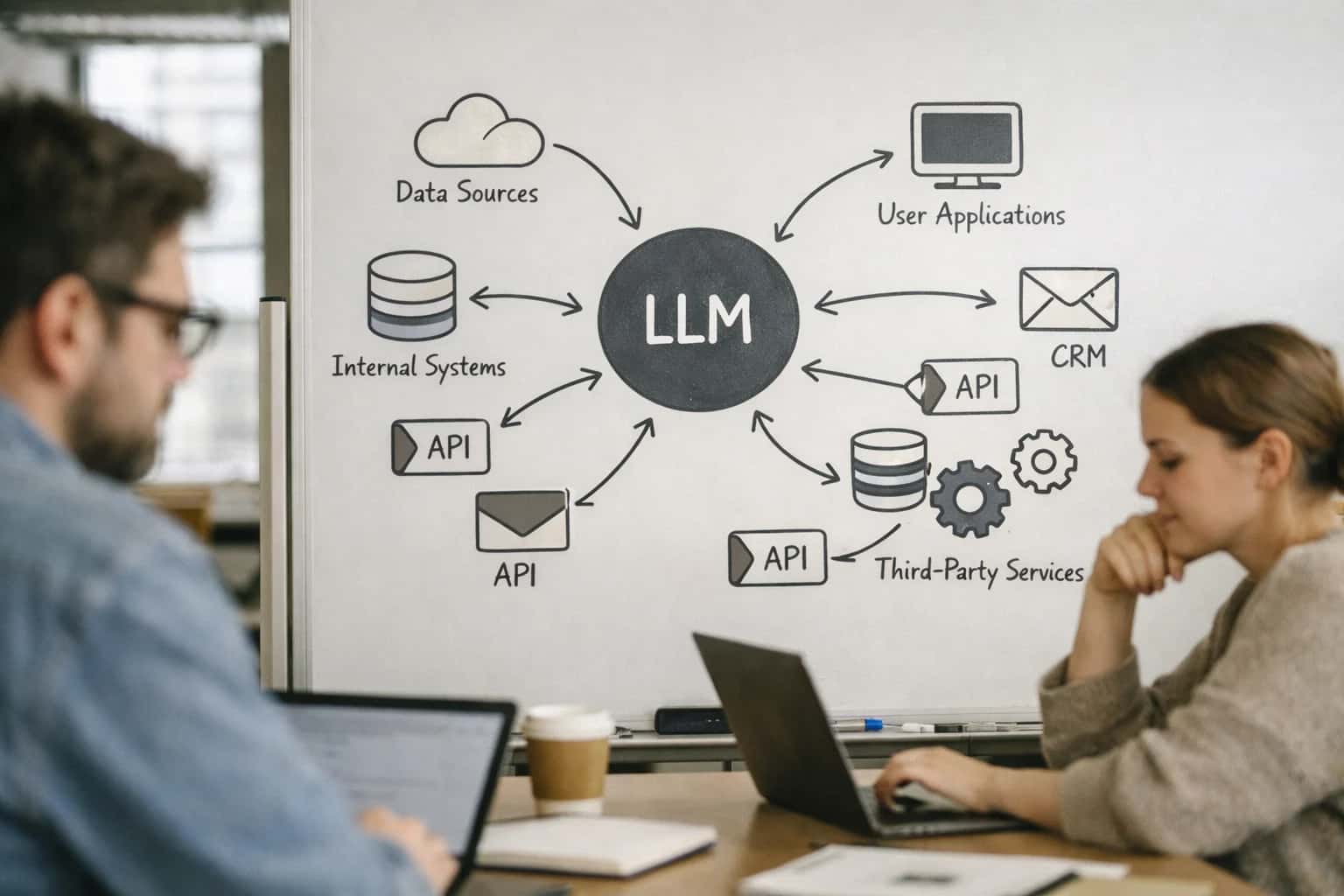
INTELLIGENT ROUTING AND COMPLIANCE AUTOMATION
Where AI Fits into Omnitracs Driver Workflows
Integrate AI directly into Omnitracs to enhance driver safety, optimize routes in real-time, and automate Hours of Service (HOS) compliance.
Key implementation patterns include:
- Proactive HOS Alerts: An AI agent monitors projected drive times against remaining HOS, analyzing traffic and weather delays to suggest optimal 30-minute break windows or mandatory off-duty periods before a violation is imminent.
- Intelligent Rest Stop Suggestions: For specialized equipment or hazmat routes, the system cross-references GPS location, parking availability APIs, and security ratings to recommend compliant and safe stops, pushing them directly to the in-cab navigation.
- Dynamic Route Re-optimization: Beyond static PC*MILER routes, an AI layer continuously evaluates active loads against real-time constraints—like bridge heights for oversize loads or temperature-controlled lane requirements—and suggests minor reroutes, which the dispatcher can approve with one click in the Omnitracs workflow.
Rollout is typically phased, starting with read-only AI recommendations displayed alongside standard Omnitracs screens to build trust. Governance is critical: all AI-suggested route changes or compliance alerts should be logged in the Omnitracs audit trail with a clear rationale, and high-stakes decisions (like major reroutes for hazmat) can be gated through a dispatcher approval workflow. This ensures safety and compliance remain paramount while augmenting driver and dispatcher decision-making. For a deeper look at AI patterns for fleet telematics, see our guide on AI Integration for Samsara for Dispatch.
AI INTEGRATION FOR ROUTING AND NAVIGATION
Key Integration Surfaces in the Omnitracs Platform
The In-Cab Experience
Integrating AI directly into the Omnitracs Driver Workflow and Navigation modules transforms the in-cab experience from reactive to proactive. This surface connects to the driver's daily tasks via the Omnitracs mobile app or in-cab telematics unit.
Key Integration Points:
- Route Deviation & Proactive Alerts: Use real-time GPS, traffic, and weather data to predict delays and suggest alternative routes before HOS violations occur. AI can analyze the driver's remaining hours against the new ETA and push a compliance alert.
- Intelligent Rest Stop Suggestions: Go beyond basic POI searches. An AI agent can analyze driver HOS status, historical parking availability at specific locations, and real-time lot occupancy (if integrated) to recommend optimal, compliant rest stops with the highest likelihood of availability.
- Specialized Equipment Routing: For hazmat or oversized loads, integrate with permitting databases and road restriction data. The AI can validate the planned route against current restrictions and automatically suggest compliant alternatives, reducing manual dispatcher checks.
ROUTING AND NAVIGATION
High-Value AI Use Cases for Omnitracs
Integrating AI directly into Omnitracs' driver workflow and navigation surfaces transforms reactive data into proactive guidance. These use cases focus on enhancing driver safety, optimizing complex routes, and automating compliance—all within the existing platform experience.
01
Proactive HOS Compliance Alerts
Integrate AI to analyze a driver's Hours of Service (HOS) log, current location, traffic, and planned route. The system predicts potential violations before they occur and surfaces intelligent, compliant rest stop suggestions directly in the Omnitracs navigation interface. This shifts compliance from a post-trip audit to an in-cab guidance system.
Reactive → Proactive
Compliance mode
02
Intelligent Rest Stop & Fuel Planning
Deploy an AI agent that continuously evaluates the route against real-time fuel prices, parking availability (via integrated APIs like Trucker Path), facility ratings, and predicted congestion at weigh stations. It recommends optimal stop sequences that balance cost, driver wellness, and schedule adherence, updating the Omnitracs route plan dynamically.
Cost & Time Optimized
Stop planning
03
Specialized Equipment & Hazmat Routing
Embed AI routing logic that goes beyond standard maps by processing constraints for oversized loads, hazmat classes, trailer height/weight, and temporary road restrictions (e.g., bridges, seasonal weight limits). The system validates the entire Omnitracs-proposed route against a dynamic rules engine, suggesting alternatives for high-risk segments and automating permit checks.
Avoid Costly Reroutes
Risk mitigation
04
Dynamic Rerouting for Weather & Congestion
Connect AI models to live weather feeds, traffic incident APIs, and road closure data. The integration analyzes these external signals against the active Omnitracs route and the fleet's performance profiles (e.g., how certain drivers/equipment handle mountain passes in snow). It automatically proposes and explains reroutes to the dispatcher and driver, considering total drive time and safety.
Real-time Adjustments
Route resilience
05
Driver Coaching & Behavior Insights
Integrate AI to synthesize data from the Omnitracs platform, ELD, and optional camera feeds. Create a driver-specific copilot that provides in-cab, context-aware feedback via the Omnitracs interface—such as gentle acceleration prompts before a known hill or reminders to reduce idle time at a specific customer site. Summaries and actionable insights are pushed to safety managers.
Personalized Guidance
Safety & efficiency
06
Automated Trip Documentation & Reporting
Use AI to automate the post-trip workflow. An agent reviews the completed route in Omnitracs, cross-references it with HOS logs, fuel receipts (via OCR), and delivery notes. It then auto-generates structured trip reports, highlights exceptions for review, and pre-populates fields for driver vehicle inspection reports (DVIRs), cutting administrative time for drivers and back-office staff.
Batch → Automated
Reporting workflow
OMNITRACS ROUTING & NAVIGATION
Example AI-Augmented Workflows
These workflows illustrate how AI agents can integrate with Omnitracs' driver-facing applications and back-office data to automate compliance, enhance routing, and improve driver support. Each flow connects to specific Omnitracs APIs and data objects to trigger intelligent actions.
Trigger: Omnitracs Roadnet or Hours of Service (HOS) module detects a driver is approaching their available drive time limit within the next 60-90 minutes.
Context Pulled:
- Real-time driver HOS status (remaining drive time, duty status)
- Current vehicle location and route from Omnitracs Navigation
- Upcoming scheduled stops and ETAs
- Nearby POI database for rest areas, truck stops, and parking (integrated or via 3rd party API)
AI Agent Action:
- Analyzes the driver's remaining legal drive window against distance to the next planned stop.
- Scores nearby rest stop options based on:
- Proximity to route
- Parking availability (predictive based on time/day)
- Amenities (fuel, food)
- Safety ratings
- Generates a personalized, proactive in-cab alert via the Omnitracs Driver App:
- "Based on your HOS, recommend taking a 30-min break at the Pilot Flying J 42 miles ahead. This will keep you compliant for your delivery in Toledo."
- Provides a one-touch option to add the stop to the active route.
System Update: If the driver accepts, the AI agent calls the Omnitracs Routing API to insert the rest stop as a waypoint, recalculating ETA and notifying dispatch automatically.
Human Review Point: Dispatchers receive a notification in the Omnitracs MCP of the planned compliance stop and can override if there is a critical service issue, triggering a re-plan.
CONNECTING AI TO DRIVER WORKFLOWS AND NAVIGATION SURFACES
Implementation Architecture & Data Flow
A practical blueprint for integrating AI agents and models directly into Omnitracs' operational surfaces to enhance driver safety, compliance, and routing intelligence.
Effective AI integration for Omnitracs focuses on three primary surfaces: the Driver Workflow application, the Navigation and Routing engine, and the back-office compliance and reporting modules. Implementation typically involves deploying lightweight AI agents that subscribe to real-time telematics streams (location, HOS status, vehicle diagnostics) and contextual data from the routing engine. These agents use this data to evaluate conditions against predefined rules and models, triggering proactive, in-cab alerts and suggestions through the Omnitracs Driver App API. For example, an agent can monitor remaining drive time against traffic patterns to suggest optimal rest stops before a violation becomes imminent, pushing a clickable location and estimated detour time directly to the driver's tablet.
The data flow is event-driven and bi-directional. 1) Ingestion: Telematics and navigation events (e.g., route deviation, hard brake, HOS clock change) are streamed via Omnitracs APIs or MQTT to a secure integration layer. 2) Orchestration: An AI workflow engine (e.g., using tools like n8n or CrewAI) evaluates the event, enriches it with external data (weather, traffic, facility hours), and runs it through specialized models for compliance prediction or route optimization. 3) Action: Approved insights are sent back as structured payloads to the Omnitracs platform to trigger in-app notifications, update trip plans, or create cases in the back-office dashboard for dispatcher review. For specialized loads like hazmat, the system can cross-reference planned routes with real-time incident reports and regulatory zones to suggest vetted alternates.
Rollout should be phased, starting with read-only monitoring and alerting to build trust, followed by driver-accepted suggestions (e.g., "Accept this rest stop?"), and eventually closed-loop adjustments for non-safety-critical parameters. Governance is critical: all AI-generated recommendations must be logged with a full audit trail—input data, model version, reasoning chain, and user action—within your existing system of record. This ensures accountability and provides data for continuous model refinement. For teams managing mixed fleets, this architecture allows you to apply different AI profiles (e.g., one for long-haul HOS focus, another for local delivery route optimization) based on the asset group or driver assignment in Omnitracs.
OMNITRACS API INTEGRATION PATTERNS
Code & Payload Examples
Proactive HOS Compliance & Rest Stop Suggestions
Integrate AI with Omnitracs' driver workflow APIs to analyze Hours of Service (HOS) logs, real-time location, and traffic data. The system predicts when a driver will need a break before a violation occurs and suggests compliant rest stops based on parking availability and amenities.
Example JSON Payload for Proactive Alert:
json{ "driver_id": "DRV-78910", "current_status": "DRIVING", "hos_remaining_minutes": 65, "predicted_violation_window": "2024-05-15T14:30:00Z", "recommended_action": "TAKE_30_MIN_BREAK", "suggested_stops": [ { "location_id": "TRUCKSTOP-456", "name": "I-80 Petro", "distance_miles": 12, "eta_minutes": 18, "parking_confidence": "HIGH", "amenities": ["fuel", "showers", "food"] } ], "delivery_impact": "ETA delay +35 minutes if stop taken" }
This payload can be sent via Omnitracs' in-cab messaging or integrated into a dispatcher dashboard for proactive intervention.
AI-ENHANCED DRIVER WORKFLOWS
Realistic Operational Impact & Time Savings
How AI integration with Omnitracs transforms manual, reactive tasks into proactive, assisted workflows for dispatchers and drivers, focusing on Hours of Service (HOS) compliance, route planning, and specialized equipment handling.
| Metric | Before AI | After AI | Notes |
|---|---|---|---|
HOS Violation Detection & Alerting | Post-trip manual log review | Proactive in-cab alerts for potential violations | AI predicts violations 1-2 hours before they occur, allowing for rest stop planning. |
Rest Stop & Fuel Planning | Driver-initiated search or dispatcher guidance | Intelligent suggestions based on HOS status, traffic, and parking availability | Reduces 15-30 minutes of daily search time per driver; optimizes for safety and cost. |
Hazmat/Specialized Route Planning | Manual review of state & local regulations per trip | Automated compliance checks and route validation during dispatch | Cuts planning time from hours to minutes for complex loads; reduces compliance risk. |
Dynamic Route Optimization | Static routes with manual adjustments for major delays | Continuous, real-time optimization for traffic, weather, and road closures | Improves on-time delivery by 5-15%; reduces fuel consumption and idle time. |
Driver-Coach Interaction for Exceptions | Radio/call for dispatcher assistance on delays | In-app AI copilot suggests next steps (e.g., reschedule appointment, find detour) | Reduces dispatcher workload by 20-30% on routine exceptions; empowers driver decision-making. |
Pre-Trip Documentation Review | Manual check of permits, bills of lading, and load specs | AI-assisted checklist with anomaly flagging (e.g., missing hazmat placard) | Cuts pre-trip admin time by 50%; ensures critical documentation is complete before departure. |
Post-Trip DVIR & Log Finalization | Manual data entry and reconciliation | Automated draft generation from telematics and AI-inferred events | Reduces driver administrative burden at end of shift, improving log accuracy and compliance. |
PRODUCTION-READY IMPLEMENTATION
Governance, Security & Phased Rollout
A structured approach to deploying AI within Omnitracs that prioritizes safety, compliance, and driver trust.
Integrating AI into driver-facing workflows requires a zero-trust data architecture. All AI interactions with the Omnitracs Driver Workflow API, navigation data, and Hours of Service (HOS) logs should be mediated through a secure gateway. This ensures driver PII, vehicle location, and compliance data are never exposed directly to external models. AI-generated suggestions—like rest stop locations or route adjustments—are treated as advisory inputs into the Omnitracs platform, where existing business rules and driver confirmations provide the final governance layer before any dispatch instruction or log update is committed.
A phased rollout is critical for adoption and risk management. Start with a read-only pilot focused on proactive HOS compliance alerts. An AI agent monitors driver logs and remaining drive time against the planned route, sending non-intrusive, predictive notifications to the dispatcher console (e.g., "Driver 1234 is projected to violate 14-hour rule in 90 minutes; consider suggesting a 30-minute break near Exit 58"). This delivers immediate value without altering core routing decisions. Phase two introduces intelligent rest stop suggestions, where the AI analyzes real-time traffic, parking availability, and driver preferences to recommend optimal break locations, presented as optional waypoints in the Omnitracs navigation interface.
For specialized equipment or hazmat routing, implement a human-in-the-loop approval workflow. The AI can propose an optimized route that accounts for bridge heights, weight restrictions, and hazmat corridors, but the proposed route must be reviewed and approved by a certified planner within the Omnitracs workflow before being dispatched. All AI interactions, prompts, and model outputs should be logged to an immutable audit trail, linked to the specific driver, vehicle, and shipment for full traceability. This governance model ensures safety and compliance remain paramount while incrementally unlocking efficiency gains through AI-assisted decision support.
Enabling Efficiency, Speed & Accuracy
Intelligent Analysis, Decision & Execution
We build AI systems for teams that need search across company data, workflow automation across tools, or AI features inside products and internal software.
Talk to Us
Search across company data
Give teams answers from docs, tickets, runbooks, and product data with sources and permissions.
Useful when people spend too long searching or get different answers from different systems.
Enterprise searchRAGPermissions
Read more
Automate internal workflows
Use AI to route work, draft outputs, trigger actions, and keep approvals and logs in place.
Useful when repetitive work moves across multiple tools and teams.
AI agentsWorkflow automationGovernance
Read more
Add AI to products and internal tools
Build assistants, guided actions, or decision support into the software your team or customers already use.
Useful when AI needs to be part of the product, not a separate tool.
AI integrationDecision supportModel routing
Read moreAI INTEGRATION FOR OMNITRACS
Frequently Asked Questions
Practical questions about embedding AI into Omnitracs routing, navigation, and driver workflow modules to enhance compliance, safety, and operational efficiency.
AI connects to Omnitracs' HOS data streams and driver logs via APIs to provide proactive compliance management.
Typical Integration Flow:
- Trigger: A driver's log approaches a HOS limit (e.g., 7 hours of driving).
- Context Pulled: The AI agent queries the Omnitracs API for the driver's current location, planned route, and nearby Points of Interest (POI) database.
- Agent Action: An LLM analyzes the context and generates a personalized, compliant alert. Example: "John, you have 45 minutes of drive time remaining. The next compliant rest stop with parking and amenities is the Pilot at Exit 142, 18 miles ahead. Suggested arrival: 4:15 PM."
- System Update: This alert is pushed back into the Omnitracs Driver App via a secure webhook, appearing as a high-priority in-cab notification.
- Human Review: Dispatchers see a dashboard of all proactive alerts in the Omnitracs MCP (Mobile Communication Platform) and can intervene if the suggested stop is unsuitable.
The key is moving from reactive violation alerts to predictive, guidance-oriented compliance that helps drivers plan ahead.

About the author
Prasad Kumkar
CEO & MD, Inference Systems
Prasad Kumkar is the CEO & MD of Inference Systems and writes about AI systems architecture, LLM infrastructure, model serving, evaluation, and production deployment. Over 5+ years, he has worked across computer vision models, L5 autonomous vehicle systems, and LLM research, with a focus on taking complex AI ideas into real-world engineering systems.
His work and writing cover AI systems, large language models, AI agents, multimodal systems, autonomous systems, inference optimization, RAG, evaluation, and production AI engineering.
LinkedIn
Limited slotsGet a Free AI Consultation
Partnered with leading AI, data, and software stack.





How We Work
Custom AI workflows for your Business
One-fit-all AI don't work for modern businesses. At Inferensys, we aim to understand your business & custom requirements; which we use to define most efficient agentic workflows, the data, and the tools for your business.
01
Review the use case
We understand the task, the users, and where AI can actually help.
Read more02
Pick the right approach
We define what needs search, automation, or product integration.
Read more03
Build the first useful version
We implement the part that proves the value first.
Read more04
Improve from there
We add the checks and visibility needed to keep it useful.
Read moreThe first call is a practical review of your use case and the right next step.
Talk to Us