Modern Translation Management Systems (TMS) like Smartling, Phrase, Lokalise, and Crowdin are built around key data objects: translation jobs, strings/keys, translation memories (TM), glossaries, and workflow stages. LLMs integrate by plugging into the APIs that manage these objects. The primary integration points are: 1) Ingestion & Analysis, where an AI agent reviews incoming source files to predict effort, tag content type, and suggest routing; 2) Translation Suggestion, where an LLM provides context-aware alternatives alongside traditional machine translation, grounded in your TM and glossary via Retrieval-Augmented Generation (RAG); and 3) Quality Assurance, where custom models perform automated checks for brand voice, regulatory compliance, and contextual accuracy that go beyond simple placeholder validation.

Integration
AI Integration for Translation Management with LLMs
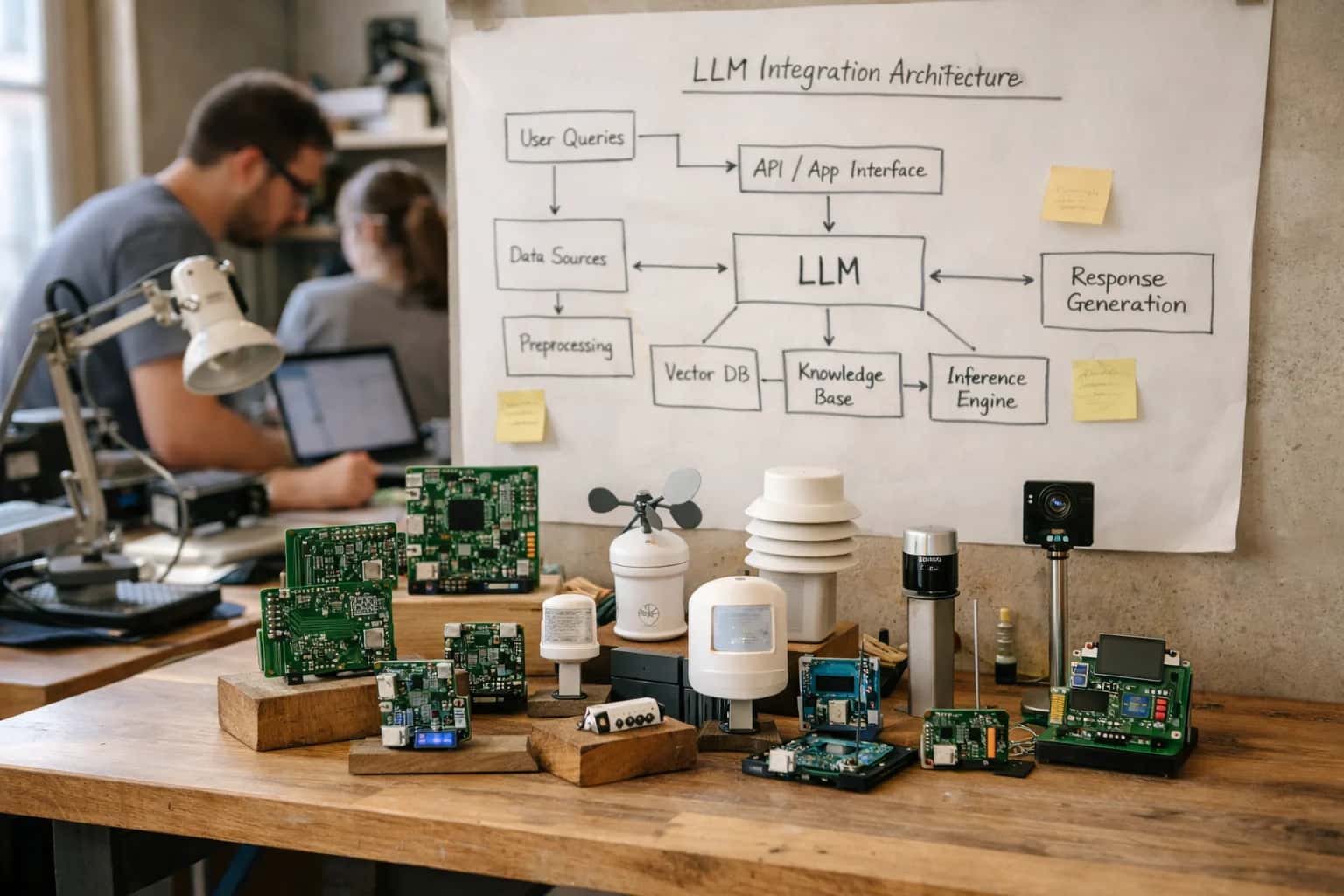
Where LLMs Fit into the Translation Management Stack
LLMs are not a replacement for your TMS; they are a new layer of intelligence that connects to its core data and workflow APIs.
Implementation requires orchestrating calls between your TMS's webhooks/API, your chosen LLM provider (e.g., OpenAI, Anthropic), and often a vector database for semantic search over your TM and style guides. A typical pattern: a new string enters a pending state in your TMS, triggering a webhook. Your integration service fetches the string and its context (surrounding keys, file path, project metadata), queries the vector store for semantically similar past translations, and constructs a prompt for the LLM. The LLM's suggestion is posted back to the TMS as a pre-translation or a comment for the linguist. Governance is managed through approval workflows in the TMS itself, ensuring human review for high-risk segments before they are approved.
Rollout should be phased. Start with a pilot project—often internal-facing content or low-risk marketing copy—where you can measure the LLM's suggestion acceptance rate and time-to-completion against a control group. Use your TMS's built-in reporting and custom webhook audit logs to track key metrics: cost per segment, post-editing effort (measured by edits made to AI suggestions), and quality scores. This data-driven approach allows you to refine prompts, adjust RAG retrieval parameters, and define clear policies for which content types and workflow stages benefit most from AI augmentation, turning a generic capability into a tailored acceleration layer for your specific localization pipeline.
Key Integration Surfaces Across TMS Platforms
Augmenting Core Linguistic Assets
Integrating AI with a TMS's translation memory (TM) and terminology modules is a foundational use case. The goal is to move beyond simple fuzzy matching to semantic retrieval. By connecting a vector database to the TMS API, you can enable translators to search the TM using natural language descriptions, not just source text. For terminology, AI can automate the extraction and suggestion of new terms from source content, product documentation, or updated style guides, pushing them into the TMS glossary via its API for human approval.
A practical implementation involves a scheduled job that:
- Queries the TMS for new source content batches.
- Uses an NLP model to extract candidate terms and entities.
- Compares them against the existing glossary via the TMS Terminology API.
- Creates new term tickets or suggests matches for existing ones, significantly reducing manual glossary maintenance.
High-Value AI Use Cases for Translation Management
Integrating LLMs into platforms like Smartling, Phrase, Lokalise, and Crowdin moves beyond basic machine translation. These patterns show where AI can automate workflows, enhance quality, and provide decision support for localization teams.
AI-Powered Translation Memory Enrichment
Use LLMs to analyze and clean up legacy translation memory (TM), deduplicate entries, and suggest higher-quality alternative translations for fuzzy matches. This improves match rates and translator efficiency by providing better starting points, directly within the TMS editor via API.
Context-Aware Translator Copilot
Embed an AI assistant in the translator's interface that retrieves relevant context from connected systems (Figma, Jira, product docs) using RAG. It answers queries about ambiguous strings, explains product features, and ensures translations fit the visual and functional UI layout.
Automated Style & Compliance QA
Deploy custom NLP models as post-translation QA steps via TMS webhooks. Beyond basic checks, AI validates brand voice consistency, detects regulatory phrasing risks (e.g., for healthcare or finance), and flags potential cultural insensitivity before human review.
Predictive Project Scoping & Routing
Analyze incoming source content (via TMS file ingestion API) with AI to predict translation complexity, cost, and timeline. Automatically route strings to appropriate vendors, machine translation engines, or internal teams based on content type, urgency, and required quality tier.
Dynamic Terminology Management
Automate the end-to-end terminology lifecycle. AI extracts candidate terms from source docs, suggests definitions, and pushes approved terms to the TMS glossary. It then monitors translations in real-time to enforce usage and flag deviations, reducing manual glossary maintenance.
Intelligent String Prioritization Engine
For agile product teams, integrate AI with the TMS and code repository to analyze which new or modified strings are user-facing and critical. Automatically prioritize their translation in the TMS queue based on release schedules, user traffic data, and A/B test participation.
Example AI-Augmented Localization Workflows
These concrete workflows illustrate how to wire LLMs and AI agents into your translation management platform's data model and automation layer. Each pattern is designed to be triggered by platform events, act on specific objects, and update system state, creating measurable efficiency gains for translators, reviewers, and project managers.
Trigger: A new translatable string is created in a project (via API, file upload, or UI).
Context Pulled: The AI agent retrieves:
- The source string and key ID.
- Project metadata (product area, target audience).
- Related strings from the same component or file.
- Recent commits or Jira tickets linked to the project (via integrated systems).
Agent Action: A small, focused LLM call analyzes the retrieved context to generate a context note. This is not a translation, but an explanation for human translators:
"This button appears in the new billing dashboard for admin users. 'Proceed' refers to advancing to the payment confirmation screen. Consistent with button labels in Account Settings."
System Update: The generated context note is automatically appended to the string's internal notes or custom fields via the TMS API (e.g., Smartling's stringDetails endpoint).
Human Review Point: The translator sees this note directly in their translation interface (Smartling Workbench, Phrase Editor), reducing back-and-forth queries by ~40%.
Implementation Architecture: Data Flow, APIs, and Guardrails
A secure, governed architecture for connecting LLMs to Smartling, Phrase, Lokalise, or Crowdin without disrupting existing localization pipelines.
A production integration flows through three layers: Ingestion & Context, AI Orchestration, and Review & Sync. The Ingestion layer listens to TMS webhooks (e.g., job.created, string.added) and uses the platform's REST API to fetch the source string, its full context (screenshot URLs, file metadata, key descriptions), and relevant Translation Memory (TM) and Terminology Base (TB) entries. This context is packaged into a structured payload for the AI. The Orchestration layer routes this payload—based on content type, project, and cost rules—to the appropriate model (e.g., GPT-4 for marketing copy, a fine-tuned model for technical UI). Crucially, it implements a RAG (Retrieval-Augmented Generation) pattern, querying a vector database of approved style guides, brand assets, and past high-quality translations to ground the LLM's output, ensuring consistency.
The core technical integration uses the TMS's QA API or translation suggestion API to post the AI's output back as a suggested translation or a pre-translation. For example, with Smartling, you would use the /jobs-api/v2/projects/{projectId}/jobs/{jobId}/strings endpoint to add translations; with Lokalise, the /projects/{projectId}/keys/{keyId}/comments or /translations endpoints. Guardrails are enforced at multiple points: pre-flight checks (e.g., don't AI-translate regulated legal copy), real-time moderation (filtering inappropriate outputs), and post-generation validation (running the suggestion through the TMS's built-in QA checks for placeholders, tags, and term compliance). All actions are logged with a full audit trail, linking the AI suggestion to the source string, model version, prompt used, and the human reviewer who accepted or edited it.
Rollout follows a phased, human-in-the-loop (HITL) model. Start with a pilot project, using AI to pre-fill translations for low-risk, high-volume content (like internal UI buttons), while routing high-stakes content (marketing slogans, legal disclaimers) directly to human translators. Implement confidence scoring from the AI model to auto-route low-confidence suggestions for mandatory human review. Governance is managed through a centralized prompt registry and model performance dashboard, tracking key metrics like translator acceptance rate, post-edit distance, and cost-per-word to continuously tune the system. This architecture turns the TMS into an intelligent orchestration hub, where AI handles the repetitive bulk, and human expertise focuses on nuance, quality, and brand voice.
Code and Payload Examples
Fetching AI Suggestions via TMS API
This pattern shows how to call an external LLM API (like OpenAI) from within a TMS webhook handler to generate translation suggestions for a specific segment. The TMS provides the source string and context, and the integration returns a ranked list of AI-generated translations.
pythonimport requests import json from typing import List, Dict def get_ai_translation_suggestions( source_text: str, target_language: str, context: Dict[str, str], # e.g., {'key_name': 'button_submit', 'project': 'mobile_app'} glossary_terms: List[str], llm_api_key: str ) -> List[Dict]: """ Calls an LLM API to generate translation suggestions. Returns a list of suggestions with confidence scores. """ prompt = f""" Translate the following text to {target_language}. Source: {source_text} Context: Key '{context.get('key_name')}' in project '{context.get('project')}'. Use these mandatory terms: {', '.join(glossary_terms)}. Provide 3 translation variants, ranked by suitability. """ headers = { "Authorization": f"Bearer {llm_api_key}", "Content-Type": "application/json" } payload = { "model": "gpt-4", "messages": [{"role": "user", "content": prompt}], "temperature": 0.3 } response = requests.post( "https://api.openai.com/v1/chat/completions", headers=headers, json=payload ) response.raise_for_status() ai_output = response.json() # Parse the LLM response into structured suggestions suggestions = parse_llm_suggestions(ai_output) return suggestions
This function would be triggered by a TMS webhook (e.g., when a new string enters the translation state) and its results posted back to the TMS job via the platform's API.
Realistic Time Savings and Operational Impact
How integrating LLMs into translation management platforms accelerates key stages of the localization lifecycle, reduces manual overhead, and improves output consistency.
| Workflow Stage | Before AI Integration | After AI Integration | Operational Impact |
|---|---|---|---|
Initial Translation Draft | Primary reliance on generic MT or manual translation from scratch | LLM-powered draft with in-context terminology and style priming | Reduces translator cognitive load; first-pass quality improves, cutting initial edit time by 30-50% |
Terminology Validation & Consistency | Manual glossary lookups and cross-referencing across files | Real-time AI term suggestion and flagging of potential inconsistencies | Enforces brand voice; reduces post-hoc consistency review cycles from days to hours |
Quality Assurance (QA) Pre-Review | Basic automated checks for placeholders, tags, and length | AI-powered checks for brand voice, regulatory compliance, and contextual accuracy | Catches nuanced errors earlier; shifts human review from basic checks to high-value stylistic and intent review |
Project Setup & Scoping | Manual analysis of source files to estimate effort and assign resources | AI analysis of content complexity, domain, and repetition for automated scoping | Turns a 2-4 hour manual task into a 15-minute review; enables data-driven resource planning |
Translation Memory (TM) Maintenance | Periodic manual cleanup of duplicate or low-quality entries | AI-assisted TM deduplication, clustering, and quality scoring | Improves TM leverage rate; maintains a cleaner, more relevant knowledge base for future projects |
Stakeholder Reporting & Insights | Manual compilation of project metrics into static dashboards | AI-generated narrative reports with anomaly detection and prescriptive recommendations | Transforms data into actionable insights; delivers stakeholder updates in minutes instead of hours |
Urgent/Rush String Handling | Manual triage and assignment, disrupting planned workflows | AI-powered prioritization and auto-routing of high-urgency content | Minimizes workflow disruption; ensures critical market launches stay on schedule |
Governance, Security, and Phased Rollout
A structured approach to integrating AI into translation management platforms that prioritizes security, quality, and operational control.
Effective AI integration for platforms like Smartling, Phrase, Lokalise, and Crowdin requires a governance layer that sits between the LLM APIs and the TMS. This typically involves a middleware service that handles secure API key management, content sanitization, and audit logging before any string or file is sent for AI processing. For example, when a translator requests an AI suggestion in the Phrase editor, the request should be routed through a controlled proxy that enforces data privacy policies—stripping PII from source content, checking against a blocklist of sensitive project IDs, and logging the interaction for compliance. This architecture ensures the TMS remains the system of record, while the AI layer operates as a governed, auditable service.
Rollout should follow a phased, content-risk-based approach. Start with low-risk, high-volume content such as UI button labels or internal knowledge base articles. Implement a human-in-the-loop (HITL) approval workflow where all AI suggestions are presented as drafts requiring reviewer sign-off in the TMS. Use the platform's native webhook and automation rules (like Smartling's Workflows or Lokalise's Automation) to route AI-processed strings to a dedicated review queue. As confidence grows, expand to more complex content like marketing copy, but introduce quality gates—such as automated checks against the terminology base in Phrase or a post-AI step that runs custom Lokalise QA checks for brand voice compliance.
A critical final phase is continuous evaluation and cost governance. Build a dashboard that correlates TMS project metrics (like edit distance and reviewer feedback) with AI usage and cost data from your model providers. This allows you to identify which content types or languages yield the best ROI from AI assistance and where human translation remains essential. Establish clear rollback protocols, ensuring you can disable AI for a specific project, language, or user via configuration changes in your middleware, without disrupting the core TMS operations. This controlled, measurable approach de-risks adoption and builds the operational proof needed to scale AI across the global localization function.
Enabling Efficiency, Speed & Accuracy
Intelligent Analysis, Decision & Execution
We build AI systems for teams that need search across company data, workflow automation across tools, or AI features inside products and internal software.
Talk to Us
Search across company data
Give teams answers from docs, tickets, runbooks, and product data with sources and permissions.
Useful when people spend too long searching or get different answers from different systems.

Automate internal workflows
Use AI to route work, draft outputs, trigger actions, and keep approvals and logs in place.
Useful when repetitive work moves across multiple tools and teams.

Add AI to products and internal tools
Build assistants, guided actions, or decision support into the software your team or customers already use.
Useful when AI needs to be part of the product, not a separate tool.
Frequently Asked Questions (Technical & Commercial)
Practical answers to common technical and business questions about integrating Large Language Models into platforms like Smartling, Phrase, Lokalise, and Crowdin.
Secure integration requires a proxy layer between your TMS and the LLM provider. The standard pattern is:
- Webhook Reception: Configure your TMS (e.g., Smartling, Phrase) to send a secure webhook to your internal endpoint when a translation job is created or a string enters a specific workflow stage.
- Internal Orchestrator: Your secure service receives the payload, which includes the string ID, source text, and project metadata. It performs necessary data masking (e.g., redacting PII using internal models) and enriches the request with context from your vector database.
- Context-Aware Prompting: The orchestrator builds a prompt using:
- The source string
- Retrieved context (approved terminology, past translations, style guide snippets)
- Specific instructions for the model (e.g., "Translate for a UK audience, tone: professional")
- Secure API Call: The orchestrator calls the LLM provider (OpenAI, Anthropic, etc.) using a service account, with all traffic over TLS. API keys are never exposed in the TMS.
- Post-Processing & Delivery: The LLM's response is parsed, validated, and posted back to the TMS via its API as a translation suggestion or placed in a custom field for reviewer approval.
Governance Note: Maintain an audit log in your orchestrator of all strings sent to the LLM, the prompt used, and the response received for compliance and model evaluation.

About the author
Prasad Kumkar
CEO & MD, Inference Systems
Prasad Kumkar is the CEO & MD of Inference Systems and writes about AI systems architecture, LLM infrastructure, model serving, evaluation, and production deployment. Over 5+ years, he has worked across computer vision models, L5 autonomous vehicle systems, and LLM research, with a focus on taking complex AI ideas into real-world engineering systems.
His work and writing cover AI systems, large language models, AI agents, multimodal systems, autonomous systems, inference optimization, RAG, evaluation, and production AI engineering.
Partnered with leading AI, data, and software stack.





How We Work
Custom AI workflows for your Business
One-fit-all AI don't work for modern businesses. At Inferensys, we aim to understand your business & custom requirements; which we use to define most efficient agentic workflows, the data, and the tools for your business.
01
Review the use case
We understand the task, the users, and where AI can actually help.
Read more02
Pick the right approach
We define what needs search, automation, or product integration.
Read more03
Build the first useful version
We implement the part that proves the value first.
Read more04
Improve from there
We add the checks and visibility needed to keep it useful.
Read moreThe first call is a practical review of your use case and the right next step.
Talk to Us