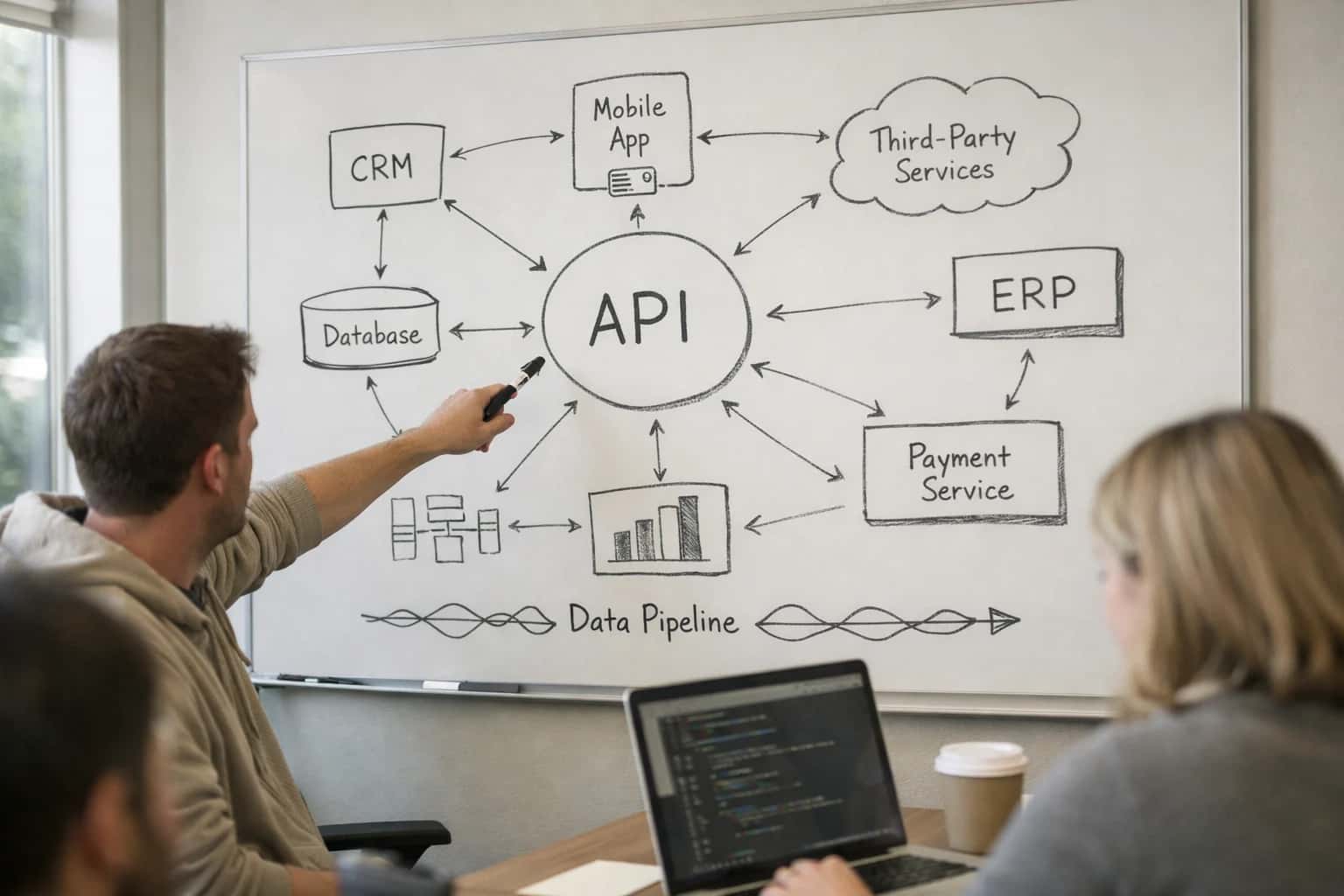
In a global enterprise, AI doesn't replace your Translation Management System (TMS) like Smartling or Phrase—it augments its data model and automates the workflows around it. The integration points are specific: translation memory APIs for retrieval-augmented generation (RAG), webhook endpoints for triggering AI QA or pre-processing jobs, and connectors to source systems (CMS, code repos, PIM) where AI can triage and prioritize content for translation. The goal is to inject intelligence at the seams: using AI to classify incoming content by domain (marketing vs. legal), predict required languages based on market rollout plans, and auto-assign jobs to the optimal vendor or MT engine based on historical quality scores.

Integration
AI Integration for Localization in Global Companies
A practical playbook for enterprise localization leaders and technical teams to implement AI across their translation management stack, addressing scale, regional variance, and integration with legacy systems.
ARCHITECTURE FOR SCALE
Where AI Fits in the Global Localization Stack
A practical blueprint for integrating AI into enterprise localization, connecting LLMs to your TMS, content systems, and operational workflows.
Implementation follows a hub-and-spoke pattern. Your TMS remains the system of record for approved translations, terminology, and project state. An orchestration layer—often a lightweight service using tools like n8n or a custom Python service—sits between source systems and the TMS. This layer uses AI to perform tasks like extracting translatable text from complex design files (Figma, PDFs), validating placeholders and variables before string ingestion, and generating context summaries from linked Jira tickets or product documentation to aid translators. Post-translation, the same layer can call custom LLMs via vector databases (Pinecone, Weaviate) to run brand-voice compliance checks that go beyond the TMS's built-in QA.
Rollout requires governance from day one. Start with a pilot workflow, such as using an AI agent to auto-translate and post-edit low-risk UI strings for a non-critical language, with a mandatory human-in-the-loop review step logged in the TMS audit trail. Implement cost tracking at the model-call level to compare AI-assisted throughput against traditional vendor costs. For enterprises, a centralized AI model registry and prompt library ensures consistency across business units, while the TMS's RBAC and project structure enforce which teams can use AI for which content types. The final architecture reduces manual triage, cuts time-to-market for tier-2 markets from weeks to days, and lets linguists focus on high-value creative transcreation instead of repetitive tasks.
AI INTEGRATION FOR LOCALIZATION IN GLOBAL COMPANIES
Key Integration Surfaces in Your TMS and Ecosystem
Connect AI to the Translation Engine
Integrate AI models directly with your TMS's core translation and project management APIs. This is the primary surface for injecting intelligence into the localization pipeline.
Key Integration Points:
- Translation Job API: Automate project creation, file ingestion, and job routing based on AI analysis of content type, complexity, and target market priority.
- Translation Memory (TM) API: Augment traditional fuzzy matches by using a RAG system. Query a vector database of past translations and brand guidelines to provide richer context to LLMs or human translators.
- Webhook Listeners: Set up intelligent agents triggered by TMS events (e.g.,
job.completed,string.added). Use these to kick off automated QA, post-process translations, or notify stakeholders.
Example Workflow: An AI agent listens for file.uploaded webhooks from Smartling, analyzes the content's domain (e.g., legal vs. marketing), and automatically assigns it to the appropriate vendor workflow with specific instructions.
ENTERPRISE INTEGRATION PATTERNS
High-Value AI Use Cases for Global Localization
Practical AI integration patterns for global companies to scale localization, reduce time-to-market, and maintain brand consistency across languages. These workflows connect LLMs and automation to your existing Translation Management Platform (TMS) and content systems.
01
AI-Powered Translation Memory Enrichment
Use LLMs to analyze source content and suggest high-confidence TM matches beyond exact string matches. Integrates with TMS APIs (Smartling, Phrase) to pre-populate translation jobs with context-aware suggestions, reducing translator search time and improving consistency across large projects.
Hours -> Minutes
TM search & prep
02
Automated Terminology Governance
Deploy AI agents to monitor TMS projects for term compliance against approved glossaries. Automatically flags deviations in real-time via webhook, suggests corrections, and updates terminology databases (in Phrase, Lokalise) based on emerging product language from source documentation.
Batch -> Real-time
Compliance checks
03
Context-Aware Quality Assurance Gates
Integrate custom NLP models as additional QA steps in TMS workflows. Beyond basic checks, AI analyzes translations for brand voice, regulatory phrasing, and cultural appropriateness by retrieving context from connected design files (Figma) or product specs. Triggers escalation via Slack or ServiceNow for human review.
1 sprint
Risk reduction lead time
04
Predictive Localization Resource Planning
Build an AI analytics layer on top of TMS data (Smartling, Crowdin) to forecast translation volume and complexity. Uses historical project data, product roadmap inputs, and string analysis to predict required translator capacity, budget, and potential bottlenecks for upcoming releases, enabling proactive planning.
Same day
Capacity visibility
05
Dynamic Content Routing & Triage
Implement an AI orchestration layer that classifies incoming content strings and routes them to appropriate translation workflows. Based on content type (UI, legal, marketing), target market, and urgency, it automatically creates TMS jobs, selects vendor tiers (premium vs. MT+PE), and sets priority—integrating with CMS and code repository webhooks.
Batch -> Real-time
Job creation
06
Translator Copilot with RAG
Embed an AI assistant within the TMS editor interface (via plugin or sidebar) that provides real-time, grounded suggestions. Uses Retrieval-Augmented Generation (RAG) against a vector store of approved style guides, past translations, and product documentation to answer translator context questions without leaving the workflow.
Hours -> Minutes
Context retrieval
IMPLEMENTATION PATTERNS
Example AI-Augmented Localization Workflows
These concrete workflows illustrate how AI agents and automations connect to your Translation Management Platform (TMP) to accelerate operations, improve quality, and reduce manual overhead. Each pattern is designed to be triggered by platform events and execute within your existing governance.
Trigger: A new commit is pushed to a monitored repository branch or a content update is published in the CMS.
Workflow:
- An AI agent monitors the source system (e.g., GitHub, Contentful) via webhook.
- The agent uses NLP to analyze the new/changed content, classifying strings by:
- Content Type: UI, marketing, legal, technical documentation.
- Priority: Based on project tags (e.g., 'launch-critical', 'internal').
- Complexity: Simple (reusable), medium (standard), high (requires transcreation).
- The agent calls the TMP API (e.g., Smartling, Phrase) to:
- Create a new project or add files to an existing one.
- Apply appropriate workflow templates (e.g., 'Marketing Launch', 'Bug Fix').
- Auto-assign strings to linguists or vendor accounts based on the classification.
- Enrich strings with context from linked design files (Figma) or Jira tickets.
Human Review Point: Project managers receive a summary of the auto-created project and can adjust assignments or priority before work begins.
AI LAYER FOR GLOBAL LOCALIZATION
Typical Implementation Architecture
A practical blueprint for integrating AI across your translation management stack without disrupting existing TMS workflows.
A production-ready AI integration for global localization typically inserts an intelligent orchestration layer between your content sources (CMS, code repos, PIM) and your Translation Management System (TMS) like Smartling or Phrase. This layer uses AI to perform pre-processing—classifying content by domain (marketing vs. legal), complexity, and urgency—before routing strings to the appropriate workflow in your TMS. For example, high-volume, low-risk UI strings might be auto-translated via a configured LLM and sent directly to a "light review" queue in the TMS, while high-stakes marketing copy is routed to a human translator with an AI-generated context pack that includes brand guidelines and past campaign materials.
The core architecture involves event-driven webhooks from your TMS (e.g., translation.job.created) triggering AI agents. These agents can: - Enrich translation jobs by fetching related product documentation or design files from connected systems. - Perform predictive quality analysis on source content to flag ambiguous terms before translation begins. - Manage a RAG (Retrieval-Augmented Generation) system where a vector database stores your approved terminology, style guides, and past translations, grounding all AI-generated suggestions in your brand's actual voice. The AI layer's outputs are injected back into the TMS via its API, appearing as custom metadata, pre-filled translator notes, or automated QA check results.
Rollout is phased, starting with a single content stream (e.g., help center articles) and a single language pair. Governance is critical: all AI-suggested translations should be logged with model version, prompt, and context used, creating an audit trail for compliance. A human-in-the-loop review step is maintained for all final approvals, with the AI's role being to reduce manual triage, provide superior context, and handle repetitive tasks—shifting your localization team's focus from volume management to strategic quality and cultural adaptation.
AI INTEGRATION FOR LOCALIZATION
Code and Payload Patterns
Orchestrating Translation Jobs
Integrating AI with a TMS like Smartling or Phrase begins with orchestrating its core APIs. The pattern involves creating a middleware service that listens for new source content, intelligently decides on translation strategy, and programmatically manages the job lifecycle.
A typical payload to create a translation job includes metadata for routing and cost control. AI can enrich this payload by analyzing the source content to assign a complexity score, suggest target languages based on market data, or pre-select the optimal machine translation engine.
json{ "job": { "name": "Q2 Marketing Campaign - AI Enriched", "description": "Email sequences and landing pages", "due_date": "2024-06-15", "ai_metadata": { "content_type": "marketing", "complexity_score": 0.3, "recommended_engines": ["gpt-4", "nmt"], "priority_languages": ["de-DE", "ja-JP"] } } }
This AI-augmented orchestration ensures high-volume content is routed efficiently, balancing cost, speed, and quality from the outset.
AI-ENHANCED LOCALIZATION WORKFLOWS
Realistic Time Savings and Operational Impact
This table illustrates the tangible impact of integrating AI agents and models into enterprise localization workflows, using a TMS like Smartling or Phrase as the orchestration hub. Metrics are based on typical enterprise-scale operations.
| Workflow Stage | Before AI Integration | After AI Integration | Implementation Notes |
|---|---|---|---|
Source Content Analysis & Scoping | Manual review by PM; 2-4 hours per project | AI-assisted classification & prioritization; 15-30 minutes | AI tags strings by content type (UI, legal, marketing) and predicts effort based on TM matches. |
Terminology Extraction & Glossary Build | Linguist-led manual extraction; 1-2 weeks for new product | NLP model auto-extraction + human validation; 2-3 days | AI scans source docs, suggests terms, and pushes candidates to TMS glossary for approval workflow. |
Translation Job Setup & Routing | PM manually configures jobs, selects vendors; 1-2 hours | AI agent auto-creates jobs based on rules; 5 minutes | Agent uses project metadata, content complexity, and vendor performance history to route strings. |
Initial Translation (First Pass) | Human translator only; 250-500 words/hour | LLM suggestion + human post-edit; 600-800 words/hour | AI provides high-quality draft; linguist focuses on nuance, brand voice, and final accuracy. |
Quality Assurance (Linguistic) | Manual review of sample or 100%; time scales linearly | AI-powered checks flag style, consistency, compliance; human reviews exceptions | AI runs as a custom QA step in TMS, reducing human review load by 40-60% on low-risk content. |
Context Provision for Translators | Translator searches TM, emails SMEs for clarifications | RAG system surfaces relevant product docs, past decisions in-context | Vector DB integrated with TMS provides semantic search, cutting clarification delays from days to minutes. |
Final Review & Deployment Sync | Manual verification of file exports and sync to CMS/CDN | AI agent validates file integrity, triggers deployment via API | Agent confirms all approved strings are exported and pushes to destination, with rollback on failure. |
Post-Release Analysis & Reporting | Monthly manual report compilation from TMS dashboards | AI-generated weekly insights on cost, quality, velocity anomalies | AI analyzes TMS API data, produces narrative reports, and alerts managers to trends or risks. |
ENTERPRISE IMPLEMENTATION
Governance, Security, and Phased Rollout
A controlled, risk-aware approach to injecting AI into global localization workflows.
Integrating AI into a global company's localization function requires a governance-first architecture. This typically involves a centralized AI orchestration layer that sits between your source systems (CMS, code repos, product) and your Translation Management System (TMS) like Smartling or Phrase. This layer acts as a secure gateway, handling tasks like content pre-processing, complexity scoring for routing, and post-translation QA. It enforces policies—such as which content types can use AI translation versus human-only workflows—and maintains a full audit log of all AI interactions, model versions used, and human approvals. Data residency is managed by ensuring this orchestration layer and any vector databases for Retrieval-Augmented Generation (RAG) are deployed in compliant cloud regions, with sensitive strings (e.g., legal, pricing) flagged and excluded from general AI processing.
A phased rollout is critical for managing change and measuring impact. Start with a pilot on a low-risk, high-volume content stream, such as internal knowledge base articles or UI strings for a non-core product module. Instrument the pilot to track key metrics: AI suggestion acceptance rate by linguists, reduction in translation memory (TM) lookup time, and post-edit distance. Use these metrics to refine prompts, RAG context retrieval, and routing logic before expanding. The next phase often targets marketing content, using AI for initial draft translation and transcreation ideation, but with a mandatory brand manager review step. The final phase integrates AI into dynamic, real-time content workflows, like user-generated content or support chat, where the orchestration layer must make near-instant decisions on translation quality and routing.
Security is woven into the data flow. All API calls between your TMS, AI models (whether cloud-based like OpenAI or private), and internal systems should be authenticated and encrypted. Implement role-based access controls (RBAC) on the AI orchestration layer so that only authorized localization managers can adjust routing rules or approve new AI models for production. For companies in regulated industries, a "human-in-the-loop" (HITL) checkpoint is configured for all AI-translated content before it's published, with the audit trail capturing the human reviewer's changes and rationale. This structured approach de-risks adoption, ensures compliance, and builds organizational trust, turning AI from a black box into a governed, measurable component of your global content supply chain.
Enabling Efficiency, Speed & Accuracy
Intelligent Analysis, Decision & Execution
We build AI systems for teams that need search across company data, workflow automation across tools, or AI features inside products and internal software.
Talk to Us
Search across company data
Give teams answers from docs, tickets, runbooks, and product data with sources and permissions.
Useful when people spend too long searching or get different answers from different systems.
Enterprise searchRAGPermissions
Read more
Automate internal workflows
Use AI to route work, draft outputs, trigger actions, and keep approvals and logs in place.
Useful when repetitive work moves across multiple tools and teams.
AI agentsWorkflow automationGovernance
Read more
Add AI to products and internal tools
Build assistants, guided actions, or decision support into the software your team or customers already use.
Useful when AI needs to be part of the product, not a separate tool.
AI integrationDecision supportModel routing
Read moreAI INTEGRATION FOR LOCALIZATION
Frequently Asked Questions
Common technical and strategic questions for global companies implementing AI across their localization function, addressing scale, regional variance, and legacy system integration.
Start with low-risk, high-volume tasks to build confidence and gather data before moving to more complex workflows.
Recommended Phased Approach:
- Phase 1: Augmented Translation Memory (TM) & Terminology: Integrate an AI agent to analyze source content and pre-fetch the most relevant TM matches and terminology from your TMS (Smartling, Phrase) before the human translator sees the segment. This provides immediate productivity lift without changing final output quality.
- Phase 2: Automated Quality Assurance (QA) Pre-Checks: Deploy AI models as custom QA steps in your TMS (Lokalise, Crowdin) to run automated checks for brand voice, glossary compliance, and basic regulatory flags (e.g., prohibited terms). This shifts QA left in the process.
- Phase 3: Context-Aware Translation Suggestions: Implement a Retrieval-Augmented Generation (RAG) system that grounds an LLM in your product documentation, style guides, and past approved translations. Provide these as "AI suggestions" alongside traditional MT in the translator's interface.
- Phase 4: Workflow Orchestration & Routing: Use AI to intelligently route content based on complexity, domain, and urgency—sending simple UI strings to a post-edited AI workflow and complex marketing/legal content directly to human translators.
Key Consideration: Run each phase as a parallel A/B test for a subset of content, measuring time savings, translator acceptance rate, and final quality scores before full rollout.

About the author
Prasad Kumkar
CEO & MD, Inference Systems
Prasad Kumkar is the CEO & MD of Inference Systems and writes about AI systems architecture, LLM infrastructure, model serving, evaluation, and production deployment. Over 5+ years, he has worked across computer vision models, L5 autonomous vehicle systems, and LLM research, with a focus on taking complex AI ideas into real-world engineering systems.
His work and writing cover AI systems, large language models, AI agents, multimodal systems, autonomous systems, inference optimization, RAG, evaluation, and production AI engineering.
LinkedIn
Limited slotsGet a Free AI Consultation
Partnered with leading AI, data, and software stack.





How We Work
Custom AI workflows for your Business
One-fit-all AI don't work for modern businesses. At Inferensys, we aim to understand your business & custom requirements; which we use to define most efficient agentic workflows, the data, and the tools for your business.
01
Review the use case
We understand the task, the users, and where AI can actually help.
Read more02
Pick the right approach
We define what needs search, automation, or product integration.
Read more03
Build the first useful version
We implement the part that proves the value first.
Read more04
Improve from there
We add the checks and visibility needed to keep it useful.
Read moreThe first call is a practical review of your use case and the right next step.
Talk to Us