In manufacturing, AI integration for platforms like Coupa, SAP Ariba, and Jaggaer focuses on three core data and workflow surfaces: direct material procurement, MRO (Maintenance, Repair, and Operations) spend, and supplier quality management. The integration architecture typically connects LLMs and agents to the platform's APIs for purchase orders, invoices, supplier records, and item masters. For direct materials, AI agents analyze Bills of Materials (BOMs) from the ERP to validate part numbers, suggest approved alternates from the supplier catalog, and flag potential line-stop risks based on supplier lead times and performance data.

Integration
AI Integration for Spend Management Platforms in Manufacturing
A technical blueprint for embedding AI agents into Coupa, SAP Ariba, and Jaggaer to automate direct material procurement, MRO spend classification, and supplier quality workflows unique to manufacturing operations.
ARCHITECTURE AND ROLLOUT
Where AI Fits in Manufacturing Spend Management
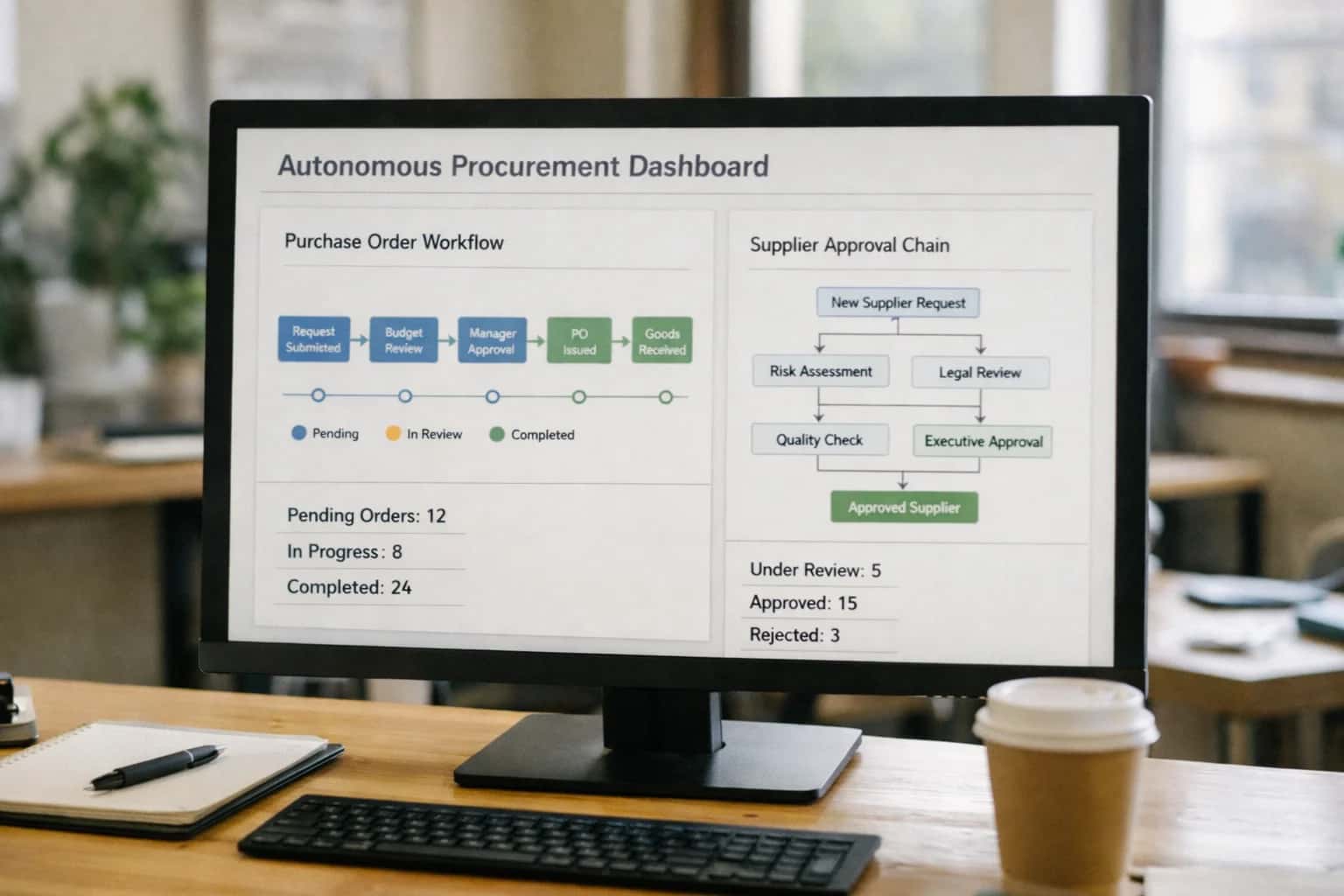
Integrating AI into manufacturing spend platforms requires a targeted approach to direct materials, MRO, and supplier quality data.
For MRO spend—a high-volume, fragmented category—AI automates the classification of un-catalogued spend (e.g., classifying a bearing purchase to the correct maintenance work center and GL code) and triggers intelligent requisition routing. Implementation involves setting up a middleware layer that listens to platform webhooks for new requisitions or invoices, enriches transaction data with context from CMMS (like Fiix or UpKeep) and inventory systems, and returns actionable recommendations (approve, route, flag) via the platform's approval workflow API. This reduces manual triage from hours to minutes and improves spend visibility.
Rollout should be phased, starting with a pilot category like indirect materials or a specific plant, using a human-in-the-loop design where AI suggestions are reviewed before auto-approval. Governance is critical: all AI-driven changes to supplier scorecards, routing rules, or category codes must be logged in the platform's audit trail. For supplier quality, AI can parse quality inspection reports (often PDFs or data from QMS platforms) linked to supplier records, extracting defect rates and linking them to performance scorecards in the spend platform, creating a closed-loop system for procurement and operations.
MANUFACTURING-SPECIFIC MODULES
Key Integration Surfaces by Platform
Direct Material Procurement
Integrate AI into the core workflows for procuring raw materials, components, and sub-assemblies. Key surfaces include:
- Purchase Requisition & RFQ Generation: AI agents analyze Bills of Materials (BOMs) from the ERP or PLM system to auto-generate requisitions and RFQ packages with technical specifications, leveraging the platform's sourcing project APIs.
- Supplier Capacity & Risk Matching: Connect LLMs to supplier master data and external market feeds. During sourcing events, AI evaluates supplier capacity, lead times, and real-time risk scores (e.g., geopolitical, financial) to recommend or disqualify bidders.
- Contract & Pricing Term Analysis: For direct material contracts, AI extracts and monitors key clauses related to volume commitments, price escalation indexes (e.g., tied to commodity prices), quality SLAs, and liability terms, alerting procurement to deviations.
Implementation typically involves a middleware layer that ingests BOM data, calls the spend platform's APIs to create sourcing events, and enriches supplier records with AI-generated insights.
AI INTEGRATION FOR COUPA, SAP ARIBA, AND JAGGAER
High-Value Manufacturing Use Cases
For manufacturing procurement teams, AI integration targets the unique data and workflow complexities of direct materials, MRO, and supplier operations. These cards detail where to connect AI agents to your spend platform for measurable operational impact.
01
Direct Material Supplier Capacity Matching
Integrate AI to analyze production schedules from your MES/ERP against supplier lead times and capacity data in your spend platform. The agent can proactively flag potential shortages, suggest alternate approved suppliers from the vendor master, and even draft RFQ packages for urgent needs, turning reactive firefighting into planned procurement.
Reactive -> Proactive
Risk mitigation
02
MRO Spend Consolidation & Catalog Rationalization
Deploy AI classification on tail-spend transactions to map thousands of unique MRO item descriptions to standardized UNSPSC codes or internal category trees. The agent identifies duplicate suppliers and SKUs across plants, recommending catalog items for consolidation. This feeds directly into Jaggaer or Coupa's catalog management APIs to clean the buying guide.
Weeks -> 1 Sprint
Catalog cleanup cycle
03
Supplier Quality Data Integration for Sourcing
Connect AI to pull non-conformance reports (NCRs) and supplier scorecards from your QMS (e.g., ETQ, MasterControl). The agent synthesizes this quality data with commercial terms from SAP Ariba contracts to provide a unified supplier performance view for sourcing events, weighting quality KPIs in bid analysis and award recommendations.
Manual Synthesis -> Automated Score
Sourcing decision support
04
Intelligent PO Acknowledgment & ASN Validation
Automate a critical yet manual communication loop. An AI agent monitors the supplier portal or EDI queue for Purchase Order acknowledgments and Advanced Ship Notices (ASNs). It validates details (part numbers, quantities, dates) against the original PO in Ivalua or Coupa, flags discrepancies to the buyer, and updates the ERP/MES, ensuring schedule integrity.
Batch -> Real-time
Exception handling
05
Contractual Raw Material Price Index Clauses
For contracts with raw material index-based pricing, use an AI agent to monitor commodity indices (e.g., LME, Platts) and automatically calculate price adjustments based on the formula in the SAP Ariba or Ivalua contract. The agent generates the adjustment memo, routes it for approval, and updates the system price, ensuring accuracy and timeliness.
Hours -> Minutes
Price calculation
06
Production-Linked GR/IR Reconciliation
Bridge the gap between procurement and production. An AI agent analyzes Goods Receipt (GR) data from the warehouse and Invoice Receipt (IR) data from the spend platform, matching them to the original PO. For discrepancies common in manufacturing (partial receipts, quality holds), it creates tailored exception tickets with context from the shop floor system, routing them to the correct planner or buyer.
Manual Ticketing -> Automated Triage
AP/Production coordination
MANUFACTURING-SPECIFIC
Example AI-Powered Workflows
These workflows illustrate how AI agents connect to manufacturing data and processes within platforms like Coupa, SAP Ariba, and Jaggaer to automate direct material procurement, MRO operations, and supplier quality management.
Trigger: A production planner creates a purchase requisition in the P2P platform for a raw material (e.g., steel coil, semiconductor wafer) linked to a production order.
AI Agent Action:
- Context Pull: The agent retrieves the requisition details and links to the Bill of Materials (BOM) and production schedule from the connected ERP (e.g., SAP S/4HANA).
- Supplier Analysis: It cross-references the item against approved supplier lists, current blanket orders, and real-time supplier performance data (on-time delivery, quality scores).
- Allocation & Creation: The agent recommends the optimal supplier and creates a purchase order, automatically attaching relevant quality specifications and delivery milestones from the contract.
- System Update: The PO is created in the spend platform and a notification is sent to the supplier via the network (e.g., Ariba Network).
Human Review Point: The agent flags any requisition for a single-source supplier that has a recent quality incident, routing it to the category manager for review before PO creation.
CONNECTING AI TO DIRECT MATERIALS, MRO, AND SUPPLIER QUALITY WORKFLOWS
Implementation Architecture & Data Flow
A practical architecture for embedding AI agents into manufacturing-specific procurement workflows within platforms like Coupa, SAP Ariba, and Jaggaer.
The integration connects to core platform APIs and webhooks, focusing on manufacturing-specific data objects: Purchase Orders for direct materials (linked to BOMs), Requisitions for MRO (Maintenance, Repair, and Operations) parts, Supplier Quality records (e.g., inspection reports, SCARs), and Item Masters with critical specifications. AI agents are triggered by events like a new PO creation for raw materials, an MRO requisition submission, or a supplier non-conformance report upload. The initial data payload—containing item descriptions, quantities, supplier details, and attached documents—is routed to the appropriate AI workflow for analysis, classification, or enrichment.
For direct material procurement, an AI agent analyzes the PO line items against the Bill of Materials (BOM) and historical supplier performance data to flag potential specification deviations or suggest alternate approved suppliers for risk mitigation. In MRO spend workflows, a separate agent classifies unstructured requisition descriptions (e.g., 'bearing for pump #AX-203') against the maintenance item catalog, recommends stock vs. non-stock, and checks for duplicate recent orders to control maverick spend. A third agent, focused on supplier quality, ingests inspection reports and corrective action requests to summarize trends, extract key failure modes, and pre-populate supplier scorecard updates within the platform.
Governance is built into the data flow. All AI-generated recommendations—such as a supplier substitution or a spend category code—are logged as audit trail entries linked to the original transaction. High-confidence actions (e.g., auto-catalog matching) can be applied directly, while lower-confidence or high-value suggestions are routed to a human-in-the-loop approval queue for the buyer or quality engineer. The architecture uses a central vector store to index supplier documentation, material specs, and past quality incidents, enabling RAG-based retrieval for context-aware agent responses. Rollout typically starts with a single pilot workflow, like MRO classification, before expanding to direct materials and supplier quality, ensuring each step delivers measurable cycle time reduction and data quality improvement.
MANUFACTURING-SPECIFIC INTEGRATION PATTERNS
Code & Payload Examples
AI Analysis of Purchase Orders for Production
In manufacturing, Purchase Orders for direct materials (raw materials, components) contain critical data like part numbers, quantities, delivery dates, and specifications. An AI agent can analyze incoming POs from systems like SAP Ariba or Coupa to validate against the Bill of Materials (BOM) and production schedules.
This Python example calls an LLM to extract and validate key PO details against an internal manufacturing data API, flagging discrepancies for planner review.
pythonimport requests def analyze_direct_material_po(po_text, bom_api_url, schedule_api_url): """ Validates a direct material PO against BOM and production schedule. """ prompt = f""" Extract the following from the Purchase Order text: - Part Number - Quantity - Required Delivery Date - Supplier Part ID PO Text: {po_text} """ # Call LLM to extract structured data extracted_data = call_llm_for_extraction(prompt) # Validate against BOM API bom_response = requests.get(f"{bom_api_url}/components/{extracted_data['part_number']}") bom_data = bom_response.json() # Check schedule feasibility schedule_response = requests.post( schedule_api_url, json={ "part_number": extracted_data['part_number'], "quantity": extracted_data['quantity'], "delivery_date": extracted_data['required_delivery_date'] } ) # Generate validation summary for planner validation_result = { "po_data": extracted_data, "bom_match": bom_data.get("is_valid", False), "schedule_feasibility": schedule_response.json().get("status"), "alerts": [] } return validation_result
MANUFACTURING OPERATIONS
Realistic Operational Impact & Time Savings
How AI integration for Coupa, SAP Ariba, and Jaggaer transforms key manufacturing procurement workflows, focusing on direct materials, MRO, and supplier quality.
| Workflow / Metric | Before AI Integration | After AI Integration | Implementation Notes |
|---|---|---|---|
Direct Material PO Creation & Routing | Manual BOM review, supplier lookup, and email approvals (2-4 hours) | AI-assisted BOM validation, supplier capacity checks, and automated routing (30-45 minutes) | Integrates with PLM/ERP for BOM data; uses AI to match specs to approved vendor lists and production schedules. |
MRO (Maintenance, Repair, Operations) Spend Request | Reactive, manual catalog search or free-text requisitions leading to maverick spend | Proactive, conversational agent suggests catalog items, predicts needs, and enforces contracts | Agent trained on historical MRO spend, failure data, and inventory levels to guide requests. |
Supplier Quality Data Consolidation | Manual collection of CoAs, inspection reports, and scorecards from disparate systems | AI agent automatically ingests, parses, and summarizes quality docs into a supplier performance dashboard | Connects to supplier portals, email, and quality management systems (QMS) via APIs and OCR. |
Invoice Exception Triage for Production Materials | AP team manually researches quantity/price mismatches against POs and goods receipts (Next-day resolution) | AI performs instant three-way match, flags discrepancies with root-cause suggestions (Same-day resolution) | Deep integration with ERP for real-time GRN status; AI explains variances (e.g., partial delivery, scrap). |
Supplier Risk Monitoring for Critical Components | Quarterly manual review of financial news and audit reports; reactive to disruptions | AI provides daily alerts on supplier financial health, geopolitical events, and plant disruptions | Aggregates data from news, financial APIs, and logistics feeds; scores integrated into vendor master. |
Tail Spend Analysis & Consolidation | Monthly manual spreadsheet analysis to identify one-off, low-value purchases | Continuous AI classification of tail spend transactions with supplier rationalization recommendations | Processes spend data feed; suggests catalog items or contract vehicles for recurring tail spend items. |
RFP Generation for Capital Equipment | Sourcing manager drafts from scratch, researches specs, and manually populates templates (1-2 weeks) | AI drafts initial RFP using historical data, technical specs, and market intelligence templates (2-3 days) | Uses past RFPs, supplier databases, and equipment manuals; human review and finalization required. |
MANUFACTURING-SPECIFIC IMPLEMENTATION
Governance, Security & Phased Rollout
A controlled, risk-aware approach to deploying AI within your manufacturing procurement operations.
In manufacturing, AI integrations for platforms like Coupa, SAP Ariba, or Jaggaer must be architected with strict data governance from the start. This means:
- Role-based access controls (RBAC) tied to existing procurement roles (e.g., Buyer, Category Manager, AP Clerk) to ensure AI insights and actions are scoped appropriately.
- Audit trails that log every AI-generated recommendation, classification, or routing decision, linking them to the source transaction (e.g., PO
P-45012, InvoiceINV-78901). - Data isolation for sensitive categories like direct materials, where supplier pricing and contract terms are kept within secure, governed workflows and not exposed to general-purpose models.
A phased rollout is critical for managing change and proving value without disrupting production. A typical sequence is:
- Phase 1: Assisted Intelligence (Read-Only). Deploy AI agents that analyze and suggest but do not act. Example: An agent reviews incoming MRO invoices in Coupa, flags potential coding errors or duplicate spend against the asset register, and creates a task for an AP specialist—all actions require human approval.
- Phase 2: Conditional Automation (Low-Risk Workflows). Automate high-volume, rule-based tasks. Example: Auto-classifying indirect spend transactions in SAP Ariba against the UNSPSC code, with a confidence threshold (e.g., >95%) for auto-acceptance and a human-in-the-loop review queue for lower-confidence items.
- Phase 3: Predictive & Prescriptive (High-Value Workflows). Integrate AI into core manufacturing processes. Example: An AI agent in Jaggaer analyzes supplier quality data (SCARs, delivery performance) alongside commodity forecasts to recommend sourcing strategies for critical raw materials, triggering a new sourcing event workflow only upon buyer approval.
Security is paramount when connecting AI systems to your spend platform's APIs and data. Implementation should enforce:
- API key management and service accounts with least-privilege access, scoped only to necessary objects (e.g.,
Invoice,PurchaseOrder,Supplier). - Data anonymization/pseudonymization for model training on historical data, especially when using third-party LLMs.
- A human approval layer for any AI-initiated change to master data (e.g., supplier risk score updates, payment term adjustments) or financial commitments. This ensures procurement policy and internal controls are never bypassed.
For deeper technical patterns, see our guide on AI Governance for Enterprise Integrations.
Enabling Efficiency, Speed & Accuracy
Intelligent Analysis, Decision & Execution
We build AI systems for teams that need search across company data, workflow automation across tools, or AI features inside products and internal software.
Talk to Us
Search across company data
Give teams answers from docs, tickets, runbooks, and product data with sources and permissions.
Useful when people spend too long searching or get different answers from different systems.
Enterprise searchRAGPermissions
Read more
Automate internal workflows
Use AI to route work, draft outputs, trigger actions, and keep approvals and logs in place.
Useful when repetitive work moves across multiple tools and teams.
AI agentsWorkflow automationGovernance
Read more
Add AI to products and internal tools
Build assistants, guided actions, or decision support into the software your team or customers already use.
Useful when AI needs to be part of the product, not a separate tool.
AI integrationDecision supportModel routing
Read moreAI INTEGRATION FOR MANUFACTURING SPEND
Frequently Asked Questions
Practical questions for manufacturing procurement, finance, and IT leaders evaluating AI integration with Coupa, SAP Ariba, or Jaggaer to optimize direct material, MRO, and supplier operations.
AI integration for direct materials typically involves a three-layer architecture connecting your spend platform, ERP (like SAP S/4HANA or Oracle), and AI services.
- Trigger & Data Pull: An AI agent monitors your spend platform for purchase requisitions or POs tagged with direct material categories (e.g., raw materials, components). It uses the platform's APIs (like Coupa's Purchase Order API or Ariba's Sourcing Event API) to fetch the item details, then calls your ERP's BOM or MRP APIs to pull related production schedules, inventory levels, and approved vendor lists.
- AI Analysis: The agent uses an LLM with a manufacturing-specific context to:
- Validate the requisition against the active BOM and production plan.
- Check for alternative approved suppliers or substitute parts based on quality specs.
- Analyze lead times and suggest order timing to avoid line stoppages.
- System Update & Workflow: The agent returns a structured payload to the spend platform, which can:
- Auto-approve the requisition if it passes all checks.
- Flag it for buyer review with specific recommendations (e.g., "Consider Supplier B; lead time is 5 days shorter").
- Update the PO in the spend platform with enriched data for tracking.
Key Integration Points: Spend platform PO/Requisition APIs, ERP BOM/MRP APIs, internal quality/spec databases.

About the author
Prasad Kumkar
CEO & MD, Inference Systems
Prasad Kumkar is the CEO & MD of Inference Systems and writes about AI systems architecture, LLM infrastructure, model serving, evaluation, and production deployment. Over 5+ years, he has worked across computer vision models, L5 autonomous vehicle systems, and LLM research, with a focus on taking complex AI ideas into real-world engineering systems.
His work and writing cover AI systems, large language models, AI agents, multimodal systems, autonomous systems, inference optimization, RAG, evaluation, and production AI engineering.
LinkedIn
Limited slotsGet a Free AI Consultation
Partnered with leading AI, data, and software stack.





How We Work
Custom AI workflows for your Business
One-fit-all AI don't work for modern businesses. At Inferensys, we aim to understand your business & custom requirements; which we use to define most efficient agentic workflows, the data, and the tools for your business.
01
Review the use case
We understand the task, the users, and where AI can actually help.
Read more02
Pick the right approach
We define what needs search, automation, or product integration.
Read more03
Build the first useful version
We implement the part that proves the value first.
Read more04
Improve from there
We add the checks and visibility needed to keep it useful.
Read moreThe first call is a practical review of your use case and the right next step.
Talk to Us