AI integration for SAP Ariba Contract Authoring focuses on three primary surfaces: the contract template library, the clause library, and the drafting workspace. The goal is to inject intelligence directly into the procurement or legal user's workflow, not create a separate AI tool. This is achieved by connecting to Ariba's APIs—such as the Contract Management API for document operations and the Event Notification API for workflow triggers—to build agents that assist with template selection, clause suggestion, and initial draft population based on sourcing event data, supplier profiles, and historical agreements.

Integration
AI Integration for SAP Ariba Contract Authoring
Technical blueprint for integrating AI into SAP Ariba Contracts to accelerate drafting, ensure clause compliance, and manage contract libraries for procurement and legal teams.
ARCHITECTURE FOR AI-ASSISTED DRAFTING
Where AI Fits into SAP Ariba Contract Authoring
A technical blueprint for integrating generative AI into the SAP Ariba Contracts module to accelerate compliant agreement creation.
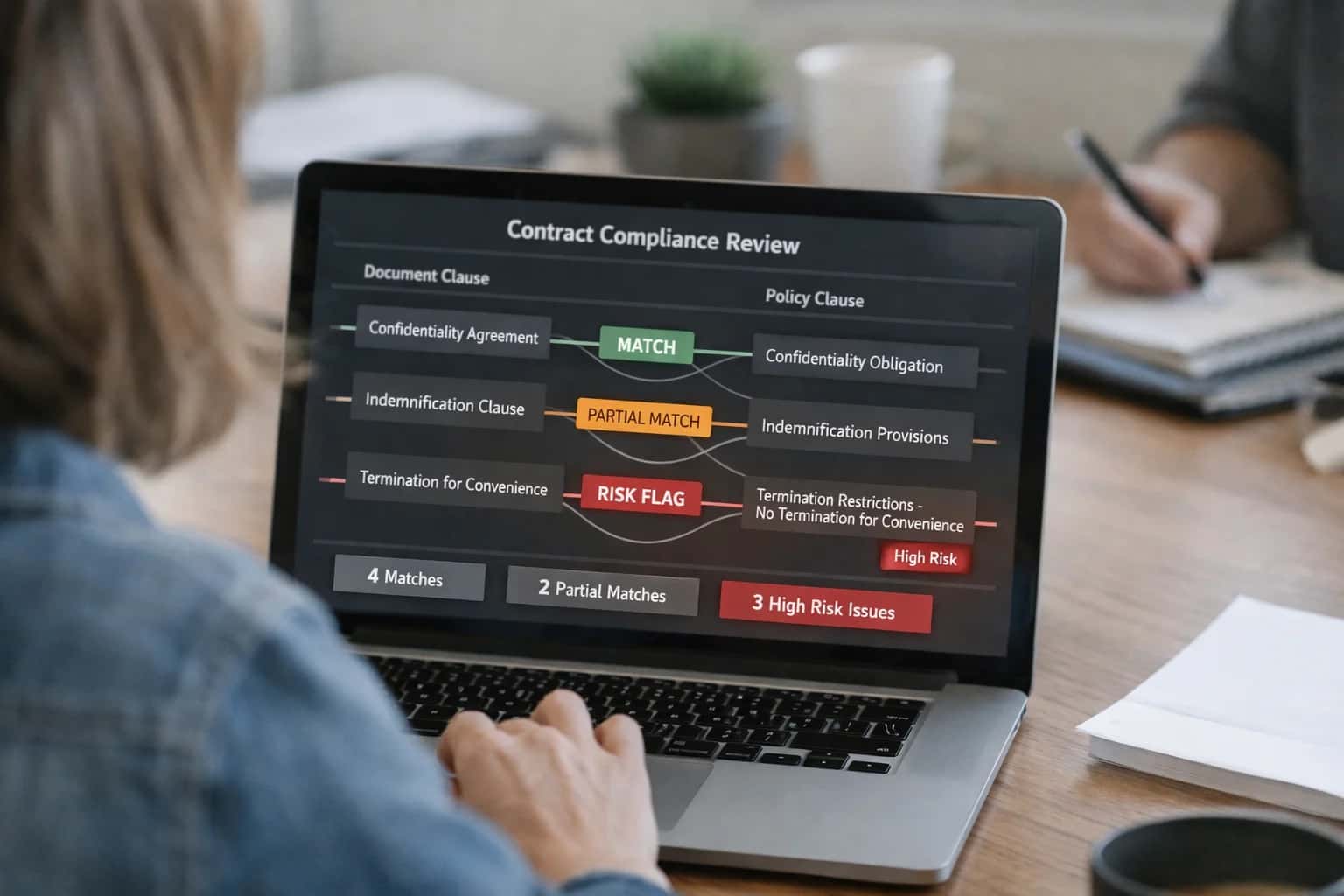
A practical implementation wires an AI layer between the user's action and Ariba's native interface. For example, when a user initiates a new contract from a sourcing project, an AI agent can: analyze the project's awarded items and supplier details; retrieve a pre-approved template from the Ariba library; and pre-fill key fields like parties, effective date, and governing law. For clause management, AI can scan the draft against a governed clause library to recommend stronger liability, termination, or IP ownership language, flagging deviations from standard positions. This reduces manual lookup and copy-paste, turning a multi-hour drafting process into a reviewed first draft in minutes.
Rollout requires a phased approach, starting with read-only analysis (e.g., clause gap reports) before enabling assisted drafting. Governance is critical: all AI-suggested clauses must be traceable to an approved library version, and final human review before signing is non-negotiable. Integration with Ariba's audit trail ensures every AI-suggested change is logged. For teams managing high volumes of NDAs, MSAs, and SOWs, this architecture turns Ariba Contracts from a document repository into an active drafting copilot, enforcing compliance and accelerating cycle times without bypassing procurement or legal oversight. For related architectural patterns, see our guide on AI Integration with Ivalua Contract Management.
AI-ASSISTED CONTRACT AUTHORING
Key Integration Surfaces in SAP Ariba Contracts
Templates & Clause Libraries
AI integration begins with the structured content layer. SAP Ariba Contracts stores templates and approved clause libraries, which are ideal surfaces for AI augmentation.
Integration Points:
- Template Recommendation: Use AI to analyze the requisition or sourcing event metadata (category, value, region) to recommend the most appropriate contract template, reducing selection errors.
- Intelligent Clause Selection: Connect an LLM to your clause library. Based on the contract type and negotiated terms, the AI can suggest compliant, pre-approved clauses, ensuring consistency and reducing manual lookup.
- Clause Gap Analysis: During drafting, an AI agent can compare the selected clauses against a policy rulebook to identify missing mandatory language (e.g., data privacy, termination for cause) and prompt the drafter.
This layer turns static libraries into dynamic, context-aware assistants, accelerating the initial drafting phase.
SAP ARIBA CONTRACTS
High-Value AI Use Cases for Contract Authoring
Integrate generative AI directly into SAP Ariba Contracts to accelerate drafting, ensure compliance, and reduce legal review cycles. These use cases connect to Ariba's clause libraries, template engines, and approval workflows.
01
Intelligent Clause Selection & Assembly
AI analyzes the procurement context (category, supplier risk, region) within a new Ariba contract workspace to recommend and assemble pre-approved clauses from your library. It ensures compliance with master agreements and reduces manual copy-paste errors.
Hours -> Minutes
Draft assembly time
02
Dynamic First Draft Generation
Trigger an AI agent via the Ariba UI or API to generate a complete first draft from a template. The agent populates fields using data from the sourcing event, supplier profile, and purchase requisition, creating a negotiation-ready document in one step.
1 sprint
Implementation timeline
03
Context-Aware Redlining Support
During negotiations, an AI copilot reviews supplier-markup versions uploaded to Ariba. It highlines non-standard terms, suggests fallback language from your playbook, and flags deviations from preferred positions, speeding up legal review.
Same day
Review cycle reduction
04
Obligation & Milestone Extraction
Once a contract is finalized in Ariba, an AI workflow parses the executed document to extract key obligations, SLAs, pricing terms, and milestones. This data is pushed to Ariba's obligation tracking or external systems, automating setup for supplier management.
Batch -> Real-time
Data activation
05
Procurement Playbook Assistant
Embed a chat interface within the Ariba Contracts module where buyers can ask natural language questions (e.g., 'What's our liability cap for IT services in EMEA?'). The AI retrieves answers from your clause library, playbooks, and past contracts.
06
Automated Contract Summarization
For contract reviews or renewals, an AI agent attached to Ariba's document store can generate executive summaries. It highlights key terms, risks, dates, and obligations, giving procurement and business stakeholders instant visibility without reading the full document.
SAP ARIBA CONTRACTS
Example AI-Assisted Contract Workflows
These workflows illustrate how generative AI integrates directly into SAP Ariba's contract lifecycle, automating drafting, review, and management tasks to accelerate cycle times and improve compliance.
Trigger: A sourcing project in SAP Ariba Sourcing is awarded and marked complete.
AI Action:
- An AI agent is triggered via webhook, receiving the awarded supplier details, final negotiated commercial terms, and the RFP/RFQ scope.
- The agent retrieves the appropriate contract template from the Ariba Contracts clause library based on the category, supplier type, and region.
- Using an LLM, the agent populates the template, inserting:
- Supplier legal name and address from the Ariba Supplier Profile.
- Agreed pricing, payment terms, and SLAs from the sourcing award sheet.
- Relevant boilerplate clauses (governing law, termination, liability) based on template rules.
- The agent flags any missing required data (e.g., insurance levels, delivery addresses) for manual entry.
System Update: A fully drafted contract is created as a new document in the Ariba Contracts workspace, pre-populated with metadata (supplier, category, owner) and routed to the procurement manager for initial review.
BUILDING A PRODUCTION-READY AI LAYER FOR CONTRACT AUTHORING
Implementation Architecture and Data Flow
A practical blueprint for integrating AI agents into SAP Ariba Contracts to accelerate drafting, ensure compliance, and manage clause libraries.
A production integration connects to the SAP Ariba Contracts API layer and the underlying SAP Ariba Document Management system. The core flow begins when a user initiates a new contract from a template within the Ariba UI. An event webhook or a scheduled job triggers an AI agent, which ingests the draft document along with contextual metadata—such as the supplier record, commodity code, and negotiated terms from the sourcing event. The agent's first task is to retrieve relevant clauses from a governed vector database (e.g., Pinecone, Weaviate) that indexes your organization's approved clause library, past contracts, and regulatory playbooks. Using semantic search, it suggests pre-approved language, flags missing mandatory sections based on the contract type (e.g., NDA, MSA, SOW), and highlights areas where standard terms may conflict with the sourced commercial deal.
The AI layer operates as a middleware service, typically deployed as a containerized microservice. It calls the LLM (e.g., GPT-4, Claude 3) via a secure gateway, passing a structured prompt that includes the draft text, the retrieved clause options, and your organization's contract policy rules as guardrails. The service logs all suggestions, user acceptances/rejections, and modifications to an audit trail, which syncs back to Ariba as a custom object or an attachment for full lineage. For rollout, we recommend a phased approach: start with assistive drafting for non-disclosure agreements and simple order forms where the risk is lower, then expand to complex master service agreements once the clause library and agent prompts are tuned. Governance is maintained through a human-in-the-loop approval step for any AI-suggested clause that deviates from a pre-approved 'golden' version.
Key technical considerations include managing API rate limits on the Ariba side, implementing role-based access control (RBAC) so suggestions are appropriate for the user's role (e.g., procurement vs. legal), and setting up a feedback loop where user corrections train a lightweight classifier to improve future suggestions. The final, approved contract is pushed back into Ariba's native version history, and key extracted terms (e.g., liability caps, renewal dates) can be written to custom fields to power downstream obligation tracking. This architecture turns Ariba Contracts from a document repository into an intelligent authoring copilot, reducing first-draft time from days to hours while enforcing compliance at the point of creation.
SAP ARIBA CONTRACTS INTEGRATION PATTERNS
Code and Payload Examples
Enriching the Clause Library with AI
Integrating an LLM with SAP Ariba's clause library allows for intelligent search, tagging, and recommendation. The typical pattern involves calling an AI service to analyze uploaded clause text, then using Ariba's APIs to update metadata. This automates the classification of clauses by type (e.g., Limitation of Liability, Termination), risk level, and applicable region.
Example Workflow:
- A new clause is added to the Ariba library via UI or API.
- A webhook triggers an analysis request to your AI service.
- The AI returns structured metadata.
- The Ariba clause object is updated via PATCH to include new custom fields for
ai_clause_type,ai_risk_score, andai_tags.
Payload Example (AI Service Response):
json{ "clause_id": "CL-2024-001", "analysis": { "primary_type": "TERMINATION", "confidence": 0.92, "risk_level": "MEDIUM", "tags": ["auto-renewal", "30-day notice", "cause"], "summary": "Allows either party to terminate for cause with 30 days written notice." } }
This metadata enables powerful filtered searches and smart clause suggestions during contract assembly.
AI-ASSISTED CONTRACT AUTHORING
Realistic Time Savings and Operational Impact
This table illustrates the tangible workflow improvements and time savings when integrating AI agents into SAP Ariba Contracts for drafting, review, and clause management.
| Contract Authoring Workflow | Before AI Integration | After AI Integration | Implementation Notes |
|---|---|---|---|
Initial Draft Creation | Manual search and copy-paste from previous contracts or static templates | AI generates a first draft with relevant clauses from a managed library, pre-populated with party details | AI uses RAG over approved clause library and past contracts; human review required for finalization |
Clause Selection and Insertion | Manual review of clause playbooks or legal memos to find appropriate language | AI suggests contextually relevant clauses based on contract type, jurisdiction, and risk profile | Suggestions are ranked by relevance; legal team maintains governance over final clause approval |
Risk and Compliance Review | Manual line-by-line review against internal policies and regulatory checklists | AI highlights clauses that deviate from standard language or contain high-risk terms (e.g., unlimited liability) | AI flags for human review; reduces oversight risk but does not eliminate legal sign-off |
Counterparty Redline Comparison | Manual comparison of received redlines against original sent version | AI summarizes changes, highlights material alterations, and suggests acceptable fallback positions | Speeds up negotiation cycles; legal team focuses on strategic concessions |
Obligation and Milestone Extraction | Manual reading to create separate tracking sheets for key dates, deliverables, and obligations | AI automatically extracts key dates, payment terms, SLAs, and deliverables into a structured summary | Output feeds into obligation management systems; requires validation for complex clauses |
Final Formatting and Assembly | Manual adjustment of numbering, cross-references, and annex integration | AI ensures consistent formatting, updates cross-references, and validates document structure before finalization | Reduces administrative errors and last-minute formatting delays |
Approval Routing and Kick-off | Manual determination of approvers based on value, department, and contract type | AI analyzes contract content to recommend the appropriate approval workflow and notify stakeholders | Integrates with Ariba's native routing; ensures policy compliance and reduces misroutes |
ARCHITECTING FOR ENTERPRISE CONTROL
Governance, Security, and Phased Rollout
A production-ready AI integration for SAP Ariba Contract Authoring requires a secure, governed architecture that aligns with legal and procurement policies.
A secure integration architecture treats the AI as a governed service, not a direct user. We recommend a middleware layer (often built with tools like n8n or Microsoft Copilot Studio) that sits between Ariba and the LLM. This layer handles authentication via Ariba's OAuth 2.0 APIs, enforces role-based access control (RBAC) by checking the user's Ariba permissions, and manages all prompt and response logging to an immutable audit trail. Sensitive contract data is never sent directly to a public LLM endpoint; instead, the middleware calls a private instance (e.g., Azure OpenAI Service or AWS Bedrock) within your VPC, ensuring data residency and compliance with internal data governance policies.
Rollout should follow a phased, risk-aware approach. Phase 1 (Pilot): Enable AI-assisted clause suggestion for non-binding documents (e.g., NDAs, simple SOWs) within a single procurement team. Use this to refine prompts, measure time savings, and establish a human-in-the-loop review process. Phase 2 (Expansion): Activate clause library management and compliance checking for master service agreements (MSAs), integrating with your legal team's approved clause repository. Implement approval workflows where AI-generated deviations from standard language are flagged for legal review within the Ariba contract workflow. Phase 3 (Scale): Roll out intelligent redlining support and obligation extraction across all contracting groups, connecting the AI's outputs to downstream systems like /integrations/spend-management-and-procure-to-pay-platforms/ai-integration-with-ivalua-contract-management for lifecycle tracking.
Governance is continuous. Establish a cross-functional steering committee (Legal, Procurement, IT, Security) to review the AI's performance metrics, audit logs, and any edge-case outputs. Use an LLMOps platform like Arize AI or Weights & Biases to monitor for prompt drift, track model versioning, and conduct regular bias/accuracy evaluations on the clause recommendations. This ensures the AI assistant remains a compliant copilot, accelerating drafting while keeping legal and procurement teams firmly in control of the final agreement.
Enabling Efficiency, Speed & Accuracy
Intelligent Analysis, Decision & Execution
We build AI systems for teams that need search across company data, workflow automation across tools, or AI features inside products and internal software.
Talk to Us
Search across company data
Give teams answers from docs, tickets, runbooks, and product data with sources and permissions.
Useful when people spend too long searching or get different answers from different systems.
Enterprise searchRAGPermissions
Read more
Automate internal workflows
Use AI to route work, draft outputs, trigger actions, and keep approvals and logs in place.
Useful when repetitive work moves across multiple tools and teams.
AI agentsWorkflow automationGovernance
Read more
Add AI to products and internal tools
Build assistants, guided actions, or decision support into the software your team or customers already use.
Useful when AI needs to be part of the product, not a separate tool.
AI integrationDecision supportModel routing
Read moreIMPLEMENTATION DETAILS
Frequently Asked Questions
Common technical and operational questions about integrating generative AI into SAP Ariba Contracts for automated drafting, clause management, and compliance.
Secure integration is built using a middleware layer (often an API gateway or integration platform) that sits between SAP Ariba and the AI service. The pattern involves:
- Authentication & Authorization: Using OAuth 2.0 with client credentials to securely call SAP Ariba's REST APIs (e.g., Contract Workspace API, Clause Library API). Permissions are scoped to the specific contract author or legal team's role.
- Data Extraction: The middleware fetches relevant context—such as the contract type, party details, selected template, and negotiation history—via API calls. No raw contract data is sent directly to a public LLM endpoint.
- Secure AI Processing: Context is sent to a private, VPC-hosted instance of the LLM (e.g., Azure OpenAI, AWS Bedrock, or a fine-tuned open model). All data remains within your cloud tenancy.
- Audit Trail: Every API call and AI generation is logged with a correlation ID, capturing the source user, timestamp, input context, and output for compliance review.
This architecture ensures data never leaves your controlled environment, adhering to corporate IT and data residency policies.

About the author
Prasad Kumkar
CEO & MD, Inference Systems
Prasad Kumkar is the CEO & MD of Inference Systems and writes about AI systems architecture, LLM infrastructure, model serving, evaluation, and production deployment. Over 5+ years, he has worked across computer vision models, L5 autonomous vehicle systems, and LLM research, with a focus on taking complex AI ideas into real-world engineering systems.
His work and writing cover AI systems, large language models, AI agents, multimodal systems, autonomous systems, inference optimization, RAG, evaluation, and production AI engineering.
LinkedIn
Limited slotsGet a Free AI Consultation
Partnered with leading AI, data, and software stack.





How We Work
Custom AI workflows for your Business
One-fit-all AI don't work for modern businesses. At Inferensys, we aim to understand your business & custom requirements; which we use to define most efficient agentic workflows, the data, and the tools for your business.
01
Review the use case
We understand the task, the users, and where AI can actually help.
Read more02
Pick the right approach
We define what needs search, automation, or product integration.
Read more03
Build the first useful version
We implement the part that proves the value first.
Read more04
Improve from there
We add the checks and visibility needed to keep it useful.
Read moreThe first call is a practical review of your use case and the right next step.
Talk to Us