AI integration for Coupa is not about replacing the platform, but about injecting intelligence into its existing workflows. The primary integration surfaces are Coupa's REST APIs and webhook subscriptions, which allow you to listen for events (like a new invoice upload or a requisition submission) and trigger AI agents. Key data objects to target include invoices, suppliers, purchase_orders, requisitions, and contracts. The goal is to automate decision-making at these touchpoints, reducing manual review cycles from hours to minutes.

Integration
AI Integration for Coupa Spend Management
A technical blueprint for embedding AI agents and workflows into Coupa's core modules to automate invoice processing, vendor analysis, and procurement operations, using Coupa's APIs and webhooks.
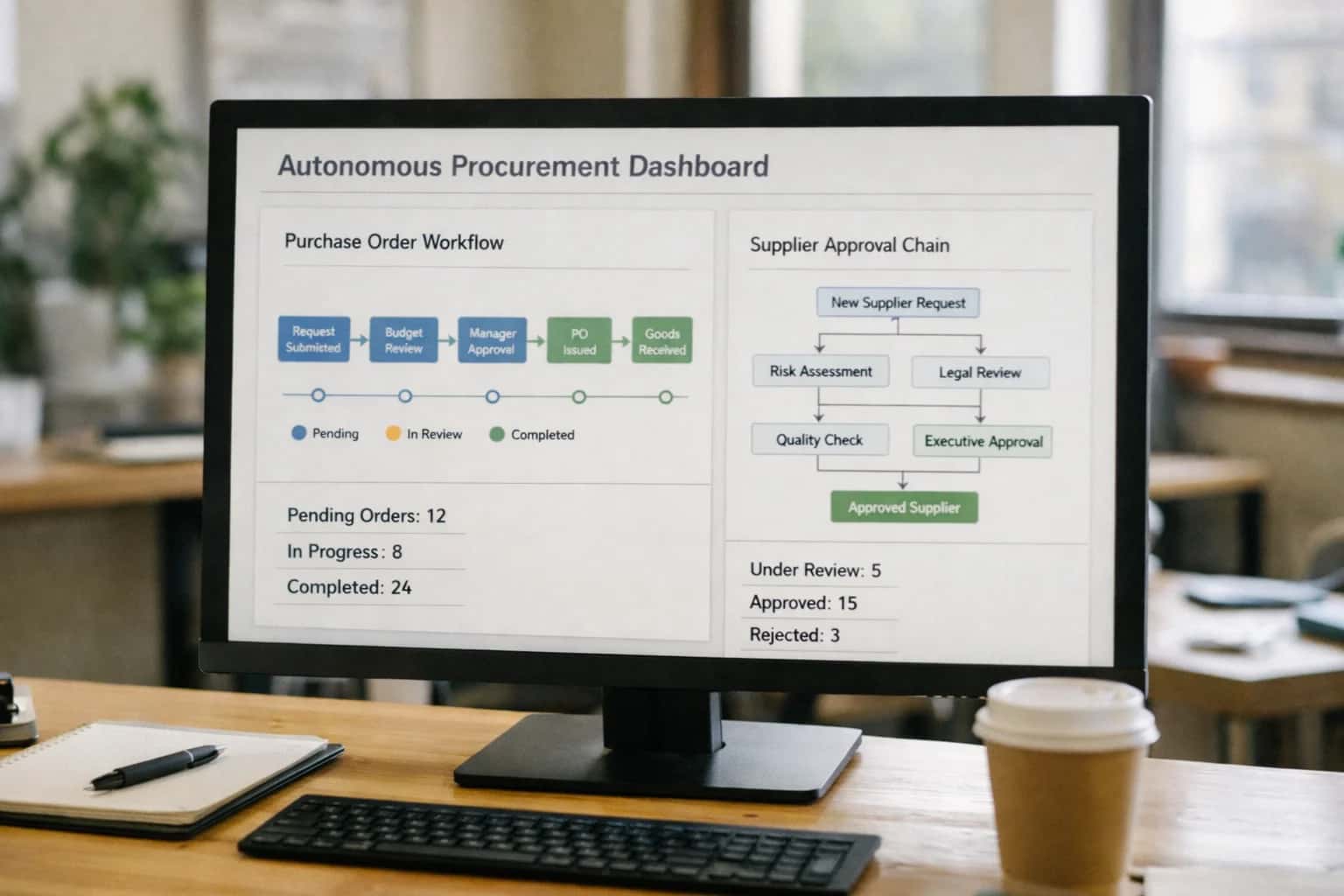
ARCHITECTURE AND INTEGRATION POINTS
Where AI Fits into the Coupa Spend Management Stack
A practical blueprint for embedding AI agents and workflows into Coupa's core modules, APIs, and data flows.
Implementation typically follows a pattern: an event triggers an API call to an orchestration layer (like an AI agent platform), which processes the data—using LLMs for document understanding, RAG for policy retrieval, or classification models for spend coding. The agent then returns an action, such as updating a field, routing for approval, or flagging an exception. For example, an AI agent listening to the invoice.created webhook can extract line-item data, perform a three-way match against the PO and receipt, and either auto-approve the invoice or route it to an exception queue with a detailed reason.
Rollout requires careful governance. Start with a pilot workflow, like AI-powered invoice data extraction, where the agent acts as a co-pilot, suggesting fields for an AP clerk to verify. Use Coupa's custom fields and approval chains to embed AI outputs directly into the user interface. For production, implement audit trails that log the AI's reasoning and confidence scores, and maintain a human-in-the-loop for high-value or low-confidence transactions. This phased approach de-risks the integration while delivering immediate operational lift.
The business impact is directional but clear: reducing invoice processing costs by automating data entry and matching, accelerating supplier onboarding through automated document validation, and improving spend visibility via AI-enhanced classification. By connecting AI to Coupa's API-first architecture, you create a system where procurement operations become more predictive, less reactive, and significantly less manual.
WHERE TO CONNECT AI AGENTS AND WORKFLOWS
Key Coupa Modules and Integration Surfaces for AI
Invoice Pay & AP Automation
Coupa Invoice Pay is the primary surface for AI-driven accounts payable automation. Integration points include the Invoice Capture API for submitting scanned or emailed invoices and the Invoice Object API for managing the invoice lifecycle.
Key AI workflows here involve:
- Line-item extraction: Using vision or document AI to parse unstructured invoices into structured line items, mapping to GL codes and purchase orders.
- Three-way matching automation: An AI agent can validate invoices against POs and receipts, flagging discrepancies for human review via webhook-triggered alerts.
- Exception triage: For mismatches, an agent can analyze the variance, check historical patterns, and either auto-resolve or route to the correct AP clerk with a summary.
Implementation typically involves a middleware service that processes inbound documents, calls an LLM or specialized model for extraction, and then posts the structured data to Coupa's APIs, updating the invoice status and triggering the next approval step.
PRACTICAL INTEGRATION PATTERNS
High-Value AI Use Cases for Coupa
These are production-ready patterns for embedding AI agents and workflows into Coupa's core modules, using its APIs and webhooks to automate high-effort tasks and provide intelligence where procurement and finance teams need it most.
01
Intelligent Invoice Exception Triage
An AI agent monitors the Invoice Exceptions queue via Coupa's APIs, reads the discrepancy reason and line-item data, and automatically researches the issue. It can pull related POs and receipts, suggest corrections, or route to the correct AP clerk with a full context summary. This turns manual research into a guided resolution workflow.
Hours -> Minutes
Resolution time
02
Dynamic Supplier Risk Scoring
Integrate AI to continuously analyze Coupa's vendor master and transactional data against external risk feeds (financial, ESG, geopolitical). The agent updates a custom supplier risk score field and triggers alerts or holds on new POs for high-risk suppliers, giving procurement teams proactive visibility.
Batch -> Real-time
Monitoring
03
Guided Requisition & Catalog Search
A copilot interface for employees creating requisitions. Using natural language, it searches the Coupa catalog and approved supplier lists, suggests compliant alternatives, pre-fills item descriptions, and validates against budget codes—all before the requisition is submitted, reducing buyer rework.
1 sprint
Pilot rollout
04
Spend Classification & Enrichment
Automatically map uncategorized transactions and line items to your chart of accounts and category tree. An AI model analyzes supplier names, descriptions, and historical patterns to assign accurate GL codes, department codes, and project tags, ensuring clean data for finance and procurement analytics.
95%+
Auto-classification rate
05
Contract Obligation Tracker
For contracts stored in Coupa, an AI agent extracts key terms (SLAs, pricing tiers, auto-renewal clauses) and creates tracked obligations. It syncs with PO and invoice data to monitor compliance, flagging invoices that deviate from contracted rates or alerting managers ahead of renewals.
Same day
Clause extraction
06
Conversational Spend Analytics
Deploy a natural language layer on top of Coupa's reporting database. Procurement and finance users can ask questions like "show me Q3 marketing spend by supplier" or "what's the tail spend under $10k?" and get instant charts and answers, without building custom reports.
Self-service
Report generation
PRACTICAL AUTOMATION PATTERNS
Example AI Agent Workflows in Coupa
These are concrete, production-ready workflows showing how AI agents connect to Coupa's APIs and webhooks to automate high-effort procurement and AP tasks. Each pattern details the trigger, data flow, agent action, and system update.
Trigger: A new invoice is submitted via Coupa Invoice Pay API, email, or portal.
Context Pulled: The agent retrieves the invoice image/PDF via Coupa's document API and extracts header/line-item data (vendor, PO number, amounts, dates). It then fetches the related PO, receipt, and vendor master record.
Agent Action:
- Performs a three-way match (PO, receipt, invoice), identifying discrepancies in quantity, price, or terms.
- For mismatches, it analyzes historical resolution patterns (e.g., "Vendor X often has a 2% price variance approved by Jane Doe").
- If a clear resolution path exists (based on policy and history), it auto-resolves the exception, logs the reason, and moves the invoice to "Ready to Pay."
- If resolution is unclear, it summarizes the discrepancy, suggests potential approvers based on spend category and amount, and routes the invoice to a dedicated "Exceptions" queue in Coupa with the analysis attached as a note.
System Update: Coupa invoice status is updated via PUT /invoices/{id}. The agent's analysis is appended to the invoice record. For routed exceptions, a task is created for the designated AP specialist.
Human Review Point: All auto-resolutions above a configurable confidence threshold (e.g., 95%) are logged in an audit report for weekly review by the AP manager.
A PRODUCTION BLUEPRINT
Implementation Architecture: Connecting AI to Coupa
A technical guide to wiring AI agents into Coupa's core APIs and webhooks for automated procurement operations.
A production-ready AI integration for Coupa is built on its REST API, webhook subscriptions, and Open Connector framework. The primary architectural pattern involves deploying lightweight AI agents as middleware that listen to events—like a new invoice submission via POST /invoices or a requisition creation—process the associated data (e.g., invoice line items, supplier details from the vendors object), and return enriched data or recommended actions back into Coupa's workflow. Key integration surfaces include Coupa Invoice Pay for AP automation, the Supplier Portal for vendor analysis, and the Guided Buying module for procurement support. Agents typically interact with Coupa's purchase_orders, invoices, and suppliers endpoints to read context and write back classifications, risk scores, or approval recommendations.
For a use case like intelligent invoice exception handling, the implementation flow is: 1) A webhook triggers on invoice creation, 2) the payload is sent to an AI agent that performs three-way matching by fetching the related PO and receipt data via API, 3) the agent uses a language model to analyze discrepancy descriptions in the invoice_lines and historical resolution data, 4) it then either auto-resolves the exception by updating the invoice status or routes it to a specific AP clerk's queue with a summarized reason and suggested action. This reduces manual triage from hours to minutes. Governance is maintained by logging all agent decisions to a separate audit system and implementing a human-in-the-loop approval step for exceptions above a configurable confidence threshold.
Rollout should follow a phased approach: start with a single, high-volume workflow like non-PO invoice classification to validate the data pipeline and agent accuracy before expanding to more complex processes like dynamic discounting analysis or supplier risk monitoring. Ensure the AI middleware respects Coupa's role-based access controls (RBAC) by using service accounts with scoped permissions and implement idempotency and retry logic for all API calls to maintain data integrity. The end state is a set of autonomous workflows where AI handles routine procurement tasks, Coupa remains the system of record, and your team focuses on strategic exceptions and supplier relationships.
COUPA API INTEGRATION PATTERNS
Code and Payload Examples
Ingesting Invoices via Webhook
Coupa can be configured to send a webhook notification when a new invoice is uploaded. An AI agent listens for this event, retrieves the invoice document (PDF, PNG) from the Coupa API, and extracts structured data using a vision-capable LLM.
Example Webhook Payload from Coupa:
json{ "event": "invoice.created", "id": "invoice-78910", "object": "invoice", "created_at": "2024-05-15T14:30:00Z", "data": { "invoice_id": 78910, "supplier_name": "Global Office Supplies Inc.", "document_url": "https://api.coupa.com/invoices/78910/document" } }
Python Handler for Extraction:
pythonimport requests from openai import OpenAI client = OpenAI() def handle_invoice_webhook(payload): invoice_id = payload['data']['invoice_id'] doc_url = payload['data']['document_url'] # Fetch invoice document from Coupa doc_response = requests.get(doc_url, headers={'Authorization': 'Bearer YOUR_COUPA_API_KEY'}) # Extract text and key fields using GPT-4 Vision extraction_response = client.chat.completions.create( model="gpt-4-vision-preview", messages=[ { "role": "user", "content": [ {"type": "text", "text": "Extract invoice number, total amount, due date, line items with quantity and unit price, and PO number from this invoice. Return as JSON."}, {"type": "image_url", "image_url": {"url": f"data:image/png;base64,{base64.b64encode(doc_response.content).decode()}"}} ] } ] ) extracted_data = json.loads(extraction_response.choices[0].message.content) # Enrich and validate against Coupa PO return validate_against_po(invoice_id, extracted_data)
AI-ENHANCED COUPA WORKFLOWS
Realistic Time Savings and Operational Impact
This table illustrates the typical operational impact of integrating AI agents into core Coupa modules, based on production implementations. Metrics focus on time-to-completion, manual effort reduction, and process quality improvements.
| Workflow / Metric | Before AI Integration | After AI Integration | Implementation Notes |
|---|---|---|---|
Invoice Data Entry & Capture | Manual keying from PDF/email (5-10 min per invoice) | Automated extraction & field population (<1 min) | AI validates against PO & receipt; exceptions flagged for human review |
Invoice Three-Way Matching | AP specialist manual review (15-20 min per exception) | AI-powered auto-matching & discrepancy highlighting (2-5 min) | Agent suggests resolution (e.g., quantity variance); approver makes final call |
Supplier Onboarding & Validation | Email exchanges, document chase (3-5 business days) | AI-guided portal intake, automated document review (Same day) | Integrates with third-party risk/credential checks; human final approval |
Purchase Requisition Policy Compliance | Buyer/approver manual policy check (Variable, often delayed) | Real-time AI validation against policy catalog during creation | Routes non-compliant reqs with explanation; reduces rework |
Spend Classification & Coding | Finance manual mapping to GL/category (Post-month-end batch) | AI auto-classification at transaction entry (Real-time) | Uses historical patterns & NLP on vendor/description; >90% accuracy typical |
Supplier Risk Monitoring | Quarterly manual review of key suppliers | AI-driven continuous monitoring with alerting (Daily) | Aggregates news, financials, ESG scores; dashboard highlights changes |
Contract Clause Extraction & Review | Legal/Procurement manual review for renewals (Hours per contract) | AI-assisted redlining & obligation extraction (Minutes) | Highlights non-standard terms, SLAs; human negotiator in the loop |
Tail Spend Analysis & Consolidation | Ad-hoc quarterly analysis, manual data aggregation | AI-powered continuous identification & recommendation reports | Flags maverick spend, suggests catalog items or preferred suppliers |
ARCHITECTING CONTROLLED DEPLOYMENT
Governance, Security, and Phased Rollout
A production-ready AI integration for Coupa requires a security-first architecture and a phased rollout to manage risk and ensure user adoption.
A secure integration is built on Coupa's API framework and webhooks. AI agents should operate as a dedicated, external service layer that interacts with Coupa's Invoice Pay, Purchase Order, and Supplier modules through OAuth 2.0, with permissions scoped to specific data objects and actions (e.g., invoice.read, supplier.write). All AI-generated outputs—such as extracted invoice line items or vendor risk scores—should be written to dedicated custom fields or external audit logs before triggering any system-of-record updates, creating a clear audit trail. For sensitive workflows like fraud detection or payment term analysis, implement a human-in-the-loop approval step within Coupa's native workflow engine, where AI recommendations are presented as actionable tasks for AP or procurement specialists.
Rollout should follow a phased, risk-based approach. Start with a pilot on a single, high-volume, low-risk process, such as automating the classification of tail-spend invoices from a specific region or business unit. This allows you to validate the AI's accuracy against a known dataset, measure cycle time reduction, and refine prompts without disrupting core operations. Subsequent phases can expand to more complex workflows like three-way matching exception handling or dynamic supplier risk scoring. For each phase, define clear success metrics (e.g., reduction in manual touch points, improvement in first-pass match rate) and establish a rollback plan that reverts to standard Coupa workflows if the AI agent's confidence score falls below a defined threshold.
Governance is critical for long-term control. Implement a centralized prompt management system to version and test all instructions given to LLMs for tasks like spend categorization or contract clause extraction. Coupa's user roles and data security profiles (DSPs) should be mirrored in the AI service to ensure agents only access data permissible for the triggering user. Finally, establish a regular review cadence with procurement, finance, and IT stakeholders to evaluate AI performance, address model drift in classification tasks, and prioritize the next set of workflows for automation, ensuring the integration evolves with business needs.
Enabling Efficiency, Speed & Accuracy
Intelligent Analysis, Decision & Execution
We build AI systems for teams that need search across company data, workflow automation across tools, or AI features inside products and internal software.
Talk to Us
Search across company data
Give teams answers from docs, tickets, runbooks, and product data with sources and permissions.
Useful when people spend too long searching or get different answers from different systems.
Enterprise searchRAGPermissions
Read more
Automate internal workflows
Use AI to route work, draft outputs, trigger actions, and keep approvals and logs in place.
Useful when repetitive work moves across multiple tools and teams.
AI agentsWorkflow automationGovernance
Read more
Add AI to products and internal tools
Build assistants, guided actions, or decision support into the software your team or customers already use.
Useful when AI needs to be part of the product, not a separate tool.
AI integrationDecision supportModel routing
Read moreAI INTEGRATION FOR COUPA
Frequently Asked Questions
Common technical and strategic questions about implementing AI agents, workflows, and automation within the Coupa Spend Management platform.
Secure integration is foundational. The standard pattern involves:
- Service Account & OAuth 2.0: Create a dedicated service account in Coupa with scoped API permissions (e.g.,
invoice:read,invoice:write,supplier:read). Use OAuth 2.0 client credentials flow for machine-to-machine authentication. - API Gateway & Webhook Receiver: Deploy a secure API gateway (e.g., Kong, Apigee) as a middleware layer. This gateway:
- Manages authentication with Coupa.
- Handles rate limiting and retries.
- Receives and validates webhooks from Coupa (e.g.,
invoice.created,purchase_order.updated).
- Context Enrichment: The gateway forwards the event payload (like an invoice ID) to your AI orchestration layer, which calls back to Coupa's REST API to fetch full context (invoice lines, supplier details, PO data).
- Audit Trail: All agent actions that modify Coupa data (e.g., posting an invoice match, updating a supplier field) should be logged with the service account ID, timestamp, and the reasoning payload from the AI for full auditability.

About the author
Prasad Kumkar
CEO & MD, Inference Systems
Prasad Kumkar is the CEO & MD of Inference Systems and writes about AI systems architecture, LLM infrastructure, model serving, evaluation, and production deployment. Over 5+ years, he has worked across computer vision models, L5 autonomous vehicle systems, and LLM research, with a focus on taking complex AI ideas into real-world engineering systems.
His work and writing cover AI systems, large language models, AI agents, multimodal systems, autonomous systems, inference optimization, RAG, evaluation, and production AI engineering.
LinkedIn
Limited slotsGet a Free AI Consultation
Partnered with leading AI, data, and software stack.





How We Work
Custom AI workflows for your Business
One-fit-all AI don't work for modern businesses. At Inferensys, we aim to understand your business & custom requirements; which we use to define most efficient agentic workflows, the data, and the tools for your business.
01
Review the use case
We understand the task, the users, and where AI can actually help.
Read more02
Pick the right approach
We define what needs search, automation, or product integration.
Read more03
Build the first useful version
We implement the part that proves the value first.
Read more04
Improve from there
We add the checks and visibility needed to keep it useful.
Read moreThe first call is a practical review of your use case and the right next step.
Talk to Us