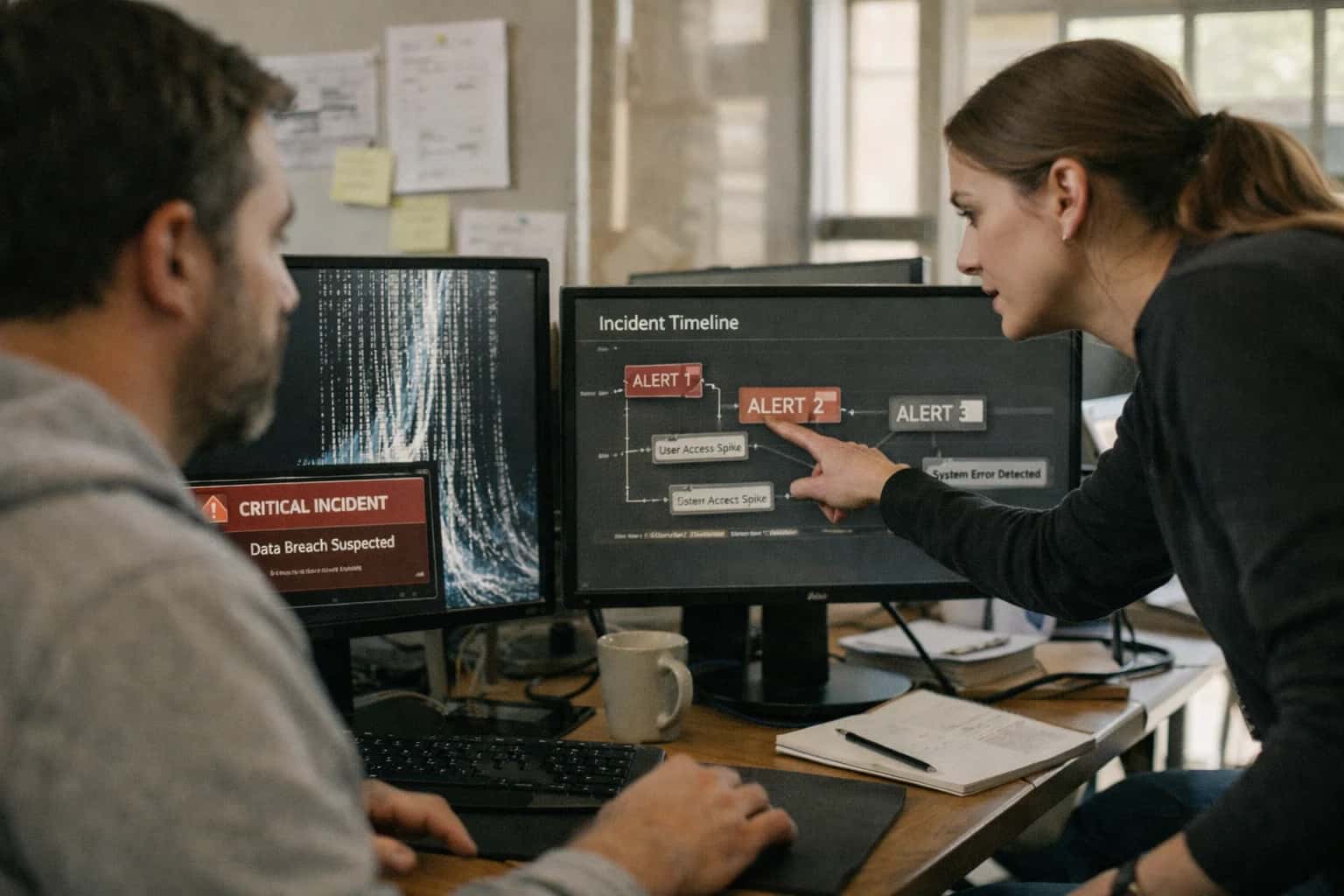
AI integration for Prisma Cloud SIEM focuses on the Alert, Incident, and Investigation surfaces. The core workflow begins with Prisma Cloud's Cloud Security Posture Management (CSPM) and Cloud Workload Protection Platform (CWPP) alerts, which are ingested into the integrated SIEM. AI acts as a co-pilot at ingestion, analyzing alert metadata, resource context (from the Prisma Cloud Asset Inventory), and network flow logs to perform initial triage. It can automatically cluster related alerts—such as a suspicious process execution on an EC2 instance paired with an anomalous outbound connection—into a single, enriched incident, reducing noise and focusing analyst attention on true attack chains.

Integration
AI Integration for Palo Alto Prisma Cloud SIEM
Integrate AI with Prisma Cloud's integrated SIEM to automatically correlate cloud workload alerts with network and identity events, generating unified, context-rich incident narratives that reduce manual investigation time.
ARCHITECTURE AND ROLLOUT
Where AI Fits into Prisma Cloud SIEM
Integrating AI with Prisma Cloud's integrated SIEM transforms cloud security operations from reactive alert monitoring to proactive, context-rich investigation.
The implementation typically involves a middleware layer (an AI agent or workflow) that subscribes to the Prisma Cloud Enterprise API or Prisma Cloud Webhook for real-time alerts. This layer enriches each event by querying Prisma Cloud's Resource Query for asset tags, compliance standards, and vulnerability data, then uses an LLM to generate a concise narrative. For example: "High-severity alert: Cryptomining malware detected on compute instance prod-app-01. Instance is tagged Env:Production and Owner:Finance, has a critical CVE (CVE-2024-1234) present, and is making calls to a known malicious IP. Recommended action: Isolate instance and review IAM role app-role for over-permissions." This narrative is appended back to the incident via the API, providing immediate context without the analyst switching consoles.
Rollout should be phased, starting with read-only enrichment for a subset of high-severity alerts to validate the AI's accuracy and usefulness. Governance is critical: all AI-generated summaries and recommendations must be logged in Prisma Cloud's Audit Logs with a clear attribution tag (e.g., source: ai_co-pilot). A human-in-the-loop approval step should be mandated for any AI-suggested remediation actions (like resource isolation) initiated through Prisma Cloud's Remediation Actions. This ensures safety and maintains accountability while progressively automating the SOC's mean time to respond (MTTR). For teams using Cortex XSOAR or ServiceNow, the AI layer can also format and route these enriched incidents directly into those ticketing systems, creating a seamless workflow from cloud detection to enterprise response.
AI INTEGRATION FOR PALO ALTO PRISMA CLOUD SIEM
Key Integration Surfaces in Prisma Cloud
Alert Triage and Incident Summarization
Prisma Cloud's SIEM generates alerts from cloud workload, network, and identity events. AI integration focuses on the Alert Management and Incident Management modules to reduce manual SOC workload.
Key AI Use Cases:
- Automated Alert Prioritization: Analyze alert metadata, resource context, and compliance posture to assign a dynamic severity score, moving critical cloud misconfigurations or active attacks to the top of the queue.
- Incident Narrative Generation: When multiple alerts are grouped into an incident, an AI agent synthesizes the timeline, affected resources (from the Resource Explorer), and potential attack path into a concise summary. This provides immediate context for Level 1 analysts.
- Response Recommendation: Based on the enriched incident data, suggest initial containment steps (e.g., "Isolate EC2 instance
i-abc123" or "Revoke IAM roleprod-lambda-exec") by calling Prisma Cloud's native remediation APIs or integrating with/integrations/security-information-and-event-platforms/ai-integration-for-palo-alto-cortex-xsoar-integrations.
This surface directly targets reducing Mean Time to Acknowledge (MTTA) and improving analyst onboarding for complex cloud incidents.
CLOUD-NATIVE SECURITY OPERATIONS
High-Value AI Use Cases for Prisma Cloud SIEM
Integrate AI with Palo Alto Prisma Cloud SIEM to move beyond basic alert correlation. These use cases leverage Prisma Cloud's unified data lake of cloud workload, network, and identity events to provide intelligent automation for overburdened SOC teams.
01
Automated Cloud Incident Narrative Generation
When Prisma Cloud SIEM creates an incident from correlated alerts, an AI agent automatically synthesizes the raw event data into a concise, plain-language narrative. It pulls context from the Prisma Cloud resource inventory, IAM findings, and network flow logs to explain the attack chain, affected resources, and potential compliance impact. This turns a list of disparate alerts into an actionable summary for an analyst's first review.
Batch -> Real-time
Narrative generation
02
Intelligent Alert Triage & Routing
AI models analyze incoming Prisma Cloud SIEM alerts, evaluating severity based on cloud resource criticality tags, exposure to the internet (from CSPM data), and anomalous user behavior patterns. High-fidelity alerts are auto-enriched with resource context and routed to the cloud security team. Low-priority or likely false-positive alerts (e.g., routine scanning of a test environment) are suppressed or sent to a dedicated queue for periodic review.
Hours -> Minutes
Initial triage time
03
AI-Powered Threat Hunting in Cloud Logs
Enable threat hunters to use natural language to query the vast data in Prisma Cloud's Log Forwarding and Cortex Data Lake. An AI co-pilot translates questions like "Find instances where a service account created a new storage bucket and modified permissions" into optimized queries. It can also propose hunting hypotheses based on emerging cloud attack TTPs and automatically search for related activity across accounts and regions.
1 sprint
To operationalize new hunt
04
Dynamic Risk Scoring for Cloud Assets
Augment Prisma Cloud's posture findings with a dynamic, AI-calculated risk score for each cloud resource (e.g., EC2 instance, storage account). The score incorporates real-time vulnerability data, network exposure, unusual API activity, and deviations from infrastructure-as-code templates. This live risk score is injected into SIEM alerts, helping prioritize response and guiding automated playbooks in Cortex XSOAR.
05
Automated Compliance Evidence & Reporting
For audits (e.g., SOC 2, PCI DSS, HIPAA in cloud), AI agents continuously monitor Prisma Cloud SIEM logs and CSPM findings. They map events to specific control requirements, gather evidence, and highlight gaps. The system can generate draft compliance reports and maintain an audit trail of exceptions and remediations, drastically reducing manual evidence collection from Cloud Audit Logs and configuration snapshots.
Same day
Evidence compilation
06
Context-Aware Response Orchestration
Integrate AI decision points into Prisma Cloud playbooks (or connected Cortex XSOAR). Before executing a containment action like isolating a VM, the AI evaluates context: Is this a production workload? Are there active user sessions? What is the business criticality from the CMDB? This prevents automated response from causing business disruption and ensures actions are proportional to the assessed risk.
Batch -> Real-time
Context evaluation
PRISMA CLOUD SIEM
Example AI-Augmented Investigation Workflows
These workflows illustrate how AI agents can be integrated into Prisma Cloud's SIEM investigation process, automating data correlation, narrative generation, and response recommendations to accelerate cloud incident resolution.
Trigger: A new high-severity alert is generated in Prisma Cloud SIEM (e.g., "Suspicious network traffic from a compute instance").
AI Agent Action:
- The agent is triggered via webhook or API call from the alert.
- It retrieves the full alert context, including the involved cloud account, resource ID (e.g., VM instance, container), VPC, and security group details.
- The agent executes a series of enrichment queries:
- Queries Prisma Cloud's Cloud Security Posture Management (CSPM) findings for the resource to check for known misconfigurations (e.g., overly permissive IAM role, exposed storage bucket).
- Pulls the resource's runtime vulnerability assessment from Prisma Cloud Cloud Workload Protection (CWP).
- Correlates the network flow with Prisma Cloud Network Security logs to see other communications from the same source.
- Optionally, queries an external threat intelligence API for the suspicious destination IP.
- The agent synthesizes this data into a concise, plain-language summary appended to the alert.
System Update: The enriched alert is updated in Prisma Cloud SIEM with a new ai_summary field and a dynamically calculated contextual_risk_score. The alert is automatically assigned to the Cloud SOC queue.
Human Review Point: The SOC analyst reviews the AI-generated summary and risk score to immediately understand the blast radius and priority, bypassing manual data gathering.
AI-ENHANCED SIEM PIPELINE
Typical Implementation Architecture
A production-ready AI integration for Palo Alto Prisma Cloud SIEM typically follows a secure, event-driven pipeline that enriches alerts, generates narratives, and feeds insights back into the investigation workflow.
The architecture is anchored on Prisma Cloud's Alert API and Investigation API. A lightweight middleware service, deployed within your cloud VPC, subscribes to new alerts via webhook or polls the Alert API. For each alert—such as a suspicious cloud storage bucket exposure, anomalous IAM role assumption, or network policy violation—the service extracts the raw JSON payload, which includes the resource ID, event log, severity, and related cloud account context. This payload is then enriched with additional context from Prisma Cloud's Resource API (to pull asset tags, configuration snapshots) and internal sources like a CMDB before being sent to an orchestration layer.
The core AI processing occurs in a controlled, asynchronous queue. A retrieval-augmented generation (RAG) system first queries a vector store containing your organization's security playbooks, past incident reports, and cloud security benchmarks to ground the response. A configured LLM (e.g., GPT-4, Claude 3, or a fine-tuned open model) then receives a structured prompt with the enriched alert data. The prompt instructs the model to output a concise incident narrative, a confidence-scored hypothesis for root cause (e.g., 'Likely misconfigured S3 bucket ACL due to Terraform drift'), and recommended investigative steps tailored to Prisma Cloud's console (e.g., 'Review the resource timeline for this EC2 instance and check associated security groups'). All inputs and outputs are logged with a correlation ID for full auditability.
The generated narrative and hypothesis are posted back to the corresponding Prisma Cloud Investigation via the API, populating the case notes or a custom field. For high-severity alerts, the system can automatically trigger a Prisma Cloud workflow to gather additional forensic data or create a Jira Service Management ticket via webhook. Governance is enforced through a human-in-the-loop approval step for any automated containment actions, and all AI-generated content is clearly watermarked. The rollout typically starts with a pilot on a single, high-volume alert type (like cloud storage misconfigurations) to tune prompts and validate accuracy before expanding to other alert categories.
PRISMA CLOUD SIEM INTEGRATION PATTERNS
Code and Payload Examples
Enriching Cloud Alerts with External Context
When Prisma Cloud generates a high-severity alert, you can call an AI service to fetch relevant threat intelligence, summarize the finding, and suggest immediate containment steps. This Python example uses the Prisma Cloud API to retrieve alert details, then calls an LLM to generate a narrative.
pythonimport requests import json # Fetch alert from Prisma Cloud API alert_id = "PC-ALERT-12345" prisma_api_url = f"https://api.prismacloud.io/v2/alert/{alert_id}" headers = {"Authorization": "Bearer YOUR_ACCESS_TOKEN"} alert_response = requests.get(prisma_api_url, headers=headers) alert_data = alert_response.json() # Prepare context for LLM context = { "alert_type": alert_data.get("policy", {}).get("name"), "resource": alert_data.get("resource", {}).get("name"), "cloud_account": alert_data.get("account", {}).get("name"), "finding": alert_data.get("alert", {}).get("description") } # Call LLM for enrichment llm_payload = { "model": "gpt-4", "messages": [ {"role": "system", "content": "You are a cloud security analyst. Summarize this Prisma Cloud alert and recommend 2-3 immediate investigation steps."}, {"role": "user", "content": json.dumps(context)} ] } llm_response = requests.post("https://api.openai.com/v1/chat/completions", headers={"Authorization": "Bearer YOUR_OPENAI_KEY"}, json=llm_payload) enrichment = llm_response.json()["choices"][0]["message"]["content"] print(f"AI-Generated Summary: {enrichment}")
AI-ENHANCED SIEM OPERATIONS
Realistic Time Savings and Operational Impact
How integrating AI with Palo Alto Prisma Cloud SIEM transforms key security workflows from manual, reactive processes to assisted, proactive operations.
| Security Workflow | Before AI Integration | After AI Integration | Implementation Notes |
|---|---|---|---|
Cloud Alert Triage | Manual review of 100+ daily alerts | AI-assisted prioritization of top 10-15 high-risk alerts | Analyst reviews AI-ranked queue; focuses on confirmed threats |
Incident Narrative Creation | Manual correlation across logs (30-60 mins) | AI-generated unified summary from correlated events (<5 mins) | Summary includes user, resource, network context; human validation required |
Threat Hunting Hypothesis | Ad-hoc query building based on experience | AI-suggested queries from latest threat intel & internal trends | Analyst refines and executes AI-generated XQL/Panorama queries |
Case Enrichment for Investigation | Manual lookup in Cortex Data Lake, TI feeds | Automated context pull from APIs (asset criticality, IoCs) | Enrichment runs on alert creation; data appended to case notes |
False Positive Reduction | Weekly rule tuning based on offense review | AI analysis of alert patterns to suggest tuning parameters | SOC lead reviews AI recommendations before deploying rule changes |
Compliance Evidence Gathering | Manual search & report assembly for audits | AI-mapped queries for control frameworks auto-run evidence | Reports highlight gaps; human auditor review for final submission |
Shift Handoff Briefing | Manual compilation of open cases & notes | AI-generated shift summary with case status & watch items | Provides consistent, actionable handoff; reduces missed context |
ARCHITECTING FOR PRODUCTION
Governance, Security, and Phased Rollout
Integrating AI with Palo Alto Prisma Cloud SIEM requires a deliberate approach to data governance, model security, and controlled deployment to ensure reliability and trust.
A production integration typically sits as a middleware service between Prisma Cloud's API endpoints (like /v2/alert and /v2/incident) and your chosen AI models. This service acts as a secure orchestrator, performing several key functions:
- Context Enrichment: It queries Prisma Cloud for related asset details, network flows, and identity context via the Prisma Cloud API before sending a structured prompt to an LLM.
- Audit Logging: Every AI interaction—input prompts, model responses, and any actions taken—is logged back to a dedicated Prisma Cloud Audit Log or a SIEM-compliant index for full traceability.
- Policy Enforcement: The middleware enforces Role-Based Access Control (RBAC), ensuring only authorized analysts or automated playbooks can trigger AI analysis on high-severity incidents, and applies data redaction filters (e.g., for PII) before context leaves the environment.
Security is paramount. We architect integrations to keep sensitive telemetry within your trust boundary. This often involves:
- Using Azure OpenAI or private AWS Bedrock endpoints with VPC endpoints to prevent data egress.
- Implementing strict input/output validation to guard against prompt injection and ensure AI-generated narratives or recommendations are formatted correctly for Prisma Cloud's case management or alert notes fields.
- Encrypting all data in transit and leveraging the existing Prisma Cloud Identity and Access Management framework for service authentication, avoiding the creation of new, weak credentials.
A phased rollout mitigates risk and builds organizational trust. A common pattern is:
- Phase 1 - Read-Only Enrichment: AI generates incident summaries and correlation hypotheses, appending them as notes to Prisma Cloud cases for analyst review. No automated actions are taken.
- Phase 2 - Assisted Response: After validation, AI suggests specific Prisma Cloud policies for creation or recommends Cloud Security Posture Management (CSPM) remediation steps. Analysts approve actions via a lightweight workflow in the middleware dashboard before they are executed via API.
- Phase 3 - Conditional Automation: For high-confidence, low-risk scenarios (e.g., auto-closing false positives based on historical patterns), pre-approved playbooks execute autonomously, with a mandatory post-action audit sent to a Slack channel or ServiceNow ticket for oversight. This crawl-walk-run approach allows your security team to calibrate the AI's performance, refine guardrails, and establish operational procedures before scaling its responsibility.
Enabling Efficiency, Speed & Accuracy
Intelligent Analysis, Decision & Execution
We build AI systems for teams that need search across company data, workflow automation across tools, or AI features inside products and internal software.
Talk to Us
Search across company data
Give teams answers from docs, tickets, runbooks, and product data with sources and permissions.
Useful when people spend too long searching or get different answers from different systems.
Enterprise searchRAGPermissions
Read more
Automate internal workflows
Use AI to route work, draft outputs, trigger actions, and keep approvals and logs in place.
Useful when repetitive work moves across multiple tools and teams.
AI agentsWorkflow automationGovernance
Read more
Add AI to products and internal tools
Build assistants, guided actions, or decision support into the software your team or customers already use.
Useful when AI needs to be part of the product, not a separate tool.
AI integrationDecision supportModel routing
Read morePRISMA CLOUD SIEM
Frequently Asked Questions
Practical questions from security leaders and architects planning AI integration with Palo Alto Prisma Cloud SIEM to enhance cloud security operations.
AI integration operates as a post-processing and enrichment layer, not a replacement for your existing detection logic. Your Prisma Cloud alert rules, CSPM policies, and CWPP runtime rules continue to generate findings as configured.
The AI layer typically:
- Ingests Prisma Cloud alerts via the Prisma Cloud API (e.g.,
/v2/alert) or streaming log exports to a data lake. - Correlates individual alerts that may be part of a broader attack sequence (e.g., a suspicious IAM role creation followed by anomalous data access from a new region).
- Enriches alerts with context from external sources (threat intel, CMDB, vulnerability scans) and internal telemetry (cloud audit logs, network flows).
- Prioritizes the enriched findings into a unified incident narrative with a dynamic risk score.
Your native policies remain the foundation; AI adds contextual intelligence to reduce alert fatigue and improve mean time to respond (MTTR).

About the author
Prasad Kumkar
CEO & MD, Inference Systems
Prasad Kumkar is the CEO & MD of Inference Systems and writes about AI systems architecture, LLM infrastructure, model serving, evaluation, and production deployment. Over 5+ years, he has worked across computer vision models, L5 autonomous vehicle systems, and LLM research, with a focus on taking complex AI ideas into real-world engineering systems.
His work and writing cover AI systems, large language models, AI agents, multimodal systems, autonomous systems, inference optimization, RAG, evaluation, and production AI engineering.
LinkedIn
Limited slotsGet a Free AI Consultation
Partnered with leading AI, data, and software stack.





How We Work
Custom AI workflows for your Business
One-fit-all AI don't work for modern businesses. At Inferensys, we aim to understand your business & custom requirements; which we use to define most efficient agentic workflows, the data, and the tools for your business.
01
Review the use case
We understand the task, the users, and where AI can actually help.
Read more02
Pick the right approach
We define what needs search, automation, or product integration.
Read more03
Build the first useful version
We implement the part that proves the value first.
Read more04
Improve from there
We add the checks and visibility needed to keep it useful.
Read moreThe first call is a practical review of your use case and the right next step.
Talk to Us