A natural language query (NLQ) layer for Splunk connects directly to the Search Head via the REST API or a custom Splunk app. Users interact with a chat interface (e.g., embedded in the Splunk Web UI or a separate Slack/Microsoft Teams bot) to ask questions like "show me failed logins for service accounts in the last 24 hours" or "what's the top source IP for malware alerts this week?" The system uses a large language model (LLM) to translate this intent into valid Search Processing Language (SPL). This translation must understand Splunk's data model, common sourcetypes, field extractions, and index naming conventions to generate accurate search, stats, timechart, or lookup commands. For production, the NLQ service acts as a middleware broker, handling authentication via Splunk tokens, managing search jobs, and enforcing role-based access control (RBAC) to ensure users only query data they are authorized to see.

Integration
AI Integration for Natural Language Query for Splunk
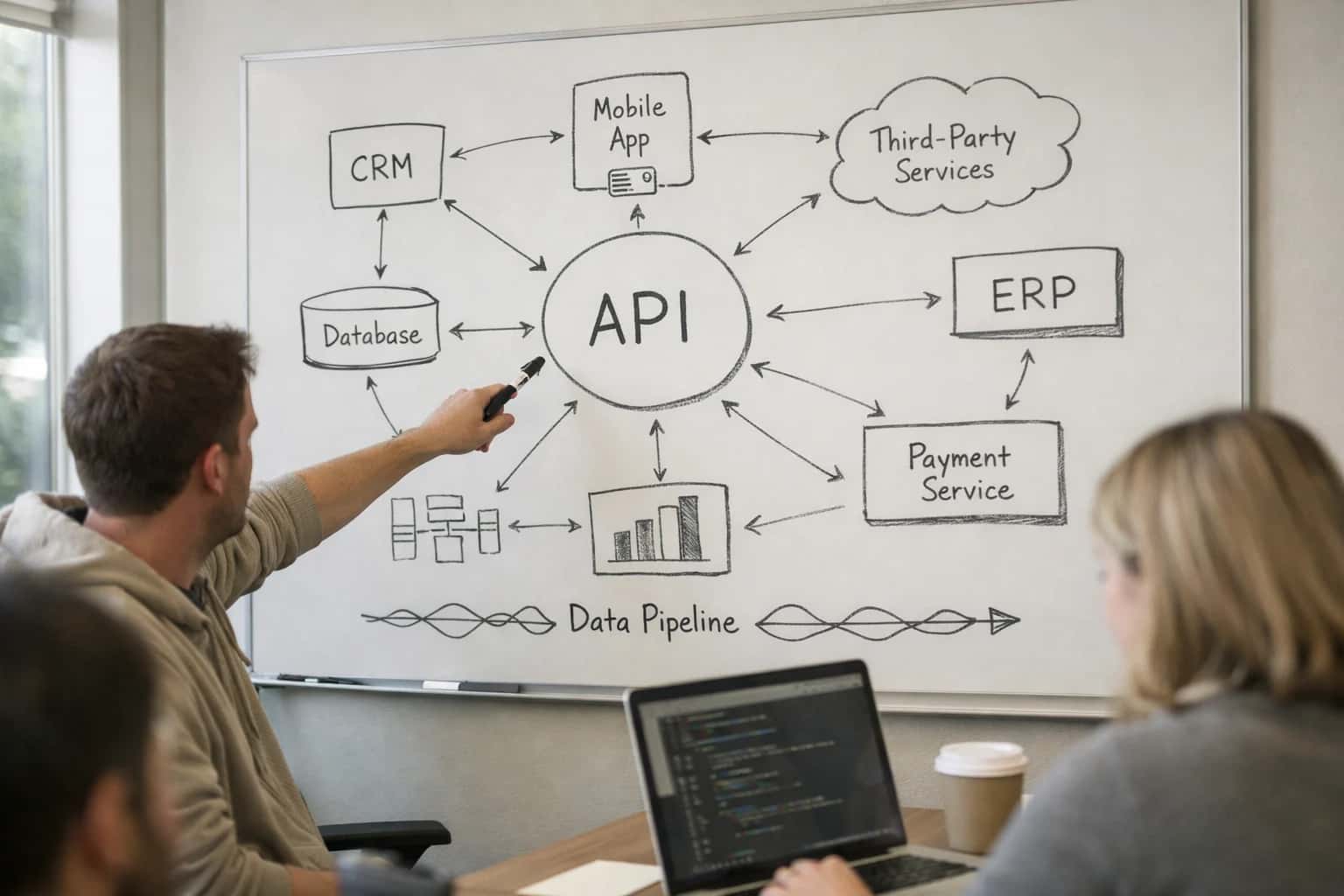
Natural Language Query for Splunk: From SPL Syntax to Plain English
Deploy a natural language interface for Splunk that enables analysts and business users to ask questions in plain English and receive answers as SPL queries, visualized results, or textual summaries.
The implementation nuance lies in grounding the LLM to your specific Splunk environment. This involves creating a knowledge retrieval layer that provides the model with context: a curated list of your critical indexes, sourcetypes, field aliases, and saved search names. This can be managed via a vector store that is updated when new data sources are onboarded. High-value use cases include enabling non-technical business units for self-service analytics (e.g., "revenue by product line last quarter" from business transaction logs), accelerating new SOC analyst onboarding by reducing SPL learning time, and allowing threat hunters to rapidly iterate on hypotheses without syntax barriers. The output can be configured as a direct SPL query for the user to review and run, an auto-executed search returning a dashboard panel, or a concise textual summary generated by having the LLM interpret the search results.
Rollout requires a phased approach, starting with a pilot group and a constrained set of data sources to build trust in the query accuracy. Governance is critical: all generated SPL should be logged with the original natural language prompt, user, and timestamp for audit. Implement a human-in-the-loop review step for queries targeting sensitive data or performing write/alerting actions before execution. Consider integrating with Splunk Enterprise Security's risk-based alerting or Mission Control to allow analysts to ask follow-up questions about notable events directly from the incident timeline. This integration doesn't replace SPL expertise but augments it, turning Splunk from a tool only for experts into a conversational platform for broader organizational intelligence.
Where AI Connects: Splunk Surfaces for Natural Language
Search Head & SPL Generation
The primary surface for a natural language interface is the Search & Reporting app. AI can integrate here to translate a user's plain-English question into a valid Search Processing Language (SPL) query. This typically involves:
- Query Intent Analysis: Parsing questions like "show me failed logins for service accounts in the last 24 hours" to identify the target index, sourcetype, fields, and time modifiers.
- SPL Construction: Generating syntactically correct SPL, handling complex joins, stats, eval, and where clauses. The AI must understand Splunk's data model (e.g.,
Authenticationdatamodel) to produce efficient queries. - Result Interpretation: After the query runs, the AI can further process the raw results to provide a textual summary (e.g., "There were 342 failed logins, a 15% increase from yesterday") or trigger the visualization engine to render a chart.
Implementation connects via the REST API (/services/search/jobs) to submit searches and retrieve results, or can be embedded as a custom visual app.
High-Value Use Cases for Splunk Natural Language Query
A natural language interface for Splunk transforms how analysts, engineers, and business users interact with security and operational data. By translating plain English into SPL queries, visualized results, or textual summaries, it accelerates investigations, democratizes data access, and reduces the cognitive load on specialized teams.
SOC Analyst Investigation Copilot
Analysts ask questions like "Show me all failed logins for service accounts in the last 24 hours, grouped by source IP" and receive a ready-to-run SPL query or a formatted table. This reduces time spent crafting complex searches, especially for junior analysts or during high-pressure incidents, allowing focus on analysis rather than syntax.
Executive & Business User Dashboards
Non-technical stakeholders use conversational queries to pull metrics without relying on pre-built dashboards. "What was our mean time to detect (MTTD) last quarter versus this quarter?" or "Show me a trend of high-severity incidents by business unit." The interface returns a chart, a summary paragraph, or both, enabling self-service reporting and reducing backlog for analytics teams.
Threat Hunting Hypothesis Testing
Hunters rapidly iterate on ideas by conversing with the data. "Find processes spawned by PowerShell that made outbound connections to IPs in suspicious ASNs." The system generates and executes the corresponding SPL, allowing the hunter to refine the question based on results ("Now filter to only those with network connections over 443"). This accelerates exploratory analysis and pattern discovery.
IT Operations Troubleshooting
IT engineers diagnose application or infrastructure issues by asking about logs and metrics. "What errors appear in the app-tier logs when the API latency spikes above 500ms?" or "Show me the top 5 hosts by CPU utilization in the last hour from the metrics index." This bridges the gap between observability data and actionable insights without requiring deep SPL knowledge for every team.
Compliance Evidence Gathering
Auditors and compliance officers use natural language to gather evidence for controls. "Extract all privileged user logins from the domain controllers for the last 90 days." or "List all changes to firewall rules made outside of change windows." The interface can generate the query, run it, and provide a summary of findings, streamlining audit preparation and continuous compliance monitoring.
Automated Alert Enrichment & Summarization
Integrate the NLQ engine with Splunk alerts. When a notable event is created, the system can be triggered to "Explain this alert in plain English" and "What other activity has this user shown in the last week?" The generated narrative and contextual summary are appended to the alert, providing triaging analysts with immediate, actionable context without manual searching.
Example Natural Language Query Workflows
These workflows illustrate how a natural language interface connects to Splunk's search processing language (SPL) and data model, enabling analysts and business users to ask questions in plain English and receive executable queries, visualized results, or summarized answers.
Trigger: An analyst in the SOC receives an alert about a potential compromised host and needs to quickly investigate related activity.
User Query (Natural Language): "Show me all network connections from host server-web-05 to external IPs over the last 24 hours, ordered by total bytes sent."
Workflow:
- The NLQ interface parses the request, identifying key entities:
source host,destination type (external IPs),time range (last 24 hours), andsort order (bytes sent). - It maps these to the Splunk Common Information Model (CIM), likely the
Network_Trafficdataset. - The system generates and validates an SPL query:
spl
| tstats `summariesonly` sum(All_Traffic.bytes) as total_bytes from datamodel=Network_Traffic where (All_Traffic.src="server-web-05") AND (All_Traffic.dest_ip!=10.0.0.0/8 OR All_Traffic.dest_ip!=172.16.0.0/12 OR All_Traffic.dest_ip!=192.168.0.0/16) by All_Traffic.dest_ip _time | where _time > relative_time(now(), "-24h@h") | stats sum(total_bytes) as total_bytes by All_Traffic.dest_ip | sort - total_bytes - The query is executed. The interface can either:
- Return the SPL for the analyst to review, modify, and run themselves.
- Execute the query directly (with appropriate RBAC) and return a results table or a simple column/line chart visualization.
- Provide a text summary: "Found 42 unique external IPs. Top destination was 185.199.109.153 with 1.2 GB sent."
Impact: Reduces the time for an analyst to formulate the correct SPL from minutes to seconds, accelerating initial investigation.
Implementation Architecture: Data Flow & Components
A practical blueprint for wiring a natural language interface into your Splunk environment, enabling analysts to ask questions in plain English and receive SPL, visualizations, or summaries.
The core architecture sits as a middleware layer between your users and Splunk's Search & Reporting or REST API. A user submits a natural language question (e.g., "top 5 source IPs causing firewall denies in the last 24 hours") via a chat interface, dashboard widget, or Slack/Teams integration. This request is sent to an orchestration service (often a lightweight API built with FastAPI or similar) which handles authentication, session management, and the multi-step reasoning process. The service first calls an LLM (like GPT-4 or Claude) with a carefully engineered system prompt that includes your Splunk data model schemas, common field names, and SPL syntax rules. The LLM's task is to translate the question into a valid, optimized SPL query.
The generated SPL is then validated and executed against your Splunk instance via the Splunk REST API (/services/search/jobs). For safety and cost control, the orchestration layer should implement query validation—checking for destructive commands, imposing time range limits, and verifying index permissions—before execution. The raw results (typically JSON) are streamed back. For a simple query answer, a second LLM call can summarize the results into plain text. For visualization, the service can pass the data to a charting library or, more powerfully, instruct Splunk's REST API to generate a visualization object (like a stat chart or timechart) and return an image or embeddable HTML. The final answer (SPL, summary, chart) is delivered back to the user interface, completing the loop.
Rollout should start with a pilot group and a sandboxed Splunk role with read-only access to specific indexes. Governance is critical: maintain an audit log of all natural language queries, generated SPL, executing user, and result sets for review. Implement a human-in-the-loop feedback mechanism where users can flag incorrect translations, which are used to fine-tune the prompt or create a correction knowledge base. For production scale, consider implementing a caching layer for frequent, identical queries to reduce LLM cost and Splunk load. This architecture doesn't replace SPL expertise but augments it, allowing broader teams to access data while enabling experts to refine the AI's translation capabilities over time. For related patterns on automating security workflows, see our guide on AI Integration for Splunk Security Orchestration.
Code & Configuration Examples
Translating Natural Language to SPL
This pattern uses an LLM to convert a user's plain English question into a valid Splunk Processing Language (SPL) query. The key is to provide the model with a schema of your commonly used indexes, sourcetypes, and field extractions to ensure accuracy.
Example Python function using OpenAI:
pythonimport openai def generate_spl_query(user_question, index_schema): prompt = f"""You are a Splunk SPL expert. Convert the user's question into a precise SPL search query. Available Indexes & Sourcetypes: {index_schema} Question: {user_question} Return ONLY the SPL query, no explanations.""" response = openai.ChatCompletion.create( model="gpt-4", messages=[{"role": "user", "content": prompt}], temperature=0.1 ) return response.choices[0].message.content.strip() # Example usage schema = "index=win_events (sourcetype=WinEventLog:Security), index=network (sourcetype=cisco:asa)" query = generate_spl_query( "Show me failed logins for domain admins in the last 24 hours", schema ) # Expected Output: `index=win_events sourcetype=WinEventLog:Security EventCode=4625 "Domain Admins" earliest=-24h`
This query can then be executed via the Splunk SDK (splunklib.client) to retrieve results.
Time Saved and Operational Impact
This table compares analyst workflows before and after implementing a natural language interface for Splunk, showing how AI reduces time-to-answer and expands access to data insights.
| Analyst Workflow | Before AI | After AI | Notes |
|---|---|---|---|
Ad-hoc data query | Write SPL manually (5-15 min) | Natural language prompt (30-60 sec) | Includes time to validate generated SPL for complex queries |
Onboarding new analysts | Weeks of SPL training | Days of tool familiarization | Reduces dependency on deep SPL expertise for basic exploration |
Business user self-service | Request to SOC/analyst team (next day) | Direct question in chat interface (same day) | Deflects simple data pulls from security team |
Hunting hypothesis testing | Iterative SPL drafting and debugging | Rapid query iteration via conversation | Enables faster exploration of multiple attack scenarios |
Report/dashboard creation | Manual SPL for each panel/metric | Describe need, receive SPL and visualization suggestions | Accelerates initial build; human design refinement still required |
Incident investigation data pull | Manual correlation across data sources | Single question returns joined query across sourcetypes | Reduces human error in complex joins and time window alignment |
Knowledge gap for complex SPL | Search internal docs or team Slack | AI explains SPL functions and suggests optimizations | Acts as an embedded learning tool for the team |
Governance, Security, and Phased Rollout
A natural language interface for Splunk requires careful planning around data access, query validation, and user adoption to ensure security and trust.
Governance starts with role-based access control (RBAC). Your AI agent must respect existing Splunk roles and data restrictions. We map the agent's identity to a dedicated service account with the minimum necessary permissions—typically search and list capabilities on specific indexes, sourcetypes, or data models. The agent's queries are executed under this service context, ensuring users cannot ask questions about data they couldn't already access via the Splunk UI. All generated SPL and user interactions are logged to a dedicated audit index for compliance and review.
Security is enforced through a query validation and sanitization layer. Before any natural language query is translated to SPL and executed, the proposed query is analyzed for potentially destructive commands (delete, inputcsv, risky eval functions) or excessive resource consumption. This layer can be configured to require approval for certain query patterns or to automatically rewrite queries to include time range limits and result caps. For deployments handling sensitive data, results can be passed through a post-processing redaction filter to mask PII, PHI, or financial data before being presented to the user.
A phased rollout is critical for adoption and tuning. We recommend a three-phase approach:
- Pilot: Deploy to a small group of security analysts or data engineers. The interface acts as a SPL co-pilot, showing both the natural language interpretation and the generated SPL query. This builds trust and provides immediate feedback for prompt and model tuning.
- Controlled Expansion: Enable the interface for business teams (e.g., finance, operations) with pre-defined, high-value "query templates" for common reporting needs. Implement a human-in-the-loop approval for any net-new query patterns during this phase.
- General Availability: Full deployment with robust guardrails. By this stage, the query validation layer is finely tuned, audit logs are integrated into existing SIEM workflows, and usage analytics inform ongoing optimization. Consider integrating this capability with your broader AI agent strategy for other platforms to create a unified enterprise query layer.
Enabling Efficiency, Speed & Accuracy
Intelligent Analysis, Decision & Execution
We build AI systems for teams that need search across company data, workflow automation across tools, or AI features inside products and internal software.
Talk to Us
Search across company data
Give teams answers from docs, tickets, runbooks, and product data with sources and permissions.
Useful when people spend too long searching or get different answers from different systems.

Automate internal workflows
Use AI to route work, draft outputs, trigger actions, and keep approvals and logs in place.
Useful when repetitive work moves across multiple tools and teams.

Add AI to products and internal tools
Build assistants, guided actions, or decision support into the software your team or customers already use.
Useful when AI needs to be part of the product, not a separate tool.
Frequently Asked Questions
Practical questions about implementing a natural language interface for Splunk, from architecture and security to rollout and maintenance.
The system acts as a middleware layer between the user interface (e.g., a web app, Slack bot, or embedded widget) and Splunk's Search API. Here's the typical data flow:
- User Input: An analyst types a question like "Show me failed logins for service accounts in the last 24 hours."
- Query Translation: The request is sent to an AI orchestration service. A language model (like GPT-4 or a fine-tuned variant) interprets the intent and generates a valid Splunk Processing Language (SPL) query, such as:
spl
index=auth sourcetype=linux_secure "Failed password" NOT user=root | stats count by user | where user=*svc* OR user=*service* | where _time > relative_time(now(), "-1d@d") - Query Validation & Safety: The generated SPL is checked against a security policy (e.g., no
| deletecommands, time range limits) and optionally run through a syntax validator. - API Execution: The validated query is executed against the Splunk REST API using a dedicated service account with appropriate search permissions.
- Result Processing & Presentation: Raw results are fetched, and a secondary AI pass can summarize the findings into text, suggest visualizations (like a timechart or table), or format the SPL for the user to review and modify.

About the author
Prasad Kumkar
CEO & MD, Inference Systems
Prasad Kumkar is the CEO & MD of Inference Systems and writes about AI systems architecture, LLM infrastructure, model serving, evaluation, and production deployment. Over 5+ years, he has worked across computer vision models, L5 autonomous vehicle systems, and LLM research, with a focus on taking complex AI ideas into real-world engineering systems.
His work and writing cover AI systems, large language models, AI agents, multimodal systems, autonomous systems, inference optimization, RAG, evaluation, and production AI engineering.
Partnered with leading AI, data, and software stack.





How We Work
Custom AI workflows for your Business
One-fit-all AI don't work for modern businesses. At Inferensys, we aim to understand your business & custom requirements; which we use to define most efficient agentic workflows, the data, and the tools for your business.
01
Review the use case
We understand the task, the users, and where AI can actually help.
Read more02
Pick the right approach
We define what needs search, automation, or product integration.
Read more03
Build the first useful version
We implement the part that proves the value first.
Read more04
Improve from there
We add the checks and visibility needed to keep it useful.
Read moreThe first call is a practical review of your use case and the right next step.
Talk to Us