The integration surfaces AI at three key connection points: the HubSpot contact/company record, the deal/opportunity timeline, and the Seismic content engagement API. This creates a bi-directional data flow where HubSpot firmographic and behavioral data (website visits, email opens, form submissions) informs Seismic's content recommendations, and Seismic's detailed asset usage data (views, shares, time spent) is written back to HubSpot as custom properties for lead scoring and campaign attribution.

Integration
AI Integration for Seismic and HubSpot
A technical blueprint for connecting AI models between Seismic's content platform and HubSpot CRM to automate content-driven lead scoring, personalized email campaigns, and closed-loop attribution reporting.
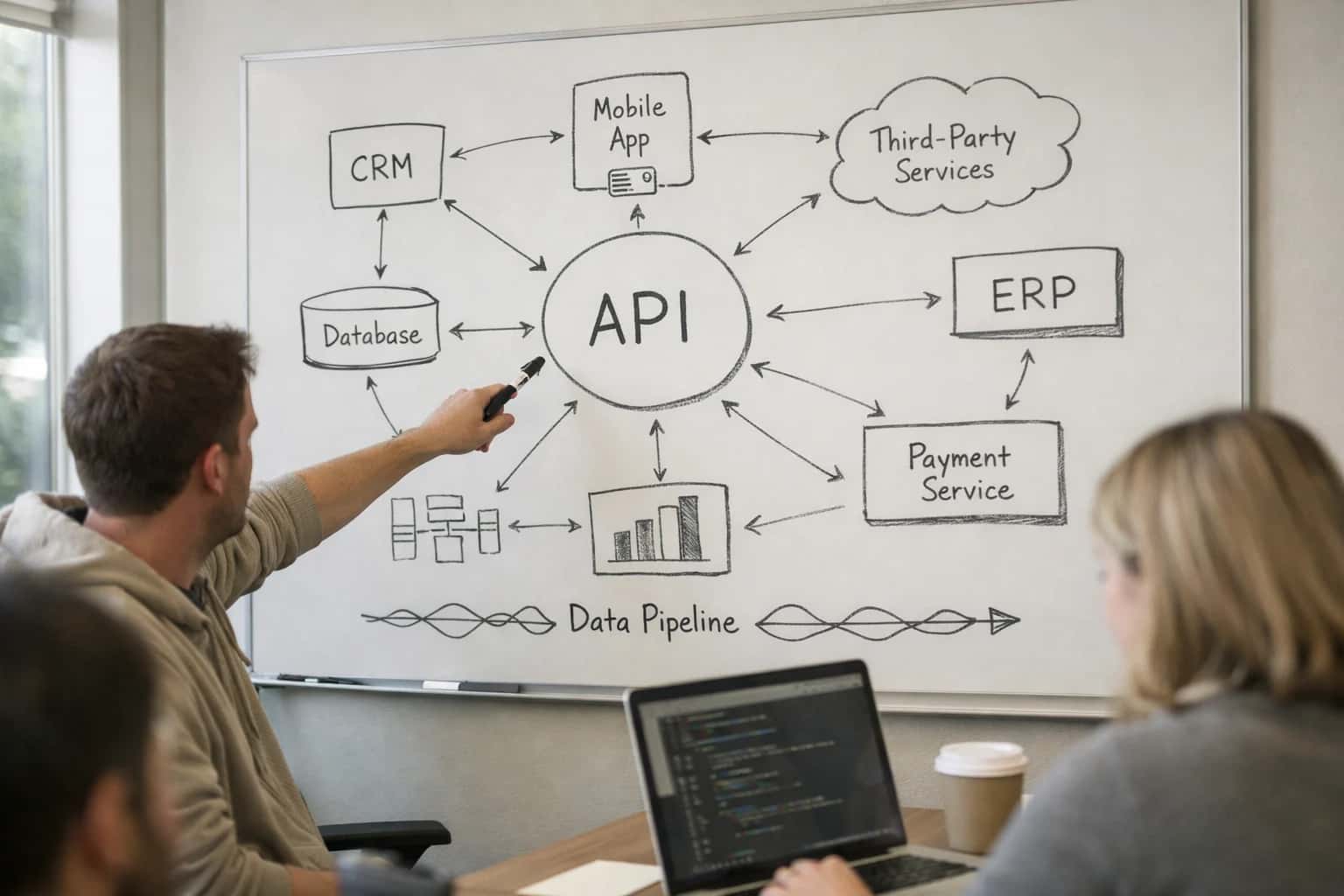
ARCHITECTURE FOR CLOSED-LOOP SALES INTELLIGENCE
Where AI Fits Between Seismic and HubSpot
A technical blueprint for connecting AI across Seismic's content engine and HubSpot's CRM to automate lead scoring, content suggestions, and attribution.
Implementation centers on a middleware service that orchestrates two primary workflows. First, a context-aware content suggestion workflow: when a seller opens a contact in HubSpot, the service calls an AI model that analyzes the contact's industry, deal stage, and recent activity, then queries the Seismic API to return a ranked list of relevant battle cards, case studies, or playbooks. Second, a closed-loop attribution workflow: webhooks from Seismic notify the service when content is consumed; an AI agent classifies the engagement (e.g., 'competitive deep-dive viewed') and updates the corresponding HubSpot deal with a timeline note and a scored 'content influence' property, feeding predictive lead scoring models.
Rollout requires careful governance, starting with a pilot on a single sales pod. Key steps include mapping HubSpot custom property schemas to Seismic content categories, establishing RBAC for which AI-suggested content is permissible for different seller segments, and implementing an audit log for all AI-generated recommendations. The architecture must also handle asynchronous processing via a message queue to manage API rate limits from both platforms and ensure real-time performance for sellers.
ARCHITECTURAL BLUEPRINT
Key Integration Surfaces in Seismic and HubSpot
Seismic Content Library & HubSpot Asset Sync
Integrate AI at the content layer to automate the flow of intelligence between Seismic's asset repository and HubSpot's marketing files. Key surfaces include:
- Seismic Content API: Use webhooks to trigger AI analysis when new assets (presentations, battle cards) are published. Models can auto-tag content with topics, sentiment, and intended buyer personas.
- HubSpot Files API: Push AI-enriched metadata from Seismic to HubSpot, making assets searchable by natural language (e.g., "case study for manufacturing CFOs") within the CRM.
- Unified Asset Lifecycle: Implement an AI agent to monitor engagement metrics from both platforms, identifying stale content in Seismic and archiving corresponding files in HubSpot to maintain a clean, relevant library.
This creates a bi-directional, intelligent content spine where marketing and sales assets are consistently categorized and discoverable.
CLOSED-LOOP SALES INTELLIGENCE
High-Value AI Use Cases for Seismic + HubSpot
Connect AI between your sales enablement platform and CRM to automate content-driven workflows, personalize buyer interactions, and measure content impact on pipeline velocity.
01
AI-Powered Lead Scoring & Content Routing
Analyze HubSpot lead activity and firmographics in real-time to predict content needs. Automatically surface the most relevant Seismic assets (e.g., case studies, one-pagers) into the lead's HubSpot record and trigger personalized email sequences via HubSpot workflows.
Batch -> Real-time
Scoring cadence
02
Dynamic Content for Email Campaigns
Generate hyper-personalized email copy and select optimal Seismic attachments for HubSpot email campaigns. Use AI to tailor messaging based on the recipient's industry, role, and past engagement with Seismic content, increasing open and click-through rates.
1 sprint
Campaign setup time
03
Automated Deal Room Curation
When a HubSpot deal reaches a key stage, trigger an AI workflow to assemble a personalized Seismic LiveSend deal room. The AI curates content based on deal attributes, competitor mentions in notes, and stakeholder roles, then logs all viewer analytics back to the HubSpot timeline.
Hours -> Minutes
Room assembly
04
Closed-Loop Attribution Reporting
Build a unified analytics layer that correlates Seismic content engagement data with HubSpot pipeline movement. Use AI to identify which assets most influence deal progression and win rates, generating actionable insights for content managers and sales leadership in a shared dashboard.
Same day
Insight latency
05
Conversation-Triggered Content Suggestions
Integrate with HubSpot's calling tool or meeting notes. Use AI to analyze conversation transcripts for discussed pain points or competitor names, then instantly recommend relevant Seismic battle cards or objection handlers directly within the HubSpot activity record for the seller's next follow-up.
06
Proactive Content Gap Detection
Continuously analyze HubSpot deal loss reasons and sales feedback against the Seismic content library. Use AI to identify missing assets or outdated materials, automatically generating task tickets in HubSpot for marketing to create new battle cards, case studies, or competitive comparisons.
SEISMIC + HUBSPOT INTEGRATION PATTERNS
Example AI-Powered Workflows
These workflows illustrate how to connect AI models between Seismic's content engine and HubSpot's CRM data to automate high-value sales and marketing operations. Each pattern is built using webhooks, API calls, and orchestration layers that respect existing permissions and data models.
Trigger: A HubSpot deal stage changes to "Decision" or a high-priority task is logged.
Context Pulled:
- HubSpot API fetches deal details (amount, close date, competitor, primary contact role).
- Seismic API searches for content recently engaged with by similar deals (using deal properties as filters).
AI Agent Action: A lightweight orchestration agent uses the combined context to call a model (e.g., GPT-4) with a prompt like:
codeBased on a {industry} deal in the {stage} stage with a competitor of {competitor}, and given these top 3 assets used in similar won deals: {asset_list}, generate a short, actionable recommendation for the sales rep on which asset to send next and why.
System Update: The AI-generated recommendation, along with deep links to the top 2 Seismic assets, is posted to:
- The HubSpot deal timeline as a note.
- The sales rep's Slack/Teams channel via a webhook.
Human Review Point: The rep reviews and clicks to send the asset via Seismic LiveSend, logging the activity back to HubSpot.
CLOSED-LOOP AI FOR SALES CONTENT AND CRM DATA
Implementation Architecture and Data Flow
A production-ready architecture for connecting AI models between Seismic and HubSpot to automate content-driven workflows and attribution.
The core integration pattern establishes a bi-directional data flow between Seismic's content engagement layer and HubSpot's CRM objects (Contacts, Companies, Deals, and Activities). An orchestration service, typically deployed as a cloud function or containerized microservice, listens for key events via webhooks from both systems. From HubSpot, it ingests deal stage changes, contact property updates, and email engagement. From Seismic, it consumes content view, download, and share events linked to a seller and a specific asset. This unified event stream is processed in near-real-time, enabling the AI layer to maintain a contextual understanding of each sales interaction.
The AI service, built on a RAG (Retrieval-Augmented Generation) architecture, uses this fused data to power three primary workflows: 1) Contextual Content Scoring: For an active HubSpot Deal, the model retrieves relevant Seismic assets based on industry, deal stage, and past engagement, scoring and ranking them for the seller. 2) Automated Campaign Suggestions: By analyzing content performance and deal progression patterns, the AI can suggest targeted HubSpot email sequences or marketing campaign triggers, drafting copy snippets populated with high-performing asset links. 3) Closed-Loop Attribution: After a deal closes (won/lost in HubSpot), the system performs a retrospective analysis, correlating Seismic content usage with deal velocity and outcome, generating insights for content managers on what assets drive wins.
Rollout follows a phased approach, starting with a read-only integration to build the unified data lake and train initial models on historical data. Phase two introduces real-time content recommendations surfaced via a custom card in the HubSpot contact/record sidebar, pulling from the Seismic API. Governance is critical; all AI-generated suggestions (like email copy) are presented as drafts for seller review and edit, with a full audit trail logging the source data and model version used for each recommendation. This ensures reps maintain control while gaining productivity, and content strategy is continuously refined with actionable, attributed intelligence.
SEISMIC AND HUBSPOT INTEGRATION PATTERNS
Code and Payload Examples
Automating Lead Scoring with Engagement Data
This workflow uses AI to analyze content engagement from Seismic (e.g., whitepaper downloads, presentation views) and combines it with HubSpot CRM data to calculate a predictive lead score. The AI model evaluates intent signals and updates the HubSpot contact property in real-time.
Example JSON Payload to HubSpot API:
json{ "properties": [ { "property": "ai_lead_score", "value": 87 }, { "property": "content_engagement_summary", "value": "High intent: Viewed competitive battle card (3x) and pricing guide. Recommended action: Sales outreach within 24h." } ] }
The payload is sent via a POST request to the HubSpot Contacts API (/crm/v3/objects/contacts/{contactId}) after the AI service processes Seismic webhook events for content interactions.
AI-ENHANCED SALES ENABLEMENT
Realistic Time Savings and Business Impact
How integrating AI between Seismic and HubSpot transforms key sales and marketing workflows, moving from manual, reactive processes to automated, proactive assistance.
| Metric | Before AI | After AI | Notes |
|---|---|---|---|
Lead Scoring & Qualification | Manual review of HubSpot form data and activity | AI-assisted scoring with Seismic content engagement signals | Scores incorporate which assets a lead consumed, improving fit prediction |
Personalized Campaign Assembly | Hours spent manually selecting assets and drafting emails | Minutes to generate AI-suggested campaign bundles | AI pulls top-performing Seismic content for a given segment; human finalizes |
Content Attribution Reporting | Manual correlation of content usage to deal stages | Automated closed-loop reporting between systems | AI maps Seismic asset views in HubSpot to opportunity progression for insights |
Sales Rep Call Prep | 30-60 minutes searching for relevant case studies and battle cards | <10 minutes with an AI-generated briefing document | AI assembles a one-pager from Seismic and HubSpot data; rep reviews and edits |
Content Gap Analysis | Quarterly manual audit of content library vs. market needs | Continuous AI monitoring of search failures and win/loss themes | Identifies missing assets needed for common objections or new competitor moves |
Follow-Up Task Creation | Rep manually logs next steps after sending content | AI automatically suggests tasks based on content engagement decay | If a lead views a proposal but doesn't open follow-up email, a task is created |
Campaign Performance Review | Weekly manual report compilation from separate systems | Daily automated insight digest with AI-generated hypotheses | Highlights which Seismic asset drove the highest HubSpot meeting bookings |
ARCHITECTING CONTROLLED DEPLOYMENT
Governance, Security, and Phased Rollout
A practical guide to implementing AI between Seismic and HubSpot with security, compliance, and measurable adoption in mind.
A production-ready integration must respect the data models and security boundaries of both platforms. For Seismic, this means securing access to content libraries, user activity logs, and playbook definitions via its OAuth 2.0 APIs and scopes like content.read, analytics.read, and users.read. For HubSpot, AI workflows will interact with CRM objects like Contacts, Companies, Deals, and Engagements, requiring scoped API keys or OAuth tokens with permissions for contacts, deals, and timeline. All AI calls should be proxied through a secure middleware layer that enforces rate limits, logs prompts and responses for audit trails, and redacts sensitive PII or proprietary deal terms before sending data to external models. This layer also manages API key rotation and can enforce data residency rules, ensuring content and CRM data never leaves approved geographic regions.
A successful rollout follows a phased, value-driven approach. Phase 1 (Pilot): Start with a single, high-impact workflow like AI-driven content suggestions in HubSpot. Configure the integration to analyze a HubSpot Contact's industry and deal stage, then query Seismic via semantic search to recommend the top 3 relevant assets, logging the suggestion and any usage back to the Contact's timeline. Run this with a small group of power users for 4-6 weeks. Phase 2 (Expand): Based on pilot feedback, activate closed-loop attribution by using the integration to analyze Seismic content engagement data (e.g., time spent on a proposal) and write a scored signal back to the associated HubSpot Deal property. This creates an AI-generated "content influence score." Phase 3 (Scale & Automate): Introduce more autonomous workflows, such as automated email campaign drafting. Here, the AI analyzes a winning Deal's history in HubSpot, finds top-performing content from Seismic used during the deal, and generates a first-draft "customer story" email sequence for marketing review.
Governance is critical for maintaining trust and compliance. Establish a review board with stakeholders from Sales Ops, RevOps, and Legal to approve new AI use cases, especially those generating customer-facing content. Implement a human-in-the-loop (HITL) approval step for any AI-generated output before it is sent to a prospect or written back to the CRM. For ongoing operations, use the audit logs from your middleware layer to monitor for model drift (e.g., declining relevance of content suggestions) and to track cost per workflow. Finally, create a clear rollback plan; the architecture should allow any AI-driven feature to be disabled via a configuration flag without breaking the core data sync between Seismic and HubSpot, ensuring business continuity.
Enabling Efficiency, Speed & Accuracy
Intelligent Analysis, Decision & Execution
We build AI systems for teams that need search across company data, workflow automation across tools, or AI features inside products and internal software.
Talk to Us
Search across company data
Give teams answers from docs, tickets, runbooks, and product data with sources and permissions.
Useful when people spend too long searching or get different answers from different systems.
Enterprise searchRAGPermissions
Read more
Automate internal workflows
Use AI to route work, draft outputs, trigger actions, and keep approvals and logs in place.
Useful when repetitive work moves across multiple tools and teams.
AI agentsWorkflow automationGovernance
Read more
Add AI to products and internal tools
Build assistants, guided actions, or decision support into the software your team or customers already use.
Useful when AI needs to be part of the product, not a separate tool.
AI integrationDecision supportModel routing
Read moreAI INTEGRATION FOR SEISMIC AND HUBSPOT
Frequently Asked Questions
Practical answers to common technical and strategic questions about connecting AI models between Seismic and HubSpot CRM to automate content-driven workflows.
The integration typically connects at three key layers:
- HubSpot CRM APIs: For reading and writing opportunity, contact, and deal stage data. This provides the business context (e.g.,
deal_stage,industry,amount) that triggers AI workflows. - Seismic Content APIs: For searching, retrieving, and logging engagement with sales assets (presentations, battle cards, case studies). The AI uses these to recommend or assemble relevant content.
- HubSpot Marketing/Engagement APIs: For executing AI-suggested actions, such as sending personalized email sequences from a campaign or updating contact properties with content engagement scores.
A common pattern is to use a middleware service (like an Inference Systems agent) that subscribes to webhooks from both platforms, orchestrates the AI logic, and calls the respective APIs to complete the loop. For example, a deal_stage change in HubSpot triggers an AI agent to find the best Seismic content for that stage, then drafts a follow-up email in HubSpot for the rep to send.

About the author
Prasad Kumkar
CEO & MD, Inference Systems
Prasad Kumkar is the CEO & MD of Inference Systems and writes about AI systems architecture, LLM infrastructure, model serving, evaluation, and production deployment. Over 5+ years, he has worked across computer vision models, L5 autonomous vehicle systems, and LLM research, with a focus on taking complex AI ideas into real-world engineering systems.
His work and writing cover AI systems, large language models, AI agents, multimodal systems, autonomous systems, inference optimization, RAG, evaluation, and production AI engineering.
LinkedIn
Limited slotsGet a Free AI Consultation
Partnered with leading AI, data, and software stack.





How We Work
Custom AI workflows for your Business
One-fit-all AI don't work for modern businesses. At Inferensys, we aim to understand your business & custom requirements; which we use to define most efficient agentic workflows, the data, and the tools for your business.
01
Review the use case
We understand the task, the users, and where AI can actually help.
Read more02
Pick the right approach
We define what needs search, automation, or product integration.
Read more03
Build the first useful version
We implement the part that proves the value first.
Read more04
Improve from there
We add the checks and visibility needed to keep it useful.
Read moreThe first call is a practical review of your use case and the right next step.
Talk to Us