An effective AI integration for sales enablement connects the data and workflows of your core platforms—Seismic for content, Highspot for deal execution, Showpad for coaching, and Mindtickle for readiness—into a single orchestrated layer. This layer acts as a central intelligence hub, using APIs and webhooks to listen for events (e.g., a new opportunity stage in the CRM, a content view in Seismic, a failed assessment in Mindtickle) and trigger context-aware AI actions. The goal is to move from siloed, reactive enablement to a proactive system where the right content, coaching, and training are automatically suggested to the seller based on their live deal context and skill gaps.

Integration
AI Integration for AI-Powered Sales Enablement
A technical blueprint for building an orchestrated AI layer across Seismic, Highspot, Showpad, and Mindtickle to create a unified, intelligent seller experience.
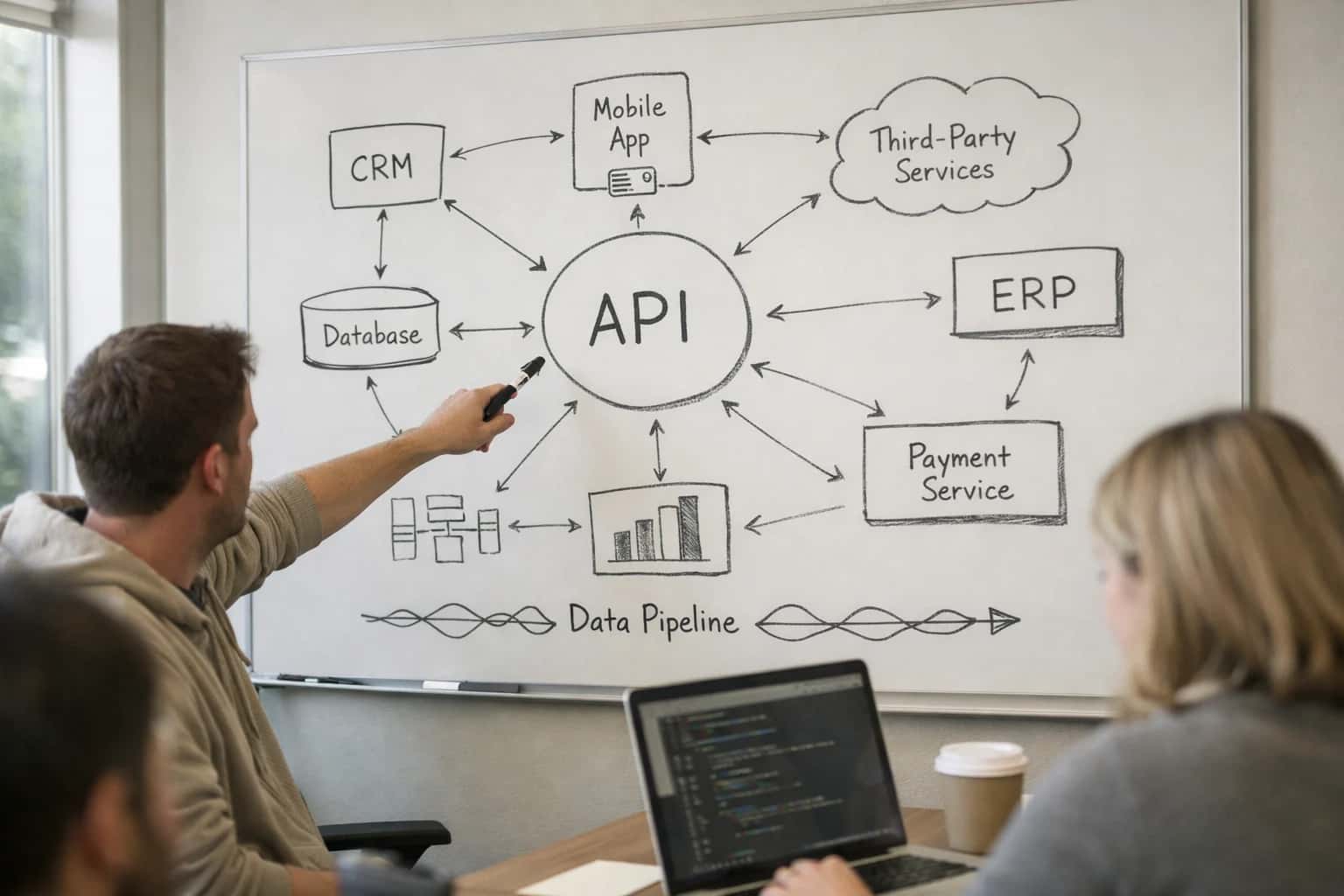
ARCHITECTURAL BLUEPRINT
Building an Orchestrated AI Layer for Sales Enablement
A technical framework for integrating AI across Seismic, Highspot, Showpad, and Mindtickle to create a unified, intelligent seller experience.
Implementation focuses on three key architectural patterns: 1) Unified Retrieval, building a RAG system over combined content libraries from Seismic and Highspot, enabling semantic search across battle cards, playbooks, and case studies; 2) Workflow Automation, using AI agents to listen for triggers (like a Competitor Mentioned event from conversation intelligence) and automatically assemble a competitive battle card from Highspot into a Seismic LiveSend; and 3) Predictive Analytics, correlating data from Showpad coaching feedback and Mindtickle assessment scores with CRM pipeline velocity to predict deal risks and prescribe specific enablement interventions.
Rollout requires a phased, use-case-driven approach. Start with a low-risk, high-impact workflow such as automating the generation of call prep briefs. An AI agent can be triggered 24 hours before a calendar meeting, pulling the opportunity record from Salesforce, recent content engagement from Highspot, and relevant training modules from Mindtickle to generate a personalized one-pager for the seller. This delivers immediate value while building the foundational data pipelines and governance model—including human review gates for AI-generated content and audit logs for all AI actions. Subsequent phases can expand to real-time call coaching and dynamic content personalization, ensuring the AI layer scales with controlled oversight.
ARCHITECTURAL BLUEPRINT
Key Integration Surfaces Across the Enablement Stack
Content & Asset Management
This is the core data layer for AI. Integrations target the content repositories, DAM, and metadata schemas within Seismic, Highspot, Showpad, and Mindtickle. The goal is to transform static libraries into intelligent, queryable knowledge bases.
Key APIs & Objects:
- Asset Upload/Management APIs (for storing AI-generated content)
- Metadata and Tagging APIs (for AI-enriched taxonomy)
- Folder and Permission structures (for governed access)
- Content Lifecycle webhooks (to trigger AI review on publish/archive)
AI Use Cases:
- Semantic Search & RAG: Implement vector embeddings of asset content (PDFs, decks, videos) to enable natural language search ("Find case studies for manufacturing CFOs concerned with ROI").
- Automated Tagging & Categorization: Use LLMs to analyze new assets and auto-assign topics, personas, deal stages, and competitive intel tags.
- Content Gap Analysis: Identify missing assets for key segments or competitive scenarios by comparing query logs against existing content.
- Stale Content Detection: Flag assets that reference outdated pricing, features, or logos based on product release feeds.
INTEGRATION PATTERNS
High-Value AI Use Cases for Sales Enablement
Practical AI integration patterns for Seismic, Highspot, Showpad, and Mindtickle that connect to CRM data, conversation intelligence, and content libraries to automate seller workflows and create a unified intelligence layer.
01
Dynamic Content Recommendation Engine
Integrate AI with Seismic's LiveSend or Highspot's deal rooms to analyze CRM opportunity stage, buyer role, and engagement history. Automatically surface the most relevant case studies, battle cards, and one-pagers, reducing manual search from hours to minutes per deal.
Hours -> Minutes
Content discovery time
02
AI-Powered Call Preparation
Build an assistant that pulls data from Highspot, the CRM, and tools like Gong. Before a meeting, it automatically generates a personalized briefing document with stakeholder insights, competitor talking points, and relevant product differentiators, ensuring reps are consistently prepared.
1 sprint
Typical build time
03
Automated Coaching & Feedback
Integrate AI into Showpad Coaching or Mindtickle to analyze uploaded pitch recordings. Provide automated feedback on messaging clarity, competitor handling, and delivery pace. Suggest targeted training modules from the platform's library to address specific skill gaps.
Batch -> Real-time
Feedback delivery
04
Semantic Asset Search (RAG)
Implement a Retrieval-Augmented Generation (RAG) layer across Seismic, Highspot, and Showpad content libraries. Enable sellers to use natural language queries (e.g., "case studies for manufacturing cost savings") to find assets, bypassing rigid folder structures and outdated tags.
05
Intelligent Content Operations
Use AI to automate Seismic or Showpad content library management. Automatically tag and categorize new assets, identify and flag outdated or underperforming materials, and generate concise summaries for faster seller consumption, freeing enablement teams for strategic work.
Same day
Asset processing
06
Predictive Readiness Scoring
Architect an AI analytics layer atop Mindtickle assessment data, Seismic content engagement, and CRM win/loss data. Generate a predictive sales readiness score for individuals and teams, identifying risk areas before a new product launch or quarter begins.
ARCHITECTURAL PATTERNS
Example AI-Orchestrated Workflows
These workflows illustrate how AI can be woven into the sales enablement stack, orchestrating data between Seismic, Highspot, Showpad, Mindtickle, and CRM systems to create a unified, intelligent seller experience.
Trigger: A sales rep marks an opportunity as moving to the 'Discovery' stage in Salesforce.
Context Pulled: AI agent retrieves the opportunity record (industry, company size, key contacts), recent email exchanges from the CRM, and any past content engagement data from Highspot/Seismic for this account.
Agent Action:
- Uses an LLM to analyze the context and generate a list of relevant topics and buyer pain points.
- Queries the semantic search index (RAG over Seismic/Highspot/Showpad libraries) to find the top 5-7 assets matching those topics.
- Drafts a brief narrative for the deal room explaining why each asset was selected.
System Update: The agent uses the Highspot API to create or update a dedicated deal room, auto-populating it with the curated assets and narrative. It posts a notification in the seller's Slack channel: "Deal room for Acme Corp updated with 7 assets focused on cloud migration ROI."
Human Review Point: The seller reviews the auto-curated room, can add/remove assets, and then shares the finalized link with the prospect.
BEYOND POINT SOLUTIONS
Implementation Architecture: The Central AI Orchestrator
A practical blueprint for building a unified AI layer that orchestrates intelligence across Seismic, Highspot, Showpad, and Mindtickle.
A point integration for a single platform creates an isolated AI silo. The strategic approach is a central AI orchestrator—a dedicated service layer that sits between your core business systems (CRM, ERP) and your sales enablement platforms. This orchestrator ingests data from all sources via APIs and webhooks, applies AI models for analysis and generation, and pushes intelligent actions back into the specific surfaces where sellers work. For example, it can pull opportunity data from Salesforce, combine it with engagement signals from Highspot and training completion from Mindtickle, and then trigger a dynamic playbook assembly in Seismic.
Implementation centers on three core flows: 1. Data Ingestion & Context Building: The orchestrator maintains a real-time view of the seller by syncing user profiles, content libraries, deal stages, and activity logs from each platform's APIs. 2. AI Processing & Workflow Execution: This is where models run—semantic search for asset retrieval, summarization for battle card creation, sentiment analysis on call transcripts for coaching moments. Results are packaged as payloads (e.g., a JSON object with recommended content IDs and talking points). 3. Action Delivery & Feedback Loop: Payloads are delivered to the target platform's API (e.g., creating a deal room in Highspot or updating a learning path in Mindtickle). All AI-driven actions are logged with an audit trail, and subsequent user engagement data is fed back to refine future recommendations.
Rollout is phased. Start with a single, high-impact workflow like AI-powered call prep, connecting the orchestrator to just Highspot and your CRM. This proves value and establishes the integration pattern. Governance is critical: define which AI outputs require human review (e.g., generated battle cards) versus those that can be automated (e.g., content tagging). Use the orchestrator's centralized control to enforce data privacy, manage API rate limits, and provide a single pane for monitoring AI performance across your entire enablement stack. For a deeper look at connecting these intelligence layers, see our guide on AI Integration for Sales Enablement Analytics.
AI-POWERED SALES ENABLEMENT INTEGRATION PATTERNS
Code and Payload Examples
Real-Time Asset Suggestion
Trigger AI-powered content recommendations within a seller's workflow by calling an orchestration service. This service typically queries the CRM for deal context, fetches user activity from the enablement platform, and calls an LLM to rank and return relevant assets.
pythonimport requests # Example payload to an AI orchestration layer recommendation_payload = { "user_id": "rep_12345", "opportunity_id": "opp_67890", "context": { "deal_stage": "proposal", "industry": "financial_services", "mentioned_competitor": "CompetitorX", "buyer_role": "cto" }, "platform": "seismic", # or 'highspot', 'showpad' "limit": 5 } response = requests.post( "https://api.your-ai-service.com/v1/recommend/content", json=recommendation_payload, headers={"Authorization": "Bearer YOUR_API_KEY"} ) # Response includes ranked assets with relevance scores recommended_assets = response.json() # e.g., [{"asset_id": "doc_abc", "title": "...", "score": 0.92, "reason": "Matches competitor mention and buyer role"}]
The AI service uses this context to perform a semantic search across the content library, scoring assets based on relevance to the deal stage, competitor mentions, and buyer persona.
AI-POWERED SALES ENABLEMENT
Realistic Time Savings and Operational Impact
This table illustrates the operational impact of integrating AI across the sales enablement tech stack (Seismic, Highspot, Showpad, Mindtickle), showing how AI shifts workflows from manual and reactive to assisted and proactive.
| Metric | Before AI | After AI | Notes |
|---|---|---|---|
Lead-to-Content Matching | Manual search across multiple libraries | Automated, context-aware recommendations in CRM | Reduces content discovery from 5-10 minutes to seconds |
Call Preparation | 1-2 hours manually assembling briefs and battle cards | AI-generated briefing doc in 5-10 minutes | Assembled from CRM data, past calls, and latest competitive intel |
Sales Coaching Feedback | Manager reviews recordings, provides feedback next day | AI analyzes pitch, provides initial feedback in minutes | Managers review AI summary and add strategic nuance |
Content Lifecycle Management | Quarterly manual audits for stale assets | Continuous AI monitoring flags outdated content | Proactive alerts reduce compliance risk and seller frustration |
Personalized Training Paths | Static 30-60-90 day plans for all new hires | Dynamic learning paths adjust weekly based on assessment data | Accelerates time-to-productivity by 2-3 weeks |
Deal Room Curation | Manual assembly of content for each opportunity stage | AI suggests and auto-populates relevant assets based on deal attributes | Ensures consistency and reduces setup from 1 hour to 15 minutes |
Win/Loss Analysis | Manual review of notes and spreadsheets post-quarter | AI aggregates data from CRM, calls, and content to draft insights | Analysis ready in days instead of weeks, focusing human effort on strategy |
ARCHITECTING A CONTROLLED DEPLOYMENT
Governance, Security, and Phased Rollout
A practical framework for implementing AI across your sales enablement stack with security, compliance, and measurable impact in mind.
A production AI layer for sales enablement must be governed by the same data security and compliance policies as the core platforms it connects. This means implementing strict role-based access control (RBAC) that respects user permissions from Seismic, Highspot, or Mindtickle, ensuring sellers only see AI-generated insights for accounts and content they are authorized to access. All AI interactions—such as content searches, generated battle cards, or coaching feedback—should be logged to an immutable audit trail, linking the activity to a specific user, session, and source data. For platforms handling sensitive information (e.g., in financial services or pharma), AI models should be configured to operate within approved data boundaries, never ingesting PII or confidential deal terms into public model endpoints without proper anonymization and contractual safeguards.
A successful rollout follows a phased, value-driven approach. Start with a pilot focused on a single, high-impact workflow, such as AI-powered content search in Seismic or automated call prep in Highspot for a specific product team. This limits initial complexity and allows you to validate the integration's architecture—typically involving event webhooks from the enablement platform, a secure middleware layer for prompt orchestration and tool calling, and a vector database for RAG over your content library. Measure pilot success through seller adoption metrics and time-saved, not just technical uptime. Subsequent phases can expand to cross-platform orchestration, like correlating Mindtickle training data with Highspot content usage to drive adaptive coaching workflows, ensuring each step delivers clear operational lift before increasing architectural scope.
Finally, establish a continuous governance model. Designate an AI steering committee with members from sales operations, enablement, IT security, and legal to review new use cases, monitor for model drift or performance degradation, and approve prompts and data sources. Use the native analytics and API ecosystems of your enablement platforms to feed performance data back into this governance process. This controlled, iterative approach de-risks the investment and ensures your AI integration evolves as a secure, governed, and indispensable part of the seller's workflow, not a disconnected experiment. For a deeper look at implementation patterns, see our guide on AI Integration for Sales Enablement Platforms.
Enabling Efficiency, Speed & Accuracy
Intelligent Analysis, Decision & Execution
We build AI systems for teams that need search across company data, workflow automation across tools, or AI features inside products and internal software.
Talk to Us
Search across company data
Give teams answers from docs, tickets, runbooks, and product data with sources and permissions.
Useful when people spend too long searching or get different answers from different systems.
Enterprise searchRAGPermissions
Read more
Automate internal workflows
Use AI to route work, draft outputs, trigger actions, and keep approvals and logs in place.
Useful when repetitive work moves across multiple tools and teams.
AI agentsWorkflow automationGovernance
Read more
Add AI to products and internal tools
Build assistants, guided actions, or decision support into the software your team or customers already use.
Useful when AI needs to be part of the product, not a separate tool.
AI integrationDecision supportModel routing
Read moreIMPLEMENTATION BLUEPRINT
Frequently Asked Questions
Practical questions from technical leaders planning to add an AI layer across their sales enablement stack. Answers focus on architecture, data flows, and rollout sequencing.
The most effective pattern is a centralized AI orchestration layer that sits between your core systems of record (CRM, ERP) and your enablement platforms (Seismic, Highspot, etc.).
Typical Architecture:
- Orchestrator: A dedicated service (often built with frameworks like LangChain or CrewAI) that manages prompts, tool calls, and workflows.
- Connectors: Lightweight API clients for each platform (Seismic API, Highspot API, Salesforce REST API).
- Vector Store: A separate database (e.g., Pinecone, Weaviate) for semantic search across unified content from all platforms.
- Event Bus: Listens for webhooks from enablement platforms (e.g.,
content.viewed,playbook.assigned) and CRM (e.g.,opportunity.stage_changed) to trigger AI workflows.
This approach avoids vendor lock-in, centralizes governance, and allows you to build cross-platform intelligence (e.g., correlating Highspot usage with Seismic content performance).

About the author
Prasad Kumkar
CEO & MD, Inference Systems
Prasad Kumkar is the CEO & MD of Inference Systems and writes about AI systems architecture, LLM infrastructure, model serving, evaluation, and production deployment. Over 5+ years, he has worked across computer vision models, L5 autonomous vehicle systems, and LLM research, with a focus on taking complex AI ideas into real-world engineering systems.
His work and writing cover AI systems, large language models, AI agents, multimodal systems, autonomous systems, inference optimization, RAG, evaluation, and production AI engineering.
LinkedIn
Limited slotsGet a Free AI Consultation
Partnered with leading AI, data, and software stack.





How We Work
Custom AI workflows for your Business
One-fit-all AI don't work for modern businesses. At Inferensys, we aim to understand your business & custom requirements; which we use to define most efficient agentic workflows, the data, and the tools for your business.
01
Review the use case
We understand the task, the users, and where AI can actually help.
Read more02
Pick the right approach
We define what needs search, automation, or product integration.
Read more03
Build the first useful version
We implement the part that proves the value first.
Read more04
Improve from there
We add the checks and visibility needed to keep it useful.
Read moreThe first call is a practical review of your use case and the right next step.
Talk to Us