The checkout flow is a dense sequence of data events and decision points. AI integrates by listening to webhooks and polling APIs at key stages: when a cart is created, as items are scanned, during tender selection, and after payment settlement. In platforms like Shopify POS or Square Retail, this means connecting to the Order and Transaction APIs to inject intelligence without disrupting the core payment processing. The functional surface area includes the cart object for dynamic discounts, the tender screen for fraud scoring, and the post-purchase workflow for receipt generation and engagement triggers.

Integration
AI Integration for Retail Checkout Workflows
A technical guide for integrating AI into the transaction surface of retail POS systems to automate discounting, summarize receipts, trigger post-purchase engagement, and accelerate checkout.
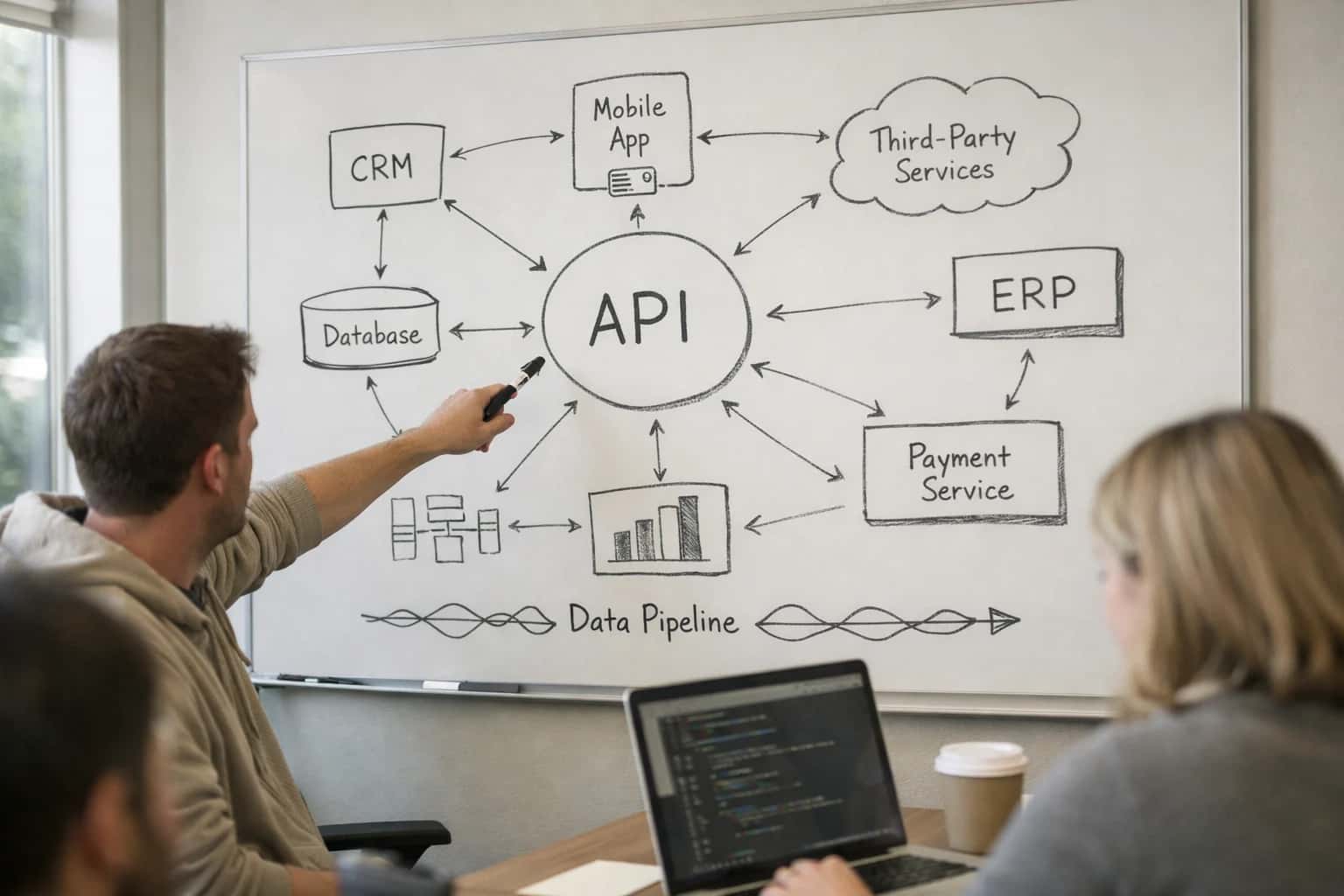
ARCHITECTURE BLUEPRINT
Where AI Fits in the Retail Checkout Flow
A technical breakdown of how AI integrates into the transaction surface of modern POS platforms like Lightspeed, Shopify, Square, and Clover.
Implementation typically involves a middleware layer that subscribes to POS events. For example, as items are added in Lightspeed Retail, an AI agent can evaluate the basket against real-time inventory levels and customer purchase history to suggest a bundled discount or an available substitute for an out-of-stock item—presenting the offer via the POS API before the cashier finalizes the sale. Post-transaction, AI can summarize the receipt into plain language, extract key data for loyalty program updates, and trigger a personalized SMS follow-up by writing back to the customer record. This turns a simple payment terminal into an intelligent engagement node.
Rollout requires a phased approach, starting with read-only analysis of transaction streams to establish baselines, followed by piloting non-critical interventions like receipt summarization. Governance is critical: any AI that modifies a transaction (e.g., applying a discount) must log a detailed audit trail and, for high-value changes, require a cashier override. For enterprise chains, the AI model is often deployed centrally, with inferences served via a low-latency API to ensure consistent behavior across all store endpoints, while respecting local pricing rules and inventory data.
A TECHNICAL BLUEPRINT FOR CHECKOUT WORKFLOWS
AI Integration Points Across Major POS Platforms
Real-Time Decisioning at the Register
This layer integrates AI directly into the payment flow. Key surfaces include the cart object, tender API, and receipt generation modules. Use cases focus on automating manual steps and enhancing security.
Primary Integration Points:
- Cart Evaluation: Analyze the cart composition in real-time via webhook or API call before tender finalization. Apply automated discounts, bundle recommendations, or compliance checks (e.g., age-restricted items).
- Fraud Scoring: Call an AI model with transaction metadata (amount, time, customer history) as the payment is processed. Return a risk score to the POS to trigger manual review or step-up authentication.
- Receipt Intelligence: Post-transaction, send receipt data to an AI service for summarization, expense categorization (for B2B), or to generate a personalized thank-you/next-step email.
Implementation Pattern: A serverless function triggered by a pre_tender webhook from the POS, calling your AI service, and returning a JSON payload with actions (e.g., {"discount_id": "AUTO20", "fraud_flag": false}).
RETAIL POINT OF SALE PLATFORMS
High-Value AI Use Cases for Checkout
Integrating AI directly into the checkout workflow transforms the transaction from a simple payment into a data-rich, automated engagement point. These patterns connect to POS APIs from Lightspeed, Shopify, Square, and Clover to drive efficiency and personalization.
01
Automated Discount & Promotion Application
AI analyzes the live cart, customer history, and active promotions to automatically apply the optimal discount at the register. This reduces manual lookups, ensures policy compliance, and maximizes basket value by surfacing relevant offers like BOGO or loyalty-tier discounts.
Seconds per transaction
Time saved
02
Intelligent Fraud & Policy Screening
Real-time AI models screen transactions for suspicious patterns like rapid gift card purchases, excessive returns, or mismatched payment methods. The POS receives a risk score, allowing staff to approve, flag, or halt the checkout based on configured rules, reducing loss.
Batch -> Real-time
Detection shift
03
Dynamic Upsell & Cross-Sell Recommendations
At the point of payment, an AI agent uses the cart contents and customer purchase history to suggest 1-2 highly relevant add-ons (e.g., 'Customers who bought this grill also purchased this cover'). This is served directly on the POS screen or via the associate's handheld device.
Increase AOV
Primary goal
04
Automated Receipt Intelligence & Follow-Up
Post-transaction, AI parses the digital receipt to categorize items, extract key data, and trigger workflows. This can automate B2B expense reporting, generate personalized thank-you emails with care instructions, or update CRM profiles, turning a receipt into an engagement tool.
Same day
Follow-up timing
05
Real-Time Inventory & Fulfillment Routing
During checkout, AI checks real-time stock levels across all locations and channels. If an item is out locally, it can automatically suggest a nearby store pickup or same-day delivery option, updating the sale and routing the fulfillment task—all before the payment is complete.
Prevent lost sales
Key impact
06
Assisted Selling for Complex Purchases
For big-ticket or configured items (e.g., furniture, electronics), an AI copilot assists the associate at the register. It answers technical questions, checks compatibility, and generates project summaries by accessing product manuals and past orders, improving accuracy and service speed.
Reduce errors
Operational value
IMPLEMENTATION PATTERNS
Example AI-Powered Checkout Workflows
These concrete workflows illustrate how AI integrates with POS APIs and data streams to automate tasks, reduce friction, and enhance the retail transaction experience. Each pattern can be adapted for Lightspeed Retail, Shopify POS, Square Retail, or Clover.
Trigger: Customer scans items at the register.
Context Pulled: The AI agent, listening via POS webhook or API stream, receives the cart contents (SKUs, quantities) and the customer's loyalty ID.
Agent Action:
- Queries the CRM/loyalty platform for the customer's purchase history and segment.
- Cross-references the cart against active promotion rules (e.g., "buy 2, get 20% off", "first-time customer offer", "loyalty tier reward").
- Executes a model to determine the optimal, valid discount to apply, balancing customer value and margin protection.
- Returns a structured payload to the POS:
{ "discount_name": "Loyalty Welcome Offer", "discount_type": "percentage", "value": 15, "target_skus": ["SKU123", "SKU456"] }
System Update: The POS applies the discount automatically before payment. The agent logs the decision and context to an audit trail.
Human Review Point: Cashier can override or confirm. High-value discounts (e.g., >30%) can be flagged for manager approval via a push notification to a supervisor's device.
A TECHNICAL BLUEPRINT FOR PRODUCTION
Implementation Architecture: Wiring AI to Your POS
A practical guide to architecting secure, scalable AI integrations that connect directly to your POS's data and automation layers.
A production-ready AI integration for a retail POS like Lightspeed Retail, Shopify POS, Square Retail, or Clover is built on three core layers: data ingestion, AI orchestration, and action execution. The integration typically consumes real-time webhooks for events like sale.completed or inventory.updated, alongside batch APIs for historical transaction and customer data. This data feeds into a central orchestration service—often built with tools like CrewAI or n8n—where AI models (LLMs, classifiers, forecasters) are applied. The results, such as a dynamic discount recommendation or a predicted reorder quantity, are then written back to the POS via its REST API, often triggering native automations or updating custom object fields for associate dashboards.
For a checkout workflow, the integration surface is precise. An AI agent can be invoked at the cart.updated event to analyze items, apply the most profitable eligible promotion via the discounts API, and suggest add-ons before payment. Post-purchase, another agent listens for receipt.created, summarizes the transaction for a personalized thank-you SMS, and updates the customer's loyalty_tier or next_best_product field in the CRM module. Key to governance is implementing a human-in-the-loop step for high-value actions (e.g., discounts over 25%) and maintaining a full audit log linking the POS transaction ID to the AI's prompt, context, and decision rationale in a system like LangSmith or Arize AI.
Rollout should be phased, starting with a single store or a non-critical workflow like receipt summarization. Use feature flags to control agent activation and establish a rollback plan to disable AI functions via a configuration dashboard. For chain stores, deploy a multi-tenant AI service that respects data isolation, using the location_id from the POS payload to route data and model inferences appropriately. This architecture ensures the AI augments—rather than disrupts—core POS operations, delivering value in days, not quarters. For related patterns on data synchronization, see our guide on POS Inventory Automation or our overview of Enterprise POS AI Solutions.
AI INTEGRATION FOR RETAIL CHECKOUT WORKFLOWS
Code and Payload Examples
Real-Time Discount & Promotion Engine
Integrate an AI model with the POS POST /transaction or POST /cart endpoint to evaluate the current basket and apply the optimal promotion. The model considers cart contents, customer history, inventory levels, and margin targets.
Example Webhook Payload to AI Service:
json{ "transaction_id": "txn_abc123", "store_id": "store_789", "customer_id": "cust_456", "basket": [ { "sku": "TSHIRT-BLK-M", "qty": 2, "unit_price": 29.99 }, { "sku": "SOCKS-STRIPE", "qty": 1, "unit_price": 12.99 } ], "total_before_tax": 72.97, "available_promotions": ["SUMMER20", "BOGO50", "LOYALTY10"] }
AI Service Response: Returns the promotion code and adjusted line items for the POS to apply, ensuring the discount is reflected on the receipt and in reporting.
AI-ENHANCED CHECKOUT WORKFLOWS
Realistic Time Savings and Business Impact
This table illustrates the operational impact of integrating AI into core retail checkout workflows, showing how manual tasks shift to assisted or automated processes, freeing staff for higher-value customer interactions.
| Checkout Workflow | Before AI | After AI | Implementation Notes |
|---|---|---|---|
Discount Application & Validation | Manual code lookup & policy verification | AI-assisted code suggestion & auto-validation | Reduces errors; human override for complex cases |
Receipt Summarization & Insights | Manual review of transaction logs | Automated receipt analysis & customer insight generation | Triggers same-day personalized follow-up campaigns |
Post-Purchase Engagement Trigger | Batch process nightly for email campaigns | Real-time trigger based on cart contents & history | Enables next-hour personalized outreach |
Payment Tender & Fraud Screening | Rule-based alerts with high false positives | AI-scored transaction risk with contextual flags | Reduces manual review by 60-80% for common cases |
Loyalty Point Accrual & Redemption | Manual point calculation & promotion stacking | Automated accrual with optimal redemption guidance | Increases loyalty utilization at point of sale |
Complex Cart & Bundle Pricing | Manual price overrides and manager approvals | AI-guided bundle pricing & automatic compliance | Cuts approval requests for standard bundles |
Return Reason & Policy Validation | Staff reference printed policy documents | AI-assisted reason categorization & policy lookup | Speeds up returns; flags exceptions for review |
ARCHITECTING FOR PRODUCTION
Governance, Security, and Phased Rollout
A secure, governed rollout of AI in retail checkout requires a phased approach that respects transaction integrity and staff workflows.
Production AI for checkout workflows must integrate with the POS platform's existing security model. This means authenticating via OAuth or API keys scoped to specific data objects (like Transaction, Customer, InventoryItem) and never storing raw cardholder data. AI agents should operate as a middleware layer, calling the POS API (e.g., Shopify's GraphQL Admin API, Square's Connect v2 API) to read transaction context and write back actions like applying a discount code or updating a customer profile. All AI-generated actions—such as a dynamic discount or a product recommendation—should be logged in the POS's native audit trail or a separate immutable log tied to the transaction_id for full traceability.
A phased rollout mitigates risk and builds operational confidence. Start with a silent monitoring phase, where the AI analyzes live transaction streams but takes no automated action, allowing you to validate its recommendations (e.g., 'suggested discount: 10%') against staff decisions. Next, move to assisted mode, where recommendations are surfaced to the cashier via a POS pinpad, tablet, or printed receipt for manual approval. The final phase is guarded automation for low-risk, high-volume actions—like auto-applying a targeted loyalty coupon or summarizing a receipt—with clear business rules (e.g., max discount of 5%, only for Tier-2+ loyalty members) and a human-in-the-loop override accessible with one tap.
Governance is critical for compliance and brand consistency. Establish a cross-functional review board (IT, Loss Prevention, Marketing) to approve prompt changes and model updates. Use feature flags controlled from a central dashboard to enable/disable AI features (e.g., receipt_summarization, next_best_offer) by store region, POS terminal, or time of day. For regulated scenarios like age-restricted sales, ensure the AI workflow never bypasses the mandatory ID check; it should only act after the POS system has recorded the compliance step. Rollback plans must be as simple as disabling a feature flag, reverting the checkout UI to its standard workflow within seconds.
Enabling Efficiency, Speed & Accuracy
Intelligent Analysis, Decision & Execution
We build AI systems for teams that need search across company data, workflow automation across tools, or AI features inside products and internal software.
Talk to Us
Search across company data
Give teams answers from docs, tickets, runbooks, and product data with sources and permissions.
Useful when people spend too long searching or get different answers from different systems.
Enterprise searchRAGPermissions
Read more
Automate internal workflows
Use AI to route work, draft outputs, trigger actions, and keep approvals and logs in place.
Useful when repetitive work moves across multiple tools and teams.
AI agentsWorkflow automationGovernance
Read more
Add AI to products and internal tools
Build assistants, guided actions, or decision support into the software your team or customers already use.
Useful when AI needs to be part of the product, not a separate tool.
AI integrationDecision supportModel routing
Read moreIMPLEMENTATION BLUEPRINT
Frequently Asked Questions
Practical questions for technical leaders planning AI integrations into retail checkout systems like Lightspeed, Shopify POS, Square, and Clover.
A production integration typically uses a secure, event-driven architecture:
- Trigger: Configure your POS platform (e.g., Shopify POS webhooks, Square Events API) to send a secure HTTPS POST request to your AI service endpoint upon key events like
transaction.completedorcart.updated. - Context: The webhook payload includes essential, anonymized context:
cart_id,line_items(SKU, quantity),total_amount,customer_id(if known), andstore_location_id. - Secure Processing: Your AI service, hosted in your VPC or a secure cloud, validates the webhook signature, enriches data with internal rules (e.g., margin tables), and calls the LLM via a private endpoint.
- Action & Audit: The AI returns a structured JSON decision (e.g.,
{"action": "apply_discount", "discount_code": "LOYALTY10"}). This is logged with thetransaction_idbefore any system update is made. - System Update: Your middleware applies the action by calling the POS API (e.g.,
POST /v2/orders/{order_id}/discounts) using scoped OAuth tokens. All changes are auditable back to the AI's input and reasoning trace.
Key Consideration: Never stream raw PII to a third-party model. Use tokenization or only send data necessary for the specific decision (e.g., product IDs, not customer names).

About the author
Prasad Kumkar
CEO & MD, Inference Systems
Prasad Kumkar is the CEO & MD of Inference Systems and writes about AI systems architecture, LLM infrastructure, model serving, evaluation, and production deployment. Over 5+ years, he has worked across computer vision models, L5 autonomous vehicle systems, and LLM research, with a focus on taking complex AI ideas into real-world engineering systems.
His work and writing cover AI systems, large language models, AI agents, multimodal systems, autonomous systems, inference optimization, RAG, evaluation, and production AI engineering.
LinkedIn
Limited slotsGet a Free AI Consultation
Partnered with leading AI, data, and software stack.





How We Work
Custom AI workflows for your Business
One-fit-all AI don't work for modern businesses. At Inferensys, we aim to understand your business & custom requirements; which we use to define most efficient agentic workflows, the data, and the tools for your business.
01
Review the use case
We understand the task, the users, and where AI can actually help.
Read more02
Pick the right approach
We define what needs search, automation, or product integration.
Read more03
Build the first useful version
We implement the part that proves the value first.
Read more04
Improve from there
We add the checks and visibility needed to keep it useful.
Read moreThe first call is a practical review of your use case and the right next step.
Talk to Us