Integrating AI with MRI Software is not about replacing the platform, but about injecting intelligence into its operational and financial workflows. The integration typically connects at three key layers: 1) The Data Layer, via MRI's REST APIs and webhooks to securely read from and write to core objects like Leases, Tenants, Work Orders, and GL Transactions. 2) The Automation Layer, where AI agents act as middleware—processing inbound documents, classifying service requests, or generating insights—before creating records or triggering native MRI automations. 3) The User Interface Layer, where AI copilots can be embedded into MRI's web interface via secure iframes or custom widgets, or delivered through side-channel applications like Slack or Teams that sync back via API.

Integration
AI Integration with MRI Commercial Property Management
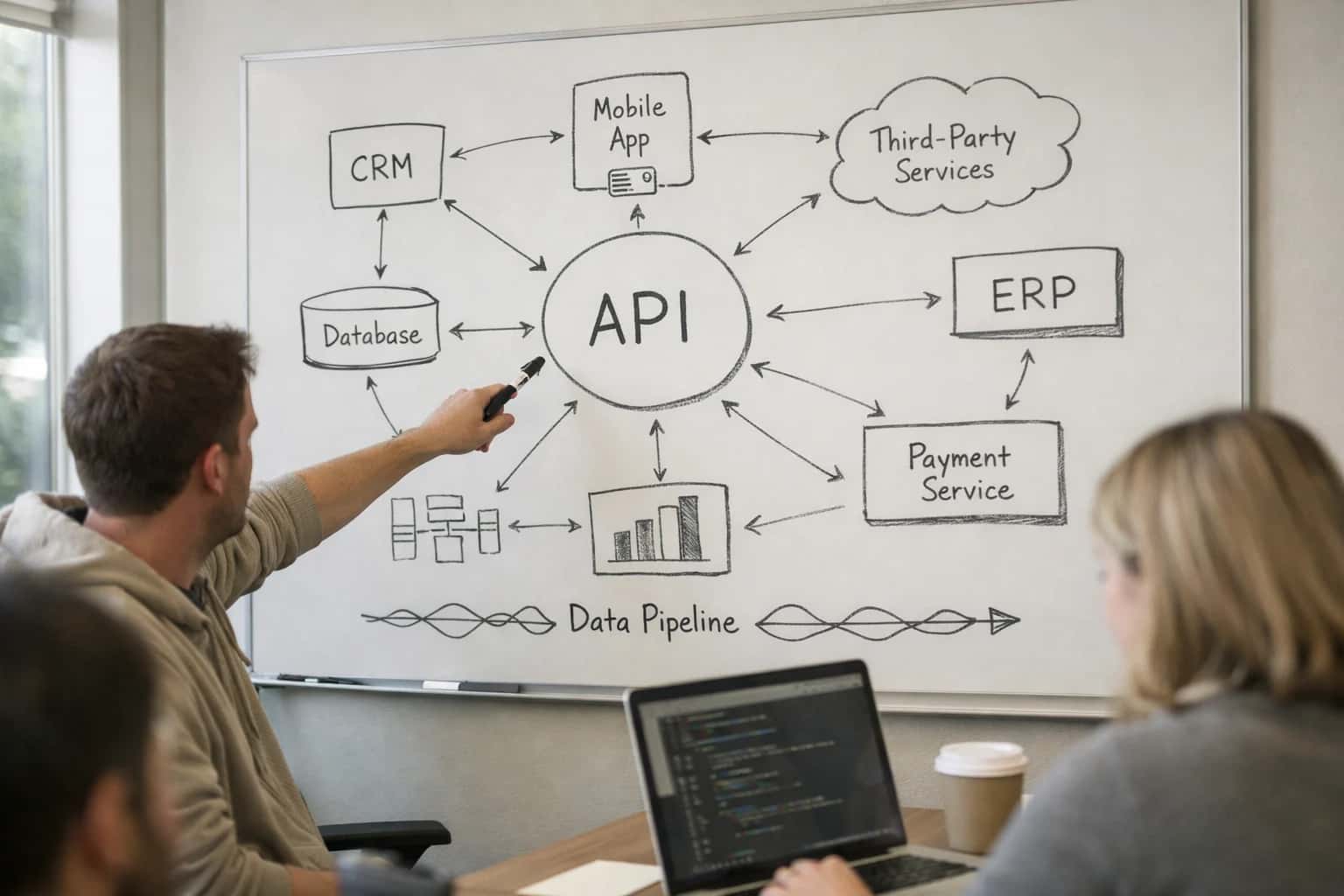
Where AI Fits into MRI's Commercial Real Estate Stack
A practical guide to integrating AI agents and workflows with MRI's property and investment management modules for office, retail, and industrial assets.
For a commercial portfolio, high-impact starting points include Lease Administration and CAM Reconciliation. An AI lease abstraction agent can ingest new lease PDFs via a secured document drop, extract key financial terms (base rent, escalations, options) and critical dates using document intelligence, and push structured data into MRI's lease module, flagging anomalies for human review. For CAM, an AI audit workflow can periodically analyze expense allocations and tenant chargeback calculations by querying MRI's general ledger and lease data, identifying discrepancies or outliers for the property accountant. This turns a quarterly manual slog into a continuous, AI-assisted review.
Rollout should be phased and governed. Start with a single asset or a pilot workflow like automated work order triage from the tenant portal. Implement a human-in-the-loop approval step for all AI-generated MRI record creations (e.g., new work orders, lease abstracts) during the initial phase. Use MRI's robust audit trails in conjunction with your AI platform's logging to maintain a complete chain of custody. As confidence grows, expand to portfolio-wide analytics, where an external AI layer queries MRI's data warehouse to benchmark performance, predict lease renewal likelihood, or forecast capital expenditures, presenting insights back to asset managers via dashboards that complement MRI's native reporting.
Key MRI Modules and Integration Surfaces
Core Financial and Legal Surfaces
Integrating AI with MRI's lease administration module automates the extraction and structuring of critical data from lease PDFs (rent, escalations, options, co-tenancy clauses) directly into the MRI data model. This enables:
- Automated lease abstraction to populate custom fields in the
LeaseandTenantobjects. - Obligation tracking by scanning executed leases for key dates, triggering workflows for rent reviews or renewal options.
- CAM reconciliation support, where AI can audit tenant chargeback calculations against lease language and expense reports.
For accounting, AI agents can connect to the general ledger via MRI's API to perform automated bank reconciliation, flag unusual journal entries, and generate narrative explanations for budget variances in cash flow reports. The integration surface is the suite of financial transaction APIs and the document management repository.
High-Value AI Use Cases for Commercial Portfolios
Integrate AI directly into MRI's operational core for office, retail, and industrial assets. These use cases connect to MRI's APIs for lease administration, tenant accounting, and portfolio management to automate high-effort workflows and surface predictive insights.
Automated CAM Reconciliation & Audit
AI parses complex utility bills, vendor invoices, and lease language to audit Common Area Maintenance (CAM) charges. It flags allocation errors, matches expenses to tenant recovery clauses, and generates preliminary reconciliation reports within MRI, reducing accountant review time from days to hours.
Lease Abstraction & Obligation Tracking
AI document intelligence extracts key dates, clauses (e.g., options, co-tenancy), and financial terms from uploaded lease PDFs, populating structured data fields in MRI. An AI agent then monitors this data to alert asset managers of critical deadlines, expirations, and landlord/tenant obligations.
Tenant Retention & Renewal Prediction
An AI model analyzes MRI tenant data—payment history, service request frequency/tone, lease tenure, and market comparables—to score renewal likelihood. It triggers personalized retention workflows in MRI CRM, suggesting concession strategies or proactive check-ins for at-risk tenants.
Portfolio-Level Cash Flow Forecasting
AI connects to MRI's rent roll and accounts payable data to model short and medium-term cash flow across the portfolio. It factors in lease expirations, market rent projections, and scheduled capital expenditures, providing asset managers with scenario-based forecasts directly in MRI reporting modules.
Intelligent Maintenance Triage & Dispatch
AI classifies incoming work requests from tenant portals or emails by analyzing description text and property history. It automatically creates and prioritizes tickets in MRI, suggests resolutions, and matches complex jobs to pre-qualified vendors in MRI's vendor management system.
Rent Roll Anomaly & Trend Detection
An AI monitor continuously analyzes the MRI rent roll, flagging anomalies like abnormal vacancy spikes in a submarket, below-market rents for comparable units, or missed escalation charges. It delivers insights via MRI dashboards or scheduled alerts, enabling proactive portfolio management.
Example AI-Augmented Workflows
These workflows illustrate how AI agents and automations can connect to MRI's core modules for office, retail, and industrial assets, driving efficiency in lease administration, tenant services, and portfolio operations.
Trigger: A new lease PDF is uploaded to the MRI document repository for a property.
Workflow:
- An AI document processing agent is triggered via webhook or scheduled scan.
- The agent extracts key terms: tenant name, lease commencement/expiration, square footage, base rent, CPI escalations, option periods, and co-tenancy clauses.
- Extracted data is validated against MRI's
LeaseandTenantobjects via the MRI API. - The agent creates or updates the lease record in MRI, populating structured fields.
- Critical Action: The agent creates calendar events and alerts in MRI for key dates (e.g., 90 days before expiration) and triggers automated workflows for renewal outreach or option exercise notices.
Human Review Point: A property manager reviews the abstracted data for high-value or complex leases before the system update is finalized. All changes are logged in MRI's audit trail.
Implementation Architecture: Data Flow and Guardrails
A production-ready AI integration for MRI Commercial Property Management requires a secure, event-driven architecture that respects the platform's data model and operational workflows.
The core integration pattern connects to MRI's RESTful APIs and webhooks, typically focusing on the Property, Lease, Tenant, WorkOrder, and FinancialTransaction objects. An AI middleware layer—hosted in your cloud—acts as the orchestration engine. It listens for events (e.g., a new ServiceRequest created in MRI's maintenance module) via webhooks, processes the data using an LLM or agent, and returns structured actions via API calls back to MRI. For example, an incoming maintenance description can be classified, prioritized, and enriched with suggested resolution steps before the work order ticket is updated. This keeps the "system of record" intact while augmenting it with intelligence.
Data flow must be designed for auditability and control. All AI interactions should be logged with trace IDs, linking the original MRI record (like a LeaseID) to the AI's input, the model call, and the resulting action. For financial workflows like Common Area Maintenance (CAM) reconciliation support, the AI system should operate in a "review mode" initially. It can ingest invoice PDFs and lease abstracts via MRI's document APIs, extract and allocate charges using document intelligence, and generate a proposed reconciliation journal entry. This draft is then pushed into a dedicated queue within MRI (or a connected workflow tool) for human review and approval before final posting, ensuring financial guardrails.
Rollout follows a phased, workflow-specific approach. Start with a single, high-volume, low-risk process such as maintenance ticket triage or lease document summarization. Deploy the AI agent in parallel to existing operations, comparing its classifications or outputs against human decisions to measure accuracy and refine prompts. Use MRI's role-based access controls (RBAC) to ensure AI-generated tasks or insights are only visible to authorized personnel. For tenant retention analytics, the AI layer can periodically query MRI's data warehouse for tenant payment history, service request frequency, and lease renewal dates to generate risk scores, which are then written to custom fields in the Tenant object for use in MRI reporting or triggered campaigns.
Governance is critical. Establish clear data boundaries: the AI system should only access the minimum necessary MRI data via scoped API credentials. For generative tasks like drafting lease amendment language, implement a human-in-the-loop step where the AI's output is presented as a suggestion within the relevant MRI module (e.g., a comment on a Lease record) for final review and action by the lease administrator. This architecture ensures MRI remains the central source of truth while AI delivers operational leverage, from automating lease abstraction to providing predictive insights for asset management.
Code and Payload Patterns
MRI Lease Abstractor API Pattern
Integrate AI to parse and structure key lease data from uploaded PDFs into MRI's lease administration module. The workflow typically involves:
- Document Ingestion: A webhook from MRI triggers when a new lease document is uploaded to a property or tenant record.
- AI Extraction: Your service calls a document intelligence API (e.g., Azure Form Recognizer, Google Document AI) with the PDF URL.
- Data Mapping & Push: Extracted clauses (commencement/expiration dates, rent escalations, CAM provisions, renewal options) are formatted into a JSON payload and posted back to MRI's lease object API to populate custom fields.
json// Example Payload to Update MRI Lease Record { "leaseId": "MRI-LEASE-12345", "customFields": { "ai_lease_start": "2025-01-01", "ai_lease_end": "2029-12-31", "ai_base_rent": 12500.00, "ai_escalation_type": "cpi", "ai_cam_recovery": true, "ai_renewal_option_months": 60, "ai_abstract_summary": "10-year NNN lease with 3% annual CPI adjustments..." } }
This automation turns a manual, multi-hour abstraction process into a reviewed, assisted workflow, ensuring critical dates and financial terms are never missed in portfolio reporting.
Realistic Operational Impact and Time Savings
How AI integration changes day-to-day operations for office, retail, and industrial asset teams, focusing on high-effort administrative workflows.
| Workflow | Before AI | After AI | Implementation Notes |
|---|---|---|---|
Lease Abstract Review | Manual extraction (45-60 min/lease) | Assisted extraction with AI highlighting (15 min/lease) | AI pre-populates key fields in MRI; legal team performs final review. |
CAM Reconciliation Support | Accountant-led audit of 100s of line items | AI anomaly detection flags 5-10 items for review | AI analyzes expense allocations against lease terms; human reviews exceptions. |
Tenant Inquiry Triage | Property manager handles all calls/emails | AI chatbot resolves 40% of common queries | Chatbot integrated with MRI tenant portal; complex issues escalated via API. |
Rent Roll Analysis | Monthly manual spreadsheet analysis | Automated trend report with risk scores | AI queries MRI data nightly; report highlights expirations and AR outliers. |
Service Vendor Invoice Coding | Manual GL code assignment per invoice | AI suggests codes with 90%+ accuracy | AI reads invoice line items; AP clerk confirms before posting to MRI. |
Portfolio Performance Briefing | Days to compile data from multiple reports | AI-generated executive summary in 2 hours | AI aggregates data from MRI Investment Management; highlights variances vs. budget. |
Capital Project Document Review | Manual search across PDFs for specs/approvals | Semantic search finds relevant clauses in seconds | AI indexes project docs in MRI Document Management; links findings to asset records. |
Governance, Security, and Phased Rollout
A production-ready AI integration for MRI Commercial Property Management must be built for institutional-grade security, data privacy, and controlled adoption.
An integration with MRI Commercial Property Management operates on sensitive financial and operational data: lease abstracts, CAM reconciliations, tenant ledgers, and portfolio valuations. The architecture must enforce strict data boundaries, ensuring AI models and agents only access the specific MRI objects and modules (e.g., Lease, Tenant, Charge, Property) required for a given workflow. This is typically achieved via scoped API credentials, with all data in transit encrypted and prompts engineered to avoid exposing raw PII or financials to the LLM. A key governance layer is a centralized audit log that records every AI-generated action—whether it's a suggested lease abstraction, a flagged reconciliation variance, or a tenant communication—back to the initiating user and source data in MRI.
Rollout follows a phased, risk-managed approach. Phase 1 often starts with a read-only AI analytics agent for portfolio managers, querying MRI data to generate narrative summaries of rent roll health or lease expiration cliffs, with no system writes. Phase 2 introduces assisted workflows, such as an AI copilot for lease administrators that suggests abstracted clauses from uploaded PDFs but requires human review and approval before writing to MRI's Lease Administration module. Phase 3 enables conditional automation for high-volume, low-risk tasks, like using AI to classify and route incoming tenant service emails to the correct MRI Work Order queue, with a defined human-in-the-loop escalation path for low-confidence classifications.
Security is paramount. The integration should leverage MRI's native authentication (OAuth 2.0) and respect its role-based access controls (RBAC), ensuring AI tools cannot act beyond the permissions of the logged-in user. For instance, a property accountant's AI assistant can only access financial data for their assigned assets. All AI-generated outputs, especially those touching financial operations like CAM reconciliation support, should be clearly watermarked as AI-assisted and stored within MRI's audit trail or a linked system of record. This controlled, phased deployment mitigates risk while delivering incremental value, turning MRI from a system of record into a system of intelligence.
Enabling Efficiency, Speed & Accuracy
Intelligent Analysis, Decision & Execution
We build AI systems for teams that need search across company data, workflow automation across tools, or AI features inside products and internal software.
Talk to Us
Search across company data
Give teams answers from docs, tickets, runbooks, and product data with sources and permissions.
Useful when people spend too long searching or get different answers from different systems.

Automate internal workflows
Use AI to route work, draft outputs, trigger actions, and keep approvals and logs in place.
Useful when repetitive work moves across multiple tools and teams.

Add AI to products and internal tools
Build assistants, guided actions, or decision support into the software your team or customers already use.
Useful when AI needs to be part of the product, not a separate tool.
Frequently Asked Questions
Practical questions for technical teams and portfolio managers planning AI integrations with MRI Commercial Property Management for office, retail, and industrial assets.
AI integrations typically connect via MRI's REST APIs (e.g., the Leases and Tenants endpoints) and webhooks. The core workflow involves:
- Trigger: A new lease document is uploaded to MRI's document repository or a lease record is created/modified.
- Context Pulled: The integration retrieves the lease PDF via API and fetches associated tenant, unit, and financial term data from the
Leasesobject. - Agent Action: A document intelligence agent (using models like GPT-4o or Claude 3) extracts key clauses, dates (commencement, expiration, option periods), rent escalations, CPI adjustments, and CAM responsibilities.
- System Update: The structured data is mapped and pushed back to populate custom fields in the MRI lease record or to a linked audit/compliance module. Critical dates are added to the MRI calendar for alerts.
- Human Review Point: The extracted terms are presented in a summary dashboard for the lease administrator to verify before finalizing the MRI record update. Discrepancies can be corrected, teaching the model for future leases.
This turns a manual, multi-hour abstraction process into a reviewed task completed in minutes.

About the author
Prasad Kumkar
CEO & MD, Inference Systems
Prasad Kumkar is the CEO & MD of Inference Systems and writes about AI systems architecture, LLM infrastructure, model serving, evaluation, and production deployment. Over 5+ years, he has worked across computer vision models, L5 autonomous vehicle systems, and LLM research, with a focus on taking complex AI ideas into real-world engineering systems.
His work and writing cover AI systems, large language models, AI agents, multimodal systems, autonomous systems, inference optimization, RAG, evaluation, and production AI engineering.
Partnered with leading AI, data, and software stack.





How We Work
Custom AI workflows for your Business
One-fit-all AI don't work for modern businesses. At Inferensys, we aim to understand your business & custom requirements; which we use to define most efficient agentic workflows, the data, and the tools for your business.
01
Review the use case
We understand the task, the users, and where AI can actually help.
Read more02
Pick the right approach
We define what needs search, automation, or product integration.
Read more03
Build the first useful version
We implement the part that proves the value first.
Read more04
Improve from there
We add the checks and visibility needed to keep it useful.
Read moreThe first call is a practical review of your use case and the right next step.
Talk to Us