The core integration surfaces are Wrike Request Forms and ServiceNow Catalog Items. An AI agent acts as a triage and translation layer, sitting between the two platforms via webhooks. When a user submits a ServiceNow request (e.g., 'New Marketing Website Project'), the AI analyzes the free-text description, attached files, and configured variables. It then maps this to a structured Wrike Blueprint, intelligently populating custom fields like Project_Type, Estimated_Complexity, Initial_Scope_Elements, and Suggested_Folder within the new Wrike project. This replaces manual intake and scoping meetings, converting a ticket into a ready-to-execute project plan in minutes.

Integration
AI Integration for Wrike and ServiceNow Integration
Architectural blueprint for an AI-powered bridge between Wrike and ServiceNow, automating the conversion of IT requests into projects and feeding real-time project status back into incident or change records.
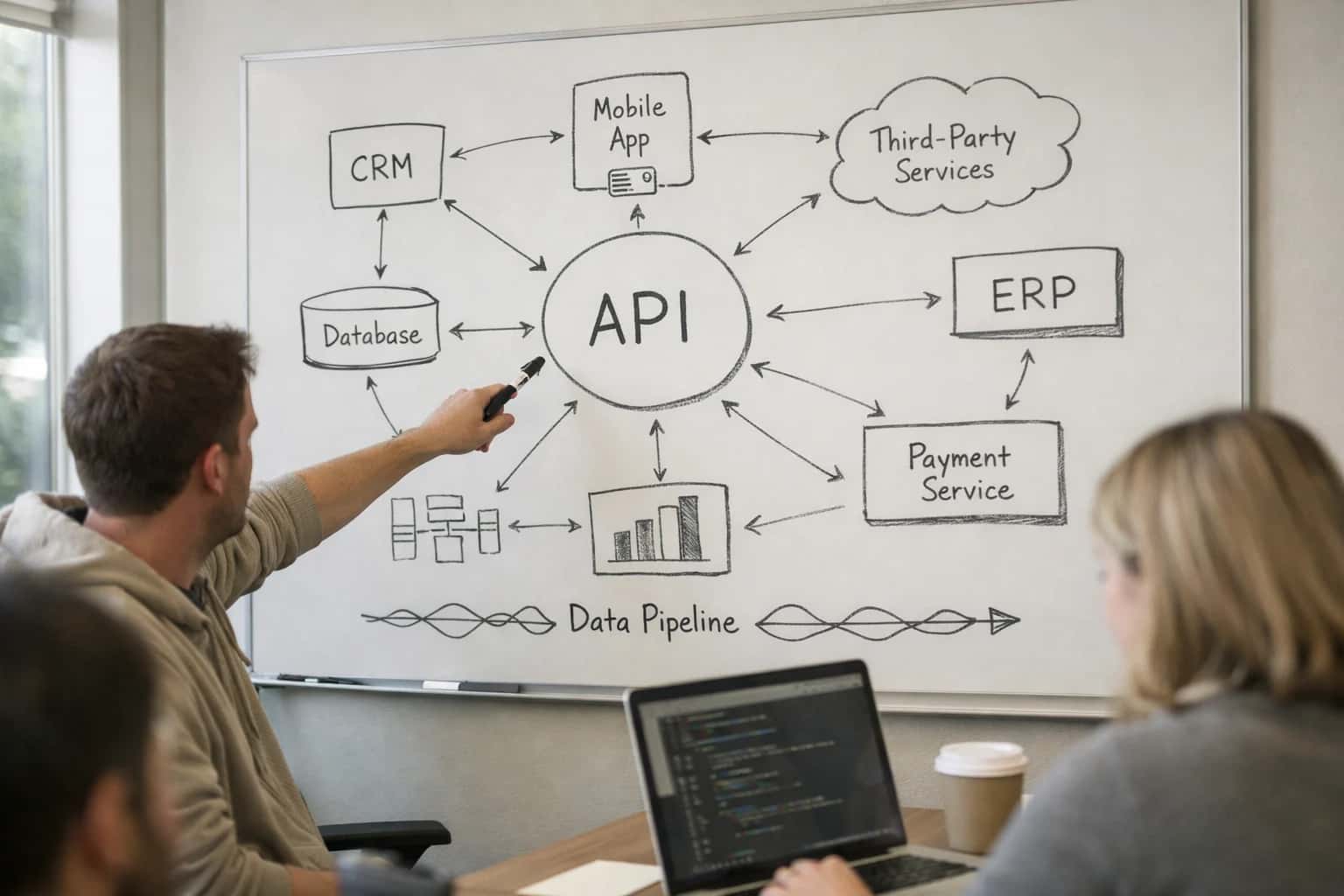
ARCHITECTURE FOR INTELLIGENT WORKFLOW ORCHESTRATION
Where AI Fits in the Wrike-ServiceNow Bridge
An AI layer transforms a simple data sync into an intelligent workflow engine, automating the handoff between IT service requests and project delivery.
In the reverse direction, AI monitors key Wrike Custom Fields (Status, % Complete, Budget_Health, RAG_Status) and task comments. Instead of simply posting status updates to the linked ServiceNow Incident or Change Request, an AI summarization agent analyzes the project's pulse. It generates a concise, actionable summary—'Development is 2 days behind due to API dependency; budget is on track'—and posts it as a work note. This gives IT stakeholders immediate, contextual insight without needing to log into Wrike, closing the feedback loop and enabling proactive risk management on the service side.
Governance is critical. This AI bridge should be implemented as a dedicated microservice with its own audit log, tracking every classification decision and summary generated. It should support a human-in-the-loop review for high-impact or high-cost request types before project creation. The system's prompts and classification logic must be version-controlled and tied to the Wrike Blueprint and ServiceNow Catalog Item lifecycle, ensuring the AI's mapping remains accurate as business processes evolve. This controlled, observable approach turns a point-to-point integration into a scalable, intelligent orchestration layer for IT-driven work.
ARCHITECTURAL BLUEPRINTS
Key Integration Surfaces in Each Platform
ServiceNow Incident, Change, and Service Catalog
AI integration surfaces here focus on intake automation and status synchronization. The primary objects are Incident, Change Request, and Service Catalog Item. An AI agent can be triggered via a ServiceNow Flow or inbound email action to:
- Parse and triage incoming Wrike project requests (e.g., "new marketing website") against the Service Catalog.
- Auto-create a Change Request or standard project record in ServiceNow, pre-populating fields like category, priority, and requester from the Wrike request.
- Monitor the linked ServiceNow record for status changes (e.g., Change
statemoving toClosed Complete) and push that update back to the corresponding Wrike task or custom field.
This creates a closed-loop where IT governance is maintained in ServiceNow, while project execution visibility lives in Wrike.
WRIKE + SERVICENOW
High-Value AI Use Cases for the Integration
An AI-powered bridge between Wrike and ServiceNow automates the bi-directional flow of work, turning IT requests into structured projects and feeding project status back into service records. These cards detail specific workflows where AI adds intelligence, reduces manual handoffs, and accelerates delivery.
01
Intelligent Request-to-Project Conversion
AI analyzes incoming ServiceNow Incident, Service Request, or Change records. Using natural language understanding, it classifies the request, estimates effort, and automatically creates a corresponding Wrike project or folder with pre-populated custom fields, task templates, and assigned teams. This turns a manual triage and scoping process into a same-day project kickoff.
Days -> Hours
Project Setup
02
Automated Status Sync & Stakeholder Updates
An AI agent monitors key Wrike project metrics—timeline health, budget burn, and task completion—and synthesizes progress into concise, role-based summaries. It then updates the linked ServiceNow record (e.g., Change Request) and can post comments or send notifications to stakeholders in ServiceNow. This eliminates manual status reporting and keeps ITIL records current.
Real-time
Record Sync
03
AI-Powered Risk Detection & Escalation
Continuously analyzes Wrike task descriptions, comments, and timeline slippage to identify project risks. When a high-priority risk is detected (e.g., critical path delay), the AI automatically creates a Problem or Risk record in ServiceNow, pre-populated with context from Wrike, and triggers an escalation workflow to the appropriate IT manager or CAB.
Proactive
Issue Prevention
04
Resource Capacity Forecasting
AI models consume data from both systems: team assignments from Wrike and incident/request volume from ServiceNow. It forecasts future IT resource capacity, identifying potential overallocation. The system can suggest resource adjustments in Wrike or recommend pausing low-priority Change requests in ServiceNow to maintain service levels.
Predictive
Planning
05
Change Implementation Post-Mortem Automation
After a Wrike project linked to a ServiceNow Change is marked complete, AI analyzes the project's actual vs. planned effort, timeline, and communication threads. It automatically generates a lessons-learned summary and attaches it to the Change record in ServiceNow. This creates a searchable knowledge base for future change planning and improves ITIL maturity.
Automated
Knowledge Capture
06
Unified Natural Language Query Interface
Deploy a copilot interface that allows users in either platform to ask questions like, 'What's the status of the firewall upgrade project?' or 'Show me all high-priority changes impacting the network team this month.' The AI query engine joins data from Wrike and ServiceNow APIs in real-time, returning a synthesized answer, bridging the gap between project delivery and IT service management contexts.
Cross-Platform
Visibility
BRIDGING IT OPERATIONS AND PROJECT DELIVERY
Example AI-Powered Workflows
These concrete workflows illustrate how an AI layer can automate the handoff between ServiceNow's IT service management and Wrike's project execution, reducing manual coordination and accelerating delivery.
Trigger: A new ServiceNow Incident (P1/P2) or Standard Change Request is approved and requires a formal project.
AI Agent Action:
- Context Retrieval: The agent uses the ServiceNow API to fetch the request details (description, attachments, CI, requester, priority, category).
- Classification & Scoping: An LLM analyzes the request to:
- Classify the project type (e.g., "Infrastructure Upgrade," "Security Remediation," "Application Deployment").
- Extract key deliverables, success criteria, and implied tasks from the description and any attached documents.
- Estimate initial effort level (Small, Medium, Large) based on historical similar requests.
- Wrike Project Creation: The agent calls the Wrike API to:
- Create a new project in the appropriate folder (e.g., "IT Initiatives").
- Auto-populate the project title, description, and custom fields (e.g.,
ServiceNow Ticket ID,Business Priority,Estimated Tier). - Generate and populate the initial task structure (milestones and subtasks) based on the scoping analysis.
- Assign the project to the designated IT PMO group.
- Bi-Directional Link: The agent writes back the new Wrike Project ID and URL into a custom field on the original ServiceNow record, creating an auditable link.
Human Review Point: The assigned project manager reviews the auto-generated project plan in Wrike for accuracy and makes adjustments before kicking off execution.
BRIDGING IT SERVICE AND PROJECT DELIVERY
Implementation Architecture: Data Flow and Guardrails
A secure, event-driven architecture for an AI-powered bridge between ServiceNow and Wrike.
The integration is built on a centralized orchestration layer that listens for events from both platforms via webhooks. Key data flows include:
- ServiceNow to Wrike: When a new
RITM(Requested Item) orCHG(Change) record is approved, the AI agent analyzes the short description, notes, and attached documents to classify the request type, estimate effort, and generate a structured project brief. It then uses the Wrike API to create a corresponding project in the correct folder, populating custom fields likeBusiness Impact,Estimated Story Points, andLinked SNOW Record ID. - Wrike to ServiceNow: As tasks within the Wrike project are updated (e.g., status changes to "Completed" or custom fields like
Blockedare set), the agent synthesizes this activity. It posts summarized progress comments back to the linked ServiceNow record and can automatically update thework_notesandstatefields (e.g., setting a parent Change toImplementwhen key milestones are met).
Governance and guardrails are implemented at multiple levels to ensure reliability and compliance:
- Approval Gates: The AI agent can be configured to require human-in-the-loop approval before creating high-effort projects or updating critical ServiceNow states. This is managed via a lightweight internal dashboard or by creating approval tasks in Wrike itself.
- Data Validation & Fallbacks: The system performs schema validation on all incoming webhook payloads. If the AI's classification confidence score for a new request falls below a configured threshold, the item is routed to a "Triage" folder in Wrike for manual review instead of auto-creating a project.
- Audit Trail: Every AI-generated action is logged with a trace ID in a separate audit database, linking the source ServiceNow sys_id, the target Wrike task ID, the prompt used, and the model's reasoning. This supports compliance reviews and debugging.
Rollout is typically phased, starting with a single, high-volume request type (e.g., "New Software Access") in a pilot team's ServiceNow queue. This allows for tuning of the classification model and workflow rules before scaling to other request catalogs (SC_REQ_ITEM) or Change types. The architecture is designed to be extended; for example, the same orchestration layer can be adapted to feed Wrike project completion status back into ServiceNow's Strategic Portfolio Management (SPM) module for portfolio-level reporting. For related integration patterns, see our guides on AI Integration for ServiceNow and AI Integration for Wrike Automation.
AI-POWERED BRIDGE ARCHITECTURE
Code and Payload Examples
Automating Project Initiation from IT Requests
When a high-priority Incident or Change Request is approved in ServiceNow, an AI agent can analyze the description, attachments, and CMDB data to create a structured Wrike project. The agent classifies the work, estimates effort, and populates Wrike custom fields for priority, resource type, and expected duration.
Example JSON Payload (ServiceNow Outbound Webhook):
json{ "event": "incident.priority_updated", "record": { "number": "INC0012345", "short_description": "Database performance degradation impacting checkout", "description": "Customers report timeout errors during payment...", "priority": "1", "category": "performance", "configuration_item": "PROD-DB-01", "assigned_to": "[email protected]" } }
Python Handler for AI Classification & Wrike Creation:
python# Pseudo-code for the integration agent incident_data = parse_webhook(request) # AI step: Classify & structure the request ai_prompt = f"""Based on this IT incident, create a project brief: Title, key deliverables, estimated complexity (High/Medium/Low), and required skills. Incident: {incident_data['description']}""" project_brief = call_llm(ai_prompt) # Map to Wrike's API wrike_payload = { "title": f"[INC{incident_data['number']}] {project_brief['title']}", "description": project_brief['summary'], "customFields": [ {"id": "priority_field_id", "value": incident_data['priority']}, {"id": "complexity_field_id", "value": project_brief['complexity']}, {"id": "source_ticket", "value": incident_data['number']} ], "project": { "ownerIds": [resolve_wrike_user(incident_data['assigned_to'])] } } create_wrike_project(wrike_payload)
AI-POWERED BRIDGE BETWEEN WRIKE AND SERVICENOW
Realistic Time Savings and Operational Impact
This table illustrates the operational impact of implementing an AI agent to automate the bi-directional flow of data and actions between Wrike (project delivery) and ServiceNow (IT service management).
| Workflow / Metric | Before AI Integration | After AI Integration | Implementation Notes |
|---|---|---|---|
IT Request to Project Creation | Manual review, copy/paste, 30-60 mins per request | Automated parsing & project draft in 2-5 mins | AI analyzes ServiceNow ticket, classifies request type, and auto-creates a Wrike project with pre-filled custom fields. |
Project Status Sync to Incident/Change Record | Manual email or comment updates, often delayed | Real-time sync upon status change in Wrike | AI monitors Wrike project health, writes summary back to linked ServiceNow record, keeping stakeholders informed. |
Resource Assignment & Routing | Manager reviews skills and availability across systems | AI suggests optimal assignee based on Wrike workload & ServiceNow CMDB | Human final approval required; reduces manual cross-referencing by 70%. |
Change Advisory Board (CAB) Prep | Manual compilation of project impact data from emails and Wrike | Automated briefing doc generated 1 hour before meeting | AI pulls timeline, risk, and resource data from Wrike to populate a standardized CAB template in ServiceNow. |
Project Closure & Knowledge Capture | Manual documentation and linking of lessons learned | Auto-generated closure summary and linked knowledge article | AI summarizes project outcomes, key decisions, and creates a draft ServiceNow KB article for future reference. |
Initial Triage & Priority Scoring | ServiceNow assignment based on basic categorizations | AI-enhanced scoring using Wrike portfolio context | Considers active project load, strategic goals, and resource constraints from Wrike to recommend ServiceNow priority. |
ARCHITECTING A CONTROLLED AI BRIDGE
Governance, Security, and Phased Rollout
A practical blueprint for implementing a secure, governed AI integration between Wrike and ServiceNow.
A production-ready AI bridge requires a clear separation of concerns and audit-first design. In this architecture, the AI agent acts as an orchestration layer, not a data store. It receives webhook events from Wrike (e.g., a new request form submission in a designated folder) and ServiceNow (e.g., a change request state update). The agent's core logic—using LLM APIs—analyzes the incoming payload against predefined rules (e.g., "Is this a standard IT hardware request?") to determine the required action, such as creating a corresponding project in Wrike or posting a status comment to a ServiceNow record. All prompts, decisions, and generated outputs (like project descriptions or field mappings) are logged to a dedicated audit table before any API calls are made to write back to the systems. This ensures every automated action is traceable and can be manually overridden if needed.
Security is enforced at multiple levels. The integration uses OAuth 2.0 service accounts with role-based access control (RBAC) scoped to the minimum necessary permissions in both platforms—typically project.creator and task.editor in Wrike and itil or change_manager roles in ServiceNow. Sensitive data, like free-text request descriptions, is processed in-memory by the AI model and is never persisted in the integration layer's logs. For initial phases, implement a human-in-the-loop approval step for all AI-generated project creations or status updates. This can be a simple approval queue in a separate dashboard or a mandatory email confirmation to the project sponsor before the ServiceNow-Wrike sync is executed, building trust in the automation.
A phased rollout is critical for adoption and risk management. Start with a pilot workflow, such as automating the creation of Wrike projects from ServiceNow RITM (Requested Item) records that match a specific category. Run this in shadow mode for 2-4 weeks, where the AI agent generates project drafts and recommendations but does not perform the create/update actions; instead, it logs what it would have done. Review these logs with the IT and PMO teams to refine the logic. For phase two, enable automated creation with a notification-only step, alerting the assigned project manager. Finally, phase three expands to bi-directional status sync, where key milestones in Wrike (e.g., a "Project Phase" custom field change) automatically post updates to the linked ServiceNow CHG task, closing the feedback loop. Governance is maintained through a regular review of the audit logs and accuracy metrics, ensuring the AI agent's decisions remain aligned with operational policies.
Enabling Efficiency, Speed & Accuracy
Intelligent Analysis, Decision & Execution
We build AI systems for teams that need search across company data, workflow automation across tools, or AI features inside products and internal software.
Talk to Us
Search across company data
Give teams answers from docs, tickets, runbooks, and product data with sources and permissions.
Useful when people spend too long searching or get different answers from different systems.
Enterprise searchRAGPermissions
Read more
Automate internal workflows
Use AI to route work, draft outputs, trigger actions, and keep approvals and logs in place.
Useful when repetitive work moves across multiple tools and teams.
AI agentsWorkflow automationGovernance
Read more
Add AI to products and internal tools
Build assistants, guided actions, or decision support into the software your team or customers already use.
Useful when AI needs to be part of the product, not a separate tool.
AI integrationDecision supportModel routing
Read moreIMPLEMENTATION AND ARCHITECTURE
Frequently Asked Questions
Common technical and operational questions about building an AI-powered bridge between Wrike and ServiceNow to automate IT-to-project workflows and bidirectional status synchronization.
The core automation is triggered by a status change in ServiceNow (e.g., Incident state changes to 'Approved for Project').
- Trigger: A ServiceNow webhook fires on the state change, sending the Incident
sys_id, summary, description, and priority to a secure endpoint. - Context Enrichment: The AI agent uses the ServiceNow REST API to pull additional context:
- Configuration Item (CI) details
- Assignment group and affected users
- Work notes and comments from the incident timeline
- Project Scoping & Creation: The LLM analyzes the incident data to:
- Generate a project title and description for Wrike.
- Propose a high-level task structure (e.g., 'Assessment', 'Implementation', 'Validation', 'Communication').
- Estimate initial effort (T-shirt sizing) based on priority and complexity.
- System Update: The agent uses the Wrike API to:
- Create a new project in the appropriate folder (e.g., 'IT Initiatives').
- Create the proposed tasks as a Blueprint.
- Populate custom fields:
ServiceNow Incident ID,Business Impact,Target Resolution Date.
- Human Review Point: The Wrike project is initially created in a 'Draft' status. A notification is sent to the assigned IT Project Manager in Wrike to review the AI-generated scope, adjust tasks, and activate the project.

About the author
Prasad Kumkar
CEO & MD, Inference Systems
Prasad Kumkar is the CEO & MD of Inference Systems and writes about AI systems architecture, LLM infrastructure, model serving, evaluation, and production deployment. Over 5+ years, he has worked across computer vision models, L5 autonomous vehicle systems, and LLM research, with a focus on taking complex AI ideas into real-world engineering systems.
His work and writing cover AI systems, large language models, AI agents, multimodal systems, autonomous systems, inference optimization, RAG, evaluation, and production AI engineering.
LinkedIn
Limited slotsGet a Free AI Consultation
Partnered with leading AI, data, and software stack.





How We Work
Custom AI workflows for your Business
One-fit-all AI don't work for modern businesses. At Inferensys, we aim to understand your business & custom requirements; which we use to define most efficient agentic workflows, the data, and the tools for your business.
01
Review the use case
We understand the task, the users, and where AI can actually help.
Read more02
Pick the right approach
We define what needs search, automation, or product integration.
Read more03
Build the first useful version
We implement the part that proves the value first.
Read more04
Improve from there
We add the checks and visibility needed to keep it useful.
Read moreThe first call is a practical review of your use case and the right next step.
Talk to Us