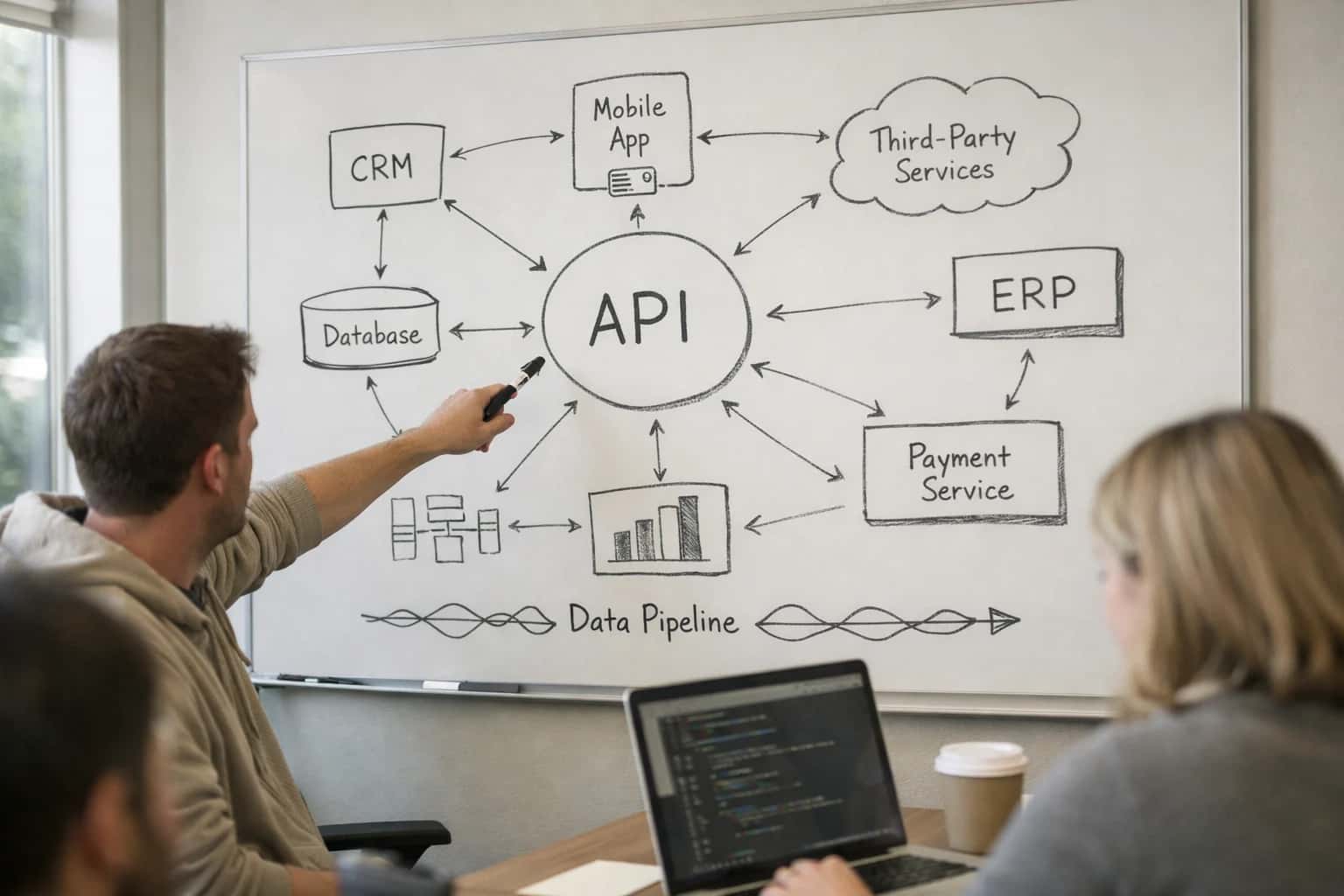
The integration between Smartsheet (for project tracking) and QuickBooks (for financials) typically relies on scheduled syncs or manual exports, leaving a gap for intelligent analysis and exception handling. AI fits into three key surfaces: 1) The Smartsheet Row, where project financial data (budget, actual hours, vendor costs) lives in custom columns; 2) The QuickBooks API, which exposes invoices, bills, and general ledger accounts; and 3) The middleware layer (often a workflow automation tool or custom service bus) that orchestrates the sync. An AI agent acts as a reconciliation copilot here, monitoring this data flow for mismatches, generating draft invoices from approved Smartsheet rows, and flagging budget variances before they post.

Integration
AI Integration for Smartsheet and QuickBooks Integration
A technical blueprint for adding an AI layer between Smartsheet and QuickBooks to automate project financial reconciliation, invoice generation, and budget vs. actual reporting, reducing manual work from hours to minutes.
ARCHITECTURE AND ROLLOUT
Where AI Fits in the Smartsheet-QuickBooks Integration
A practical blueprint for using AI to automate financial reconciliation, invoice generation, and budget reporting between Smartsheet and QuickBooks.
For implementation, the AI system is triggered by webhooks from Smartsheet (e.g., when a Status column changes to "Ready to Bill") or by scheduled jobs from the middleware. It reads the relevant row data—including linked attachments like timesheets or purchase orders—and uses the QuickBooks API to fetch corresponding customer, item, and account records. Core use cases include:
- Automated Invoice Drafting: An LLM parses Smartsheet row descriptions and comments to generate line-item descriptions for a QuickBooks invoice, ensuring they meet accounting standards.
- Intelligent Reconciliation: A model compares Smartsheet
Actual Costcolumns against posted QuickBooks bills, identifying discrepancies due to data entry errors or timing differences and creating exception tickets. - Budget vs. Actual Reporting: An agent analyzes Smartsheet budget sheets and QuickBooks profit & loss data to produce narrative-driven variance reports, explaining overruns in the context of project delays or scope changes.
Rollout should start with a single, high-volume project in Smartsheet and a corresponding QuickBooks income account. Governance is critical: implement a human-in-the-loop step for all AI-generated invoices before they are finalized in QuickBooks, and maintain a dedicated Smartsheet column (e.g., AI Reconciliation Status) for auditability. The architecture must respect the rate limits and data models of both APIs, using a queue (like Redis or Amazon SQS) to manage webhook bursts. This turns a brittle point-to-point integration into a resilient, intelligent financial workflow that reduces manual review from hours to minutes per project cycle.
ARCHITECTURAL BLUEPRINT
Key Integration Surfaces in Smartsheet and QuickBooks
Core Financial Data Flow
The primary integration surface is the bidirectional sync of project financials between Smartsheet grids and QuickBooks transactions. AI acts as the reconciliation engine, automating the matching of project expenses, time entries, and purchase orders to invoices and bills.
Key Surfaces:
- Smartsheet Columns:
Budget,Actual Cost,Vendor,Invoice #,QB Transaction ID. - QuickBooks Objects:
Invoice,Bill,Purchase Order,Time Activity.
AI Workflow: An agent monitors designated Smartsheet rows for status changes (e.g., "Ready for QB"). It extracts line-item details, calls the QuickBooks API to create the corresponding transaction, and writes back the QuickBooks transaction ID and status to the Smartsheet row, closing the loop. For reconciliation, AI compares Budget vs. Actual columns in Smartsheet with posted amounts in QuickBooks, flagging variances above a threshold in a dedicated Reconciliation Notes column.
SMARTSHEET + QUICKBOOKS INTEGRATION
High-Value AI Use Cases for Project Financials
Connecting AI to the Smartsheet-QuickBooks bridge automates the most manual, error-prone parts of project accounting. These use cases show where AI agents can read, reason, and write back to both systems, turning reconciliation from a monthly chore into a continuous, auditable process.
01
Automated Invoice Drafting from Timesheets
An AI agent monitors Smartsheet timesheet rows linked to projects and clients. It validates hours against approved budgets, applies the correct billing rates from QuickBooks Items & Services, and generates a complete invoice draft in QuickBooks—including line-item descriptions pulled from task notes. This turns weekly timesheet submission into a near-invoice-ready event.
Weekly -> Daily
Billing cycle
02
Real-Time Budget vs. Actual Reconciliation
Instead of waiting for the monthly close, an AI system continuously syncs QuickBooks Expenses and Bills (actuals) with Smartsheet budget columns (planned). It flags variances exceeding thresholds, suggests cost re-categorization, and updates the Smartsheet project health dashboard. Project managers see burn rate and forecast overruns in real-time.
Monthly -> Continuous
Reconciliation cadence
03
Intelligent Expense Categorization & Coding
When receipts are uploaded to a Smartsheet row or emailed to a shared inbox, an AI agent extracts vendor, amount, date, and description. It matches the expense to the correct QuickBooks Class (for department) and Customer:Job, then suggests the proper Chart of Accounts code based on historical patterns and project context. This reduces manual coding errors by 80%.
80% fewer errors
Typical reduction in miscoding
04
Cash Flow Forecasting from Project Pipelines
AI analyzes the Smartsheet project timeline (milestones, % complete) and linked QuickBooks invoices (sent, paid, overdue) to build a 90-day cash flow forecast. It models scenarios based on payment term delays or project acceleration, providing finance teams with a project-aware forecast far more accurate than AR aging reports alone.
Scenario-based
Forecast model
05
Automated Project Profitability Reporting
An AI workflow runs weekly: it pulls all revenue (invoices) and direct costs (labor, expenses) for a given QuickBooks Customer:Job, maps them to the corresponding Smartsheet project sheet, and calculates gross margin. It then generates a narrative summary highlighting drivers of variance from the planned budget, automatically posting it to the Smartsheet project dashboard.
1 sprint
Implementation timeline
06
AI-Powered Change Order Workflow
When a scope change is logged in a Smartsheet row, an AI agent reviews the description and attached documents to draft a QuickBooks Estimate for the change order. It routes the draft via Smartsheet alerts for approval. Once approved, it converts the estimate to an invoice and updates the Smartsheet project budget columns, maintaining a single source of truth.
Days -> Hours
Approval cycle time
AUTOMATING PROJECT FINANCIAL OPERATIONS
Example AI-Powered Workflows
These workflows demonstrate how an AI layer can transform the manual, error-prone handoff between Smartsheet project data and QuickBooks financial records into an automated, intelligent reconciliation engine.
Trigger: A Smartsheet row's Invoice Status column changes to 'Ready for Billing' via a project manager update or an automated rule based on a milestone date.
AI Agent Action:
- The agent retrieves the full project row context, including
Client Name,Project Code,Billing Rate, andHours Logged(pulled from a linked timesheet sheet). - It analyzes attached
Scope of Workdocuments orDeliverable Completionnotes to generate a descriptive line-item narrative for the invoice. - Using the
Client Name, it calls the QuickBooks API to fetch the correctCustomerrecord and validated billing address. - The agent constructs a complete invoice payload with line items, calculates totals (applying tax rules based on the customer's location), and posts it to QuickBooks via the
Invoiceendpoint. - Upon successful creation, it updates the Smartsheet row: sets
Invoice Statusto 'Sent', populatesQuickBooks Invoice #andInvoice Date, and triggers an email alert to the project manager with a PDF link.
Human Review Point: The agent can be configured to flag invoices over a predefined threshold (e.g., $50k) for manager approval in Smartsheet before the QuickBooks API call is executed.
CONNECTING PROJECT FINANCE TO THE GENERAL LEDGER
Implementation Architecture: Data Flow and Guardrails
A production-ready blueprint for an AI agent that automates reconciliation, invoice generation, and variance reporting between Smartsheet projects and QuickBooks.
The core integration pattern treats Smartsheet as the source of project financial truth and QuickBooks as the system of record. A middleware AI agent, typically deployed as a serverless function or containerized service, orchestrates the flow. It polls the Smartsheet API for changes to key sheets—often named Project Budget, Actual Costs, or Vendor Invoices—using webhooks on modified rows or scheduled syncs. The agent extracts structured data from critical columns like Budget Amount, Actual Spend, Vendor Name, Invoice #, and GL Code. This data is then validated, enriched (e.g., matching vendor names to QuickBooks records), and formatted into the precise JSON payloads required by the QuickBooks Online API or QuickBooks Desktop SDK for creating Bills, Journal Entries, or Invoice records.
High-value automations this architecture enables include:
- Automated Project-to-GL Reconciliation: The AI compares
Budget vs. Actualcolumns in Smartsheet to posted amounts in QuickBooks, flagging discrepancies over a configurable threshold and suggesting correcting journal entries. - Intelligent Invoice Drafting: For rows marked "Ready to Bill," the agent pulls line-item details, applies client-specific billing rules, and generates a draft Invoice in QuickBooks, populating line items, descriptions, and classes linked to the Smartsheet project ID.
- Real-time Budget Health Dashboards: The agent writes summarized insights—like
Forecasted OverrunorUnderutilized Budget—back into dedicated Smartsheet report columns or a companionFinance Dashboardsheet, giving project managers near real-time visibility without leaving Smartsheet.
Governance is enforced through a configurable approval layer and audit trail. For example, journal entries over $10,000 or invoices to new vendors can be routed to a Smartsheet approval workflow or a Slack channel for human sign-off before the AI agent executes the QuickBooks write. Every transaction attempt is logged with a full payload snapshot and status to a separate audit sheet or a logging service. The system is designed for incremental rollout: start with a single pilot project sheet and a limited set of GL accounts, monitor accuracy for a full billing cycle, then scale to additional departments.
AUTOMATING PROJECT FINANCIAL WORKFLOWS
Code and Payload Examples
Real-Time Invoice Trigger
When a Smartsheet row is marked "Ready to Invoice," a webhook sends the project data to an AI agent. The agent validates the data against QuickBooks customer and item records, then drafts an invoice. This handler receives the webhook, extracts the payload, and calls the orchestration service.
pythonimport json from smartsheet.models import Row from quickbooks import QuickBooks # This is a simplified webhook handler endpoint @app.route('/smartsheet/invoice-webhook', methods=['POST']) def handle_invoice_trigger(): payload = request.json # Extract key data from Smartsheet webhook sheet_id = payload['sheetId'] row_id = payload['rowId'] # Fetch the full row data via Smartsheet API row = smartsheet_client.Sheets.get_row(sheet_id, row_id) project_data = { 'project_name': row.get_column('Project Name'), 'customer_name': row.get_column('Client'), 'hours_billed': row.get_column('Hours'), 'rate': row.get_column('Rate'), 'expenses': row.get_column('Expenses') } # Call AI orchestration service to validate and create invoice ai_response = requests.post( AI_ORCHESTRATION_URL + '/create-invoice', json=project_data ) # AI service returns a validated QuickBooks invoice object invoice_data = ai_response.json() # Post to QuickBooks API qb_client = QuickBooks(...) created_invoice = qb_client.create_invoice(invoice_data) # Write back invoice ID and status to Smartsheet smartsheet_client.Sheets.update_row(sheet_id, row_id, { 'Invoice ID': created_invoice.Id, 'Invoice Status': 'Created' }) return jsonify({'status': 'success'}), 200
AI-ENHANCED FINANCIAL OPERATIONS
Realistic Time Savings and Operational Impact
This table illustrates the operational impact of integrating AI into the Smartsheet-to-QuickBooks workflow, focusing on automating reconciliation, reporting, and invoice generation to reduce manual effort and accelerate financial close cycles.
| Financial Workflow | Before AI Integration | After AI Integration | Implementation Notes |
|---|---|---|---|
Project Cost Reconciliation | Manual cross-check of Smartsheet hours/materials against QuickBooks bills (2-4 hours weekly) | AI auto-matches line items and flags discrepancies for review (15-30 minutes weekly) | AI reviews Smartsheet 'Actual Cost' columns against QuickBooks vendor bills; human reviews exceptions |
Budget vs. Actual Reporting | Finance exports data, builds pivot tables in Excel (1 day monthly) | AI generates report draft with variance analysis from linked sheets (1 hour monthly) | Report is auto-populated into a Smartsheet dashboard; finance team edits narrative |
Client Invoice Generation | Manual compilation of billable items from Smartsheet into QuickBooks template (3-5 hours per invoice batch) | AI drafts invoices by pulling approved billable items and rates (1 hour per batch for review) | AI uses Smartsheet 'Billable' flags and client rate cards; approver reviews in QuickBooks before sending |
Expense Categorization & Coding | AP manager manually reviews receipts and assigns GL codes (Next-day processing) | AI suggests GL codes based on vendor and description (Same-day processing) | AI analyzes Smartsheet expense rows and attached receipts; human confirms or overrides |
Project Financial Health Alerts | Relies on manual spot-checks or end-of-month surprises | AI monitors budget burn rate and alerts PMs of projected overruns (Real-time) | AI sets Smartsheet status column based on spend vs. plan; triggers automated email alerts |
Month-End Close Support | Tedious data consolidation and variance investigation (Adds 2-3 days to close) | AI preps reconciliation summaries and highlights priority variances (Reduces close by 1-2 days) | AI runs scheduled analysis post-QuickBooks close; outputs findings to a Smartsheet close checklist |
ARCHITECTING A CONTROLLED FINANCIAL AUTOMATION PIPELINE
Governance, Security, and Phased Rollout
A practical approach to deploying AI for Smartsheet-QuickBooks integration with audit trails, role-based access, and incremental value delivery.
A production AI integration for Smartsheet and QuickBooks must be built on a secure, observable pipeline. This typically involves a middleware service or agent that uses OAuth 2.0 for API access to both platforms, ensuring credentials are never exposed in sheet formulas. The AI's primary surfaces are Smartsheet columns (like Budget, Actual Spend, Invoice Status) and QuickBooks objects (like Invoice, Bill, Purchase). All AI-generated actions—such as creating a draft invoice or updating a budget variance flag—should be written to a dedicated audit log table before execution, allowing for pre-commit review or automated reversal if anomalies are detected by a secondary validation rule.
Rollout should follow a phased, risk-based approach. Phase 1 focuses on read-only analysis: an AI agent reviews linked Smartsheet rows and corresponding QuickBooks transactions to generate a weekly reconciliation report, flagging discrepancies for human review. Phase 2 introduces controlled write-backs: after approval via a Smartsheet approval column or a dedicated web dashboard, the system can auto-generate draft invoices in QuickBooks for approved project phases. Phase 3 enables conditional automation, such as auto-posting recurring invoices below a certain threshold, but gates any journal entry or payment actions behind multi-person approval workflows defined in your existing financial controls.
Governance is critical. Implement role-based access control (RBAC) so that only authorized users in Smartsheet (e.g., Project Managers with 'Finance' role) can trigger AI financial actions. Use QuickBooks Class and Location tracking to ensure AI-generated transactions are properly categorized. Establish a regular review cycle of the AI's decision log, comparing its suggested actions against manual audits to monitor accuracy and drift. This controlled, phased approach de-risks the integration, aligns with accounting compliance needs, and delivers tangible ROI—like reducing manual reconciliation from hours to minutes—while maintaining full oversight. For related architectural patterns, see our guides on /integrations/accounting-and-finance-platforms/ai-integration-for-quickbooks and /integrations/project-and-portfolio-management-platforms/ai-integration-for-smartsheet-automation.
Enabling Efficiency, Speed & Accuracy
Intelligent Analysis, Decision & Execution
We build AI systems for teams that need search across company data, workflow automation across tools, or AI features inside products and internal software.
Talk to Us
Search across company data
Give teams answers from docs, tickets, runbooks, and product data with sources and permissions.
Useful when people spend too long searching or get different answers from different systems.
Enterprise searchRAGPermissions
Read more
Automate internal workflows
Use AI to route work, draft outputs, trigger actions, and keep approvals and logs in place.
Useful when repetitive work moves across multiple tools and teams.
AI agentsWorkflow automationGovernance
Read more
Add AI to products and internal tools
Build assistants, guided actions, or decision support into the software your team or customers already use.
Useful when AI needs to be part of the product, not a separate tool.
AI integrationDecision supportModel routing
Read moreAI INTEGRATION FOR SMARTSHEET AND QUICKBOOKS
Frequently Asked Questions
Practical questions and workflow details for teams implementing AI to automate financial reconciliation, invoicing, and reporting between Smartsheet and QuickBooks.
This workflow automates the matching of Smartsheet project expenses with QuickBooks transactions.
- Trigger: A nightly scheduled job or a webhook from Smartsheet when a
Budget vs Actualcolumn is updated. - Context Pulled: The AI agent fetches:
- Project rows from a designated Smartsheet Project Financials sheet (columns:
Project ID,Planned Labor,Actual Labor (hrs),Material Costs,Vendor). - Corresponding transactions from QuickBooks for the same period and vendor/project codes using the QuickBooks API.
- Project rows from a designated Smartsheet Project Financials sheet (columns:
- AI Action: A model compares line items, categorizes discrepancies (e.g.,
unbilled labor,missing receipt,coding error), and generates a reconciliation summary. - System Update: The agent writes back to Smartsheet:
- A
Reconciliation Statuscolumn (e.g.,Matched,Variance - Review,Missing in QB). - A summary comment with a link to the detailed variance report.
- A
- Human Review: Discrepancies above a configurable threshold are logged as a task in a "Finance Review" Smartsheet sheet or sent via email to the project accountant.

About the author
Prasad Kumkar
CEO & MD, Inference Systems
Prasad Kumkar is the CEO & MD of Inference Systems and writes about AI systems architecture, LLM infrastructure, model serving, evaluation, and production deployment. Over 5+ years, he has worked across computer vision models, L5 autonomous vehicle systems, and LLM research, with a focus on taking complex AI ideas into real-world engineering systems.
His work and writing cover AI systems, large language models, AI agents, multimodal systems, autonomous systems, inference optimization, RAG, evaluation, and production AI engineering.
LinkedIn
Limited slotsGet a Free AI Consultation
Partnered with leading AI, data, and software stack.





How We Work
Custom AI workflows for your Business
One-fit-all AI don't work for modern businesses. At Inferensys, we aim to understand your business & custom requirements; which we use to define most efficient agentic workflows, the data, and the tools for your business.
01
Review the use case
We understand the task, the users, and where AI can actually help.
Read more02
Pick the right approach
We define what needs search, automation, or product integration.
Read more03
Build the first useful version
We implement the part that proves the value first.
Read more04
Improve from there
We add the checks and visibility needed to keep it useful.
Read moreThe first call is a practical review of your use case and the right next step.
Talk to Us