Monday.com forms serve as a critical intake layer for requests, projects, and tasks, but they rely on submitters to provide complete, accurate information. AI integration transforms this static form into an interactive guide. By connecting an AI agent to the form's webhook or API, you can analyze submission text as it's entered, validate inputs against business rules, and suggest relevant options from connected systems like your CRM or project portfolio. This turns a simple data capture point into a context-aware copilot for the submitter, reducing back-and-forth and improving data quality from the source.

Integration
AI Integration for Monday.com Forms
Transform static Monday.com forms into intelligent intake systems using AI to guide submitters, validate inputs, and trigger context-aware workflows.
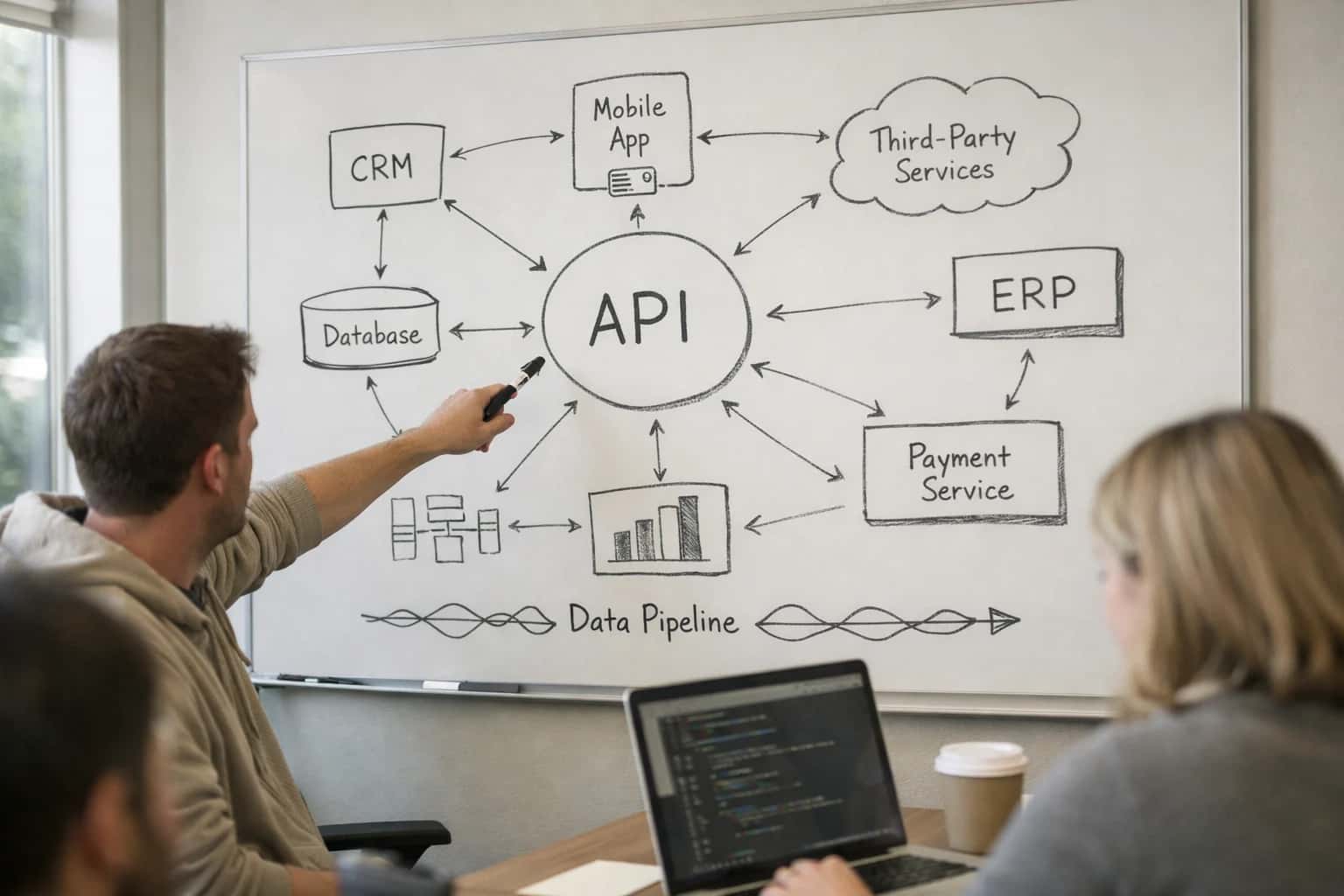
ARCHITECTURE FOR INTELLIGENT INTAKE
Where AI Fits into Monday.com Forms
A technical blueprint for embedding AI directly into Monday.com forms to validate, enrich, and route submissions in real-time.
The implementation typically involves a middleware service that intercepts the item_created or item_updated webhook from Monday.com. This service calls an LLM with the submission data, a prompt defining validation and enrichment logic, and access to relevant knowledge bases (e.g., product catalogs, project templates). The AI can then: - Auto-populate fields: Derive project type, priority, or estimated effort from a free-text description. - Trigger intelligent board creation: Use analyzed details to select the correct Monday.com board template, pre-fill columns, and set up automations. - Initiate workflow routing: Assign the item to the correct team or individual based on content analysis and current capacity pulled from other boards. The result is a form that adapts to the user, turning a 10-minute submission process into a 60-second guided experience.
For governance, the AI's suggestions should be presented as recommendations within the Monday.com item via an update or a custom field, preserving human oversight. Audit trails are maintained through Monday.com's native activity log and the middleware's execution records. Rollout is best done incrementally—start with a single high-volume form, like a new project request, to demonstrate value in reducing manual triage and misrouted work before scaling to other intake points. This pattern complements other integrations like /integrations/project-and-portfolio-management-platforms/ai-integration-for-mondaycom by making the initial data capture intelligent, setting the stage for AI-enhanced project execution.
AI-ENHANCED FORM PROCESSING
Key Integration Surfaces in Monday.com Forms
The Primary Data Interface
When a Monday.com form is submitted, it sends a JSON webhook payload containing all the user's responses. This payload is the primary surface for AI integration, providing the raw data for real-time analysis and action.
Key fields in the payload include:
boardIdandpulseIdfor the newly created item.columnValues– a JSON string containing the answers mapped to your board's columns.userIdof the submitter.
AI Integration Pattern:
Your AI service receives this webhook, parses the columnValues, and can immediately:
- Analyze the natural language text in open-ended responses.
- Validate inputs against business rules or external data.
- Enrich the submission by calling external APIs (e.g., CRM lookup).
- Return a modified
columnValuesJSON object to update the item before it's fully created, or trigger a follow-up automation.
This enables intelligent triage and data enrichment at the point of creation, turning a simple form into a smart intake agent.
INTELLIGENT FORM PROCESSING
High-Value AI Use Cases for Monday.com Forms
Transform static Monday.com forms into intelligent intake systems. By connecting AI to form submissions, you can validate inputs in real-time, auto-populate complex boards, and trigger sophisticated workflow routing—turning manual data entry into automated, context-aware operations.
01
Real-Time Submission Guidance & Validation
An AI agent analyzes text as users type into form fields, providing instant feedback and suggestions. It can validate against policy (e.g., 'Project name must be unique'), check for completeness, and even reformat inputs (dates, IDs) before submission, reducing errors and rework.
90% fewer errors
Typical reduction
02
Intelligent Board & Item Creation
Upon form submission, AI parses the unstructured request to dynamically create and configure boards or items. It can interpret the request's intent to select the correct board template, map form answers to specific column types (status, person, timeline), and set dependencies or tags—automating complex setup.
Batch -> Real-time
Setup automation
03
AI-Powered Triage & Routing
Use AI to read the submission and automatically assign priority, owner, and workflow path. By analyzing text sentiment, urgency keywords, and historical data, the system can populate 'Priority' and 'Assignee' columns, add the item to the correct group, and trigger specific Monday.com automations—eliminating manual sorting.
Same day
Assignment speed
04
Dynamic Field Enrichment from Attachments
When a form includes file uploads (PDFs, images), an AI agent extracts key data to auto-populate other form fields or board columns. For example, parsing a project charter PDF to fill in 'Budget', 'Timeline', and 'Key Stakeholders' columns, creating a richer, searchable record upon creation.
Hours -> Minutes
Data extraction
05
Proactive Duplicate & Conflict Detection
AI scans existing boards and items at the moment of submission to flag potential duplicates or resource conflicts. It compares the new request's description, dates, and assignees against historical data, adding a 'Flag' column with a note (e.g., 'Possible duplicate of PROJ-101') for the intake team to review.
Pre-emptive
Risk management
06
Automated Follow-Up & Status Communication
After the item is created, an AI agent monitors the new board item and automatically sends tailored updates to the form submitter. Using Monday.com's update column or email integrations, it can acknowledge receipt, provide a timeline estimate, or request clarification—improving requester experience without manual effort.
Zero-touch
Stakeholder comms
IMPLEMENTATION PATTERNS
Example AI-Powered Form Workflows
Monday.com forms are a powerful entry point for data, but they often require manual triage and setup. These workflows show how AI can analyze submissions in real-time to guide users, validate inputs, and trigger intelligent board creation and task routing, turning a static form into an intelligent intake agent.
This workflow automates the conversion of a vague project request into a structured, ready-to-work Monday.com board.
- Trigger: A user submits a "New Project Request" form.
- Context Pulled: The AI agent receives the full form payload, including the long-text project description, selected priority, requester info, and any attached files.
- AI Action: A model analyzes the description to:
- Classify the project type (e.g., "Marketing Campaign," "Product Bug Fix," "Internal Process Improvement").
- Extract implied key deliverables, milestones, and potential stakeholders mentioned.
- Estimate a complexity score (e.g., Low, Medium, High) based on description length, keywords, and historical similar projects.
- System Update: Using the Monday.com API, the agent:
- Creates a new board using a pre-defined template mapped to the classified project type.
- Populates board columns: Sets the project title, priority, complexity score, and a summarized project brief in the description.
- Creates initial group/items: Generates the first 3-5 high-level tasks (e.g., "Define Scope," "Assemble Team," "Kickoff Meeting") as items in a "Phase 1" group.
- Updates the form item: Adds a status column on the original form submission item with "Board Created [Link]" and tags the requester.
- Human Review Point: The newly created board is automatically assigned to a "Portfolio Manager" group for final review and resource assignment before work begins.
FROM FORM SUBMISSION TO INTELLIGENT WORKFLOW
Implementation Architecture & Data Flow
A practical blueprint for connecting AI to Monday.com's form and automation layer to validate inputs, guide users, and trigger intelligent board creation.
The integration architecture centers on Monday.com's Forms feature and its Automations Center. When a form is submitted, the payload—containing all respondent answers—is sent via a webhook to a secure AI processing endpoint. This endpoint, built on a serverless or containerized runtime, performs three core functions in sequence: 1) Real-time Validation & Guidance by analyzing text responses for completeness, policy compliance, or potential errors, returning immediate feedback to the user via a dynamic message or a follow-up email; 2) Intent Classification & Enrichment using an LLM to categorize the request (e.g., 'New Marketing Project', 'IT Support', 'Client Onboarding') and extract key entities to populate Monday.com columns; and 3) Intelligent Board Creation & Routing where the AI decides the destination board, sets status, assigns owners based on skillset or workload, and populates custom fields like Estimated Effort or Priority Score derived from the submission text.
The processed data flows back into Monday.com via its GraphQL API. The AI system executes a mutation to create a new item (or update an existing one) on the designated board. Critical to this flow is the use of Monday.com's Connect Column and Status Column to establish relationships and workflow state from day one. For example, a 'Client Onboarding' submission might automatically link to a master 'Clients' board. The automation is then extended by triggering Monday.com's native Automations, such as notifying the assigned team, creating sub-items for a checklist, or starting a time-tracking column. This creates a closed-loop system where the form is not just a data collector but an intelligent intake agent that structures unstructured requests into actionable, context-rich work items.
Rollout and governance for this integration follow a phased approach. Start with a single, high-volume form (e.g., 'New Project Request') in a sandbox board to tune the AI's classification accuracy and enrichment logic. Use Monday.com's Activity Log and the AI system's own audit trail to track every submission, enrichment decision, and board mutation for review. Implement a human-in-the-loop approval step for low-confidence classifications before board creation, which can be managed via a dedicated 'Review' status column. As confidence grows, expand to other forms and connect the AI to multiple boards across different teams, leveraging Monday.com's workspace structure to maintain data isolation and role-based access. The final architecture reduces manual triage from hours to minutes, ensures consistent project setup, and turns every form submission into a structured, AI-enriched work item ready for execution.
AI-ENHANCED FORM WORKFLOWS
Code & Payload Examples
Real-Time AI Processing on Form Submit
When a Monday.com form is submitted, a webhook fires to your integration endpoint. This handler receives the payload, extracts the raw text, and calls an AI model for initial analysis. The AI can classify the request, extract key entities (like project names, dates, or priority indicators), and validate inputs against business rules.
python# Example: Flask webhook handler for Monday.com form submission from flask import Flask, request, jsonify import openai import os app = Flask(__name__) openai.api_key = os.getenv("OPENAI_API_KEY") @app.route('/monday-form-webhook', methods=['POST']) def handle_form_submission(): data = request.json # Extract form response text form_values = data.get('event', {}).get('pulseValues', {}) description = form_values.get('description_column', {}).get('text') # Call LLM for analysis response = openai.chat.completions.create( model="gpt-4o-mini", messages=[ {"role": "system", "content": "Classify this project request and extract priority, estimated effort (S/M/L), and key stakeholders."}, {"role": "user", "content": description} ] ) analysis = response.choices[0].message.content # Parse analysis into structured data # ... parsing logic here ... # Return structured data for Monday.com automation return jsonify({ "classification": "New Feature Request", "priority": "High", "estimated_effort": "Medium", "recommended_board": "Product Development" }), 200
This structured output is then used by a subsequent Monday.com automation to create an item on the correct board with pre-populated custom fields.
AI-ENHANCED FORM WORKFLOWS
Realistic Time Savings & Operational Impact
How AI integration transforms manual Monday.com form processing into intelligent, guided workflows.
| Form Workflow Stage | Before AI | After AI | Key Notes |
|---|---|---|---|
Form Submission Triage | Manual review by coordinator | AI auto-classifies & routes | Uses NLP on submission text to set board, assignee, priority |
Data Validation & Enrichment | Back-and-forth emails for missing info | Real-time guidance & auto-population | AI prompts submitter in-form; cross-references existing items |
Board & Item Creation | Manual copy/paste from form to board | Automated, intelligent board setup | AI maps form answers to custom fields, sets dependencies |
Initial Priority Scoring | Gut-feel based on subject line | Consistent scoring against business rules | AI analyzes text urgency, submitter role, and historical SLAs |
Workflow Triggering | Manual activation of automations | Conditional, AI-decided automation paths | AI selects the right Monday.com automation recipe based on content |
Requester Follow-up | Manual status updates or forgotten | Automated, personalized progress nudges | AI sends updates via Monday.com updates or email based on item stage |
Form Analytics & Optimization | Quarterly manual report review | Continuous insight generation | AI analyzes drop-off points, common errors, and suggests form tweaks |
ARCHITECTING FOR CONTROL AND ADOPTION
Governance, Security, and Phased Rollout
A production-ready AI integration for Monday.com forms requires deliberate governance, secure data handling, and a phased rollout to ensure value and user trust.
Governance starts with defining which forms and data are in scope. Map your critical Monday.com boards and their associated forms—like project intake, IT requests, or marketing campaign briefs—and establish clear rules for AI access. Use Monday.com's item-level permissions and board privacy settings to control which data the AI can read. The integration should operate under a dedicated service account with scoped OAuth permissions, logging all AI interactions (prompts, responses, board mutations) to a separate audit trail for review and compliance. This creates a transparent chain of custody for AI-assisted decisions.
For security, the AI agent should never store raw Monday.com data. Implement a zero-retention policy where form submissions and board context are processed in memory, with only derived actions (like creating an item or updating a column) written back via the Monday.com API. If using RAG for guidance, pre-index approved policy documents or historical project data into a secure vector database, ensuring all retrieved context is from vetted sources. Encrypt all data in transit and consider a private endpoint for your LLM to keep sensitive project details internal.
A phased rollout is critical for adoption and tuning. Start with a pilot board and a single high-volume form, like an internal software request. Enable AI for basic validation and field auto-population. Monitor the AI Suggestions column for user acceptance rates and gather feedback. Phase two introduces intelligent routing—having the AI analyze the submission to recommend the correct team board and pre-fill a detailed item. The final phase activates advanced workflows, such as automatic dependency creation or timeline estimation based on analyzed request complexity. Each phase includes a human-in-the-loop review step, gradually automating as confidence grows.
This controlled approach minimizes disruption, allows for prompt and workflow refinement based on real usage, and builds organizational trust in the AI as a reliable copilot. For teams managing complex portfolios, this governance model ensures the integration scales safely, turning Monday.com forms from simple data collectors into intelligent workflow triggers. Explore our broader framework for AI Integration for Project Management Platforms or learn about connecting these insights to other systems like AI Integration for Monday.com and Salesforce Integration.
Enabling Efficiency, Speed & Accuracy
Intelligent Analysis, Decision & Execution
We build AI systems for teams that need search across company data, workflow automation across tools, or AI features inside products and internal software.
Talk to Us
Search across company data
Give teams answers from docs, tickets, runbooks, and product data with sources and permissions.
Useful when people spend too long searching or get different answers from different systems.
Enterprise searchRAGPermissions
Read more
Automate internal workflows
Use AI to route work, draft outputs, trigger actions, and keep approvals and logs in place.
Useful when repetitive work moves across multiple tools and teams.
AI agentsWorkflow automationGovernance
Read more
Add AI to products and internal tools
Build assistants, guided actions, or decision support into the software your team or customers already use.
Useful when AI needs to be part of the product, not a separate tool.
AI integrationDecision supportModel routing
Read moreIMPLEMENTATION GUIDE
Frequently Asked Questions
Common technical and strategic questions for teams adding AI to Monday.com forms to automate intake, validation, and workflow creation.
The integration typically uses a webhook trigger from the Monday.com form. When a form is submitted, Monday.com sends a JSON payload to a designated endpoint. An AI agent processes this payload, which includes all form field values.
Example workflow:
- Trigger: Webhook from Monday.com form
"Form Submitted"event. - Context Pulled: The agent receives the raw submission JSON.
- AI Action: The agent (e.g., using OpenAI's API) analyzes the unstructured text fields (like "Project Description") to:
- Classify the request type (e.g., "Bug Report", "Feature Request", "IT Support").
- Extract key entities (dates, product names, urgency indicators).
- Validate completeness against a checklist.
- System Update: The agent uses the Monday.com API to update the newly created item, populating custom columns like
AI Classification,AI Extracted Priority, andAI Validation Notes. - Next Step: Based on the classification, an automation rule can move the item to the correct board or assign it to the appropriate team.

About the author
Prasad Kumkar
CEO & MD, Inference Systems
Prasad Kumkar is the CEO & MD of Inference Systems and writes about AI systems architecture, LLM infrastructure, model serving, evaluation, and production deployment. Over 5+ years, he has worked across computer vision models, L5 autonomous vehicle systems, and LLM research, with a focus on taking complex AI ideas into real-world engineering systems.
His work and writing cover AI systems, large language models, AI agents, multimodal systems, autonomous systems, inference optimization, RAG, evaluation, and production AI engineering.
LinkedIn
Limited slotsGet a Free AI Consultation
Partnered with leading AI, data, and software stack.





How We Work
Custom AI workflows for your Business
One-fit-all AI don't work for modern businesses. At Inferensys, we aim to understand your business & custom requirements; which we use to define most efficient agentic workflows, the data, and the tools for your business.
01
Review the use case
We understand the task, the users, and where AI can actually help.
Read more02
Pick the right approach
We define what needs search, automation, or product integration.
Read more03
Build the first useful version
We implement the part that proves the value first.
Read more04
Improve from there
We add the checks and visibility needed to keep it useful.
Read moreThe first call is a practical review of your use case and the right next step.
Talk to Us