AI integration targets the partner object lifecycle within your PRM (like Impartner or PartnerStack), automating manual checks and communications that delay time-to-first-deal. Key surfaces include the partner application form, profile completion workflows, training assignment modules, and the welcome communication engine. Instead of a linear, human-dependent process, AI creates a parallel review track: as a new application lands via API or webhook, an agent can instantly validate business details, assign risk scores, check for conflicts in the CRM, and trigger the next appropriate step—whether that's auto-approval, routing for manual review, or requesting additional documentation.

Integration
AI Integration for Channel Onboarding
A technical guide to automating partner application review, training assignment, and welcome communications in PRM platforms like Impartner, PartnerStack, Allbound, and ZINFI to reduce time-to-first-deal from weeks to days.
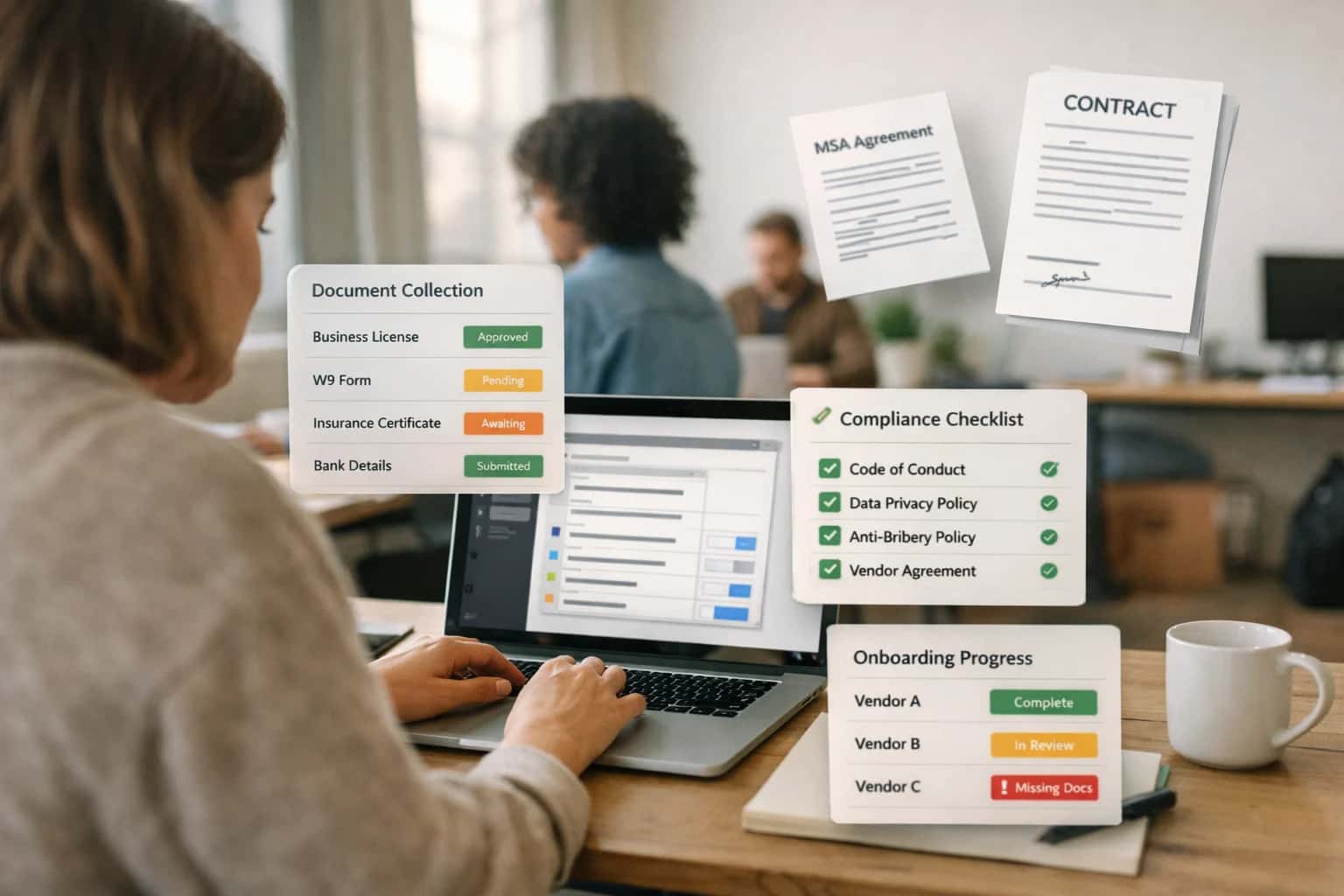
ARCHITECTURE BLUEPRINT
Where AI Fits in the Partner Onboarding Workflow
A technical guide to embedding AI into the high-friction, multi-stage process of bringing new partners into your channel program.
Implementation typically involves a middleware layer (like an AI workflow platform) that subscribes to PRM webhooks for events like partner.created or application.submitted. This layer orchestrates agents that call external APIs for business verification, use document intelligence to parse uploaded certificates or contracts, and apply rules to score the application. Approved partners are then pushed back into the PRM via its API to update their status, auto-enroll in required training tracks in the LMS module, and trigger personalized welcome sequences from the communications hub. The impact is operational: reducing onboarding from weeks to days, ensuring consistent policy application, and freeing channel managers to focus on high-touch enablement instead of administrative triage.
Rollout requires careful governance. Start with a pilot phase where AI actions are logged as recommendations in a shadow queue for manager review before execution, ensuring the model's judgment aligns with channel strategy. Key integration points to instrument are audit trails (logging every AI-taken action to the partner record) and human-in-the-loop breakpoints for high-value or high-risk partners. This architecture doesn't replace the PRM; it turns it into an intelligent orchestration layer, making the onboarding workflow a competitive advantage in partner acquisition. For related patterns, see our guides on /integrations/partner-relationship-management-platforms/ai-integration-for-partner-enablement and /integrations/partner-relationship-management-platforms/ai-integration-for-deal-registration.
CHANNEL ONBOARDING
PRM Platform Touchpoints for AI Integration
Automating Application Intake and Review
The Partner Application Hub is the primary surface for new partner submissions. AI can be integrated here to automate the initial screening and data enrichment process.
Key Integration Points:
- Webhook Triggers: Configure a webhook on the
application.submittedevent to send the full application payload (company details, tax IDs, certifications) to an AI agent for immediate processing. - Data Validation Agent: An AI agent can cross-reference submitted information against internal databases (like Dun & Bradstreet) and public sources to verify business legitimacy and flag discrepancies.
- Automated Scoring: Based on predefined criteria (geography, target market, revenue band), the agent can assign a preliminary tier or score, updating the
Partner_Application__cobject via the PRM's REST API. - Next-Step Assignment: The agent can automatically assign required training modules or compliance documents based on the partner's profile and product interests, creating tasks in the onboarding workflow.
This reduces manual data entry and review from days to hours, ensuring qualified partners move faster into enablement.
PRM AUTOMATION
High-Value AI Use Cases for Channel Onboarding
Reduce time-to-first-deal by embedding AI directly into your PRM's onboarding workflows. These patterns target the manual bottlenecks in partner application review, training assignment, and initial engagement.
01
Automated Partner Application Review
AI agents ingest new partner applications from your PRM (Impartner, PartnerStack, etc.), validate business details against external databases, score fit based on ideal partner profiles, and route for approval—flagging high-potential candidates instantly.
Days -> Hours
Review cycle
02
Personalized Onboarding Path Assignment
Analyze a new partner's profile, location, and declared competencies to automatically assign tailored training modules, certifications, and resource kits within the PRM's enablement portal. Dynamically adjusts based on initial engagement metrics.
Batch -> Real-time
Path generation
03
Intelligent Welcome & Kickoff Automation
Generate and send personalized welcome communications, schedule kickoff calls via calendar APIs, and provision initial portal access—all triggered by the Partner Status change in the PRM. AI drafts context-aware emails using partner data.
Same day
First contact
04
Document & Compliance Packet Processing
Extract and validate data from uploaded partner agreements, W-9s, and insurance certificates using document AI. Cross-reference with PRM application fields, flag discrepancies, and auto-populate compliance records—reducing manual data entry for channel ops.
Hours -> Minutes
Packet review
05
Predictive Time-to-First-Deal Scoring
During onboarding, an AI model analyzes partner engagement signals (training completion, portal logins, resource downloads) and historical data to predict likelihood and timeline for first deal registration. Alerts channel managers to partners needing intervention.
Proactive alerts
Risk mitigation
06
Partner Portal Copilot for New Partners
Deploy an AI assistant within the PRM partner portal that answers FAQs, guides navigation, explains MDF processes, and helps submit first deal registrations—reducing support tickets and accelerating partner self-sufficiency from day one.
24/7 support
Portal deflection
CHANNEL ONBOARDING
Example AI Automation Workflows
These concrete workflows illustrate how AI agents can be integrated into your PRM's onboarding sequence to reduce manual work, accelerate time-to-first-deal, and ensure consistency. Each flow connects to specific PRM APIs, objects, and automation surfaces.
Trigger: A new partner application is submitted via the PRM portal (e.g., a new Partner record is created in Impartner or PartnerStack with a status of Application Submitted).
AI Agent Action:
- The agent is invoked via a PRM webhook or a scheduled job.
- It retrieves the application payload, including company details, references, and uploaded documents (business license, insurance certificates).
- Using a multi-step orchestration, the agent:
- Extracts and validates key fields from unstructured documents using document intelligence.
- Scores the application against ideal partner profile criteria (e.g., geographic coverage, technical certifications, complementary offerings).
- Performs a lightweight external check, such as verifying the company domain or D-U-N-S number.
- The agent updates the PRM
Partnerrecord with:- A calculated
Application Score(0-100). - A
Recommended Actionfield (Approve,Review,Reject). - Extracted data populated into structured fields.
- A summary of the scoring rationale in a notes field.
- A calculated
System Update: The PRM's native workflow engine routes the application based on the Recommended Action. High-score applications auto-advance; Review flagged apps are queued for a channel manager.
Human Review Point: All Reject recommendations and low-confidence extractions are routed to a human-in-the-loop queue for final decision before any notification is sent.
SYSTEM-LEVEL INTEGRATION PATTERNS
Implementation Architecture: Data Flow & System Design
A production-ready AI integration for channel onboarding connects to the PRM's core data objects and automation layer, orchestrating workflows without disrupting existing processes.
The integration architecture typically connects at three key points within the PRM platform (e.g., Impartner, PartnerStack, Allbound, ZINFI):
- Application API & Webhooks: Ingest new partner submissions, profile data, and supporting documents (W9s, business licenses).
- Partner & Deal Objects: Read and write to fields for status (
Onboarding_Stage), scores (Application_Score), and next-action flags (Training_Module_Assigned). - Communication & Task Engines: Trigger personalized welcome emails, portal notifications, and task assignments for channel managers via native automation tools or direct API calls.
A standard data flow for an automated review agent looks like this:
- Event Capture: A webhook from the PRM signals a new
Partner_Application_Submittedevent. - Data Enrichment: The AI service fetches the full application record, attached documents, and any existing firmographic data via the PRM's REST API.
- Orchestrated Processing: A multi-step AI agent runs in sequence:
- Document Intelligence: Extracts and validates key entities (business name, tax ID, address) from uploaded PDFs.
- Profile Scoring: Cross-references application data against ideal partner profiles and past performance of similar partners to generate an
Application_Risk_Score. - Training Assignment: Uses the partner's declared focus area and product interest to map to a pre-defined
Onboarding_Path_IDfrom the LMS or enablement library.
- System of Record Update: The agent posts results back to the PRM, updating the partner record with scores, assigned path, and setting the
Application_StatustoReview_Readyfor final manager approval.
Governance and rollout require a phased approach. Start with a human-in-the-loop pilot, where AI scores and recommendations are written to a sandbox object or a dedicated AI_Recommendation field for manager review before any automated status changes. Use the PRM's native audit trails to log all AI-generated actions. For production, implement circuit breakers—such as a confidence threshold on document extraction—that route low-confidence applications to a manual queue. This architecture ensures the AI augments the PRM's workflow engine, reducing time-to-first-deal while maintaining compliance and control for channel operations teams.
PRM API INTEGRATION PATTERNS
Code & Payload Examples
Automating Partner Application Triage
This Python example calls a PRM platform's API to fetch new partner applications, uses an LLM to score and summarize them, and posts a recommendation back to the record. This automates the initial review, flagging incomplete forms or high-potential candidates for immediate follow-up.
pythonimport requests from inference_systems import AgentClient # 1. Fetch pending applications from PRM API prm_api_url = "https://api.your-prm.com/v1/partner_applications" headers = {"Authorization": "Bearer YOUR_PRM_API_KEY"} params = {"status": "submitted", "limit": 10} applications = requests.get(prm_api_url, headers=headers, params=params).json() # 2. Process each app with an AI agent agent = AgentClient(model="gpt-4") for app in applications['data']: prompt = f""" Review this partner application for completeness and strategic fit. Company: {app['company_name']} Primary Vertical: {app['primary_vertical']} Submitted Info: {app['application_details']} Return a JSON with: score (1-10), summary, missing_fields (list), recommendation ('approve', 'review', 'reject'). """ analysis = agent.complete(prompt, response_format="json") # 3. Update PRM record with AI analysis update_url = f"{prm_api_url}/{app['id']}/notes" update_payload = { "note": f"AI Review: {analysis['summary']}", "tags": ["ai_review", f"score_{analysis['score']}"], "internal_fields": { "ai_recommendation": analysis['recommendation'], "ai_missing_fields": analysis['missing_fields'] } } requests.post(update_url, json=update_payload, headers=headers)
AI-ENHANCED CHANNEL ONBOARDING
Realistic Time Savings & Operational Impact
This table illustrates the operational lift reduction and velocity gains when integrating AI agents into a PRM platform's partner onboarding workflow. Metrics are based on typical implementations for platforms like Impartner, PartnerStack, Allbound, or ZINFI.
| Workflow Stage | Before AI | After AI | Key Impact & Notes |
|---|---|---|---|
Application Intake & Review | Manual data entry and validation (1-2 days) | Automated data extraction and validation (2-4 hours) | Reduces ops team manual review; flags incomplete applications for human follow-up. |
Initial Partner Scoring | Manual review of firmographic data (4-6 hours) | AI-assisted scoring based on ICP match & market data (30 minutes) | Provides a consistent scoring rubric; human team reviews top-tier recommendations. |
Training & Certification Assignment | Generic learning path assignment (Next business day) | Personalized learning path based on partner profile & goals (Same day) | Dynamic assignment reduces time-to-competency; uses PRM partner object data. |
Welcome & Initial Communications | Manual email sequence setup (3-4 hours per partner) | Automated, personalized welcome sequence generation (15 minutes) | Ensures consistent messaging; triggers are based on onboarding stage in PRM. |
First Deal Registration Support | Reactive support via email/ticket (Response in 24-48 hrs) | Proactive guidance via portal copilot & checklist (Real-time) | Portal agent answers policy questions, reducing support tickets and accelerating first deal. |
Onboarding Completion to Active Status | Manual milestone tracking & approval (5-7 business days) | Automated milestone tracking with alerts for manual gates (2-3 business days) | System provides a single pane of glass for channel manager oversight; human approval remains for final activation. |
Data Entry into Downstream Systems (CRM/ERP) | Manual export/import or re-keying (1-2 hours per partner) | Automated sync via triggered workflows (Near real-time) | Eliminates errors and ensures partner record consistency across the tech stack. |
ARCHITECTING FOR SCALE AND COMPLIANCE
Governance, Security, and Phased Rollout
A production-ready AI integration for channel onboarding must be built for security, auditability, and controlled adoption across a diverse partner base.
Governance starts with the data model. Your AI agents will interact with sensitive partner objects in your PRM—like Partner Profile, Onboarding Application, Training Module, and MDF Agreement. We architect integrations to operate within strict RBAC (Role-Based Access Control) boundaries, ensuring AI actions (e.g., auto-approving an application, assigning training) are logged against a service account in the PRM's audit trail and trigger the same approval workflows a human user would. For platforms like Impartner or ZINFI, this means using dedicated API credentials with scoped permissions and designing webhook payloads that exclude sensitive PII unless required for a specific, justified workflow.
A phased rollout is critical for managing risk and proving value. We recommend a three-phase approach: 1) Assist Phase: Deploy AI as a copilot for your channel operations team. For example, an agent pre-fills an onboarding application review form in Impartner with a recommendation score and extracted data highlights, but a manager makes the final approval. 2) Automate Phase: Move to full automation for low-risk, high-volume tasks—like sending personalized welcome emails or assigning baseline training modules in PartnerStack based on partner type—with a human-in-the-loop override. 3) Augment Phase: Expand to predictive and prescriptive workflows, such as an AI that analyzes a new partner's profile and first 30-day activity to predict time-to-first-deal and automatically triggers a high-touch intervention from a channel manager if needed.
Security extends to the AI's outputs and inputs. We implement content filters and grounding techniques to ensure communications generated for partners (e.g., welcome emails, policy summaries) are brand-appropriate and accurate. All document processing for MDF or compliance forms is performed in a secure, transient environment, with extracted data validated against PRM records before any system updates are committed. This layered approach—combining the PRM's native security model with AI-specific guardrails—ensures the integration scales without introducing compliance or reputational risk.
Enabling Efficiency, Speed & Accuracy
Intelligent Analysis, Decision & Execution
We build AI systems for teams that need search across company data, workflow automation across tools, or AI features inside products and internal software.
Talk to Us
Search across company data
Give teams answers from docs, tickets, runbooks, and product data with sources and permissions.
Useful when people spend too long searching or get different answers from different systems.
Enterprise searchRAGPermissions
Read more
Automate internal workflows
Use AI to route work, draft outputs, trigger actions, and keep approvals and logs in place.
Useful when repetitive work moves across multiple tools and teams.
AI agentsWorkflow automationGovernance
Read more
Add AI to products and internal tools
Build assistants, guided actions, or decision support into the software your team or customers already use.
Useful when AI needs to be part of the product, not a separate tool.
AI integrationDecision supportModel routing
Read moreAI INTEGRATION FOR CHANNEL ONBOARDING
Frequently Asked Questions
Practical questions for technical and operational leaders planning to embed AI into partner onboarding workflows within PRM platforms like Impartner, PartnerStack, Allbound, or ZINFI.
AI integrates at key manual choke points, typically via the PRM's API and webhook system. Common integration surfaces include:
- Application Intake: Intercepting new partner submissions via webhook for initial review and data enrichment.
- Document Processing: Connecting to the PRM's document storage (e.g., for business licenses, W-9s) to extract and validate information using document intelligence.
- Training Assignment: Analyzing the partner's profile (tier, geography, product focus) against training catalog metadata to generate a personalized learning path.
- Communication Triggers: Using the PRM's email or notification API to send personalized welcome sequences, status updates, and next-step reminders generated by AI.
- Approval Workflows: Posting analysis and recommendations to custom objects or fields that drive approval automation in the PRM.
The AI system acts as a middleware layer, consuming PRM events, processing with LLMs or specialized models, and posting back updates or actions.

About the author
Prasad Kumkar
CEO & MD, Inference Systems
Prasad Kumkar is the CEO & MD of Inference Systems and writes about AI systems architecture, LLM infrastructure, model serving, evaluation, and production deployment. Over 5+ years, he has worked across computer vision models, L5 autonomous vehicle systems, and LLM research, with a focus on taking complex AI ideas into real-world engineering systems.
His work and writing cover AI systems, large language models, AI agents, multimodal systems, autonomous systems, inference optimization, RAG, evaluation, and production AI engineering.
LinkedIn
Limited slotsGet a Free AI Consultation
Partnered with leading AI, data, and software stack.





How We Work
Custom AI workflows for your Business
One-fit-all AI don't work for modern businesses. At Inferensys, we aim to understand your business & custom requirements; which we use to define most efficient agentic workflows, the data, and the tools for your business.
01
Review the use case
We understand the task, the users, and where AI can actually help.
Read more02
Pick the right approach
We define what needs search, automation, or product integration.
Read more03
Build the first useful version
We implement the part that proves the value first.
Read more04
Improve from there
We add the checks and visibility needed to keep it useful.
Read moreThe first call is a practical review of your use case and the right next step.
Talk to Us