The foundation is Jamf Pro's inventory data, particularly extension attributes and smart group logic. Instead of manually defining static compliance rules, an AI model continuously analyzes this inventory—OS versions, security settings, installed applications, disk encryption status, and custom script outputs—to identify patterns that precede actual policy violations. For example, the system can correlate a specific combination of outdated kernel extensions, low disk space, and failed security update attempts to predict a future encryption failure or security baseline non-compliance with high accuracy.

Integration
AI-Powered Device Compliance for Jamf
Transform reactive Jamf Pro compliance monitoring into a predictive, automated system using AI to analyze extension attributes, inventory data, and policy states—reducing manual review by 70% and catching violations before they impact security.
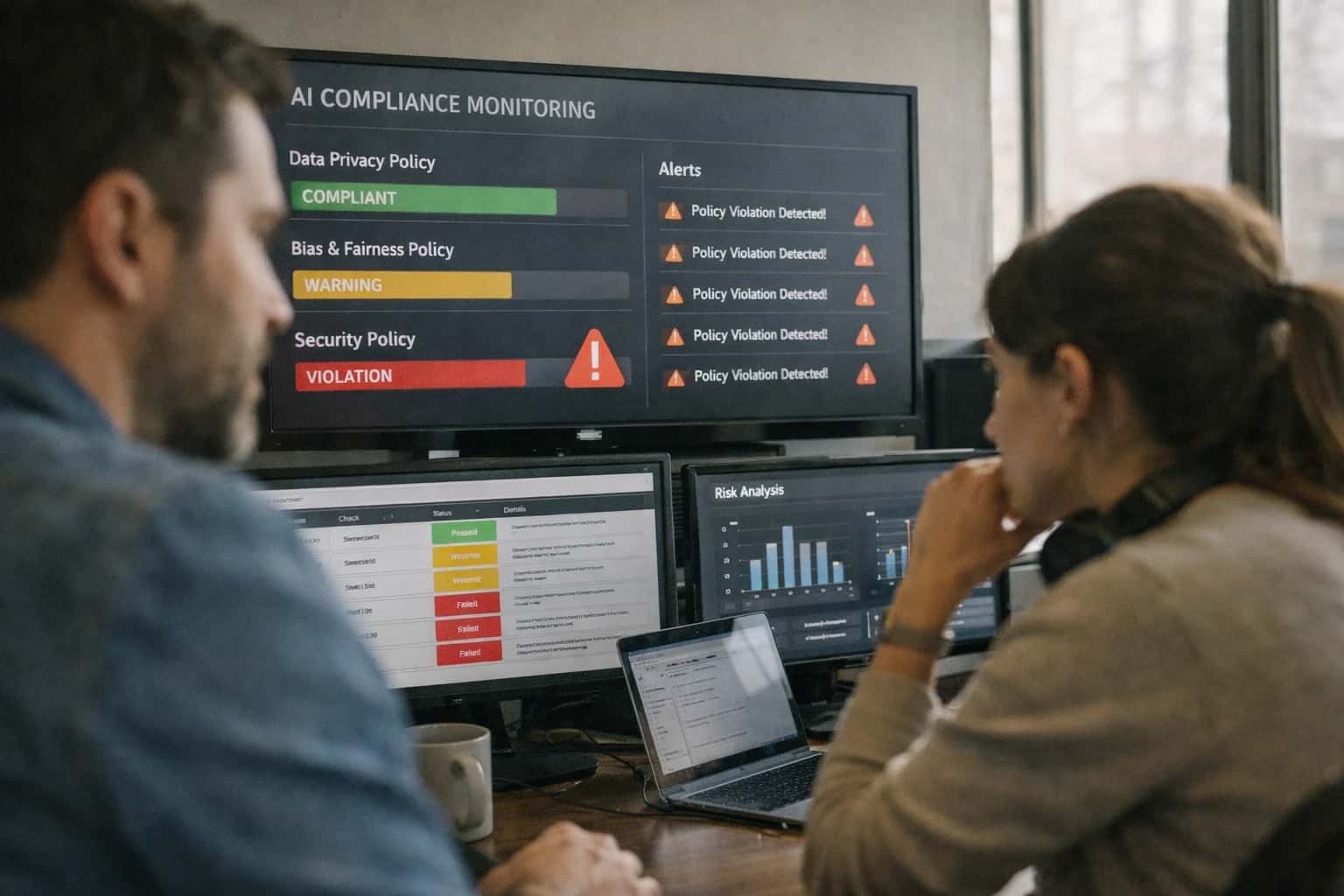
ARCHITECTURE & ROLLOUT
From Reactive Checklists to Predictive Compliance
How to architect an AI layer that transforms Jamf Pro from a policy enforcer into a predictive compliance engine.
Implementation involves a lightweight service that polls the Jamf Pro API (or consumes webhooks for inventory updates) to feed a vectorized dataset into a trained model. The AI's output isn't just an alert; it's a prescriptive action fed back into Jamf. This can be: 1) Automatically adding the device to a remediation smart group, triggering a pre-defined policy or script, 2) Generating a support ticket in your ITSM with root-cause analysis attached, or 3) Dynamically adjusting the device's compliance policy in Jamf—for instance, temporarily relaxing a non-critical rule to prevent a false "non-compliant" lockout while the core issue is being fixed. This shifts the workflow from detect -> manually investigate -> remediate to predict -> auto-remediate or flag for review.
Rollout requires a phased, policy-based approach. Start with a pilot smart group of non-critical devices. Use the AI to generate predictions but only create audit log entries in Jamf, not automated actions. This builds trust in the model's accuracy and allows fine-tuning. Governance is critical: all AI-triggered actions must be logged in Jamf's audit trail and optionally require approval via a webhook to a separate orchestration platform (like /integrations/ai-agent-builder-workflow-platforms/ai-agent-builder-and-workflow-platforms) for high-risk changes. The end state is a self-optimizing system where IT spends time on strategic exceptions, not routine checklist reviews.
AI-POWERED DEVICE COMPLIANCE FOR JAMF
Where AI Connects to Jamf Pro's Data Model
The Foundation for AI Analysis
Jamf Pro's Extension Attributes and Inventory data provide the raw material for AI-powered compliance. Extension Attributes allow you to collect custom data points from macOS and iOS devices—anything from installed kernel extensions to custom security settings. When combined with standard inventory (OS version, disk encryption status, installed applications), this creates a rich, queryable dataset.
An AI layer consumes this data via the Jamf Pro Classic API or Jamf Pro API to build a dynamic compliance profile for each device. Instead of static checklists, AI models can identify correlations and anomalies—like a device with full disk encryption but an outdated SSH configuration that introduces risk. This enables predictive scoring: flagging devices likely to fall out of compliance before the next inventory update, based on historical drift patterns.
PREDICTIVE & AUTOMATED
High-Value AI Compliance Use Cases for Jamf
Move beyond static compliance checks. Integrate AI with Jamf Pro's extension attributes, inventory data, and scripting engine to predict violations, automate reporting, and dynamically adjust policies for Apple fleets.
01
Predictive Patch Compliance Violations
AI models analyze Jamf patch reports, threat intelligence feeds, and device telemetry to predict which devices will fall out of compliance before the next audit cycle. Automatically generates prioritized work orders for IT or triggers patch deployment scripts.
Weeks -> Days
Lead time on violations
02
Dynamic Security Policy Assignment
An AI agent evaluates real-time risk signals (user role, network location, installed software) from Jamf inventory and dynamically assigns or modifies configuration profiles. For example, automatically enforcing stricter FileVault settings on devices accessing sensitive data.
Static -> Adaptive
Policy enforcement
03
Automated Audit Evidence & Reporting
For regulated industries (HIPAA, FINRA), AI synthesizes data from Jamf's compliance history, extension attributes, and admin logs to auto-generate narrative audit trails and evidence packs. Reduces manual evidence collection from days to hours.
1 sprint
Typical report build time
04
Intelligent Script Remediation Orchestration
When a compliance violation is detected (e.g., outdated SSH settings), AI selects or generates the optimal remediation shell script from a library, orchestrates its execution via Jamf Pro, and validates the fix—closing the loop without admin intervention.
Manual -> Automated
Remediation workflow
05
Anomaly Detection in Extension Attributes
Monitor custom Jamf extension attributes for security and compliance signals. AI establishes baselines and flags anomalous values (e.g., unexpected kernel extensions, sudoers file changes) that could indicate configuration drift or compromise, triggering investigation workflows.
Batch -> Real-time
Anomaly detection
06
Predictive Device Retirement & Refresh
AI analyzes Jamf inventory data (battery cycles, storage health, repair history) and compliance upgrade requirements to predict which devices are likely to fail or become non-compliant. Automates lifecycle workflows, updating asset records and triggering procurement.
Reactive -> Proactive
Lifecycle management
JAMF PRO INTEGRATION PATTERNS
Example AI-Driven Compliance Workflows
These workflows illustrate how AI agents can consume Jamf Pro inventory data and extension attributes to automate compliance monitoring, predictive violation detection, and dynamic policy adjustment for Apple fleets. Each pattern connects to Jamf's Classic and Pro APIs to execute actions.
Trigger: Scheduled daily agent run after Jamf Pro patch management reports are generated.
Context/Data Pulled:
- Agent queries Jamf Pro API for
/api/v1/patch-software-title-configurationsand/api/v2/patch-reports. - Pulls device-level patch status, last check-in time, and OS version from inventory (
/api/v1/computers-inventory). - Enriches with external threat intelligence feed (e.g., NVD) for CVSS scores of missing patches.
Model/Agent Action:
- AI model analyzes the dataset, prioritizing devices based on:
- Severity of missing patches (CVSS score > 7.0).
- Device role (executive, developer, finance).
- Historical patch failure rate for that device model.
- Predicts which devices are likely to remain non-compliant beyond a 72-hour SLA.
System Update/Next Step:
- Agent creates a high-priority ticket in the connected ITSM (e.g., ServiceNow) for each predicted violation, pre-populated with device details, missing patches, and recommended script ID for forced installation.
- Updates a custom Jamf Pro extension attribute (
ai_predicted_violation) on the computer record with a timestamp and risk score. - Sends a targeted notification to the assigned IT admin group in Microsoft Teams.
Human Review Point: The AI flags the top 5% highest-risk predictions for manual review before ticket creation, allowing an admin to confirm or override based on known maintenance windows.
PREDICTIVE COMPLIANCE & SELF-HEALING
Architecture: Building the AI Layer on Jamf Pro
A technical blueprint for adding an intelligent orchestration layer that uses Jamf Pro's APIs and data model to predict compliance violations and automate remediation.
The integration architecture treats Jamf Pro as the system of record and execution layer, while the AI system acts as a decision engine. The AI layer ingests data from Jamf's extension attributes, inventory reports, and patch management modules via the Classic and Pro APIs. It processes this data to identify patterns—like devices consistently missing security updates, showing declining battery health, or exhibiting configuration drift from gold images. The core objects are computers, mobile_devices, and their associated extension_attributes, which the AI uses to build a real-time risk profile for each Apple endpoint in the fleet.
For predictive compliance, the system analyzes historical violation data against current inventory states. For example, it can correlate a device's operating_system_version with known patch deadlines or flag a Mac with a filevault2_status of "Not Encrypted" that belongs to a user in Finance. When a high-likelihood violation is predicted, the AI orchestrator uses Jamf's API to execute predefined remediation workflows. This could involve pushing a configuration profile, triggering a policy to install missing software, or running a shell script to correct a misconfiguration. All actions are logged back to Jamf's audit trail, maintaining a clear chain of custody for compliance audits.
Rollout is typically phased, starting with a pilot group of non-critical devices. Governance is critical: the AI's recommended actions should route through an approval queue or a human-in-the-loop step for high-risk changes before execution. The system should also be configured with rollback procedures, leveraging Jamf's scope functionality to quickly revert changes if an automated action causes unintended issues. This architecture doesn't replace Jamf Pro; it augments it with proactive intelligence, shifting IT operations from reactive ticket-fighting to predictive fleet management. For related patterns on automating policy enforcement, see our guide on AI Integration for Automated Policy Enforcement with Intune.
AI-POWERED DEVICE COMPLIANCE FOR JAMF
Code & Payload Examples for Key Integration Points
Analyzing Custom Extension Attributes for Risk
Extension attributes in Jamf Pro are custom fields that can store device-specific data (e.g., installed kernel extensions, security tool versions, custom scripts). An AI system can analyze these attributes to predict compliance drift.
Example Workflow:
- Query Jamf Pro's Classic API for devices and their extension attributes.
- Use an LLM to parse and classify the unstructured text values.
- Flag devices where attributes indicate outdated software, missing security tools, or non-standard configurations.
Python API Call Example:
pythonimport requests import json # Authenticate and get token auth_url = "https://your-jamf-instance.jamfcloud.com/api/v1/auth/token" auth_response = requests.post(auth_url, auth=('api_user', 'api_pass')) token = auth_response.json()['token'] headers = {'Authorization': f'Bearer {token}', 'Accept': 'application/json'} # Fetch computers with extension attributes computers_url = "https://your-jamf-instance.jamfcloud.com/api/v1/computers-inventory?section=EXTENSION_ATTRIBUTES" response = requests.get(computers_url, headers=headers) devices = response.json()['results'] # Prepare payload for AI analysis analysis_payload = [] for device in devices[:10]: # Sample first 10 analysis_payload.append({ "id": device['id'], "name": device['general']['name'], "extensionAttributes": device['extensionAttributes'] }) # Send to AI service for evaluation # ai_response = requests.post('https://your-ai-service/analyze', json=analysis_payload)
AI-POWERED COMPLIANCE FOR JAMF PRO
Realistic Time Savings & Operational Impact
How AI transforms manual, reactive compliance monitoring into a predictive, automated workflow for Apple device fleets.
| Workflow | Before AI | After AI | Impact & Notes |
|---|---|---|---|
Compliance violation detection | Manual review of extension attributes and inventory reports (2-4 hours weekly) | Automated daily analysis with prioritized alerts (15 minutes weekly) | Shifts focus from finding problems to fixing them; reduces oversight blind spots. |
Policy exception review & approval | Manual ticket triage and email chains (next-day response) | AI-assisted routing with context and suggested resolution (same-day resolution) | Accelerates user productivity by reducing wait times for policy exceptions. |
Audit evidence compilation | Manual data extraction and spreadsheet assembly (8-12 hours per audit) | Auto-generated compliance packs from Jamf data (1-2 hours per audit) | Ensures consistent, defensible reporting for HIPAA, SOC 2, or internal audits. |
Remediation script execution | Reactive, manual script deployment after issues are reported | Predictive, automated script triggers based on violation patterns | Prevents common compliance drifts (like encryption or firewall settings) before users notice. |
Device grouping for targeted policies | Static groups based on manual tagging; updates lag behind changes | Dynamic groups auto-created by AI based on real-time attributes and risk | Ensures policies are applied to the right devices immediately, improving security posture. |
Executive reporting on fleet compliance | Manual slide deck creation from disparate reports (quarterly) | AI-generated dashboard with trends and forecasts (continuously available) | Provides leadership with real-time visibility into risk and program ROI. |
Root cause analysis for recurring violations | Time-consuming log correlation and guesswork by senior staff | AI identifies patterns and suggests systemic fixes (e.g., a faulty configuration profile) | Reduces repeat tickets and addresses underlying platform issues, not just symptoms. |
ARCHITECTING A CONTROLLED, AUDITABLE DEPLOYMENT
Governance, Security & Phased Rollout
A production-ready AI integration for Jamf compliance requires a structured approach to data handling, model governance, and incremental rollout to manage risk and build trust.
The integration architecture must treat Jamf Pro's inventory and extension attributes as a governed data source. This involves:
- API Authentication & Rate Limiting: Using Jamf Pro's token-based authentication with scoped API roles, ensuring the AI system operates within defined data boundaries and respects API rate limits to avoid impacting core MDM operations.
- Data Pipeline Isolation: Ingesting and processing inventory snapshots in a dedicated, secure environment—not directly on the Jamf server—to prevent performance degradation. Sensitive data like serial numbers and user associations are hashed or tokenized before analysis.
- Audit Trail Integration: Every AI-generated insight (e.g., a predicted compliance violation) must be logged with a traceable link back to the source Jamf device record and the specific extension attributes used, creating an immutable chain of evidence for audits.
Model governance is critical for predictive accuracy and regulatory compliance. We implement a closed-loop system:
- Human-in-the-Loop (HITL) Validation: Initial AI predictions for policy violations are presented to IT admins as recommendations within a dedicated dashboard or via Jamf Pro webhooks that create tickets in your ITSM. Admins confirm or reject predictions, and this feedback continuously retrains the model.
- Dynamic Policy Adjustment with Approval Gates: When the AI system recommends a dynamic policy change (e.g., adjusting a restriction profile for a device group), the change is drafted in Jamf but requires a manual admin approval via a phased rollout group before deployment. This prevents uncontrolled automation.
- Bias & Drift Monitoring: We monitor the model for bias (e.g., disproportionately flagging devices in a specific department) and performance drift against the HITL feedback, ensuring predictions remain fair and accurate as your Apple fleet evolves.
A phased rollout minimizes disruption and proves value incrementally:
- Phase 1: Read-Only Reporting (Weeks 1-2): The AI system analyzes a historical snapshot of your Jamf data to generate a baseline compliance risk report. No actions are taken. This phase validates data quality and establishes a benchmark.
- Phase 2: Pilot Group & Advisory Alerts (Weeks 3-6): Enable the AI for a pilot group of non-critical devices (e.g., IT department devices). The system generates real-time alerts for predicted violations posted to a Slack/MS Teams channel or a simple dashboard, but does not interact with Jamf Pro.
- Phase 3: Automated Reporting & Ticket Creation (Weeks 7-10): Connect the AI to your ITSM (like ServiceNow or Jira). The system now automatically creates low-priority tickets for predicted violations in the pilot group, enriching them with Jamf context and suggested remediation scripts. Admins work from these AI-generated tickets.
- Phase 4: Conditional Automation (Week 11+): For high-confidence, low-risk predictions (e.g., a device missing a required security setting), implement automated remediation via Jamf Pro scripts or policy pushes, but only for device groups explicitly marked as eligible for automation. All actions are logged back to the device inventory record in Jamf.
Enabling Efficiency, Speed & Accuracy
Intelligent Analysis, Decision & Execution
We build AI systems for teams that need search across company data, workflow automation across tools, or AI features inside products and internal software.
Talk to Us
Search across company data
Give teams answers from docs, tickets, runbooks, and product data with sources and permissions.
Useful when people spend too long searching or get different answers from different systems.
Enterprise searchRAGPermissions
Read more
Automate internal workflows
Use AI to route work, draft outputs, trigger actions, and keep approvals and logs in place.
Useful when repetitive work moves across multiple tools and teams.
AI agentsWorkflow automationGovernance
Read more
Add AI to products and internal tools
Build assistants, guided actions, or decision support into the software your team or customers already use.
Useful when AI needs to be part of the product, not a separate tool.
AI integrationDecision supportModel routing
Read moreAI-POWERED DEVICE COMPLIANCE FOR JAMF
FAQ: Technical & Commercial Questions
Practical answers for IT leaders and architects planning to integrate AI with Jamf Pro for predictive compliance, automated reporting, and dynamic policy management.
AI models for predictive compliance rely on structured, time-series data from Jamf's inventory and extension attributes. Key data sources include:
- Extension Attributes: Custom attributes tracking security settings (e.g.,
FileVaultEnabled,SIPStatus,FirewallStatus), installed software versions, and local admin status. - Inventory Reports: OS version, patch history, disk encryption status, security software installs, and last check-in timestamps.
- Device Compliance States: Historical records of devices falling in/out of compliance with specific policies.
- Smart Group Membership: Devices dynamically grouped by criteria, which can serve as training labels for AI (e.g.,
Smart Group: "High-Risk - Outdated OS").
For a production implementation, we typically set up a nightly export of this data via Jamf Pro's Classic API or Jamf Pro API to a secure data lake. The AI layer then processes this data to identify patterns leading to violations.

About the author
Prasad Kumkar
CEO & MD, Inference Systems
Prasad Kumkar is the CEO & MD of Inference Systems and writes about AI systems architecture, LLM infrastructure, model serving, evaluation, and production deployment. Over 5+ years, he has worked across computer vision models, L5 autonomous vehicle systems, and LLM research, with a focus on taking complex AI ideas into real-world engineering systems.
His work and writing cover AI systems, large language models, AI agents, multimodal systems, autonomous systems, inference optimization, RAG, evaluation, and production AI engineering.
LinkedIn
Limited slotsGet a Free AI Consultation
Partnered with leading AI, data, and software stack.





How We Work
Custom AI workflows for your Business
One-fit-all AI don't work for modern businesses. At Inferensys, we aim to understand your business & custom requirements; which we use to define most efficient agentic workflows, the data, and the tools for your business.
01
Review the use case
We understand the task, the users, and where AI can actually help.
Read more02
Pick the right approach
We define what needs search, automation, or product integration.
Read more03
Build the first useful version
We implement the part that proves the value first.
Read more04
Improve from there
We add the checks and visibility needed to keep it useful.
Read moreThe first call is a practical review of your use case and the right next step.
Talk to Us