AI fits into the mobile printing workflow by acting as an intelligent orchestrator between the MDM platform, the user's device context, and the enterprise print server or cloud print service. The integration typically consumes real-time signals from the MDM—such as user role, device security posture (e.g., jailbreak status, encryption), network location (corporate Wi-Fi vs. public), and even time of day—to make granular, automated decisions about print job routing, release, and policy enforcement. Instead of static print queues, AI enables dynamic workflows where a print request from a salesperson's phone in a hotel triggers different rules than the same request from an engineer's tablet on the factory floor.

Integration
AI Integration for Intelligent Print Management from Mobile
Automate secure mobile printing workflows by integrating AI with your MDM platform. Use device, user, and location context to intelligently route print jobs, enforce policies, and reduce IT support tickets.
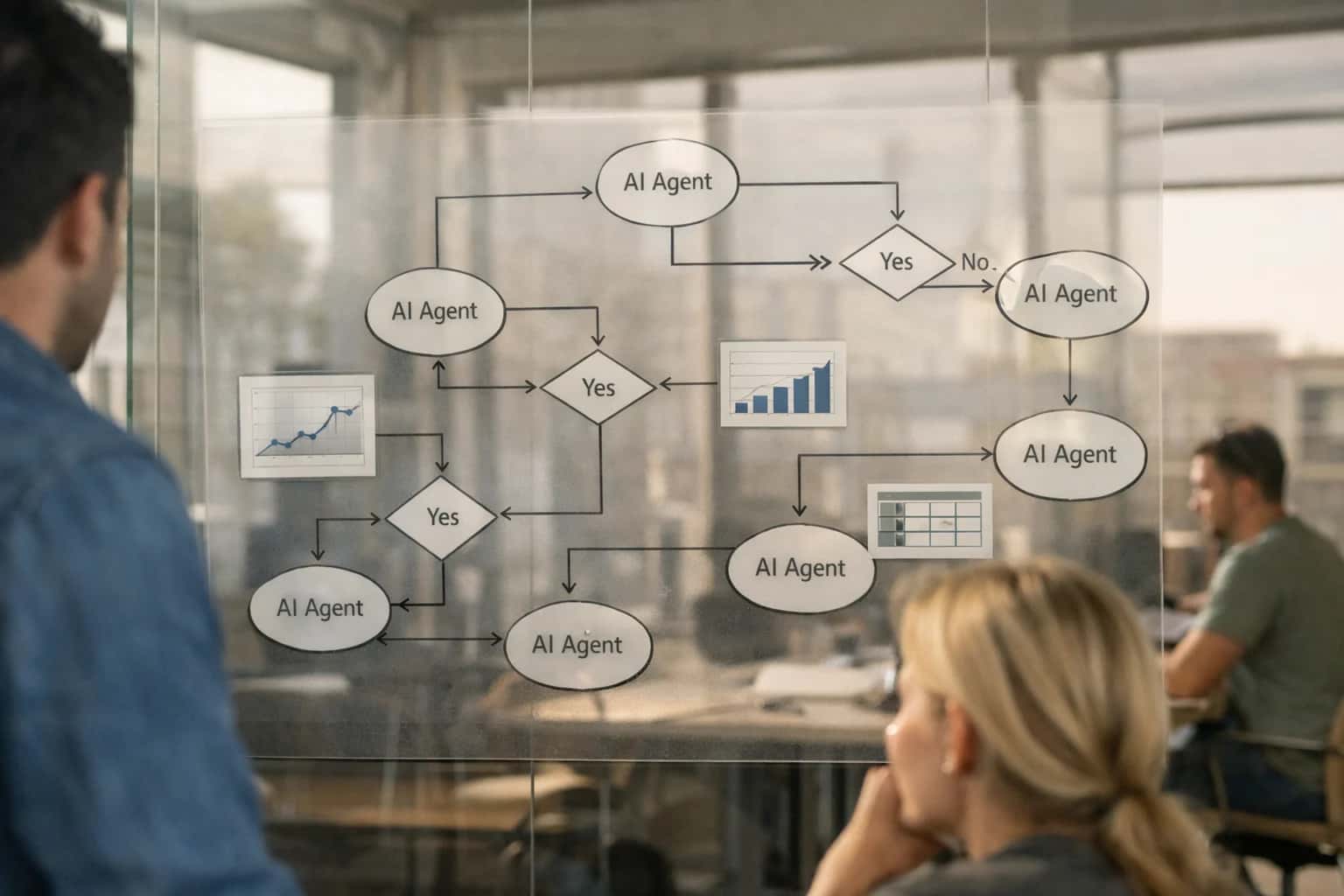
ARCHITECTURE AND ROLLOUT
Where AI Fits in Mobile Printing Workflows
Integrating AI into mobile print management transforms a rigid, permission-based process into a dynamic, context-aware system that enhances security and user productivity.
Implementation involves deploying an AI agent or middleware layer that subscribes to MDM webhooks for device events and polls APIs from print management solutions like PaperCut, PrinterLogic, or native CUPS servers. For each print request, this layer evaluates the context against a policy engine, which can be rule-based initially and enhanced with ML models for anomaly detection (e.g., unusual print volume or location). Key actions the AI can automate include:
- Secure Release: Holding jobs in a queue until the user authenticates at a designated printer via badge, PIN, or proximity (using MDM location data).
- Cost Allocation: Automatically charging jobs to the correct department or project code based on the user's MDM-assigned attributes.
- Policy Enforcement: Blocking or downgrading (e.g., to grayscale) prints containing sensitive data patterns when the device is non-compliant.
- Route Optimization: Selecting the nearest, least busy, or most cost-effective printer based on real-time data.
Rollout requires a phased approach, starting with a pilot group of users and a limited set of print policies. Governance is critical; all AI-driven decisions should be logged with an audit trail linking the print job, the MDM context used, and the action taken. This ensures compliance and provides a feedback loop to tune the models. The final architecture creates a closed-loop system where the MDM provides the device intelligence, the AI makes the contextual decision, and the print server executes the command—reducing help desk tickets for print issues and cutting waste from abandoned print jobs.
AI-ENABLED PRINT WORKFLOWS
MDM & Print Integration Touchpoints
MDM Context & Policy Layer
AI-driven print management starts with the rich device and user context available in your MDM platform. This layer provides the real-time signals needed to make intelligent routing and policy decisions.
Key MDM Data Points for AI:
- Device Identity & Health: Device type (iOS, Android, rugged), model, OS version, enrollment type (corporate vs. BYOD), and security posture (jailbreak/root detection, encryption status).
- User & Role Context: User identity from directory services (Azure AD, Okta), group memberships, department, and location (via GPS or network geofencing).
- Network & Location: Connected SSID, IP subnet, and cellular/Wi-Fi state to determine if the user is on a trusted corporate network or a public hotspot.
AI models consume this context via MDM REST APIs (e.g., Jamf Pro, Intune Graph API, Workspace ONE UEM) to evaluate the print request against dynamic policies. For example, a high-security document might only be released to a printer on the corporate network when the requesting device is corporate-owned, fully encrypted, and located within a secure geofence.
INTELLIGENT PRINT MANAGEMENT
High-Value AI Use Cases for Mobile Printing
Integrating AI with your MDM platform transforms mobile printing from a static, policy-driven task into a dynamic, context-aware workflow. These use cases show how to leverage device, user, and location data to automate secure print routing, enforce compliance, and optimize operations.
01
Context-Aware Secure Print Release
AI analyzes the MDM context (user role, device security posture, network SSID) to dynamically route print jobs. A field technician on a secure corporate Wi-Fi might have jobs print immediately, while a contractor on guest Wi-Fi triggers a secure hold/release queue at the nearest authorized printer, preventing sensitive documents from being left unattended.
Zero Unattended Prints
Security outcome
02
Automated Policy Enforcement & Cost Allocation
An AI layer intercepts print requests via MDM APIs and enforces granular policies. It can block color printing for non-marketing roles, route large jobs to cost-effective departmental printers, and tag each job with a cost center based on the user's AD group or MDM tag. This automates compliance and provides accurate chargeback data.
20-30% Reduction
In print waste & cost
03
Predictive Printer Selection & Load Balancing
AI uses historical print data and real-time status from print servers to intelligently select a destination. It considers printer proximity (via MDM location services), current queue length, toner levels, and maintenance schedules. The system routes jobs to the optimal available printer, balancing load and minimizing user wait times.
Batch -> Real-time
Routing logic
04
Intelligent Mobile Print Troubleshooting
When a mobile print job fails, an AI agent uses MDM device diagnostics (OS version, driver status, network connectivity) and print server logs to diagnose the root cause. It can then trigger an automated remediation via the MDM, such as pushing a corrected printer driver payload or executing a network configuration script, often resolving issues before a help desk ticket is created.
Tier-1 -> Zero-Touch
Support shift
05
Dynamic Geofenced Print Policies
Integrate AI with MDM location services to enforce location-based printing rules. For example, disable all printing when a managed device leaves a defined geofence (e.g., a secure campus) to prevent data leakage. Alternatively, enable printing only to pre-approved secure printers when a sales rep is at a client site, using SSID or GPS data for verification.
Policy-on-the-Move
Enforcement model
06
Automated Print Audit & Compliance Reporting
An AI system continuously ingests print logs from the server and enriches them with MDM context (user, device ID, location). It automatically generates compliance reports for regulations like HIPAA or GDPR, flagging anomalies such as after-hours printing of sensitive document types or attempts to print from unauthorized devices. This turns manual monthly audits into a continuous, automated process.
Days -> Minutes
Report generation
INTELLIGENT MOBILE PRINTING
Example AI-Powered Print Workflows
These workflows illustrate how AI can transform mobile printing from a manual, error-prone task into a secure, context-aware, and automated process by integrating MDM data with print servers and policy engines.
Trigger: A user initiates a print job from a managed mobile device (iOS/Android).
Context/Data Pulled:
- MDM Data: Device identity, enrolled user, assigned security group (e.g.,
Finance,Contractor), and real-time geolocation from the MDM platform (Jamf, Intune, Workspace ONE). - Print Context: Document metadata (filename, application source, page count).
Model or Agent Action: An AI agent evaluates the context against a policy engine:
- Policy Check: Is the user allowed to print from this location (e.g., HQ vs. public café)?
- Security Routing: Based on user group, should the job be routed to a secure
Follow-Mequeue requiring badge release, or a general department printer? - Cost Optimization: For high-page-count jobs, the AI may route to a more cost-effective printer if the user's role permits.
System Update or Next Step:
The agent calls the print server's API (e.g., PaperCut, Pharos) with a dynamic print command, specifying the exact printer and applying secure print release or hold parameters. The user receives a push notification via the MDM's hub app: "Your document is held at Printer Finance-Secure-12. Release with your badge."
Human Review Point: None for standard workflows. Policy violations (e.g., contractor attempting to print a sensitive document type at an offsite location) trigger an alert to the help desk for review and can automatically hold the job.
ARCHITECTING THE AI LAYER FOR SECURE, CONTEXT-AWARE PRINTING
Implementation Architecture & Data Flow
A production-ready AI integration for mobile print management connects MDM context, print server APIs, and policy engines to automate secure job routing.
The core architecture establishes the MDM platform (e.g., Jamf, Intune, Workspace ONE) as the authoritative source for user, device, and location context. When a print job is initiated from a managed mobile device, the system captures key attributes via the MDM API: the user's Active Directory group, the device's enrolled location (via GPS or network SSID), its security compliance state, and the assigned kiosk or work profile mode. This context is packaged into a secure payload and sent to a central AI orchestration layer.
The AI layer evaluates the payload against configured business rules and a learned model of print behavior. It makes real-time decisions on job routing, such as:
- Routing to the nearest secure printer based on the device's geofenced location.
- Enforcing follow-me printing by holding the job until the user authenticates at any corporate device.
- Blocking the job if the device is non-compliant (e.g., out-of-date OS, jailbroken) or if the document sensitivity (detected via initial content scan) conflicts with the printer's physical location (e.g., a public floor).
The approved job, with its target printer and release code, is then passed via a secure API (like
IPPor a vendor-specific cloud print API) to the organization's print server or cloud print service (e.g., PaperCut, PrinterLogic, Universal Print).
Governance is built into the data flow. All decisions are logged with an audit trail linking the user, device ID, document hash, policy applied, and target printer. For high-risk or anomalous decisions (like a first-time attempt to print a sensitive document type), the workflow can be configured to require human-in-the-loop approval via a Slack or Teams alert to the help desk before release. Rollout typically follows a phased approach, starting with a pilot user group and a single print server queue, using the AI layer's logs to refine routing rules and policy thresholds before enterprise-wide deployment.
INTEGRATION PATTERNS
Code & Payload Examples
Dynamic Print Job Routing with MDM Context
This pattern uses an AI agent to analyze the print request alongside real-time MDM context (user role, device location, security posture) to select the optimal print server and apply security policies before releasing the job.
Key Integration Points:
- MDM Location Services API (for geofencing)
- MDM Device Compliance API (for security posture)
- Print Server REST API (CUPS, PaperCut, PrinterLogic)
Example AI Agent Logic:
- Receive print job payload from mobile app.
- Query MDM for user's device location and compliance status.
- AI evaluates: Is the device on the corporate network? Is it compliant? Is the user in a secure zone?
- Based on rules, route to a secure, follow-me print queue or block the job.
- Send release command to the selected print server with user authentication token.
This moves print management from static rules to dynamic, context-aware workflows.
AI-ENHANCED PRINT MANAGEMENT
Realistic Time Savings & Operational Impact
How AI integration transforms mobile print workflows by automating policy enforcement and job routing, reducing IT overhead and user friction.
| Workflow Stage | Before AI | After AI | Key Notes |
|---|---|---|---|
Print Job Routing & Policy Check | Manual user selection of printer; IT help desk tickets for access issues | Automatic routing based on MDM context (user, location, device); policy checks happen in background | Eliminates 80% of 'printer not found' or 'access denied' support calls |
Secure Release & Authentication | User walks to printer, manually enters PIN or badge swipe | Proximity-based secure release via MDM-managed device Bluetooth/Wi-Fi; authentication is passive | Cuts walk-up time by ~2 minutes per job; enhances security without added steps |
Print Policy Exception Handling | IT admin manually reviews and approves exception requests (e.g., color, large jobs) | AI evaluates request against policy, user role, and historical data; auto-approves low-risk or flags high-risk | Reduces exception approval time from hours to minutes; admins focus on policy breaches |
Driver & Configuration Deployment | Manual driver pushes via MDM scripts after new printer rollout or user moves | AI analyzes user print history and location to auto-deploy correct drivers and profiles via MDM | Prevents 'driver missing' issues; configuration is proactive, not reactive |
Print Cost Allocation & Reporting | Monthly manual reconciliation of print logs by department | AI auto-tags jobs by project/department using MDM user group data; generates real-time cost dashboards | Shifts reporting from a monthly accounting task to continuous operational insight |
Compliance Audit for Sensitive Prints | Quarterly manual sampling of print logs for policy violations (e.g., confidential docs) | AI continuously monitors print metadata, flags anomalies, and auto-generates audit trails | Enables continuous compliance vs. periodic checks; reduces audit prep from days to hours |
Printer Fleet Health Monitoring | Reactive alerts when printers fail; users report issues | AI correlates MDM device location with printer SNMP data to predict failures and auto-create IT work orders | Moves from break-fix to predictive maintenance, reducing unplanned downtime |
ARCHITECTING CONTROLLED DEPLOYMENT
Governance, Security & Phased Rollout
Implementing AI for mobile print management requires a security-first architecture and a phased rollout to manage risk and validate ROI.
Governance starts with defining the data flow and access boundaries. The AI agent typically acts as a middleware orchestrator, receiving print job requests enriched with MDM context (user, device ID, location from Jamf Pro, Microsoft Intune, or Workspace ONE) via a secure webhook. It never stores print data long-term. Instead, it uses this context to call your print server's API (like PaperCut, PrinterLogic, or native Windows Print Server) with the appropriate secure queue, driver, and policy settings. All decisions—job routing, hold/release, cost-center charging—are logged with a full audit trail linking the user, device, and policy applied.
A phased rollout mitigates risk and builds confidence:
- Phase 1: Monitoring & Shadow Mode. Deploy the AI integration in a read-only "shadow" mode. It analyzes print requests and MDM context to recommend routing decisions, but all jobs flow through the existing, manual process. This validates the AI's logic without impacting users.
- Phase 2: Pilot with High-Value Workflow. Enable automated routing for a single, well-defined use case, such as secure "Follow-Me" printing for executives or label printing for warehouse devices managed by SOTI MobiControl. Restrict the pilot to a specific device group, location, or user role within your MDM.
- Phase 3: Broad Rollout with Human-in-the-Loop. Expand automation to more workflows, but implement approval gates for edge cases. For example, if the AI encounters a device with an unknown location or a user with conflicting roles, it can place the job in a hold queue and alert an IT admin via your ITSM platform (ServiceNow, Jira) for manual review before release.
Security is enforced at multiple layers. The AI system should only have the minimum necessary API permissions in your MDM (e.g., read-only for device inventory, no remote wipe). Print job data in transit is encrypted, and the AI's decision prompts are designed to avoid data leakage (e.g., never including sensitive document content in logs). Integration with your Identity and Access Management (IAM) platform ensures the AI agent's API calls are authenticated and its permissions are reviewed regularly. Finally, establish a rollback plan; the architecture should allow you to disable the AI routing logic instantly via a feature flag, reverting all print jobs to a default, known-good server queue.
Enabling Efficiency, Speed & Accuracy
Intelligent Analysis, Decision & Execution
We build AI systems for teams that need search across company data, workflow automation across tools, or AI features inside products and internal software.
Talk to Us
Search across company data
Give teams answers from docs, tickets, runbooks, and product data with sources and permissions.
Useful when people spend too long searching or get different answers from different systems.
Enterprise searchRAGPermissions
Read more
Automate internal workflows
Use AI to route work, draft outputs, trigger actions, and keep approvals and logs in place.
Useful when repetitive work moves across multiple tools and teams.
AI agentsWorkflow automationGovernance
Read more
Add AI to products and internal tools
Build assistants, guided actions, or decision support into the software your team or customers already use.
Useful when AI needs to be part of the product, not a separate tool.
AI integrationDecision supportModel routing
Read moreAI INTEGRATION FOR INTELLIGENT PRINT MANAGEMENT
Frequently Asked Questions
Practical questions for IT and operations teams planning AI-driven mobile print workflows.
An AI agent orchestrates routing by analyzing multiple real-time signals pulled from your MDM and print server APIs.
- Trigger: A user initiates a print job from a managed mobile device (iOS/Android).
- Context Pull: The AI system queries:
- MDM API: For user role, device location (GPS/network), and current security posture (is the device compliant?).
- Print Server API: For queue status, printer capabilities (color, duplex, stapling), and proximity to the user.
- Agent Action: A lightweight model evaluates the rules:
- Security Rule: Confidential document? Route only to printers in secure zones with follow-me release.
- Proximity & Cost Rule: User is in Building A? Route to the nearest available printer in that building. Color document? Route to a designated color printer to manage consumable costs.
- Fallback Logic: If the primary printer is offline or jammed, automatically reroute to the next best available printer and notify the user via a push notification.
- System Update: The AI agent sends the formatted job with routing instructions directly to the selected print queue via the print server's API (e.g., IPPS).
This moves routing from static, location-based queues to dynamic, policy-aware decisions.

About the author
Prasad Kumkar
CEO & MD, Inference Systems
Prasad Kumkar is the CEO & MD of Inference Systems and writes about AI systems architecture, LLM infrastructure, model serving, evaluation, and production deployment. Over 5+ years, he has worked across computer vision models, L5 autonomous vehicle systems, and LLM research, with a focus on taking complex AI ideas into real-world engineering systems.
His work and writing cover AI systems, large language models, AI agents, multimodal systems, autonomous systems, inference optimization, RAG, evaluation, and production AI engineering.
LinkedIn
Limited slotsGet a Free AI Consultation
Partnered with leading AI, data, and software stack.





How We Work
Custom AI workflows for your Business
One-fit-all AI don't work for modern businesses. At Inferensys, we aim to understand your business & custom requirements; which we use to define most efficient agentic workflows, the data, and the tools for your business.
01
Review the use case
We understand the task, the users, and where AI can actually help.
Read more02
Pick the right approach
We define what needs search, automation, or product integration.
Read more03
Build the first useful version
We implement the part that proves the value first.
Read more04
Improve from there
We add the checks and visibility needed to keep it useful.
Read moreThe first call is a practical review of your use case and the right next step.
Talk to Us