In biotech R&D, AI integration connects to three primary surfaces within your LIMS: the experiment layer, the sample and data pipeline, and the knowledge repository. For Benchling, this means enhancing the ELN with copilots that suggest experimental designs, analyze CRISPR screening outcomes, and draft protocol steps based on molecular biology context. In LabVantage, AI agents interface with sample management modules to automate high-throughput screening (HTS) data analysis, flagging potential hits and correlating results across plates and runs. The integration point is often the platform's native API—Benchling's GraphQL or LabVantage's REST endpoints—where AI services listen for new experiment commits, sample status changes, or result postings to trigger analysis.

Integration
AI Integration for LIMS in Biotech R&D
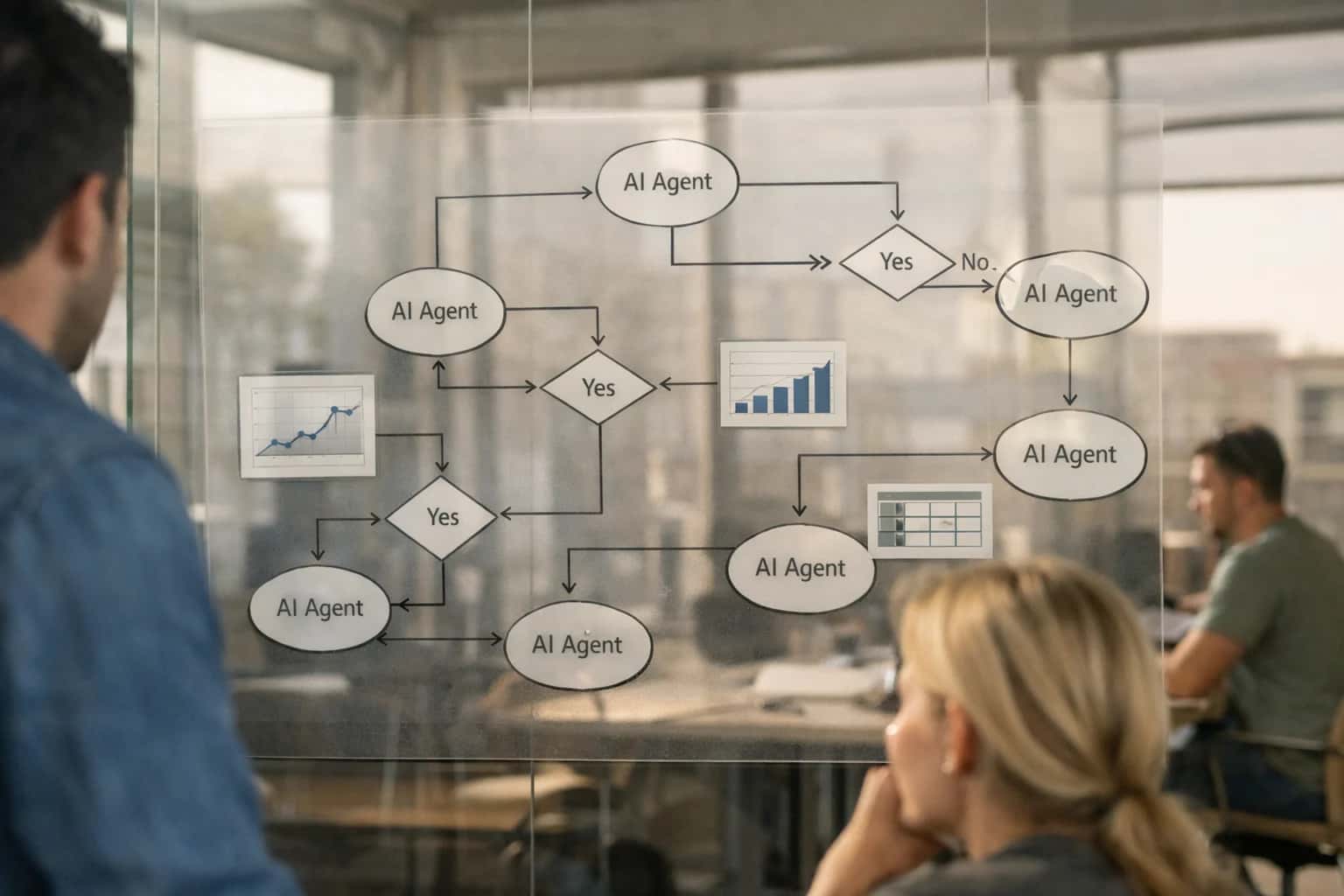
Where AI Fits into Biotech R&D LIMS Workflows
A practical blueprint for integrating AI into Benchling and LabVantage to accelerate discovery and optimize high-throughput operations.
A production implementation typically involves a secure middleware layer that hosts the AI models, manages context retrieval from the LIMS, and enforces role-based access. For instance, when a scientist in Benchling finalizes a CRISPR workflow experiment, an event webhook can push the experiment ID and result data to a queue. An AI agent retrieves the full context—including plasmid maps, gRNA sequences, and past screening data from connected vector stores—to perform analysis, then posts a summary and visualization back to a dedicated 'AI Insights' field in the experiment record. This keeps the workflow inside the scientist's primary interface while adding intelligence. Governance is built in: all AI-generated content is tagged, all data accesses are logged to the LIMS audit trail, and key outputs (like hit identification) require scientist review and electronic signature before proceeding.
Rollout should be phased, starting with a single, high-value workflow like intellectual property mining from experiment notes or HTS hit cluster analysis. This allows validation of the data pipeline, user acceptance, and compliance checks (critical for IP protection and GxP-adjacent research). The goal isn't to replace the LIMS but to make it smarter—turning days of manual data correlation into hours, reducing oversights in high-volume screens, and surfacing latent insights from years of experiment notes that are otherwise trapped in unstructured text.
AI Integration Surfaces for Benchling and LabVantage
Core Data Objects for AI Enrichment
AI integration surfaces begin with the primary data entities within Benchling and LabVantage that fuel R&D workflows. In Benchling, this includes Entries (experiment notes), Samples (biological or chemical entities), Results, and Containers. For LabVantage, the key objects are Samples, Tests, Results, and Worklists.
AI models can be triggered on record creation or update via webhook to perform tasks like:
- Automatic sample login by parsing request PDFs or emails to populate fields.
- Semantic tagging and linking of experiment entries to related protocols, materials, and outcomes.
- Anomaly detection in high-throughput screening result streams before validation.
- Intellectual property mining across experiment notes to surface novel findings or patentable concepts.
These integrations use platform-specific APIs (Benchling's GraphQL, LabVantage's REST/SOAP) to read, write, and link records, ensuring AI outputs are stored with full auditability.
High-Value AI Use Cases for Biotech R&D
Integrating AI into your LIMS and ELN platforms automates data-heavy workflows, surfaces hidden insights, and accelerates research cycles. These are the most impactful patterns for biotech R&D teams using Benchling and LabVantage.
High-Throughput Screening (HTS) Hit Identification
Connect AI models directly to Benchling's assay data tables to automatically cluster compound responses, identify false positives, and rank hits based on multi-parameter efficacy and toxicity signals. This moves analysis from batch review to real-time, in-workflow prioritization for medicinal chemists.
CRISPR Workflow Optimization & Guide RNA Design
Integrate an AI agent with Benchling's molecular biology data to analyze past editing efficiency, predict off-target effects, and suggest optimal gRNA sequences for new targets. The agent pulls from internal experiment history and public databases, drafting protocol steps directly in the ELN.
Intellectual Property Mining from Experiment Notes
Deploy a secure RAG pipeline over Benchling's project notebooks and LabVantage sample metadata to semantically search for novel findings, correlate disparate results, and auto-draft invention disclosures. This turns the ELN/LIMS from a passive record into an active IP asset for R&D and legal teams.
Automated Stability Study Trend Forecasting
Integrate time-series AI models with LabVantage's stability study management module to predict shelf-life breaches, flag out-of-trend (OOT) results early, and auto-populate interim regulatory tables. This provides stability scientists with proactive alerts instead of retrospective analysis.
Protocol Generation & Optimization from Text
Implement an AI copilot within Benchling that allows scientists to describe an experiment in natural language and receive a structured, editable protocol draft, populated with suggested controls, reagents (linked to inventory), and steps based on similar past experiments. This accelerates experimental design for research associates.
Cross-Platform Semantic Search for R&D Knowledge
Build a unified retrieval layer over Benchling (ELN), LabVantage (LIMS sample data), and document repositories to allow scientists to ask complex, cross-project questions (e.g., "Show me all failed purity assays for molecule class X using vendor Y's column"). This eliminates siloed, manual searching across systems.
Example AI-Augmented Workflows
These are production-ready automation patterns that connect AI models directly to Benchling and LabVantage workflows, focusing on high-throughput screening, CRISPR optimization, and IP mining. Each flow is designed to be implemented with secure APIs, audit trails, and defined human review points.
This workflow uses AI to analyze high-throughput screening results, cluster compound responses, and automatically flag candidate hits for follow-up.
- Trigger: A screening plate run is completed, and results are posted to a Benchling experiment via instrument integration or manual upload.
- Context Pulled: An AI agent queries the Benchling GraphQL API to retrieve the raw well-level data, compound structures (SMILES/InChI), associated controls, and historical performance data for the assay.
- Model Action: A clustering model (e.g., UMAP/t-SNE) groups compounds by response pattern. A separate classification model scores each compound for 'hit likelihood' based on potency, selectivity flags, and similarity to known actives in a private knowledge base.
- System Update: The agent writes back to the Benchling experiment:
- Creates a new result table with AI-generated scores and cluster assignments.
- Tags high-probability hits with a custom field (
AI_Hit_Candidate: TRUE). - Logs the analysis rationale in the experiment notes.
- Human Review Point: An automated notification is sent via Benchling or Slack to the project lead, listing the flagged compounds. The scientist reviews the AI's rationale and cluster visualization before promoting hits to the next stage in the registered molecule registry.
Implementation Architecture: Connecting AI to Your LIMS
A practical guide to wiring AI agents into Benchling and LabVantage for high-throughput screening, CRISPR workflows, and IP mining.
A production-ready integration connects AI to the functional surfaces of your LIMS where data is created, reviewed, and acted upon. For Benchling, this means interfacing with the Experiment API and Entity Registry to read/write experimental data, protocols, and molecular constructs. For LabVantage, the integration taps into the Sample Manager API and Stability Module to access sample lifecycles, test results, and study data. The architecture typically uses a middleware layer (e.g., a secure cloud function) that subscribes to LIMS webhooks—like a new experiment saved in Benchling or an OOS result posted in LabVantage—and orchestrates AI agents to analyze the payload.
For a CRISPR optimization workflow, the sequence is: 1) An agent is triggered by a new experiment record in Benchling containing gRNA sequences and target cells. 2) It calls a specialized LLM to review the design against an internal knowledge base of past experiments and public data, suggesting potential off-target effects. 3) The agent writes its analysis back to the experiment as a comment or a structured custom field, flagging it for the scientist. All tool calls are logged, and the original data remains the system of record. For intellectual property mining, a scheduled agent performs semantic search across all Experiment Notes and Project Discussions in Benchling, using a vector store to cluster concepts and draft potential invention disclosures for legal review.
Rollout follows a phased, governed approach. Start with a single pilot workflow, such as automated analysis of high-throughput screening data in LabVantage, where an agent reviews plate reader results to flag potential hits. Implement strict RBAC so agents only access data scoped to the pilot project team. Use the LIMS's native audit trail (critical for GxP) to log all AI-generated actions. Governance includes a human-in-the-loop approval step for any AI-suggested changes to core records (like sample dispositions) and regular drift monitoring of the agent's output quality against scientist feedback. This controlled integration delivers operational lift—turning days of manual data review into hours—without compromising compliance or data integrity.
Code and Payload Examples
Automating Hit Identification and Analysis
Integrating AI with Benchling's GraphQL API allows for real-time analysis of high-throughput screening (HTS) data as it's logged. An AI agent can be triggered via a webhook when a new experiment plate result is finalized. The agent retrieves raw well-level data, applies pre-trained models for hit calling and dose-response curve fitting, and posts structured annotations back to the experiment record. This automates the initial triage of thousands of compounds, allowing scientists to focus on validated leads.
Example Workflow Trigger:
json{ "event": "experiment.result.finalized", "entityId": "exp_abc123", "plateId": "plt_xyz789", "assayType": "CRISPR_Cas9_screening" }
The agent uses this payload to fetch the relevant Experiment and Plate objects via the Benchling API, runs the analysis, and updates the experiment with a new ResultAnalysis entry.
Realistic Time Savings and Operational Impact
How AI agents integrated into Benchling and LabVantage accelerate core research and quality workflows, shifting effort from manual execution to expert review.
| Workflow / Metric | Before AI Integration | After AI Integration | Implementation Notes |
|---|---|---|---|
High-Throughput Screening (HTS) Data Analysis | Manual review of 10k+ data points; 2-3 days to identify hits | AI-powered clustering & hit detection; results in 2-4 hours | AI model runs on data lake; flags top candidates for scientist review |
Experiment Note & Protocol Search | Keyword searches across ELN; often miss relevant past experiments | Semantic search across Benchling; finds related protocols & outcomes in minutes | Uses embedded vectors of experiment text; requires initial indexing |
Deviation / Investigation Report Drafting | QA investigator manually writes from scratch; 4-8 hours per report | AI agent drafts initial report using LIMS data & past templates in 1 hour | Pulls from SampleManager OOS records; human edits and approves final |
Intellectual Property Mining from ELN Notes | Quarterly manual review by R&D & legal teams for patentable concepts | Continuous AI scanning of Benchling entries; weekly highlight reports | Identifies novel compound descriptions and experimental results; flags for disclosure |
Stability Study Trend Analysis | Biweekly manual chart review to spot out-of-trend (OOT) results | AI monitors LabVantage stability data; alerts on anomalies same-day | Model forecasts expected degradation; alerts stability scientist via dashboard |
CRISPR Workflow Optimization Suggestions | Trial-and-error optimization based on literature and lab experience | AI analyzes past Benchling experiment success rates to suggest guide RNA designs | Correlates outcomes with genomic metadata; suggests 2-3 optimized parameters per run |
Sample Login & Metadata Capture | Manual data entry from paper or PDF request forms; 15-20 minutes per sample batch | Document AI parses request forms; auto-populates LIMS fields in <5 minutes | Integrated with Benchling/LabVantage UI; technician verifies extracted fields |
Regulatory Submission Data Compilation | Manual query building and table formatting for FDA/EMA submissions; 1-2 weeks | AI agent assembles data packages from LIMS, drafts tables & summaries in 2-3 days | Runs on scheduled pull from SampleManager; generates audit-ready data packages |
Governance, Compliance, and Phased Rollout
A production AI integration for a LIMS in biotech R&D is a controlled deployment, not a feature flip.
In a regulated environment, AI must operate within the existing quality management system. This means every AI-generated output—a suggested experimental parameter, a flagged data anomaly, or a draft deviation report—should be treated as a reviewable record. We architect integrations where AI actions are logged against specific sample IDs, user sessions, and audit trails within the LIMS (e.g., Benchling's activity log or LabVantage's audit module). AI agents are configured with role-based permissions, ensuring a research scientist can receive protocol suggestions, while only a QA manager can approve an AI-drafted deviation for formal routing.
A phased rollout is critical for adoption and risk management. A typical implementation follows this path:
- Phase 1: Assisted Review. Deploy AI as a copilot for data entry and review. For example, an agent pre-populates sample fields in LabVantage from a parsed request form, flagging missing fields for technician confirmation. In Benchling, an AI highlights potential inconsistencies in experiment notes against a protocol template.
- Phase 2: Workflow Automation. Introduce AI into defined, lower-risk automation paths. This could be auto-routing stability data in LabVantage that fits expected trends for approval, or using AI to generate first drafts of common experiment summaries in Benchling, which a scientist then edits and finalizes.
- Phase 3: Predictive & Generative Actions. Activate AI for higher-value, predictive tasks, such as forecasting reagent depletion in inventory or suggesting CRISPR guide RNA optimizations in Benchling based on historical editing efficiency data. Each step requires clear SOP updates, user training, and defined human-in-the-loop checkpoints.
Governance is built into the integration architecture. We implement version-controlled prompt libraries, track model performance and drift against a ground-truth dataset of lab decisions, and establish a change control process for any modification to the AI logic, aligning with the lab's existing change control for the LIMS itself. The goal is not to replace human expertise but to instrument it—providing scientists and QA staff with AI-powered tools that accelerate work while keeping them firmly in control of the final, compliant outcome.
Enabling Efficiency, Speed & Accuracy
Intelligent Analysis, Decision & Execution
We build AI systems for teams that need search across company data, workflow automation across tools, or AI features inside products and internal software.
Talk to Us
Search across company data
Give teams answers from docs, tickets, runbooks, and product data with sources and permissions.
Useful when people spend too long searching or get different answers from different systems.

Automate internal workflows
Use AI to route work, draft outputs, trigger actions, and keep approvals and logs in place.
Useful when repetitive work moves across multiple tools and teams.

Add AI to products and internal tools
Build assistants, guided actions, or decision support into the software your team or customers already use.
Useful when AI needs to be part of the product, not a separate tool.
Frequently Asked Questions
Common technical and operational questions about implementing AI agents and copilots within Benchling and LabVantage to accelerate discovery, optimize CRISPR workflows, and extract insights from experimental data.
Secure integration is built through a layered architecture:
- API Gateway & Authentication: We establish a dedicated integration layer (often using a cloud function or containerized service) that acts as a secure broker. This layer authenticates to your LIMS using existing service accounts (OAuth 2.0, API keys) with strictly scoped permissions, adhering to the principle of least privilege.
- Data Flow Control: The AI service pulls only the specific data needed for a task (e.g., a specific experiment's notes, a batch of screening results) via the LIMS REST or GraphQL APIs. It never has direct database access.
- Prompt & Payload Security: User prompts and context data are sanitized to prevent injection attacks. AI-generated content is validated before any write-back action is performed in the LIMS.
- Audit Trail: Every AI-initiated action—data read, analysis performed, record created or updated—is logged with a distinct service user ID, creating a clear audit trail compliant with GxP requirements where needed.

About the author
Prasad Kumkar
CEO & MD, Inference Systems
Prasad Kumkar is the CEO & MD of Inference Systems and writes about AI systems architecture, LLM infrastructure, model serving, evaluation, and production deployment. Over 5+ years, he has worked across computer vision models, L5 autonomous vehicle systems, and LLM research, with a focus on taking complex AI ideas into real-world engineering systems.
His work and writing cover AI systems, large language models, AI agents, multimodal systems, autonomous systems, inference optimization, RAG, evaluation, and production AI engineering.
Partnered with leading AI, data, and software stack.





How We Work
Custom AI workflows for your Business
One-fit-all AI don't work for modern businesses. At Inferensys, we aim to understand your business & custom requirements; which we use to define most efficient agentic workflows, the data, and the tools for your business.
01
Review the use case
We understand the task, the users, and where AI can actually help.
Read more02
Pick the right approach
We define what needs search, automation, or product integration.
Read more03
Build the first useful version
We implement the part that proves the value first.
Read more04
Improve from there
We add the checks and visibility needed to keep it useful.
Read moreThe first call is a practical review of your use case and the right next step.
Talk to Us