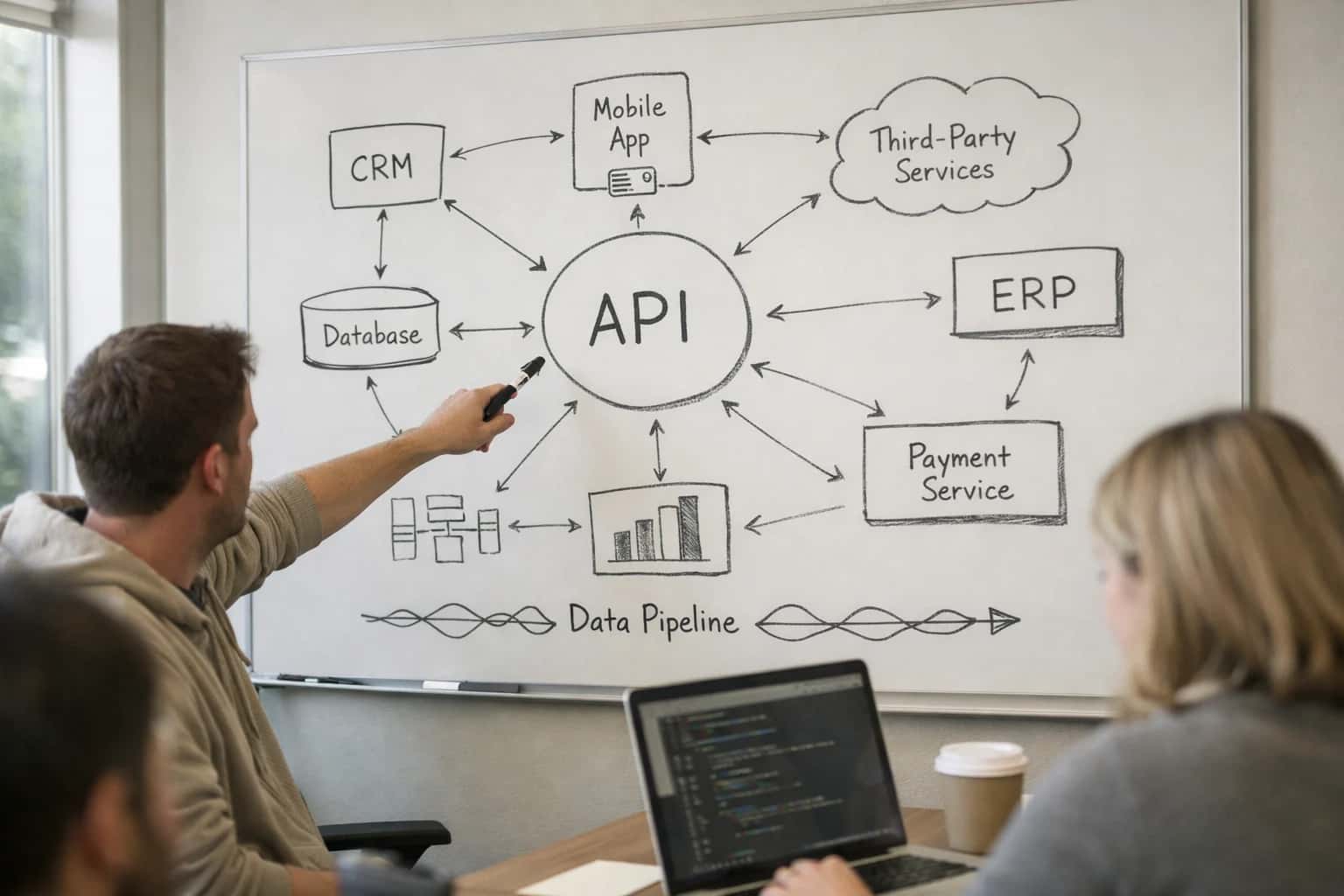
AI integration for Snapsheet Payment Processing connects at three key surfaces: the estimate approval queue, the payment generation workflow, and the audit log. The primary data objects are the estimate, supplement, payee, and payment record. AI services are triggered via webhook from Snapsheet's workflow engine or called via API from a custom middleware layer to perform real-time checks before a payment is authorized. This allows for validation logic that is too complex for simple business rules, such as comparing line-item descriptions against industry-standard repair databases or detecting subtle patterns indicative of duplicate billing across a repair network.

Integration
AI Integration for Snapsheet Payment Processing
A technical guide to automating payment approval and processing in Snapsheet using AI for validation, duplicate detection, estimate alignment, and audit-ready justification generation.
ARCHITECTURE & ROLLOUT
Where AI Fits into Snapsheet Payment Workflows
A technical blueprint for embedding AI into Snapsheet's payment approval and processing engine to automate validation, reduce errors, and accelerate settlement.
A typical implementation wires an AI agent into the approval path. When an estimate reaches the payment stage, the system payload (estimate details, photos, prior payments, payee info) is sent to an orchestration service. This service calls a series of specialized models: one to validate payee information against internal vendor masters and external business registries, another to check for duplicate payments by semantically matching line items against historical claims, and a third to ensure estimate alignment by comparing the initial appraisal against all supplements for scope creep. The agent then compiles findings into a natural-language payment justification that cites specific validations performed, which is attached to the payment record for audit. High-confidence approvals can be auto-routed, while exceptions are flagged with clear reasoning for adjuster review.
Rollout is typically phased, starting with AI as a co-pilot in the approval UI, providing recommendations the adjuster must accept. Governance is critical: all AI inferences must be logged with the claim ID, model version, input data hash, and output score. This creates an immutable audit trail for compliance and model performance tracking. A human-in-the-loop design is maintained for payments exceeding a configurable threshold or for payees outside a trusted network. Successful pilots often begin with a single, high-volume line of business (e.g., non-injury auto glass claims) to refine the integration and measure impact on payment accuracy and approval cycle time before expanding. For a deeper dive on orchestrating these multi-step validations, see our guide on AI Agent Builder and Workflow Platforms.
AI FOR PAYMENT PROCESSING
Key Integration Surfaces in Snapsheet
Automating the Payment Approval Chain
The payment approval workflow in Snapsheet is a primary surface for AI integration, where logic can be injected to validate and route payments before human sign-off. AI agents can be triggered at key workflow stages—such as after an estimate is finalized or a supplement is approved—to perform automated checks.
Key integration points include:
- Estimate-to-Payment Validation: Cross-reference the final approved estimate line items against the payment request to flag discrepancies in part numbers, labor hours, or non-OEM part usage.
- Duplicate Payment Detection: Query historical payment records for the same claim, repair facility, and invoice amount to prevent duplicate disbursements.
- Payee Verification: Validate payee name, tax ID, and banking details against internal vendor master lists and external compliance databases.
Integrating here reduces manual review time for supervisors and minimizes financial leakage from erroneous payments.
SNAPSHEET PAYMENT PROCESSING
High-Value AI Use Cases for Payment Processing
Integrate AI directly into Snapsheet's payment workflow to automate validation, reduce errors, and accelerate settlement. These use cases connect to Snapsheet's payment APIs, estimate data, and audit logs to create a secure, compliant, and efficient payment operation.
01
Automated Payee & Banking Validation
Use AI to instantly validate payee names, addresses, and banking details (routing/account numbers) against internal records and external data sources before payment release. Flags mismatches, potential fraud indicators, or changes from prior payments for human review, reducing payment errors and fraud risk.
Batch -> Real-time
Validation speed
02
Duplicate Payment Detection
AI models analyze payment requests against historical Snapsheet payment records, vendor master data, and claim details. Identifies near-duplicate payments based on payee, amount, invoice number, and claim context. Automatically holds suspected duplicates and generates an audit summary for the payment approver, preventing overpayments.
Same day
Issue detection
03
Estimate-to-Payment Alignment Review
AI cross-references the final payment amount against the approved repair estimate, supplements, and policy coverage in Snapsheet. Automatically verifies line-item alignment, checks for unapproved parts or labor, and ensures payments adhere to negotiated rates. Flags discrepancies with a clear justification for the adjuster, ensuring estimate compliance.
04
Audit-Ready Payment Justification Drafting
For each payment, an AI agent automatically generates a concise, structured payment justification. It pulls data from the claim file, estimate, approval notes, and compliance rules to create a narrative explaining the 'why' behind the payment. This document is attached to the payment record in Snapsheet, streamlining internal and external audits.
Hours -> Minutes
Document creation
05
Payment Exception Triage & Routing
AI classifies and routes payment exceptions (e.g., failed ACH, missing W-9, address mismatch) by severity and required action. Integrates with Snapsheet's workflow engine to automatically create tasks, assign them to the correct team (AP, adjuster, vendor management), and prioritize based on claim settlement date. Reduces manual sorting and follow-up.
06
Predictive Cash Flow Forecasting
By analyzing the pipeline of approved estimates and supplements in Snapsheet, AI models forecast upcoming payment batches and cash requirements. Integrates forecast data with payment scheduling to optimize treasury operations and provide finance teams with advanced visibility into claim settlement liabilities.
IMPLEMENTATION PATTERNS
Example AI-Powered Payment Workflows
These workflows illustrate how AI can be integrated into Snapsheet's payment processing to automate validation, reduce errors, and accelerate settlement. Each pattern connects to specific Snapsheet APIs and data objects to trigger actions, enrich decisions, and post results back to the claim file.
Trigger: A payment request is submitted in Snapsheet with a PAYMENT_READY status.
AI Agent Action:
- The integration service calls Snapsheet's
GET /claims/{claimId}/paymentsAPI to retrieve the payment details, including payee name, address, and banking information (if ACH). - An AI agent is invoked with the payee data and the full claim context (claimant, repair facility, third-party details).
- The agent performs two parallel checks:
- Entity Resolution: Compares the payee against all parties on the claim and internal vendor databases to confirm the correct entity is being paid.
- Duplicate Detection: Queries recent payments across Snapsheet for similar payee names, amounts, and claim numbers within a configurable time window.
System Update:
- If validation passes and no duplicates are found, the agent updates a custom Snapsheet field (e.g.,
ai_payee_validation_status = "APPROVED") and can optionally move the payment to the next approval stage via aPOSTto the workflow engine. - If a potential issue is found (e.g., payee mismatch or suspected duplicate), the agent creates a task in Snapsheet's task manager for a human reviewer, attaching a clear justification like: "Potential duplicate: Payment to 'ABC Auto Body' for $1,200 on claim CL-12345 matches 90% of payment issued 7 days ago on claim CL-67890."
PAYMENT INTEGRITY & AUDIT AUTOMATION
Implementation Architecture & Data Flow
A production-ready architecture for adding AI-driven validation and justification to Snapsheet's payment processing workflow.
The integration connects to Snapsheet's payment APIs and data model, typically intercepting the payment approval workflow. The core AI service acts as a pre-approval validation layer, receiving a payment request payload containing the estimate, payee details, payment amount, and claim context. It performs a multi-step check: validating payee information against internal vendor masters and external databases, scanning for duplicate payment patterns across the claim history, and ensuring the payment amount aligns with the approved estimate line items and any prior supplements.
For each validation step, the AI generates an audit-ready justification. This includes a natural language summary of the checks performed, any discrepancies found (e.g., 'Payee name mismatch detected between estimate and W-9 on file'), and a confidence score for payment approval. This structured output is posted back to a dedicated field in the Snapsheet payment object and can trigger automated actions: routing low-confidence payments to a human-in-the-loop review queue, auto-approving high-confidence payments, or flagging potential duplicates for investigator review. The system logs all AI decisions, model inputs, and human overrides for full traceability.
Rollout is typically phased, starting with a shadow mode where AI recommendations are generated and logged but do not affect the live workflow. This builds a performance baseline and refines prompts. Governance is critical: a payment operations lead should define the approval thresholds and review exception queues, while IT manages the API integration and data security. The final architecture reduces manual review for routine payments, cuts duplicate payment losses, and creates an immutable, queryable audit trail for every transaction, directly within the Snapsheet platform.
INTEGRATION PATTERNS
Code & Payload Examples
Validate Payee & Estimate Alignment
This pattern calls an AI service to validate a payment request before it's submitted to the payment processor. It checks for duplicate payments, payee name mismatches, and ensures the payment amount aligns with the approved estimate.
python# Example: Pre-payment validation service call import requests def validate_payment_request(payment_data): """ Calls an AI validation service for a Snapsheet payment. Returns a validation result and reasoning. """ payload = { "claim_id": payment_data["claim_id"], "payee_name": payment_data["payee_name"], "payee_tax_id": payment_data.get("tax_id"), "payment_amount": payment_data["amount"], "estimate_amount": payment_data["estimate_amount"], "historical_payments": payment_data.get("payment_history", []), "payment_type": payment_data["type"] # e.g., 'REPAIR', 'SUPPLEMENT', 'RENTAL' } # Call the AI validation endpoint response = requests.post( "https://api.your-ai-service.com/validate-payment", json=payload, headers={"Authorization": f"Bearer {API_KEY}"} ) return response.json() # Contains 'is_valid', 'flags', 'confidence', 'reasoning'
The response includes actionable flags (e.g., DUPLICATE_SUSPECTED, AMOUNT_MISMATCH) and a natural language justification suitable for an audit log.
AI-ENHANCED PAYMENT PROCESSING
Realistic Time Savings & Operational Impact
How AI integration transforms manual payment review and approval workflows in Snapsheet, automating validation, reducing errors, and accelerating cycle times.
| Workflow Stage | Before AI | After AI | Key Impact |
|---|---|---|---|
Payee & Vendor Validation | Manual cross-check across systems (5-15 min) | Automated API checks & duplicate detection (<1 min) | Eliminates manual lookup errors and duplicate payment risk |
Estimate-to-Payment Alignment | Line-by-line review for supplement matching (10-30 min) | AI comparison flags discrepancies for review (2-5 min) | Focuses human effort on true exceptions, not routine verification |
Regulatory & Compliance Check | Checklist review for state-specific rules (5-10 min) | Automated policy & compliance scan with audit trail (1 min) | Ensures consistent application of rules and creates defensible records |
Payment Justification Drafting | Manual note entry for approval chain (5-15 min) | AI-generated narrative from claim data (1 min + edit) | Standardizes communication, reduces adjuster administrative burden |
Approval Routing & Exception Handling | Manual triage based on adjuster judgment & email | AI-powered routing by amount, complexity, history (<1 min) | Optimizes reviewer workload, accelerates high-priority exceptions |
Audit Package Preparation | Manual document gathering and indexing (15-45 min) | Automated compilation with AI-generated summaries (2-5 min) | Turns a periodic scramble into an on-demand, consistent process |
End-to-End Payment Cycle (Standard) | 24-48 hours with multiple handoffs | 4-8 hours for straight-through processing | Enables same-day settlements, improves claimant satisfaction and cash flow |
ARCHITECTING FOR AUDIT AND CONTROL
Governance, Security, and Phased Rollout
Integrating AI into payment workflows requires a deliberate approach to security, compliance, and change management.
A production integration for Snapsheet payment processing must be architected with a human-in-the-loop model at its core. This means AI acts as a recommendation engine, not an autonomous actor. For example, an AI agent can analyze an estimate, validate the payee's banking details against policy records, check for duplicate payment patterns, and draft a justification memo—but the final approval and payment release should remain a manual step within Snapsheet's native workflow. This ensures all financial controls and segregation of duties are preserved. The integration should log every AI-generated recommendation, the data points it used, and the human approver's final decision to an immutable audit trail, typically via a dedicated logging service or by appending notes to the Snapsheet claim record.
Security is paramount when handling payment data. The integration architecture should ensure that sensitive data like bank account numbers or full Social Security Numbers are never sent directly to a third-party LLM. Instead, implement a data masking or tokenization layer before any external API call. For instance, the system can extract and hash payee identifiers for duplicate checking without exposing the raw values. All communication between Snapsheet, your internal middleware, and AI services must be encrypted in transit. Access to the AI orchestration layer itself should be governed by role-based access control (RBAC), mirroring the payment approval permissions already defined in Snapsheet.
A phased rollout mitigates risk and builds organizational trust. Start with a pilot program on a single, low-risk payment type—such as non-injury auto physical damage claims below a specific threshold. Use this phase to tune the AI's validation logic, measure its false-positive/false-negative rates for duplicate detection, and gather adjuster feedback on the usefulness of the automated justification memos. Gradually expand the scope by increasing the payment threshold, adding new payment types (like rental reimbursements), or including more complex workflows involving multiple payees. Each phase should include a parallel run where AI recommendations are generated but not shown to users, allowing you to compare its outputs against historical human decisions to validate performance before going live.
Enabling Efficiency, Speed & Accuracy
Intelligent Analysis, Decision & Execution
We build AI systems for teams that need search across company data, workflow automation across tools, or AI features inside products and internal software.
Talk to Us
Search across company data
Give teams answers from docs, tickets, runbooks, and product data with sources and permissions.
Useful when people spend too long searching or get different answers from different systems.
Enterprise searchRAGPermissions
Read more
Automate internal workflows
Use AI to route work, draft outputs, trigger actions, and keep approvals and logs in place.
Useful when repetitive work moves across multiple tools and teams.
AI agentsWorkflow automationGovernance
Read more
Add AI to products and internal tools
Build assistants, guided actions, or decision support into the software your team or customers already use.
Useful when AI needs to be part of the product, not a separate tool.
AI integrationDecision supportModel routing
Read moreIMPLEMENTATION AND OPERATIONS
Frequently Asked Questions
Practical questions about integrating AI into Snapsheet's payment processing workflows, covering architecture, security, rollout, and governance.
The integration connects via Snapsheet's REST API and webhooks. A typical flow is:
- Trigger: A payment request reaches a defined approval threshold in Snapsheet, triggering a webhook to our integration layer.
- Context Pull: The integration service fetches the full payment context via the Snapsheet API, including:
- Estimate details and line items
- Payee information (vendor/repair facility)
- Prior payment history for the claim
- Any attached photos or supporting documents
- AI Action: A validation agent processes this payload, calling several checks in sequence:
- Duplicate Detection: Compares payee, amount, and invoice references against recent payments.
- Estimate Alignment: Validates the payment amount against the approved estimate and any supplements using natural language understanding of notes.
- Payee Verification: Checks payee details against internal vendor master data for inconsistencies.
- System Update: The agent returns a structured JSON payload to Snapsheet, which can:
- Auto-approve the payment (if confidence is high and rules are met)
- Flag it for manual review with specific reasoning
- Request additional documentation via a diary entry
- Human Review Point: All auto-approved payments are logged in an audit queue for post-payment sampling by the finance team.

About the author
Prasad Kumkar
CEO & MD, Inference Systems
Prasad Kumkar is the CEO & MD of Inference Systems and writes about AI systems architecture, LLM infrastructure, model serving, evaluation, and production deployment. Over 5+ years, he has worked across computer vision models, L5 autonomous vehicle systems, and LLM research, with a focus on taking complex AI ideas into real-world engineering systems.
His work and writing cover AI systems, large language models, AI agents, multimodal systems, autonomous systems, inference optimization, RAG, evaluation, and production AI engineering.
LinkedIn
Limited slotsGet a Free AI Consultation
Partnered with leading AI, data, and software stack.





How We Work
Custom AI workflows for your Business
One-fit-all AI don't work for modern businesses. At Inferensys, we aim to understand your business & custom requirements; which we use to define most efficient agentic workflows, the data, and the tools for your business.
01
Review the use case
We understand the task, the users, and where AI can actually help.
Read more02
Pick the right approach
We define what needs search, automation, or product integration.
Read more03
Build the first useful version
We implement the part that proves the value first.
Read more04
Improve from there
We add the checks and visibility needed to keep it useful.
Read moreThe first call is a practical review of your use case and the right next step.
Talk to Us