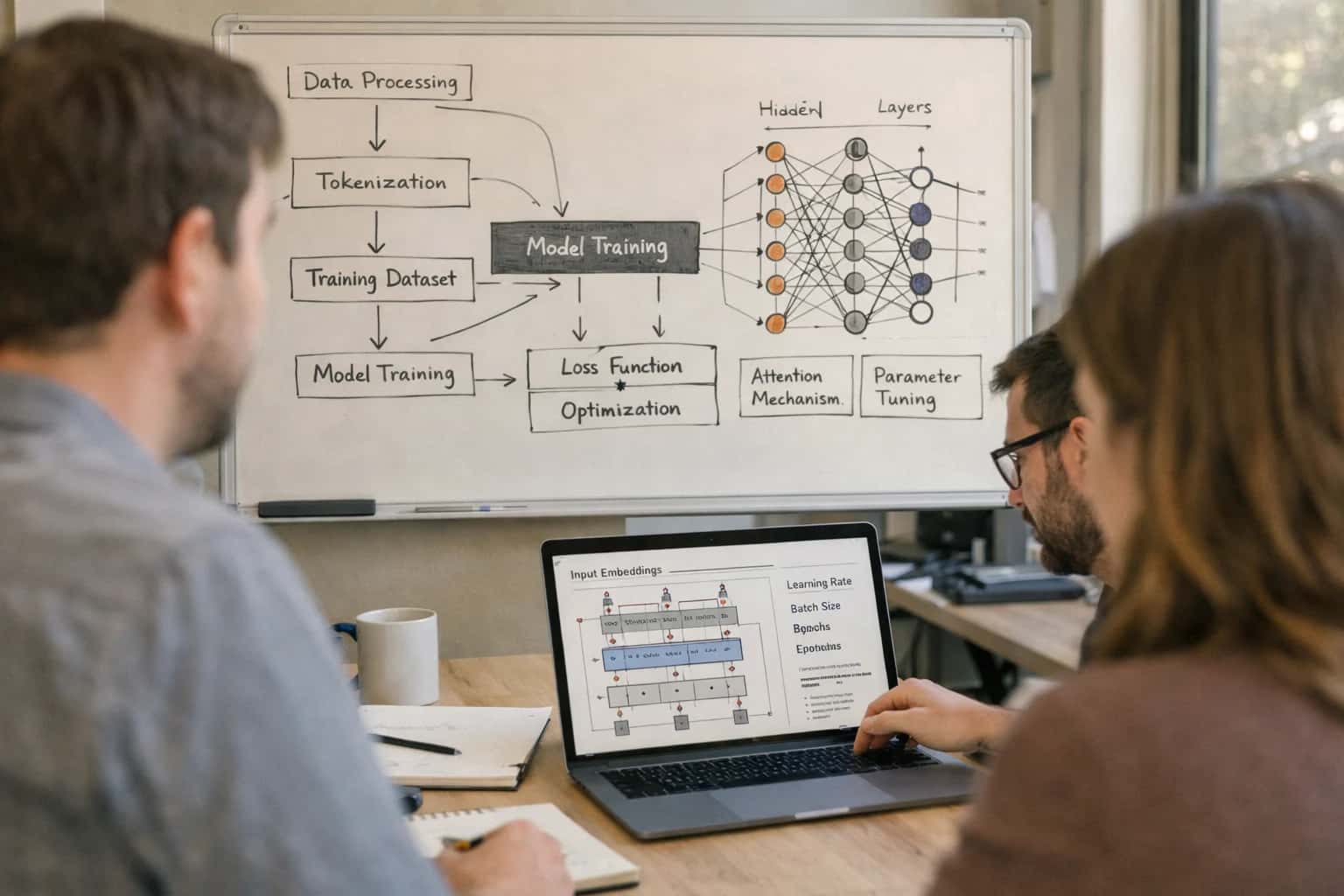
Sapiens AI for Claims is a native module designed to inject intelligence directly into the claims lifecycle. The integration architecture typically involves three primary layers: 1) The AI Model Layer, where custom models are trained on your historical claims data (FNOL narratives, adjuster notes, settlement amounts) and deployed via Sapiens' managed service or your own inference endpoints. 2) The Data Integration Layer, which synchronizes live claims data from the core Sapiens IDITSuite or CoreSuite databases—pulling from objects like ClaimHeader, ClaimLine, ReserveTransaction, and Document—to feed the models and post results back. 3) The Workflow Action Layer, where model outputs (e.g., a fraud score, a recommended reserve amount) trigger actions within the Sapiens rules engine, populate fields on the adjuster's workspace, or create diary entries for follow-up.

Integration
AI Integration for Sapiens AI for Claims
Where AI Fits into the Sapiens Claims Stack
A practical guide to embedding AI into the Sapiens AI for Claims platform, focusing on deployment, data pipelines, and workflow orchestration.
For a production rollout, the sequence matters. Start with a closed-loop pilot on a specific claim type (e.g., low-complexity auto glass). Configure the Sapiens AI for Claims console to score incoming claims but route all outputs to a validation queue instead of auto-applying them. Use this phase to tune prompts, refine data mappings via the platform's API (POST /api/v1/ai/predictions), and establish guardrail metrics like model confidence thresholds and human override rates. Successful patterns then get operationalized by embedding AI scores into the Sapiens workflow designer, automating tasks like directing high-fraud-score claims to the Special Investigations Unit (SIU) queue or suggesting initial reserves that adjusters can accept/modify with a single click.
Governance is critical. Ensure all AI-assisted decisions are logged to Sapiens' audit trail, linking the model version, input data snapshot, and output to the specific ClaimID. This creates an immutable record for compliance and model performance tracking. Use the Sapiens platform's role-based access control (RBAC) to manage who can view, approve, or override AI recommendations—treating the AI as a new system role. For ongoing operations, integrate your LLMOps monitoring (e.g., for drift, latency) with Sapiens' alerting system to ensure the AI layer remains reliable and its performance degrades gracefully, defaulting to manual workflows when needed.
Key Integration Surfaces in the Sapiens Ecosystem
Core Workflow Automation
The Sapiens Claims Processing Engine manages the end-to-end lifecycle. AI integration here focuses on injecting intelligence into automated workflow steps. Key surfaces include:
- Rules Engine Triggers: Configure the native rules engine to call AI services for decision support (e.g., triage scoring, fraud flagging) based on claim events, using webhooks or direct API calls.
- Activity & Diary Automation: Use AI to auto-generate activity notes from call transcripts or emails, and to suggest next diary dates based on predicted claim development timelines.
- Reserve Setting APIs: Integrate predictive models via API to provide initial and ongoing reserve recommendations, posting suggested amounts to the financials module with an audit trail for adjuster review.
This layer ensures AI actions are logged, auditable, and reversible, fitting within existing governance controls.
High-Value Use Cases for Sapiens AI Integration
Integrating Sapiens' native AI for Claims requires connecting model outputs to specific workflows, data objects, and user roles within the platform. These cards detail where AI can plug into the claims lifecycle to drive efficiency and accuracy.
Automated FNOL Triage & Routing
Integrate AI to analyze the initial loss description from calls, web forms, or mobile apps. The model classifies claim type, predicts complexity, and suggests initial exposure—automatically populating the Claim Header and Exposure objects in Sapiens. This triggers intelligent routing rules, sending claims to the appropriate adjuster queue or straight-through processing path based on predicted handling requirements.
Document Intelligence for Loss Packets
Connect AI document processing services to Sapiens' Document Management module. Ingest police reports, estimates, and medical records. AI extracts key data points (e.g., date of loss, parties involved, line-item damages) and maps them to the relevant Claim Fact or Reserve fields. Flag inconsistencies between documents for adjuster review, reducing manual data entry and search time.
Adjuster Copilot for Complex Claims
Embed an AI assistant within the adjuster's workspace, grounded in the specific claim file and company guidelines. The copilot uses the Sapiens API to fetch claim history, notes, and documents. It helps draft complex correspondence, summarizes lengthy activity logs, suggests next investigation steps based on claim type, and performs rapid policy coverage lookups—all without leaving the native interface.
Predictive Reserve & Settlement Analytics
Integrate predictive AI models with Sapiens' Financials module. At key milestones (FNOL, investigation update), the model analyzes claim facts, historical similar claims, and external data to recommend initial and ongoing reserve amounts. For settlement, it analyzes negotiation history and jurisdictional data to suggest a settlement range, automatically generating a summary memo in the Activity log for adjuster review and approval.
Subrogation & Recovery Identification
Augment Sapiens' Recovery module with AI that continuously scans new claim data. After liability assessment, the model analyzes loss facts against policy wordings and regulatory frameworks to automatically flag potential subrogation opportunities. It can draft the initial subrogation demand letter by pulling data from the claim file and populate a recovery case with recommended actions and statute timelines.
Compliance & Communication Audit
Integrate AI with Sapiens' Customer Communications and audit trails. Analyze all outbound correspondence (letters, emails) for regulatory compliance, tone, and clarity. Flag potential issues (e.g., missing legally required language, overly complex jargon) before sending. Post-call, analyze recordings to extract key details and sentiment, auto-creating a summary Activity Note and ensuring all required disclosures were provided.
Example AI-Augmented Claims Workflows
These concrete workflows illustrate how Sapiens AI for Claims connects to the platform's core modules, data model, and automation engine to deliver measurable improvements in adjuster productivity and claims cycle time.
Trigger: A new claim is created via the Sapiens portal, IVR, or agent call center.
Context/Data Pulled: The system ingests the initial FNOL data, including loss description, policy number, and any uploaded images or documents.
Model or Agent Action:
- An AI agent calls the Sapiens AI for Claims API, sending the unstructured loss description for analysis.
- The model classifies the claim type (e.g., auto collision, property water damage), extracts key entities (date, location, involved parties), and performs an initial severity triage (low, medium, high complexity).
- The agent cross-references the policy number via Sapiens CoreSuite APIs to verify coverage and pull relevant limits.
System Update or Next Step:
- The AI agent posts structured data back to the claim file:
claimType,estimatedSeverity,keyEntities. - It triggers a Sapiens workflow rule that uses the
estimatedSeverityand adjuster skill codes to automatically assign the claim to the appropriate team and set initial diary dates. - A summary note is auto-generated: "AI Triage: Classified as 'Auto Collision - Medium Complexity'. Auto-assigned to Auto Physical Damage team. Initial contact diary set for 24 hours."
Human Review Point: The adjuster reviews the AI-generated summary and structured data upon opening the claim, correcting any misclassifications. The assignment can be manually overridden.
Implementation Architecture: From POC to Production
A phased approach to operationalizing Sapiens' native AI for Claims, from initial pilot to governed, enterprise-scale deployment.
A successful integration begins by identifying a high-volume, low-risk workflow within Sapiens ClaimsPro or CoreSuite—such as automated document classification for FNOL packets or initial reserve setting for simple auto claims. The POC architecture typically involves a secure API gateway that routes specific document types or claim events from Sapiens to the AI for Claims service. The AI's output (e.g., a predicted document type, extracted fields, or a reserve recommendation) is returned as a structured JSON payload, which is then consumed by a lightweight middleware service. This service validates the data against business rules and posts the results back to the relevant Sapiens data objects (like ClaimDocument or FinancialTransaction), often using Sapiens' own APIs or by triggering a configured business rule to create a diary note for adjuster review.
For production, the architecture evolves to include robust orchestration, observability, and human-in-the-loop controls. A central workflow engine (like Apache Airflow or a serverless function) manages the end-to-end process: listening for Sapiens events via webhook or polling, calling the AI service, handling retries and fallbacks, and routing outputs based on confidence scores. High-confidence extractions can auto-populate claim screens, while low-confidence results are queued in a dedicated review interface built into the adjuster's workspace. Critical to this phase is integrating the AI's actions with Sapiens' audit trail, ensuring every automated field change or recommendation is logged with a traceable source (e.g., "AI_Reserve_Recommendation_v1.2"). Governance is enforced through a prompt management layer that version-controls the instructions sent to the AI models, ensuring consistency and enabling rapid updates to compliance or procedural guidelines.
The final stage focuses on scale and continuous improvement. This involves setting up a feedback loop where adjuster overrides or corrections to AI suggestions are captured and used to retrain or fine-tune the underlying models on your specific claims data. Performance dashboards are integrated, tracking metrics like straight-through processing rate, average handling time reduction for AI-assisted claims, and model accuracy drift. The architecture must also plan for multi-region deployment to comply with data residency requirements, often using Sapiens' deployment footprint as a guide. For a comprehensive view of how AI decisioning integrates with core insurance workflows, see our guide on AI Integration for Insurance Workflow Automation.
Integration Code and Payload Patterns
Deploying and Training Custom Models
Sapiens AI for Claims provides a managed environment for deploying pre-built and custom AI models. The core integration involves connecting your claims data lake to the AI platform's training pipelines via secure APIs.
Key Integration Points:
- Data Pipeline API: Push historical claims data (structured fields, documents, notes) to the AI platform for model fine-tuning. This typically uses a batch ingestion endpoint with JSONL or Parquet formats.
- Training Job Orchestration: Trigger and monitor custom model training jobs via REST API, specifying the target use case (e.g., FNOL triage, reserve forecasting).
- Model Registry: Once trained, models are versioned and stored in a registry. Integrate by fetching the latest approved model endpoint for inference.
Example Payload - Trigger Training Job:
jsonPOST /api/v1/training/jobs { "job_name": "reserve_model_v2", "dataset_uri": "s3://your-bucket/claims_q3_2024.jsonl", "use_case": "initial_reserve_prediction", "target_metric": "mean_absolute_percentage_error", "notification_webhook": "https://your-claims-system.com/api/ai/training/complete" }
Realistic Time Savings and Operational Impact
Typical impact of integrating and operationalizing Sapiens' native AI for Claims capabilities, based on augmenting existing adjuster workflows rather than full automation.
| Process or Metric | Before AI Integration | After AI Integration | Implementation Notes |
|---|---|---|---|
FNOL Document Triage | Manual sorting and routing (15-30 min/claim) | AI classification and priority scoring (<2 min/claim) | AI tags docs for type (police report, estimate) and urgency; human reviews high-priority items first. |
Reserve Setting Initial Recommendation | Manual review of similar historical claims (20-45 min) | AI-powered reserve range suggestion with rationale (instant) | Model trained on your historical loss data; adjuster reviews and approves final reserve. |
Medical Record Summarization | Adjuster reads full records (30-60 min/claim) | AI extracts key diagnoses, treatments, and timelines (2-5 min) | Summary is appended to claim file; adjuster verifies critical details before decision-making. |
Subrogation Potential Flagging | Periodic manual review or rule-based alerts (next-day) | Real-time AI scoring at FNOL and key milestones (instant) | Flags claims with high recovery likelihood; integrates with Sapiens rules engine for workflow creation. |
Complex Correspondence Drafting | Manual drafting from templates (15-25 min/letter) | AI-assisted generation with claim context (5-8 min) | Drafts denial letters, coverage explanations; adjuster personalizes tone and finalizes. |
Activity Note Consolidation | Adjuster skims previous notes for context (5-10 min) | AI-generated chronological summary of actions (instant) | Provides quick context for handoffs or supervisor reviews; sourced from Sapiens diary entries. |
Supplement Review on Estimates | Manual line-by-line comparison (20-40 min) | AI highlights discrepancies and missing line items (5 min) | Compares new estimate against initial appraisal; adjuster reviews flagged items only. |
Model Training & Feedback Loop | Quarterly batch analysis and manual retraining | Continuous performance monitoring and retraining prompts | Governance dashboard tracks AI accuracy; prompts retraining when drift is detected in specific loss types. |
Governance, Security, and Phased Rollout
Deploying Sapiens AI for Claims requires a structured approach to manage risk, ensure compliance, and build user trust.
A production integration must respect the existing security and data governance model of your Sapiens core platform. This means AI services should be invoked via secure, logged API calls from within Sapiens' workflow engine or business rules, never exposing raw claim data to unvetted external endpoints. All AI-generated outputs—like reserve recommendations or fraud scores—should be written to dedicated audit fields in the claims database, creating a clear lineage from model inference to adjuster action. Access to AI-powered features should be controlled by the same Role-Based Access Control (RBAC) profiles in Sapiens, ensuring only authorized users can trigger automations or view AI insights.
A phased rollout is critical for adoption and risk management. Start with a low-risk, high-volume use case like automated document classification for uploaded PDFs or initial triage scoring at FNOL. Run this in a shadow mode for 4-6 weeks, where AI recommendations are generated and logged but not acted upon, allowing you to compare AI suggestions against human decisions and calibrate model confidence thresholds. The next phase introduces human-in-the-loop automation, where the AI pre-populates a field (e.g., loss description from a recorded call) or flags a claim for review, requiring adjuster approval before proceeding. This builds trust and surfaces edge cases. The final phase enables straight-through processing for well-defined, high-confidence scenarios, such as auto-adjudicating simple glass claims or sending automated status updates.
Governance is an ongoing operation, not a one-time setup. Establish a cross-functional AI Steering Committee with members from Claims Ops, IT, Compliance, and Legal to review model performance, audit logs, and user feedback. Implement regular reviews of the AI's impact on key metrics like cycle time, leakage, and customer satisfaction (CSAT). Use Sapiens' reporting tools or connected BI platforms to track these outcomes. Finally, maintain a human override and appeal process that is simple for adjusters to use, ensuring the AI remains a tool that augments—not replaces—expert judgment, especially for complex or high-value claims.
Enabling Efficiency, Speed & Accuracy
Intelligent Analysis, Decision & Execution
We build AI systems for teams that need search across company data, workflow automation across tools, or AI features inside products and internal software.
Talk to Us
Search across company data
Give teams answers from docs, tickets, runbooks, and product data with sources and permissions.
Useful when people spend too long searching or get different answers from different systems.

Automate internal workflows
Use AI to route work, draft outputs, trigger actions, and keep approvals and logs in place.
Useful when repetitive work moves across multiple tools and teams.

Add AI to products and internal tools
Build assistants, guided actions, or decision support into the software your team or customers already use.
Useful when AI needs to be part of the product, not a separate tool.
FAQs: Sapiens AI for Claims Integration
Practical answers to common technical and operational questions about deploying, customizing, and governing Sapiens' native AI for Claims capabilities within your existing claims environment.
Deployment is managed through Sapiens' AI Hub, but integration requires connecting model outputs to your specific claims processes. A typical implementation involves:
- API & Event Integration: Configure Sapiens AI services to be triggered by specific events in ClaimsPro or CoreSuite (e.g., a new document upload, a status change to "Awaiting Triage"). This often uses webhooks or direct API calls from the Sapiens workflow engine.
- Data Context Provision: Ensure the AI service receives the necessary claim context. This involves passing a structured payload containing the claim ID, line of business, and pointers to relevant documents stored in Sapiens Document Management.
- Output Handling & Orchestration: Route the AI's output (e.g., a extracted data JSON, a triage recommendation) back into the workflow. This usually requires:
- Writing results to custom fields or activity notes in the claim file.
- Triggering a business rule in the Sapiens Rules Engine to assign the claim or update reserves.
- Creating a task in a human review queue if confidence scores are below a configured threshold.
Key is to treat the AI as a new, intelligent participant in your existing orchestration, not a replacement for it.

About the author
Prasad Kumkar
CEO & MD, Inference Systems
Prasad Kumkar is the CEO & MD of Inference Systems and writes about AI systems architecture, LLM infrastructure, model serving, evaluation, and production deployment. Over 5+ years, he has worked across computer vision models, L5 autonomous vehicle systems, and LLM research, with a focus on taking complex AI ideas into real-world engineering systems.
His work and writing cover AI systems, large language models, AI agents, multimodal systems, autonomous systems, inference optimization, RAG, evaluation, and production AI engineering.
Partnered with leading AI, data, and software stack.





How We Work
Custom AI workflows for your Business
One-fit-all AI don't work for modern businesses. At Inferensys, we aim to understand your business & custom requirements; which we use to define most efficient agentic workflows, the data, and the tools for your business.
01
Review the use case
We understand the task, the users, and where AI can actually help.
Read more02
Pick the right approach
We define what needs search, automation, or product integration.
Read more03
Build the first useful version
We implement the part that proves the value first.
Read more04
Improve from there
We add the checks and visibility needed to keep it useful.
Read moreThe first call is a practical review of your use case and the right next step.
Talk to Us