An effective claims chatbot is not a standalone application; it's an intelligent orchestration layer that sits between customer-facing channels (web, mobile, IVR) and your core systems of record. Its primary role is to capture, validate, and route structured data while managing the conversation. Key integration points are: 1) FNOL Systems (Guidewire ClaimCenter, Duck Creek Claims) for creating the initial claim record and triggering workflow; 2) Policy Administration Systems (Guidewire PolicyCenter, Sapiens IDITSuite) for real-time coverage verification and limits checks; and 3) Document Management platforms for storing chat transcripts and uploaded media as part of the official claim file. The chatbot acts as a pre-processor, ensuring data quality before it hits the core platform.

Integration
AI Integration for Insurance Chatbots for Claims
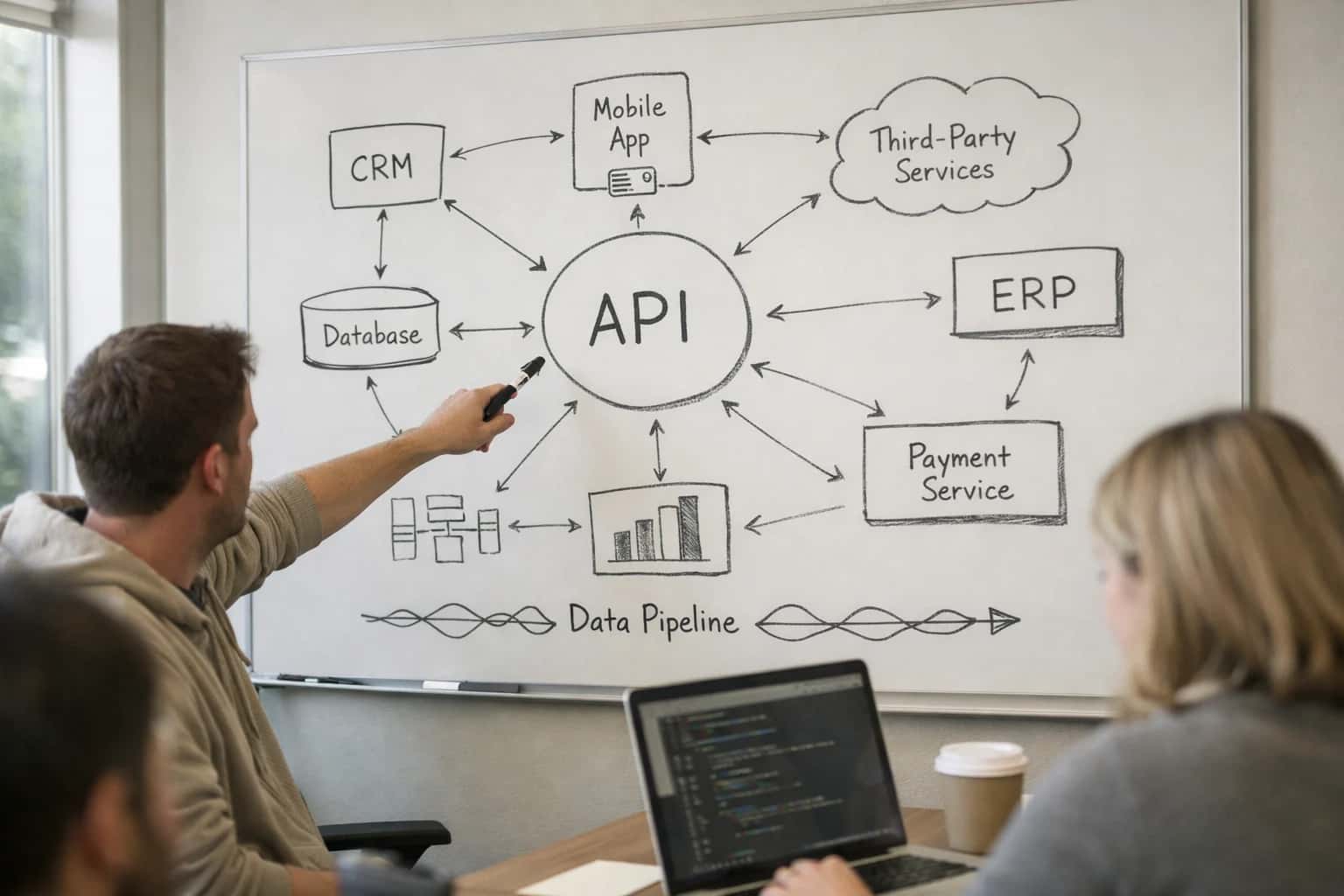
Where AI Chatbots Fit in the Claims Technology Stack
A practical guide to integrating conversational AI as a new orchestration layer between customer touchpoints and core claims systems.
Implementation requires a secure, event-driven architecture. The chatbot platform, hosted in your cloud environment, should expose a secure API. Customer interactions trigger a sequence of API calls: first to the PAS for a coverage check, then to the claims system to create a loss report with populated fields (date, location, description). For status updates, the chatbot queries the claims system via its REST API. All conversations must be logged with a unique claim ID for auditability. A critical design pattern is the human-in-the-loop handoff; when complexity exceeds a confidence threshold (e.g., a coverage dispute), the chatbot should seamlessly transfer the conversation—along with the full context—to a live agent's workspace in your CRM or contact center platform.
Rollout should be phased, starting with simple informational queries ("check my claim status") and document collection before advancing to full FNOL. Governance is paramount: every AI-generated response should be grounded in your official knowledge base and policy wording. Implement a feedback loop where adjusters can flag incorrect chatbot responses, which are used to retrain the underlying models. This approach turns the chatbot from a cost center into a force multiplier, handling routine inquiries 24/7 while ensuring complex cases are triaged to human experts with better context, reducing handle time and improving the customer experience.
Core System Integration Points for Claims Chatbots
Connecting to First Notice of Loss
Claims chatbots must integrate directly with the FNOL workflow in systems like Guidewire ClaimCenter or Duck Creek Claims. This is the primary entry point for automation.
Key integration surfaces:
- Web/Mobile Chat Widgets: Embed conversational AI into customer self-service portals to capture loss details via natural language.
- IVR & Call Center Feeds: Process call transcripts or summaries in real-time using speech-to-text APIs, extracting structured data (date, location, vehicle VIN, policy number).
- IoT & Telematics Alerts: Ingest automated first notice events from connected devices (e.g., crash detection from telematics, leak sensors) via webhook. The chatbot can then initiate contact with the policyholder for confirmation.
The AI must validate coverage by calling the Policy Administration System (e.g., Guidewire PolicyCenter) API with the extracted policy number before creating the claim record. Successful integration populates core fields (insured, loss details, coverage line) and triggers the initial assignment workflow.
High-Value Use Cases for Claims AI Chatbots
Practical AI chatbot implementations that connect directly to core claims platforms like Guidewire, Duck Creek, and Snapsheet to automate workflows, reduce manual effort, and improve customer and adjuster experiences.
Automated FNOL Intake & Triage
Integrate a chatbot with the FNOL module of your claims system (e.g., Guidewire ClaimCenter) to capture loss details via natural conversation. The bot validates policy coverage in real-time via API, performs instant triage using rule-based logic, and creates a fully populated claim file—routing complex cases directly to a human adjuster.
24/7 Claim Status & Document Hub
Deploy a customer-facing chatbot in your policyholder portal (e.g., Guidewire Digital Engagement) that provides secure, instant claim status. It answers FAQs, sends proactive updates triggered by claim system events, and guides users to upload documents (photos, invoices) which are automatically classified and attached to the correct claim record via API.
Adjuster Copilot for Case Summarization
Build an internal AI assistant that integrates with the adjuster workspace. With one click, it fetches the full claim history via the claims platform API, summarizes lengthy activity notes, correspondence, and medical reports into a concise timeline, and highlights key facts—saving hours of manual review per complex claim.
Intelligent Supplement Detection & Routing
For platforms like Snapsheet, integrate a chatbot that monitors incoming repair facility supplements. It compares new estimates against the original appraisal using AI, flags discrepancies in parts/labor, and automatically routes the supplement with an analysis summary to the appropriate adjuster for approval—streamlining the supplement workflow.
Proactive Communication for Stalled Claims
Connect a chatbot to the claims workflow engine to monitor diaries and tasks. When a claim is idle beyond a threshold, the bot automatically engages the customer or agent via SMS/email to request missing information (e.g., a repair estimate), using a conversational interface. Responses are parsed and used to update the claim, reducing cycle time without adjuster intervention.
Integrated Voice-to-Claim for Call Centers
Deploy an AI voice agent integrated with your IVR and core claims system. During FNOL calls, it conducts a natural conversation, performs real-time voice-to-text transcription, extracts key entities (date, location, vehicle), and populates a draft claim. The transcript and structured data are posted via API, allowing the human agent to focus on empathy and complex details.
Example Chatbot Workflows: From Trigger to System Update
These concrete workflows illustrate how an AI chatbot integrates with core claims systems to automate tasks, capture data, and update records, all within a secure, logged framework. Each flow connects the customer interaction to a backend system-of-record update.
Trigger: A policyholder initiates a web chat on the insurer's portal to report a new auto claim.
Context/Data Pulled:
- Chat session is initiated with the user's authenticated policy number.
- The chatbot calls the Policy Administration System (e.g., Guidewire PolicyCenter) API to retrieve active coverage details, vehicle information, and named drivers.
- It checks for any existing open claims for the same policy.
Model/Agent Action:
- The LLM-powered chatbot conducts a structured, conversational interview:
- Confirms loss type (e.g., collision, comprehensive).
- Asks for date, time, location, and a brief description of the incident.
- Gathers third-party information (if applicable).
- Guides the user to upload photos of the damage directly in the chat.
- The agent uses the gathered details to perform an initial triage: classifying claim complexity and estimating potential severity based on internal rules.
System Update/Next Step:
- The chatbot uses the Guidewire ClaimCenter API (or equivalent) to create a new claim file.
- It populates core fields: loss details, involved parties, initial coverage check result, and triage score.
- It attaches uploaded photos to the claim's document repository.
- The claim is automatically assigned a "New" status and routed to the appropriate queue (e.g., "Low Complexity Auto") based on the triage logic.
- A confirmation with the claim number and next steps is sent to the user via chat and SMS.
Human Review Point: The initial coverage determination and triage score are logged as "AI-suggested" and flagged for a quick adjuster review within 4 business hours.
Implementation Architecture: Orchestration, APIs, and Guardrails
A claims chatbot is not a standalone widget; it's a workflow orchestrator that must securely interact with multiple core systems.
A production-ready claims chatbot architecture is built on three layers: an orchestration layer that manages the conversation flow and calls specialized tools, a secure API gateway that brokers connections to backend systems like Guidewire ClaimCenter or Duck Creek Claims, and a set of operational guardrails. The orchestration layer uses a framework like LangChain or a custom agent to decide when to retrieve policy details from the PAS, create a claim draft in the FNOL system, or fetch document status from the DMS. Each action is executed via authenticated API calls (REST or SOAP) through a gateway that enforces rate limits, logs all transactions for audit, and masks sensitive data like Social Security Numbers before passing it to the LLM.
Critical guardrails are implemented at multiple points. Input validation occurs at the customer portal or IVR interface, scrubbing PII if needed before the LLM call. Response grounding ensures every answer about coverage or claim status is generated from a real-time query to the policy or claims system, not from the model's general knowledge. A human-in-the-loop escalation workflow is triggered by specific intents (e.g., 'I want to dispute') or low-confidence scores, seamlessly transferring the chat transcript and context to a live agent's workspace in the core system. Finally, a compliance and audit log records the full chain: user query, system calls made, data retrieved, and the final response, creating an immutable record for regulators.
Rollout follows a phased, claims-type-specific approach. Start with informational queries (status, document lists) which are low-risk and build user trust. Then, layer in guided FNOL data capture for simple auto glass or windshield claims, using the chatbot to collect VIN, date, and photos, and then invoking the FNOL API to create a draft claim. Finally, introduce complex workflow support, such as guiding a policyholder through a water damage claim by asking for sequential photos and scheduling a virtual inspection, all while updating the claim file after each step. This measured deployment, coupled with continuous monitoring of escalation rates and user satisfaction, ensures the AI augments the adjuster team without introducing process risk.
Code & Payload Examples for Key Integrations
Handling Initial Loss Report
A claims chatbot typically receives the first notice of loss (FNOL) via a webhook from your customer portal or IVR. The handler validates the session, extracts key details, and calls an LLM to structure the narrative.
Example Python Webhook Handler:
pythonfrom flask import request, jsonify import os from inference_client import ClaimsAIClient def handle_fnol_webhook(): data = request.json # Validate session & policy policy_id = data.get('policyNumber') raw_description = data.get('lossDescription') # Call AI service to structure FNOL client = ClaimsAIClient(api_key=os.getenv('INFERENCE_API_KEY')) structured_fnol = client.extract_fnol_entities( narrative=raw_description, line_of_business='auto' # or 'property', 'wc' ) # Payload to create claim in Guidewire/Duck Creek claim_payload = { "claim": { "policyId": policy_id, "lossDate": structured_fnol.get('loss_date'), "lossCause": structured_fnol.get('peril'), "description": structured_fnol.get('summary'), "extractedFields": structured_fnol.get('entities') # e.g., vehicle, location } } # Post to core system API # response = requests.post(CORE_SYSTEM_API + '/claims', json=claim_payload) return jsonify({"claimId": "CLM12345", "nextStep": "upload_photos"})
This pattern ensures the chatbot captures a structured FNOL payload ready for system-of-record creation, reducing manual data entry.
Realistic Time Savings and Operational Impact
How AI chatbots integrated with FNOL, policy, and claims systems transform key claims operations from manual, sequential tasks to assisted, parallel workflows.
| Metric | Before AI | After AI | Notes |
|---|---|---|---|
Initial FNOL Data Capture | 15-25 minutes (agent call) | 3-5 minutes (chatbot-guided) | Chatbot collects structured data via guided conversation, pre-populating FNOL record. |
Policy & Coverage Verification | Manual lookup, 2-5 minutes | Instant, automated API call | Chatbot queries policy system in real-time during FNOL, confirms coverage before proceeding. |
Claim Status Inquiries | Agent lookup, call-back required | Instant, 24/7 self-service | Chatbot retrieves real-time status from claims system, reducing call volume by 60-80%. |
Document Collection & Intake | Email/portal upload, manual filing | Guided upload with AI classification | Chatbot prompts for specific docs (police report, photos), AI classifies and files to correct claim folder. |
Simple Claim Triage & Routing | Agent review, 10-15 minutes | AI-assisted scoring, <1 minute | Chatbot uses initial data to assign complexity score and suggest assignment group, adjuster approves. |
Post-FNOL Communications | Manual email drafting & scheduling | Automated, personalized updates | Chatbot triggers status updates, next-step reminders, and document requests based on workflow stage. |
Agent/Adjuster Handoff | Manual case summary required | Automated conversation summary | Full chatbot transcript & extracted data summary auto-attached to claim, providing context for human agent. |
Governance, Security, and Phased Rollout
Deploying AI chatbots for claims requires a secure, auditable architecture and a phased rollout that builds trust and manages risk.
A production-ready claims chatbot must operate within the strict security and compliance boundaries of your core systems. This means implementing a claims-aware API gateway that sits between the chatbot and backend systems like Guidewire ClaimCenter, Duck Creek Claims, or Sapiens ClaimsPro. The gateway enforces role-based access control (RBAC), ensuring the chatbot only accesses the specific claim, policy, and customer data necessary for the session. All queries and actions—such as fetching a claim status, initiating an FNOL, or posting a document—are logged with a full audit trail, linking the AI-generated activity to the original user session for complete transparency.
Rollout should follow a phased, risk-managed approach. Start with a low-risk, high-volume use case like post-FNOL status inquiries, where the chatbot pulls data from the claims system to answer "Where's my check?" or "Is my estimator assigned?". This phase validates the integration's stability and user acceptance. Next, expand to guided data capture during FNOL, where the chatbot uses structured conversation to collect loss details, populating fields in the claims platform via API, but requires a human adjuster's final review and submission. The final phase introduces assisted decision support, such as the chatbot suggesting relevant coverage questions based on the loss description or recommending next steps from a playbook, always presenting its reasoning for the adjuster's approval.
Governance is critical. Establish a human-in-the-loop (HITL) framework where the chatbot's actions are scoped by clear protocols: it can retrieve information and draft responses, but any action that changes a claim's financials (reserves, payments) or legal standing must route through a human approval step within the native claims workflow. Implement regular model and prompt audits to ensure responses remain accurate, compliant, and aligned with company guidelines. By designing the integration with these controls from the start, you gain the efficiency of AI-powered self-service and adjuster support without compromising the security, compliance, and oversight required in insurance claims handling.
Enabling Efficiency, Speed & Accuracy
Intelligent Analysis, Decision & Execution
We build AI systems for teams that need search across company data, workflow automation across tools, or AI features inside products and internal software.
Talk to Us
Search across company data
Give teams answers from docs, tickets, runbooks, and product data with sources and permissions.
Useful when people spend too long searching or get different answers from different systems.

Automate internal workflows
Use AI to route work, draft outputs, trigger actions, and keep approvals and logs in place.
Useful when repetitive work moves across multiple tools and teams.

Add AI to products and internal tools
Build assistants, guided actions, or decision support into the software your team or customers already use.
Useful when AI needs to be part of the product, not a separate tool.
Frequently Asked Questions (FAQ)
Practical questions about integrating AI chatbots into claims workflows, covering architecture, security, rollout, and governance for platforms like Guidewire, Duck Creek, and Snapsheet.
We implement a secure API gateway layer between the chatbot and your core insurance systems (e.g., Guidewire PolicyCenter, Duck Creek Claims). This layer handles:
- Authentication & RBAC: The chatbot user's identity (customer, agent, adjuster) is validated via your existing IAM (e.g., Okta, Entra ID). API calls to backend systems are made with a system service account, scoped to the user's permissions, ensuring they only see data they're entitled to.
- Audit Logging: Every chatbot interaction, query, and data retrieval is logged with a user ID, timestamp, and system accessed for a complete audit trail.
- Data Masking: Sensitive data (e.g., full SSN, financial account numbers) is masked in the prompt context sent to the LLM (e.g., OpenAI, Anthropic). Only necessary identifiers (claim #, policy #) are passed through.
- Network Security: All connections use TLS 1.3. The chatbot and orchestration layer are typically deployed within your VPC or a private cloud, with outbound calls to LLM APIs whitelisted.
Example payload to a claims system API for a status check, initiated by a user-triggered chatbot query:
json{ "user_identity": "auth_token_verified", "requested_action": "get_claim_status", "parameters": { "claim_number": "CL-2024-5678" }, "audit_id": "chat-session-abc-123" }

About the author
Prasad Kumkar
CEO & MD, Inference Systems
Prasad Kumkar is the CEO & MD of Inference Systems and writes about AI systems architecture, LLM infrastructure, model serving, evaluation, and production deployment. Over 5+ years, he has worked across computer vision models, L5 autonomous vehicle systems, and LLM research, with a focus on taking complex AI ideas into real-world engineering systems.
His work and writing cover AI systems, large language models, AI agents, multimodal systems, autonomous systems, inference optimization, RAG, evaluation, and production AI engineering.
Partnered with leading AI, data, and software stack.





How We Work
Custom AI workflows for your Business
One-fit-all AI don't work for modern businesses. At Inferensys, we aim to understand your business & custom requirements; which we use to define most efficient agentic workflows, the data, and the tools for your business.
01
Review the use case
We understand the task, the users, and where AI can actually help.
Read more02
Pick the right approach
We define what needs search, automation, or product integration.
Read more03
Build the first useful version
We implement the part that proves the value first.
Read more04
Improve from there
We add the checks and visibility needed to keep it useful.
Read moreThe first call is a practical review of your use case and the right next step.
Talk to Us