AI connects to Okta IGA through its core APIs and event hooks, primarily focusing on the Access Certification, Role Management, and Segregation of Duties (SoD) modules. The integration ingests data from the Okta System Log, User, Group, and Application objects, along with custom attributes and lifecycle events. This creates a real-time feed of access changes, usage patterns (lastLogin, lastAccess), and business context (e.g., department, location from HR sync) for AI analysis.

Integration
AI Integration for Okta Identity Governance
A practical guide for augmenting Okta Identity Governance (IGA) with AI to analyze access patterns, suggest role definitions, automate certification campaigns, and identify segregation of duties conflicts.
ARCHITECTURE AND ROLLOUT
Where AI Fits into Okta Identity Governance
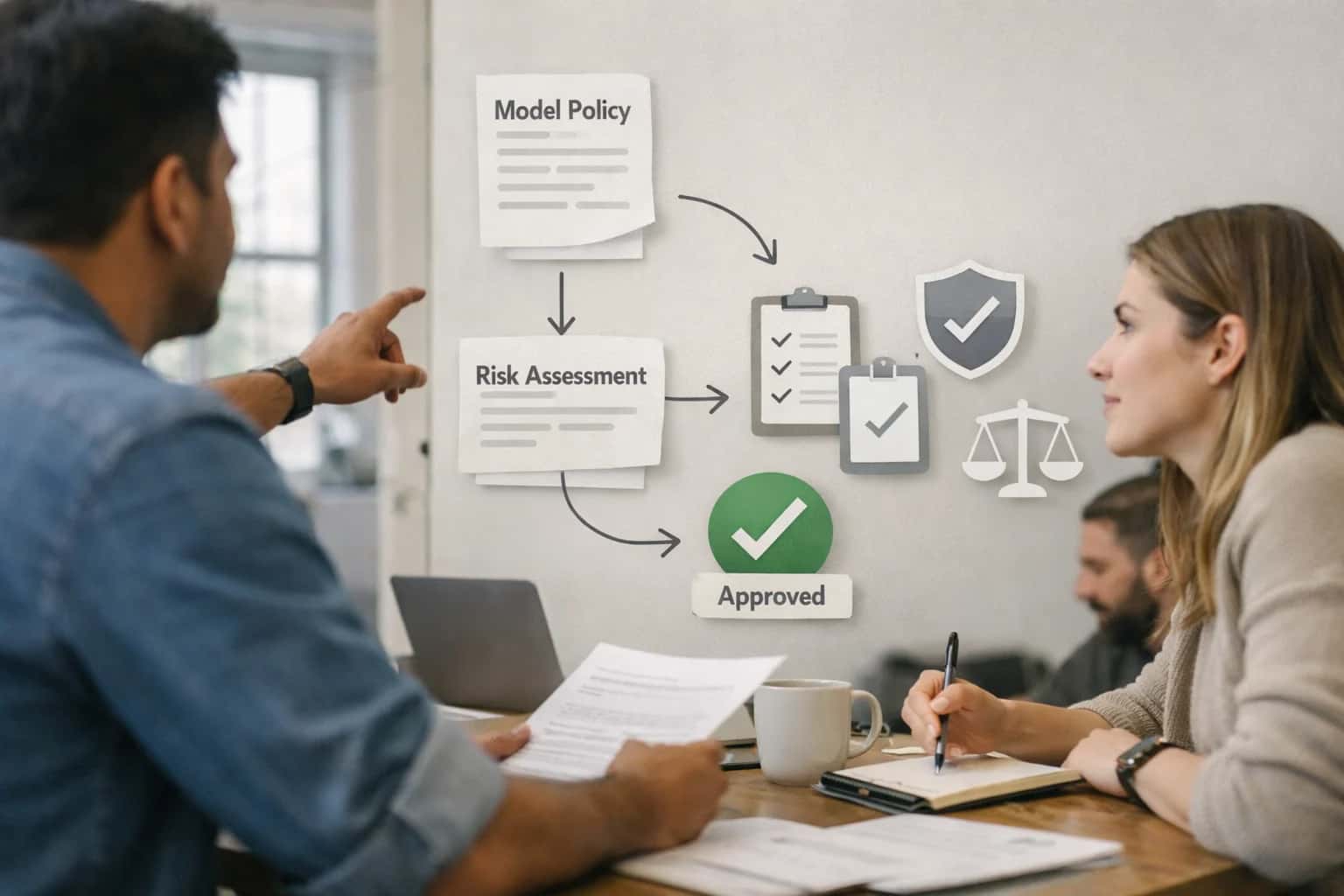
Integrating AI into Okta Identity Governance (IGA) transforms manual, periodic reviews into a continuous, intelligent control plane.
The primary workflow is a continuous analysis loop: AI models evaluate user entitlements against peer groups, historical activity, and business rules to generate intelligent recommendations for upcoming certification campaigns. For example, it can flag a user in Finance with recent SAP access but no login in 90 days for Revoke or suggest adding a contractor in Engineering to a new project-specific Okta Group based on their tool usage. This shifts governance from a blanket quarterly review to a targeted, evidence-driven process, reducing reviewer fatigue and cutting certification cycle times from weeks to days.
A production rollout typically uses a middleware agent or cloud function that subscribes to Okta webhooks (e.g., user.lifecycle.update, group.user_membership.add). This agent enriches events with external data, calls AI services for scoring, and writes recommendations back to Okta as pre-populated certification decisions or creates tickets in a connected ITSM platform like Jira for exception handling. Governance is maintained through a human-in-the-loop approval for high-risk changes, with all AI-driven actions logged to the Okta System Log for a full audit trail. The key is starting with a pilot on a single, high-impact access certification campaign—like Application Owners or Privileged Roles—to tune models and demonstrate value before expanding.
Where AI Agents Connect to Governance Workflows
Key Integration Surfaces in Okta IGA
Automating Review Generation and Prioritization
AI integrates directly into Okta IGA's certification campaign engine via the /campaigns and /reviews API endpoints. Instead of presenting reviewers with a static list of entitlements, an AI agent can pre-analyze user activity logs, role definitions, and peer group memberships to generate intelligent recommendations (e.g., "Revoke," "Certify with Exception").
Typical Workflow:
- A scheduled campaign is initiated in Okta IGA.
- An AI service is triggered via webhook, receiving the campaign ID and reviewer list.
- The agent fetches user access data and analyzes patterns (e.g.,
lastLogin > 90 days,entitlement not used in current role). - Recommendations are posted back to Okta as review comments, prioritizing high-risk outliers for human attention. This reduces manual review time by surfacing context, not just data.
AUGMENTING GOVERNANCE OPERATIONS
High-Value AI Use Cases for Okta IGA
Integrate AI directly with Okta Identity Governance to move from periodic, manual reviews to continuous, intelligent access management. These patterns connect to the Okta IGA API, Workflows, and System Log to automate analysis and decision-making.
01
Intelligent Access Certification Campaigns
Use AI to pre-analyze user entitlements, role memberships, and 90-day activity logs from the Okta System Log. Generate narrative summaries for each user, highlighting anomalous logins, unused applications, and role drift. Campaign reviewers receive a concise, risk-prioritized list instead of raw spreadsheets.
Hours -> Minutes
Review preparation
02
AI-Powered Role Engineering & Optimization
Analyze the aggregate access patterns of thousands of users against Okta IGA's role definitions. AI models identify common entitlement clusters, outliers, and segregation of duties (SoD) conflicts to suggest new role structures or clean up existing ones. Feed recommendations directly into the Okta IGA API for governance approval workflows.
1 sprint
Role refinement cycle
03
Dynamic Segregation of Duties (SoD) Monitoring
Move beyond static SoD policy checks. Integrate an AI agent that continuously monitors Okta IGA entitlements, user assignments, and provisioning requests. It detects emerging or contextual SoD risks based on business unit, project phase, or temporary access, triggering Okta Workflows for manager attestation or automated remediation.
04
Automated Access Request Triage & Routing
Deploy an AI copilot on the access request portal. When a user submits a request, the agent analyzes their current profile, job title, and peer access patterns to suggest appropriate entitlements, recommend approvers, or flag high-risk requests. It can auto-approve low-risk, common requests by calling the Okta IGA API, logging the AI's rationale in the audit trail.
Same day
For standard requests
05
Anomaly Detection for Certified Access
Post-certification, use AI to monitor the activity of users whose access was recently confirmed. By analyzing Okta logins, application launches, and geographic patterns, the system detects deviations from certified baselines, such as sudden access to sensitive apps from new locations, generating alerts for the security team within Okta IGA.
06
Narrative-Driven Compliance Reporting
Automate the generation of compliance evidence (e.g., for SOX, SOC 2). An AI agent queries the Okta IGA API for user lists, role changes, and certification completion status, then synthesizes executive summaries, identifies control gaps, and drafts narrative explanations. This transforms raw data into auditor-ready reports.
Batch -> Real-time
Report generation
IMPLEMENTATION PATTERNS
Example AI-Augmented Governance Workflows
These workflows illustrate how AI agents can be integrated with Okta Identity Governance (IGA) APIs and event streams to automate complex, manual processes. Each pattern connects a business trigger to an AI action that results in a system update within Okta, creating a closed-loop, auditable automation.
Trigger: A scheduled Okta IGA access review campaign is initiated for 5,000+ user-application entitlements.
Context/Data Pulled: The AI agent queries the Okta API for:
- The list of user-application assignments in scope.
- 90 days of Okta System Log data for login frequency and IP patterns for each assignment.
- User attributes (department, location, job title) from the Okta Universal Directory.
- Recent IT service tickets related to access requests or issues.
Model/Agent Action: A classification model analyzes each assignment to predict review outcome and priority:
- High-Risk/Revoke: Assignments with no logins in 90 days, user in mismatched department, or with conflicting SoD flags.
- Low-Risk/Auto-Approved: Assignments with daily logins from a consistent location matching the user's role.
- Needs Clarification: Assignments with irregular patterns; the agent drafts a concise question for the reviewer (e.g., "User in Marketing logs into SAP FI weekly. Confirm business need?").
System Update/Next Step: The agent uses the Okta IGA API to:
- Pre-populate the review interface with its recommendation (
Approve,Revoke,Comment). - Attach the generated evidence summary and question to the relevant items.
- Adjust campaign due dates, prioritizing high-risk items for early review.
Human Review Point: Campaign owners and reviewers see AI-generated recommendations and evidence, making the final decision. All AI actions are logged in the campaign audit trail.
ARCHITECTING AI-ENHANCED IGA
Implementation Architecture and Data Flow
A practical blueprint for connecting AI models to Okta Identity Governance's core workflows and data.
The integration connects at three primary surfaces within Okta IGA: the API layer (Okta Identity Governance API), the event stream (Okta System Log), and the automation engine (Okta Workflows). AI models ingest data from these sources—such as user-role assignments, access certification campaign results, and entitlement usage logs—to generate insights. These insights are then written back via API to create intelligent recommendations within IGA objects like AccessProfiles, RoleDefinitions, and CertificationCampaigns. For example, an AI agent analyzing historical certification decisions can post a recommendedAction (Approve/Revoke/Review) to a user's CertificationItem, directly within the IGA console for reviewer consideration.
A production deployment typically uses a middleware service or an orchestration platform like n8n or Microsoft Copilot Studio to manage the flow. This service subscribes to Okta System Log webhooks for events like user.lifecycle.update or group.user_membership.add, triggering AI analysis. The AI service, often a containerized model endpoint or a call to a managed LLM API, processes the data. It might use a RAG pipeline with a vector database like Pinecone, populated with policy documents and past SoD conflict resolutions, to ground its recommendations in your specific compliance context. Approved AI-driven actions, such as auto-revoking an unused entitlement, are executed via secure, service-account-authenticated API calls back to Okta, with full audit trails logged in both systems.
Rollout should be phased, starting with a read-only 'observer' mode where AI generates recommendations visible only to IGA admins, before progressing to automated, low-risk actions. Governance is critical; implement a human-in-the-loop approval step in Okta Workflows for any AI-suggested role changes or revocations. Regularly evaluate model performance against a ground-truth dataset of manual IGA decisions to monitor for drift. This architecture ensures AI augments—rather than replaces—existing IGA controls, providing scalable intelligence for access reviews and role engineering while maintaining the governance and auditability required for compliance frameworks like SOX and GDPR. For related patterns, see our guide on AI-Powered Access Reviews for IAM Platforms.
AI-ENHANCED OKTA IGA WORKFLOWS
Code and Payload Examples
Automating Certification Campaigns with AI
Use AI to analyze user access patterns, peer group memberships, and activity logs to pre-populate review recommendations for Okta Identity Governance campaigns. The AI agent calls the Okta IGA API to create campaigns, assign reviewers, and set intelligent due dates based on risk.
Example Python payload for campaign creation:
pythonimport requests # AI-generated recommendation payload campaign_payload = { "name": "Q3 High-Risk Access Review", "description": "AI-identified high-risk entitlements based on segregation of duties conflicts and dormant accounts.", "type": "ACCESS_REVIEW", "reviewers": [{ "type": "GROUP", "id": "00g1a2b3c4d5e6f7g8h9" # Okta Group ID for 'Line Managers' }], "reviewedItems": [{ "type": "ROLE", "id": "0ra1b2c3d4e5f6g7h8i9", # Okta Role ID "recommendation": "REVOKE", # AI-generated recommendation "recommendationReason": "User has not logged into related applications in 90+ days and holds conflicting financial approval role." }], "deadline": "2024-12-15T23:59:59Z" } # Create the campaign via Okta IGA API response = requests.post( "https://your-org.okta.com/api/v1/iga/campaigns", json=campaign_payload, headers={"Authorization": "SSWS your-api-token"} )
This pattern reduces manual campaign setup from hours to minutes and surfaces the highest-risk access for review.
AI-ENHANCED IDENTITY GOVERNANCE
Realistic Operational Impact and Time Savings
This table illustrates how AI integration transforms key Okta Identity Governance workflows, shifting effort from manual review to intelligent, assisted operations.
| Governance Workflow | Before AI | After AI | Implementation Notes |
|---|---|---|---|
Access Review Campaign Creation | Manual role and user selection, 2-4 hours per campaign | AI-suggested scope based on risk and change data, 30-60 minutes | Human manager reviews and approves AI-generated campaign parameters. |
Segregation of Duties (SoD) Conflict Detection | Periodic manual audits or rule-based static checks | Continuous analysis of entitlements and usage to flag potential conflicts | AI identifies novel conflict patterns beyond static rule sets. |
Role Definition and Optimization | Quarterly manual analysis of entitlement sprawl | Monthly AI-driven recommendations for role consolidation or creation | Recommendations based on actual usage patterns and peer group analysis. |
Certification Justification Review | Manual reading of every user-provided justification | AI summarization and risk-flagging of justifications for reviewer focus | Reviewer time focused on high-risk or anomalous justifications only. |
Anomalous Access Pattern Investigation | Manual log review triggered by threshold alerts | AI-prioritized alerts with narrative context on user behavior shifts | SOC analysts start with AI-generated investigative summary. |
User Lifecycle Entitlement Recommendations | Static rule-based provisioning from HR title/department | Context-aware AI suggestions based on project, manager, and peer data | Integrates with Okta Workflows for intelligent provisioning automation. |
Compliance Report Generation (e.g., SOX, SOC2) | Manual data extraction, formatting, and narrative writing | AI-assisted data aggregation, summarization, and draft narrative creation | Compliance officer reviews, edits, and finalizes AI-generated drafts. |
CONTROLLED DEPLOYMENT FOR ENTERPRISE IGA
Governance, Security, and Phased Rollout
A pragmatic approach to integrating AI with Okta IGA that prioritizes security, auditability, and incremental value.
Integrating AI with Okta Identity Governance requires a secure-by-design architecture. AI agents interact with Okta's APIs—primarily the Identity Governance API for access reviews and role management, and the System Log API for behavioral data—through a dedicated middleware layer. This layer enforces strict RBAC, logs all AI-initiated actions (like role suggestions or certification campaign updates) to a separate audit trail, and implements approval workflows for any high-impact changes before they are committed to Okta. Sensitive data, such as user-role mappings and access history, is processed in-memory or within a secure enclave; prompts are engineered to avoid exposing PII to the LLM, and all outputs are validated against existing IGA policies.
A successful rollout follows a phased, risk-aware model. Phase 1 focuses on assistive intelligence: deploying a read-only AI analyst that surfaces insights—like outlier access patterns or potential Segregation of Duties (SoD) conflicts—in a dashboard for human reviewers. Phase 2 introduces guided automation: the AI suggests role definitions or certification campaign targets, but a human in the loop must approve each action via an integrated workflow in Okta Workflows or a custom portal. Phase 3 enables conditional automation for low-risk, high-volume tasks, such as auto-certifying access for standard role memberships with no policy violations, based on rules defined by the governance team.
Governance is continuous. We establish a control plane that includes regular reviews of the AI's recommendation accuracy and bias, prompt versioning, and model drift detection. Access to the AI integration's control interfaces is gated by Okta itself, ensuring only authorized IGA admins can adjust its behavior. This approach ensures the AI augments your governance posture without introducing unmanaged risk, turning Okta IGA from a periodic compliance exercise into a continuously intelligent system. For related patterns on securing AI agents within IAM, see our guide on AI-Powered Threat Detection for Identity Platforms.
Enabling Efficiency, Speed & Accuracy
Intelligent Analysis, Decision & Execution
We build AI systems for teams that need search across company data, workflow automation across tools, or AI features inside products and internal software.
Talk to Us
Search across company data
Give teams answers from docs, tickets, runbooks, and product data with sources and permissions.
Useful when people spend too long searching or get different answers from different systems.
Enterprise searchRAGPermissions
Read more
Automate internal workflows
Use AI to route work, draft outputs, trigger actions, and keep approvals and logs in place.
Useful when repetitive work moves across multiple tools and teams.
AI agentsWorkflow automationGovernance
Read more
Add AI to products and internal tools
Build assistants, guided actions, or decision support into the software your team or customers already use.
Useful when AI needs to be part of the product, not a separate tool.
AI integrationDecision supportModel routing
Read moreIMPLEMENTATION AND OPERATIONS
Frequently Asked Questions
Common technical and strategic questions for teams planning to integrate AI with Okta Identity Governance to automate access reviews, role engineering, and compliance workflows.
AI integration connects primarily through Okta's REST APIs and event hooks. Key touchpoints include:
- Okta IGA API: To read
User,Group,Role, andApplicationassignments, and to write back certification decisions or role recommendations. - System Log API: To ingest historical access events, certification campaign activity, and admin actions for pattern analysis.
- Event Hooks: To trigger AI workflows in real-time, such as when a new certification campaign is launched or a high-risk access assignment is made.
- SCIM 2.0: For bidirectional sync with HR systems of record, providing the AI context on job changes, departments, and employment status.
A typical architecture uses a middleware service (often built with Node.js or Python) that:
- Polls or receives webhooks from Okta.
- Enriches the data with context from HR, ticketing, or activity logs.
- Calls an AI model (e.g., via OpenAI, Anthropic, or a fine-tuned internal model) for analysis.
- Returns structured decisions (e.g.,
{"recommendation": "revoke", "confidence": 0.92, "reasoning": "No logins in 90 days"}) to the Okta API or a human review queue.

About the author
Prasad Kumkar
CEO & MD, Inference Systems
Prasad Kumkar is the CEO & MD of Inference Systems and writes about AI systems architecture, LLM infrastructure, model serving, evaluation, and production deployment. Over 5+ years, he has worked across computer vision models, L5 autonomous vehicle systems, and LLM research, with a focus on taking complex AI ideas into real-world engineering systems.
His work and writing cover AI systems, large language models, AI agents, multimodal systems, autonomous systems, inference optimization, RAG, evaluation, and production AI engineering.
LinkedIn
Limited slotsGet a Free AI Consultation
Partnered with leading AI, data, and software stack.





How We Work
Custom AI workflows for your Business
One-fit-all AI don't work for modern businesses. At Inferensys, we aim to understand your business & custom requirements; which we use to define most efficient agentic workflows, the data, and the tools for your business.
01
Review the use case
We understand the task, the users, and where AI can actually help.
Read more02
Pick the right approach
We define what needs search, automation, or product integration.
Read more03
Build the first useful version
We implement the part that proves the value first.
Read more04
Improve from there
We add the checks and visibility needed to keep it useful.
Read moreThe first call is a practical review of your use case and the right next step.
Talk to Us