Auth0's extensibility model provides three primary surfaces for AI integration: Actions, Hooks, and Log Streaming. Actions, triggered during authentication flows (like post-login, pre-user-registration), are the most powerful. Here, you can call an external AI service via a fetch() call within your Action's Node.js code. For example, an AI model can analyze the user's profile, device, and location from the event object to return a custom risk score, which your Action logic uses to add a risk_level claim to the ID token or to trigger a step-up authentication challenge via the api.access.deny() method.

Integration
AI Integration for Auth0 Actions and Hooks
Step-by-step guide to building and deploying AI-powered Auth0 Actions for pre/post-login, user registration, and password change flows to add custom intelligence.
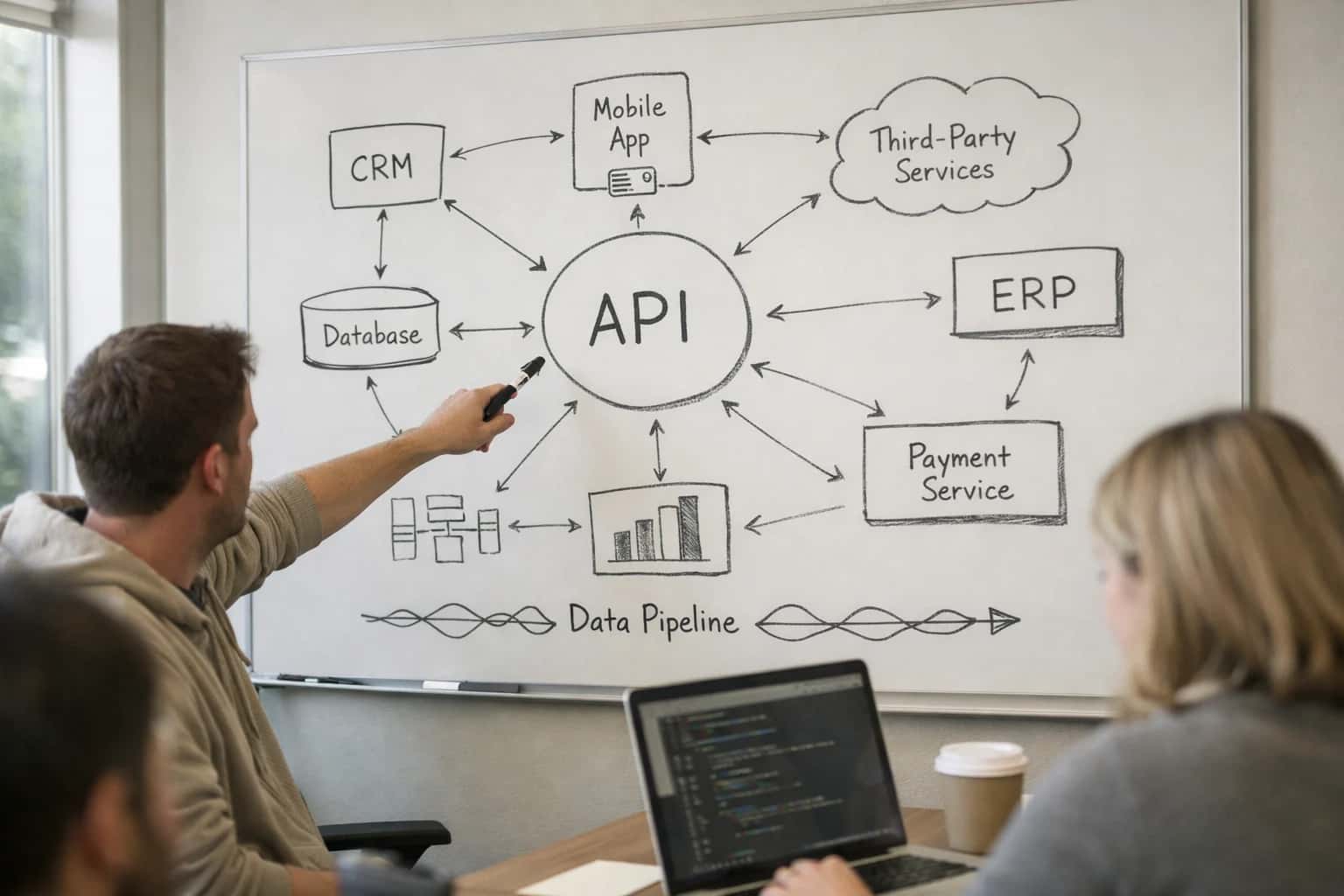
ARCHITECTURE FOR INTELLIGENT ACTIONS
Where AI Fits into Auth0's Authentication Pipeline
A practical guide to injecting AI-driven decisions into Auth0's extensibility points for smarter, adaptive authentication and user management.
Beyond real-time authentication, Hooks for Database Connections and Password Change flows allow for AI-powered profile enrichment or anomaly detection. A common pattern is to use a Post-User Registration Action to call an AI service that enriches the new user's app_metadata with inferred department or role data based on their email domain and name, automating group assignments. For governance, all AI calls should be logged to a secure audit trail, and sensitive data sent to external models must be pseudonymized. Implement circuit breakers and fallback logic in your Action code to ensure authentication reliability if the AI service is unavailable.
Rollout should be phased, starting with a non-blocking Audit Mode. Deploy an Action that calls your AI model and logs its risk assessment without enforcing it, allowing you to tune thresholds and evaluate false positives. Once validated, you can move to Advisory Mode, where high-risk assessments trigger additional logging or alerts, before finally implementing Enforcement Mode that dynamically alters the authentication journey. This approach, combined with Auth0's built-in deployment and versioning for Actions, allows for controlled, iterative deployment of AI intelligence across your customer identity and access management (CIAM) pipeline.
WHERE TO INJECT INTELLIGENT WORKFLOWS
Key Auth0 Surfaces for AI Integration
The Primary Orchestration Layer
Auth0 Actions are serverless functions that execute during authentication flows. This is the most direct surface for integrating AI to make real-time decisions about users.
Key Triggers for AI:
- Post-Login: Inject AI to analyze the login context (device, location, time) against user history. Use an AI model to score risk and append custom claims (e.g.,
risk_score: 0.92) to the token for downstream applications. - Pre-User Registration: Use AI to screen sign-up data. For example, validate business email domains, detect potentially fraudulent patterns, or enrich the user profile by calling an external API before the user is created in the Auth0 database.
- Post-User Registration: Trigger a welcome workflow. Use a language model to generate a personalized onboarding message or automatically assign the user to groups based on AI-analysis of their registration metadata.
Implementation Pattern: Your AI service is called via a secure API from within the Action. The Action receives the Auth0 event payload, sends relevant data to your AI endpoint, receives a decision or enriched data, and modifies the Auth0 session accordingly.
INTELLIGENT ACTIONS AND HOOKS
High-Value AI Use Cases for Auth0
Inject AI directly into Auth0's extensibility layer to automate decisions, personalize experiences, and respond to security signals. These patterns use Auth0 Actions, Hooks, and Log Streaming to add intelligence without rebuilding your authentication stack.
01
Intelligent Sign-Up Risk Scoring
Use a Post-Registration Action to call an AI model that analyzes the provided email, name, and IP address against internal fraud signals. Automatically flag or place high-risk accounts into a manual review group, or trigger step-up authentication for the first login.
Batch -> Real-time
Risk assessment
02
Dynamic MFA & Step-Up Authentication
In a Pre-User Registration or Post-Login Action, integrate a real-time risk engine. Based on device fingerprint, location velocity, and user behavior, dynamically bypass MFA for low-risk logins or enforce it for suspicious sessions, improving UX while maintaining security.
Hours -> Minutes
Policy tuning
03
Personalized Post-Login Journeys
Leverage a Post-Login Action to call an AI service that fetches user context (e.g., support tickets, recent orders). Redirect users to the most relevant application page or surface personalized messages and next-best-actions directly in the token response.
1 sprint
Typical implementation
04
AI-Powered Suspicious Activity Response
Stream Auth0 logs to a security data lake and use an AI model to detect anomalous patterns (impossible travel, brute force). Automatically trigger an Auth0 Hook via API to disable the user, revoke sessions, or notify the SOC, creating a closed-loop detection and response workflow.
Same day
Detection to action
05
Automated Profile Enrichment & Validation
In a Post-Registration Action, call an external API or internal AI service to validate and enrich user profiles. Append data like company details from a domain, correct name formatting, or assign default attributes and groups based on inferred role.
Reduce manual triage
For admin teams
06
Context-Aware Password Reset
Enhance the Pre-User Registration or Password Reset flow with an AI copilot. Analyze the user's historical data and current context to provide a guided, self-service recovery experience or intelligently escalate to a helpdesk ticket in systems like Zendesk or ServiceNow.
Deflect 40%+ tickets
Conservative estimate
IMPLEMENTATION PATTERNS
Example AI-Powered Auth0 Workflows
These concrete examples show how to wire AI models into Auth0 Actions and Hooks to inject intelligence into authentication, registration, and user management flows. Each workflow is production-ready, specifying triggers, data, model calls, and system updates.
Trigger: User successfully authenticates via an Auth0 Action in the Post-Login trigger.
Context Pulled: The Action's event object provides:
event.user(user_id, email, app_metadata, user_metadata)event.request.ipevent.request.geoip(city, country)event.connection.name(e.g., 'Username-Password-Authentication', 'google-oauth2')
AI Action: Call a language model (e.g., GPT-4) with a prompt to analyze the login context and generate a concise, structured user profile summary.
javascript// Example within an Auth0 Action const axios = require('axios'); async function onExecutePostLogin(event, api) { const prompt = `Analyze this login event for user profiling. User: ${event.user.email} Connection: ${event.connection.name} Location: ${event.request.geoip?.city}, ${event.request.geoip?.country} IP: ${event.request.ip} Previous logins: ${event.stats?.loginsCount || 1} Provide a short, 2-3 sentence behavioral summary focusing on login patterns and potential risk/engagement signals.`; try { const aiResponse = await axios.post('https://api.openai.com/v1/chat/completions', { model: 'gpt-4-turbo-preview', messages: [{ role: 'user', content: prompt }], max_tokens: 150 }, { headers: { 'Authorization': `Bearer ${configuration.OPENAI_API_KEY}` } }); const summary = aiResponse.data.choices[0].message.content; // Store summary in app_metadata for downstream use api.user.setAppMetadata('last_login_ai_summary', summary); } catch (error) { // Fail open - log error but don't block login console.error('AI profiling failed:', error.message); } }
System Update: The generated summary is stored in the user's app_metadata. This enriches the user profile for:
- Security dashboards reviewing anomalous behavior.
- Marketing platforms for personalized messaging.
- Support systems providing context to agents.
Human Review Point: Summaries flagged with high-risk keywords (e.g., "unusual location," "first time") can trigger an alert in a security team's Slack channel via a subsequent Auth0 Hook to a webhook.
AUTOMATING IDENTITY DECISIONS WITH CUSTOM LOGIC
Implementation Architecture and Data Flow
A practical blueprint for injecting AI-driven logic into Auth0's extensibility layer to make authentication flows smarter.
An AI integration for Auth0 typically connects at two key extensibility points: Auth0 Actions and Auth0 Hooks. Actions are serverless functions triggered during authentication flows (e.g., Pre/Post-Login, Pre/Post-User Registration, Password Change). Hooks are functions for extensibility in the Auth0 Management API (e.g., Post-User Creation, Post-Change Password). Your AI model or agent is deployed as a separate service, and the Auth0 function makes an authenticated API call to it, passing relevant context like user, context, and metadata objects. The AI service returns a decision or enriched data, which the function uses to modify the Auth0 transaction—such as adding custom claims, redirecting the user, or blocking the request.
For a Post-Login Action, the flow might be: 1) User authenticates, 2) Auth0 executes your Action, 3) Action calls your AI risk service with user.logins_count, ip_address, and user_metadata, 4) AI returns a risk score and reason, 5) Action adds risk_score and risk_reason as custom claims to the ID token, and 6) Your application uses these claims to require step-up authentication. For a Pre-User Registration Action, you could call an AI service to validate and enrich profile data from a social login before the user record is created, reducing fake accounts. All external calls should be asynchronous with timeouts and include fallback logic to ensure the login pipeline remains resilient.
Governance is critical. Audit all AI decisions by logging the input payload and the AI's response from within the Action to your SIEM or a dedicated audit service. Implement a human review queue for edge cases; for example, a high-risk login flagged by AI could trigger a workflow that places the user in a "pending review" group and alerts security staff via a webhook to your ITSM platform like ServiceNow. Roll out incrementally: start with a logging-only "shadow mode" Action to compare AI recommendations against actual outcomes, then progress to a pilot that affects low-risk flows like password changes before enabling AI-driven blocks on main login. Use feature flags within your Action code to toggle AI behavior without redeployment.
AUTH0 ACTIONS AND HOOKS
Code and Payload Examples
Validate and Enrich Sign-Up Data
Use a Pre-Registration Action to intercept new user sign-ups before the user is created. This is ideal for applying AI-driven validation, fraud scoring, or profile enrichment using external data.
Common AI Use Cases:
- Risk Scoring: Call an external API to evaluate the sign-up for synthetic identities or credential stuffing patterns.
- Profile Enrichment: Use a company domain or name to append default roles, groups, or app metadata.
- Data Validation: Use an LLM to check the semantic validity of free-text fields like "Job Title" or "Department."
Example Action Code (Node.js):
javascript// Auth0 Action: Pre-Registration const axios = require('axios'); exports.onExecutePreUserRegistration = async (event, api) => { // Call your AI risk service const riskResponse = await axios.post('https://your-ai-service/risk', { email: event.user.email, ip: event.request.ip, user_agent: event.request.user_agent }); // Block registration if high risk if (riskResponse.data.score > 0.8) { api.access.deny('high_risk', 'Sign-up blocked due to elevated risk score.'); } // Enrich user profile with AI-generated metadata api.user.setAppMetadata('signup_risk_score', riskResponse.data.score); api.user.setAppMetadata('inferred_department', riskResponse.data.inferredDepartment); };
AI-POWERED AUTH0 ACTIONS
Realistic Operational Impact and Time Savings
This table illustrates the tangible operational improvements and time savings achievable by integrating AI into Auth0 Actions and Hooks, moving from manual, reactive processes to intelligent, automated workflows.
| Workflow / Task | Before AI | After AI | Implementation Notes |
|---|---|---|---|
User Registration Risk Scoring | Manual review of limited signals (IP, email domain) | Automated scoring using AI models analyzing device, behavior, and external threat intel | AI Action runs in a Post-Registration Hook; high-risk scores trigger a custom email verification or manual review step. |
Dynamic MFA Step-Up | Static rules based on user group or location | Context-aware MFA prompts based on real-time AI risk score and session behavior | AI-powered Action in a Pre-Login Hook can add/remove authentication factors; integrates with Auth0 Guardian or custom providers. |
Profile Enrichment & Personalization | Manual data entry or batch updates from CRM | Real-time enrichment from internal APIs and LLM-generated summaries during login | Post-Login Action calls AI service to append data to |
Anomalous Login Investigation | Security analyst reviews Auth0 logs manually post-incident | AI analyzes log streams in real-time, flags suspicious patterns, and creates preliminary incident report | Log Streaming to AI platform; feedback loop can trigger a Hook to block session or require re-authentication. |
Password Reset Fraud Detection | Basic checks (time since last reset, known device) | AI evaluates request context, user history, and typo-squatting patterns to flag suspicious resets | Action in a Pre-User-Registration Hook (for password change) can deny or add extra verification challenges. |
B2B Tenant Onboarding | IT manually creates organization, configures connections | AI parses sign-up form or contract to auto-provision org, set policies, and suggest applications | Orchestration combines a Post-Registration Action with calls to Auth0 Management API and external systems. |
Support Ticket Triage for Auth Issues | User submits ticket; L1 support manually checks logs | AI support agent analyzes error context from Hooks, suggests fixes, or auto-resolves common issues | Failed authentication events can trigger a Hook to create a pre-populated ticket or initiate a remediation workflow. |
PRODUCTION ARCHITECTURE
Governance, Security, and Phased Rollout
A secure, controlled implementation of AI in Auth0 requires deliberate design for data handling, auditability, and incremental deployment.
AI-powered Auth0 Actions and Hooks should be deployed as external, containerized services, not inline code. This architecture keeps your Auth0 tenant clean and allows you to implement robust security controls around the AI service itself. The Auth0 Action triggers an HTTPS call to your service endpoint, which should enforce mutual TLS (mTLS) for Auth0, implement strict input validation, and apply a dedicated API gateway for rate limiting and logging. Sensitive data, like PII from user profiles, should be tokenized or pseudonymized before being sent to an LLM API, with strict data retention policies on any intermediate logs.
Governance is built on three layers: prompt governance (version-controlled prompts in a secure registry), model governance (tracking which model version processed each request), and decision logging. Every AI-influenced decision—like a risk score that triggers a step-up authentication—must generate an immutable audit trail in your SIEM or data lake, linking the Auth0 log_id, the user context, the exact prompt used, the model's reasoning (if available), and the final action taken. This is critical for compliance reviews and debugging anomalous behavior.
Roll out in phases, starting with a non-critical, post-authentication Action (e.g., logging a welcome message) to validate the integration pattern. Next, target a low-risk, high-volume pre-registration Hook to add intelligence, such as using an LLM to enrich a user's profile from social login data. Only after monitoring performance and audit logs should you progress to security-sensitive flows, like a pre-login Action for anomaly detection. Implement a feature flag system to instantly disable AI logic per flow without disrupting the authentication pipeline, and establish a clear rollback plan to default Auth0 rules.
Enabling Efficiency, Speed & Accuracy
Intelligent Analysis, Decision & Execution
We build AI systems for teams that need search across company data, workflow automation across tools, or AI features inside products and internal software.
Talk to Us
Search across company data
Give teams answers from docs, tickets, runbooks, and product data with sources and permissions.
Useful when people spend too long searching or get different answers from different systems.
Enterprise searchRAGPermissions
Read more
Automate internal workflows
Use AI to route work, draft outputs, trigger actions, and keep approvals and logs in place.
Useful when repetitive work moves across multiple tools and teams.
AI agentsWorkflow automationGovernance
Read more
Add AI to products and internal tools
Build assistants, guided actions, or decision support into the software your team or customers already use.
Useful when AI needs to be part of the product, not a separate tool.
AI integrationDecision supportModel routing
Read moreAI INTEGRATION FOR AUTH0
Frequently Asked Questions
Practical answers for architects and developers implementing AI-powered Auth0 Actions and Hooks.
Auth0 Actions execute during authentication flows, providing natural triggers for AI. Common triggers include:
- Post-Login: After successful authentication, to enrich user sessions or apply conditional logic.
- Pre-User Registration: Before a user is created, to screen or enrich profile data.
- Post-User Registration: After creation, for welcome messaging or initial setup.
- Credentials Exchange: During machine-to-machine token flows.
- Password Change/Reset: To analyze security posture or trigger notifications.
Key Data Available in the Action event object:
javascript// Example context available to an AI model { "user": { "email": "[email protected]", "user_metadata": { "department": "Sales" }, "app_metadata": { "tier": "premium" } }, "request": { "ip": "203.0.113.1", "geoip": { "country_name": "United States" }, "user_agent": "Mozilla/5.0..." }, "connection": { "name": "Username-Password-Authentication" }, "stats": { "logins_count": 42 } }
You can augment this with external API calls to fetch additional user or company context before calling an AI model.

About the author
Prasad Kumkar
CEO & MD, Inference Systems
Prasad Kumkar is the CEO & MD of Inference Systems and writes about AI systems architecture, LLM infrastructure, model serving, evaluation, and production deployment. Over 5+ years, he has worked across computer vision models, L5 autonomous vehicle systems, and LLM research, with a focus on taking complex AI ideas into real-world engineering systems.
His work and writing cover AI systems, large language models, AI agents, multimodal systems, autonomous systems, inference optimization, RAG, evaluation, and production AI engineering.
LinkedIn
Limited slotsGet a Free AI Consultation
Partnered with leading AI, data, and software stack.





How We Work
Custom AI workflows for your Business
One-fit-all AI don't work for modern businesses. At Inferensys, we aim to understand your business & custom requirements; which we use to define most efficient agentic workflows, the data, and the tools for your business.
01
Review the use case
We understand the task, the users, and where AI can actually help.
Read more02
Pick the right approach
We define what needs search, automation, or product integration.
Read more03
Build the first useful version
We implement the part that proves the value first.
Read more04
Improve from there
We add the checks and visibility needed to keep it useful.
Read moreThe first call is a practical review of your use case and the right next step.
Talk to Us