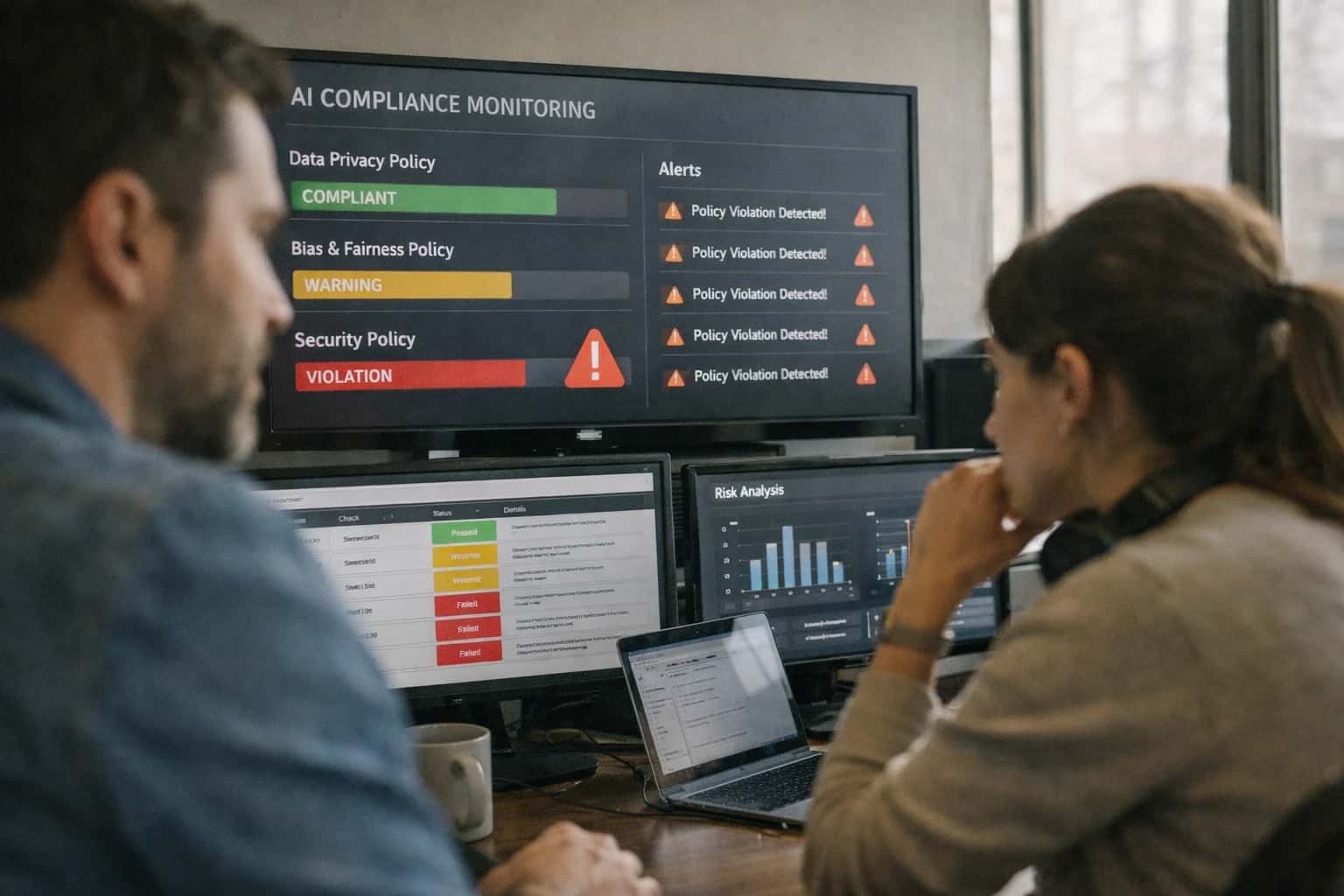
Traditional HR compliance relies on manual spot-checks of critical data points like overtime hours, certification expiry dates, work authorization documents (I-9s), and required training completions. This process is labor-intensive, prone to human error, and often detects issues only after a violation has occurred. An AI integration transforms this by establishing a continuous monitoring agent that connects directly to your HRIS—be it Workday, UKG, ADP, or BambooHR—via its APIs. The agent is configured to scan relevant objects and records (e.g., Worker_Time, Certification, Training_Completion) on a scheduled basis, applying business rules and regulatory logic to flag anomalies in real-time.

Integration
AI Integration for Compliance Monitoring in HRIS
Implement continuous AI monitoring of HRIS data to detect compliance risks like overtime violations, certification expiries, and policy breaches. Automate alerts and case creation for proactive resolution.
HR COMPLIANCE AUTOMATION
From Manual Audits to Continuous AI Monitoring
Shift from reactive, sample-based audits to proactive, AI-driven compliance monitoring across your HRIS data.
When a potential risk is identified—such as an employee approaching overtime thresholds in a pay period or a professional license expiring in 30 days—the AI agent doesn't just alert an analyst. It can autonomously execute a predefined workflow: creating a case or ticket in your HR service delivery platform, assigning it to the correct manager or HRBP, and even drafting the initial communication for review. This moves resolution from a monthly audit cycle to a same-day workflow, significantly reducing exposure and administrative burden. Implementation involves mapping your compliance rules to queryable data fields, setting confidence thresholds for automated actions versus human review, and establishing a secure audit log of all agent activities for governance.
Rollout is typically phased, starting with high-risk, rule-based areas like certification tracking before expanding to more complex predictive analytics, such as identifying patterns that could lead to wage and hour violations. Governance is critical; the AI's actions should be integrated into existing HR approval matrices and all automated case creation should be visible within the standard HRIS or service management dashboard. This approach turns your HRIS from a system of record into an active compliance engine. For a deeper look at orchestrating these cross-system workflows, see our guide on [/integrations/human-resources-information-systems/ai-integration-for-hr-operations-automation](AI Integration for HR Operations Automation).
ARCHITECTURE BLUEPRINT
Where AI Connects to Your HRIS for Compliance
Data Foundation for Compliance Monitoring
AI agents for compliance need secure, real-time access to core HRIS objects. This is typically achieved via the platform's REST APIs or, for platforms like Workday, its Web Services API.
Key objects to connect include:
- Employee Master Records: For demographic data, employment status, and location.
- Time & Attendance Data: To monitor for overtime violations, missed breaks, and schedule adherence.
- Compensation & Payroll Records: For reviewing pay equity, bonus accruals, and tax jurisdiction compliance.
- Certification & Licensure Objects: To track expiry dates for required credentials (e.g., safety certifications, professional licenses).
The integration pattern involves setting up a secure middleware layer or using a platform like Workday Extend to host the agent logic. The agent polls or receives webhooks for data changes, runs its compliance rules, and writes findings back as Cases or Alerts within the HRIS or a connected case management system.
HRIS INTEGRATION PATTERNS
High-Value Compliance Monitoring Use Cases
Proactively manage HR compliance by integrating AI agents with your HRIS (Workday, UKG, ADP, BambooHR). These patterns enable continuous monitoring, automated case creation, and manager alerts for critical workforce risks.
01
Overtime & Wage Law Monitoring
An AI agent continuously scans time and attendance data (e.g., from UKG Dimensions or Workday Time Tracking) against configured rules for state/local overtime laws, meal/break violations, and FLSA classifications. Detected risks trigger alerts to managers and create cases in the HR service desk for resolution.
Batch -> Real-time
Monitoring cadence
02
Certification & Licensure Expiry Tracking
Automates the tracking of employee certifications, licenses, and required training expiry dates stored in the HRIS (e.g., custom objects in Workday or BambooHR fields). The agent sends proactive renewal reminders to employees and managers, and escalates to HR if a critical credential lapses, creating a compliance case.
Manual -> Automated
Tracking method
03
I-9 & Work Authorization Verification
Orchestrates the end-to-end Form I-9 and work authorization process. The agent monitors hire dates in the HRIS, initiates the verification workflow, prompts employees and HR for documentation via integrated systems, and flags incomplete or expiring documents for follow-up, ensuring audit readiness.
Prevents fines
Primary value
04
Policy Acknowledgment & Training Compliance
Ensures mandatory policy acknowledgments and training completions are tracked. The agent syncs completion status from the LMS or survey tool with HRIS employee records, identifies non-compliant individuals, and automatically enrolls them or generates manager task lists via HRIS APIs.
100% → Enforced
Compliance rate
05
Leave & Accommodation Law Adherence
Monitors leave of absence data (FMLA, state-paid leave, ADA) within the HRIS for potential non-compliance. The agent analyzes dates, reasons, and documentation status against relevant laws, alerting HR case workers to missing certifications, improper denials, or required interactive process steps.
Reduces legal risk
Core impact
06
Multi-Jurisdiction Payroll Compliance
For distributed workforces, an AI agent cross-references employee work locations in the HRIS with payroll tax setups and local minimum wage rates in systems like ADP SmartCompliance or Workday Payroll. It flags mismatches for HR and Finance to correct before payroll runs.
Complex → Managed
Scale handled
CONTINUOUS AUDIT AGENTS
Example AI Compliance Monitoring Workflows
These workflows illustrate how AI agents can be deployed to proactively monitor HRIS data for compliance risks, automatically creating cases or alerts for human review when thresholds are breached or deadlines approach.
Trigger: Scheduled daily batch job after timecard submission closes.
Context/Data Pulled:
- Current and historical time & attendance records from UKG Dimensions, Workday Time Tracking, or ADP Time.
- Employee classification (exempt vs. non-exempt), work state, and applicable overtime rules from the HRIS core employee object.
- Company-specific overtime approval policies.
Model or Agent Action:
- The agent analyzes timecards for the period.
- Flags instances where non-exempt employees exceed weekly/hourly thresholds without prior approval.
- Calculates potential wage & hour exposure based on missed breaks or unauthorized overtime.
- Cross-references against employee work state to ensure multi-state compliance rules are applied.
System Update or Next Step:
- For minor, first-time occurrences: An automated notification is sent to the employee's manager via email or Teams/Slack, with a link to approve or correct the timecard in the HRIS.
- For repeat violations or significant exposure: The agent creates a case in the HR Service Delivery platform (e.g., UKG HR Service Delivery, ServiceNow) assigned to the HR Compliance team. The case includes all relevant data, calculated risk, and a suggested action plan.
Human Review Point: All cases created by the agent are routed to the HR Compliance queue for final review and action. The agent does not auto-correct payroll data.
CONTINUOUS MONITORING FOR HR COMPLIANCE
Implementation Architecture: Data Flow & Guardrails
A production-ready architecture for AI-powered compliance monitoring that integrates with your HRIS to detect risks and trigger corrective workflows.
The core integration connects to your HRIS (Workday, UKG, ADP, BambooHR) via its native APIs to continuously poll key data objects for compliance signals. This includes monitoring employee records for certification expiry dates, time and attendance data for overtime violations or missed breaks, compensation tables for minimum wage or pay equity thresholds, and training completion status against regulatory requirements. An AI agent acts as a persistent scanner, applying configurable business rules and using an LLM to interpret unstructured policy documents, flagging potential exceptions in a dedicated queue.
When a risk is detected—such as a professional license expiring in 30 days or a pattern of consistent overtime—the system performs a multi-step workflow. It first enriches the alert by pulling related employee history and manager context. It then determines the appropriate action: creating a case in your HR service management module, sending a targeted notification to a manager or HRBP via email or Slack, or, for urgent issues, escalating directly into an approval workflow for immediate intervention. All actions are executed through secure API calls back to the HRIS or connected systems, with a full audit log written to a dedicated compliance database.
Governance is built into every layer. Data access is scoped via HRIS API roles to a read-only service account, with sensitive data (like SSN) optionally masked or excluded. The AI's findings are not auto-remediated; they are presented as recommended actions in a human-in-the-loop dashboard for HR review before any system writes occur. This dashboard allows for bulk approval, override with rationale logging, and tuning of detection sensitivity. The entire pipeline is monitored for data freshness, model drift in classification tasks, and API health, ensuring the compliance monitor itself remains a compliant, reliable system.
ARCHITECTURE FOR CONTINUOUS MONITORING
Code & Configuration Patterns
Scheduled Data Extraction & Vectorization
Continuous monitoring requires a reliable pipeline to extract, transform, and index HRIS data for AI analysis. This is typically implemented as a scheduled job (e.g., nightly or hourly) that queries the HRIS API for delta changes.
Key objects to monitor include:
- Employee Work Records: Hours worked, overtime calculations, shift patterns.
- Certification & Licensure: Expiration dates, renewal status, required training completion.
- Policy Acknowledgment: Tracking completion of mandatory policy reviews.
The extracted data is chunked, embedded, and stored in a vector database (like Pinecone or Weaviate) to enable semantic search for similar past issues. A metadata store links the vector IDs back to the original HRIS record IDs (e.g., employee_id, certification_id) for actionable remediation.
python# Example: Scheduled extraction for certification expiry import hrissdk from datetime import datetime, timedelta def fetch_expiring_certifications(hris_client, days_lookahead=30): """Fetch certifications expiring within the next N days.""" today = datetime.now().date() expiry_cutoff = today + timedelta(days=days_lookahead) # HRIS-specific API call certs = hris_client.get( endpoint="/certifications", params={"expiry_date_lte": expiry_cutoff.isoformat()} ) return [ { "employee_id": c['employeeId'], "certification_name": c['name'], "expiry_date": c['expiryDate'], "record_id": c['id'] } for c in certs ]
CONTINUOUS COMPLIANCE MONITORING
Realistic Time Savings & Operational Impact
How AI integration transforms manual, reactive compliance checks into a proactive, automated system of record within your HRIS.
| Compliance Workflow | Before AI | After AI | Implementation Notes |
|---|---|---|---|
Overtime Threshold Monitoring | Manual weekly report review | Real-time alerts for violations | Triggers a case in the HRIS for manager follow-up |
Certification & License Expiry Tracking | Monthly spreadsheet audit | Automated 30/60/90-day expiry alerts | Creates a learning assignment or offboarding task |
I-9 & Work Authorization Verification | Quarterly manual sampling | Continuous document review & gap detection | Flags records missing required documents for HR action |
Required Training Completion | End-of-period compliance reporting | Dynamic dashboards & nudges for non-compliant employees | Integrates with LMS to auto-assign overdue courses |
Policy Acknowledgment Campaigns | Email blasts with manual tracking | Targeted campaigns with AI-driven follow-up | Uses HRIS data to segment populations and track completion |
Audit Evidence Preparation | Days of manual data gathering | Automated report generation with source links | Exports a structured, time-stamped audit trail from the HRIS |
Compliance Risk Scoring | Annual risk assessment | Continuous risk scoring per department/manager | Prioritizes HRBP review based on live data and trends |
BUILDING TRUST IN AI-DRIVEN COMPLIANCE
Governance, Security & Phased Rollout
A practical framework for deploying AI compliance monitoring with the necessary controls, security, and staged adoption.
Effective AI governance for compliance monitoring starts with role-based access control (RBAC) and audit trails. AI agents should operate with service accounts that have strictly scoped, read-only access to sensitive HRIS data objects like EmployeeTimeRecords, CertificationExpiry, and OvertimeLimits. Every AI-generated alert, case creation, or data query must be logged with a timestamp, user/service ID, and action taken, creating a defensible audit trail for internal audits or regulatory inquiries. This ensures the AI system is a transparent, accountable component of your compliance program.
A phased rollout minimizes risk and builds organizational confidence. Phase 1 (Pilot) targets a single, high-volume risk area—such as monitoring state-specific overtime thresholds in UKG Dimensions or certification expiries for a specific job family in Workday. The AI agent runs in a monitoring-only mode, generating alerts in a dedicated dashboard for HR analysts to review and act upon manually. Phase 2 (Assisted Workflow) introduces automation by allowing the AI to create draft Compliance Cases in your HR service delivery platform (e.g., UKG HR Service Delivery) or Tasks in Workday for analyst approval before routing. Phase 3 (Closed-Loop Automation) enables fully automated case creation and routing for pre-defined, low-risk exceptions, with the AI agent also suggesting resolution steps based on historical case data.
Security is paramount when AI accesses employee data. Implement data minimization by configuring the AI to retrieve only the fields necessary for its rule checks (e.g., employee ID, hours worked, certification date). Use encryption-in-transit and at-rest for all data exchanged between your HRIS, the AI inference layer, and any vector store used for policy documentation. For highly sensitive analyses, consider an on-premises or VPC-deployed inference model to keep data within your controlled environment. Finally, establish a regular review cadence where HR, Legal, and Compliance stakeholders audit the AI's alert accuracy, false-positive rate, and the business impact of resolved cases to continuously refine rules and prompts.
Enabling Efficiency, Speed & Accuracy
Intelligent Analysis, Decision & Execution
We build AI systems for teams that need search across company data, workflow automation across tools, or AI features inside products and internal software.
Talk to Us
Search across company data
Give teams answers from docs, tickets, runbooks, and product data with sources and permissions.
Useful when people spend too long searching or get different answers from different systems.
Enterprise searchRAGPermissions
Read more
Automate internal workflows
Use AI to route work, draft outputs, trigger actions, and keep approvals and logs in place.
Useful when repetitive work moves across multiple tools and teams.
AI agentsWorkflow automationGovernance
Read more
Add AI to products and internal tools
Build assistants, guided actions, or decision support into the software your team or customers already use.
Useful when AI needs to be part of the product, not a separate tool.
AI integrationDecision supportModel routing
Read moreIMPLEMENTATION AND GOVERNANCE
FAQs: AI for HR Compliance Monitoring
Practical questions for technical and operational leaders planning to integrate AI agents with HRIS platforms like Workday, UKG, or ADP for continuous compliance monitoring.
The agent requires read access to specific HRIS API endpoints and objects. The exact schema varies by platform, but core monitoring surfaces typically include:
- Time & Attendance Records: For overtime rule violations (e.g.,
Workday_Time_Entry,UKG_Dimensions_Timecard). - Employee Certification & Licensure Tables: To track expiry dates against required roles (e.g.,
Certification_Assignmentobject). - Job and Position Data: To validate employee classifications (Exempt vs. Non-Exempt) and associated rule sets.
- Training Completion Records: For mandatory compliance training deadlines.
- Leave of Absence Data: To monitor FMLA, ADA, or other protected leave usage and return-to-work deadlines.
A production implementation uses a scheduled agent or listens for webhook events from the HRIS to pull delta changes, minimizing API load. Data is often staged in a vector database or data lake for historical trend analysis and to provide context to the LLM.

About the author
Prasad Kumkar
CEO & MD, Inference Systems
Prasad Kumkar is the CEO & MD of Inference Systems and writes about AI systems architecture, LLM infrastructure, model serving, evaluation, and production deployment. Over 5+ years, he has worked across computer vision models, L5 autonomous vehicle systems, and LLM research, with a focus on taking complex AI ideas into real-world engineering systems.
His work and writing cover AI systems, large language models, AI agents, multimodal systems, autonomous systems, inference optimization, RAG, evaluation, and production AI engineering.
LinkedIn
Limited slotsGet a Free AI Consultation
Partnered with leading AI, data, and software stack.





How We Work
Custom AI workflows for your Business
One-fit-all AI don't work for modern businesses. At Inferensys, we aim to understand your business & custom requirements; which we use to define most efficient agentic workflows, the data, and the tools for your business.
01
Review the use case
We understand the task, the users, and where AI can actually help.
Read more02
Pick the right approach
We define what needs search, automation, or product integration.
Read more03
Build the first useful version
We implement the part that proves the value first.
Read more04
Improve from there
We add the checks and visibility needed to keep it useful.
Read moreThe first call is a practical review of your use case and the right next step.
Talk to Us