The performance review workflow is a structured, multi-stage process within your HRIS (like Workday, UKG, or BambooHR), typically involving goal setting, self-assessments, manager feedback, calibration, and final review submission. AI integrates at specific, high-friction points: as a writing assistant within the feedback text boxes, a synthesis engine for 360-degree reviews, and a bias-checking layer before data is committed to the Performance Document or Review object. This integration works by calling secure APIs (e.g., Workday Extend, BambooHR API) to fetch context—employee goals, past reviews, job profile—and returning structured suggestions directly into the user interface, keeping the user within their familiar HRIS workflow.

Integration
AI Integration for AI-Driven Performance Reviews
A technical blueprint for augmenting HRIS performance management modules with AI to reduce manager time spent writing reviews, synthesize 360 feedback, and check for bias before submission.
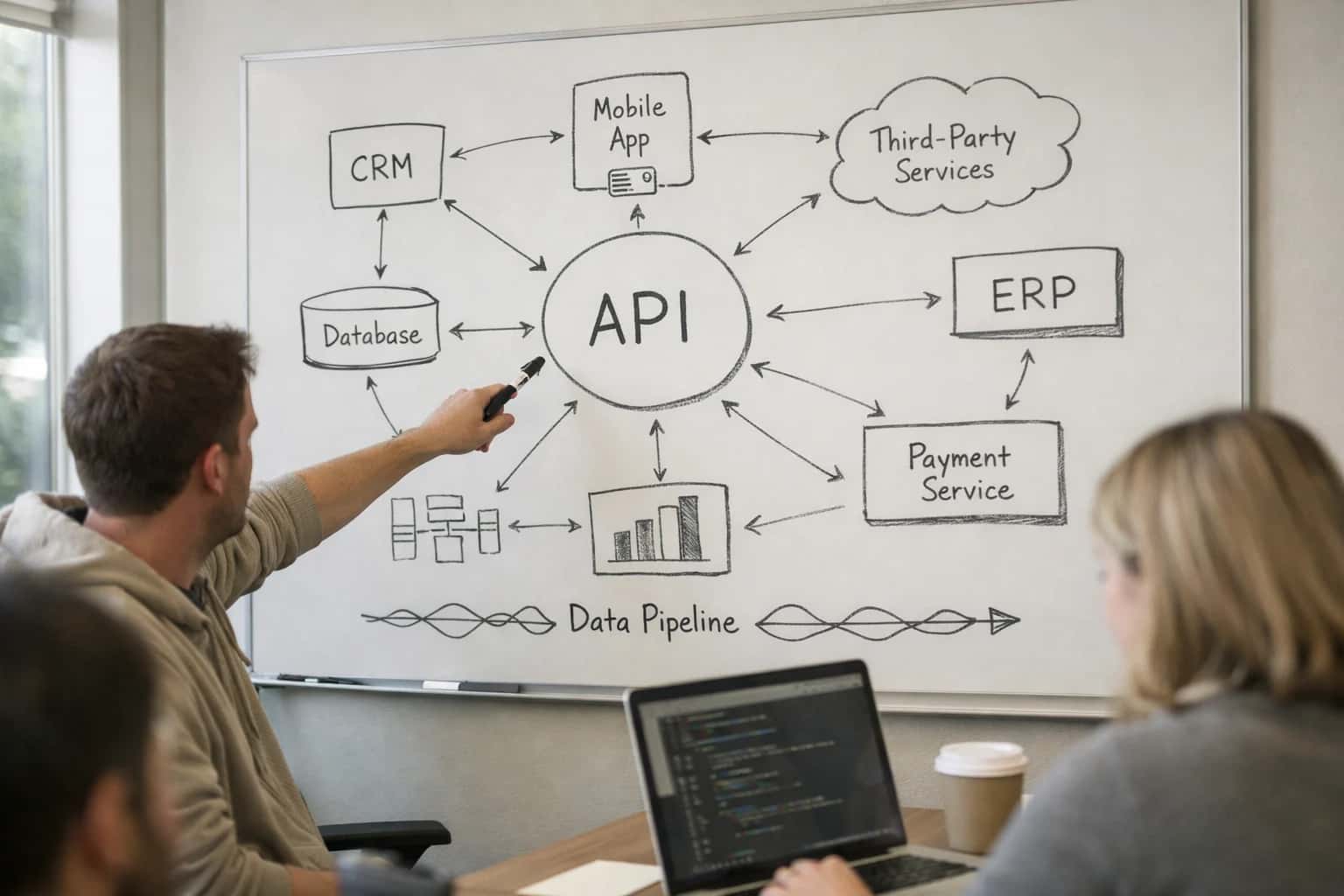
ARCHITECTURE AND ROLLOUT
Where AI Fits into the Performance Review Workflow
A practical blueprint for integrating AI into the performance review cycle within your HRIS, focusing on augmentation, not replacement.
For implementation, an AI agent acts as a co-pilot. When a manager drafts feedback, the agent can analyze the text against the employee's goals and suggest more specific, behaviorally-anchored language. For 360 reviews, it can ingest multiple free-text responses, summarize themes, and highlight conflicting viewpoints for the reviewer. Before final submission, a separate governance check can scan for biased language, flag inconsistent ratings against feedback, and ensure compliance with review guidelines. This is typically architected using a secure middleware layer that handles prompt engineering, maintains an audit log of all AI interactions, and enforces role-based access controls (RBAC) so suggestions are only seen by authorized users.
Rollout should be phased, starting with an optional "AI Assist" button in the review UI to build trust. Governance is critical: all AI suggestions should be clearly labeled as such, with the human reviewer retaining full editorial control. The system must log which suggestions were accepted or rejected for model improvement and compliance auditing. This approach transforms a manually intensive, often delayed process into a guided, consistent, and higher-quality workflow, reducing administrative burden on managers and HR while improving the fairness and developmental value of the review itself. For a deeper look at connecting AI to core HR objects, see our guide on AI Integration for Workday HCM.
WHERE AI CONNECTS TO THE PERFORMANCE WORKFLOW
Integration Touchpoints by HRIS Platform
Workday Performance & Talent Modules
AI integrates directly with Workday Performance Management and Workday Talent Review objects via the Workday REST API. Key touchpoints include the Review_Event and Worker_Review business objects for reading existing reviews and writing AI-generated content. For 360-feedback, the Feedback_Question_Response API provides the raw data for synthesis.
Implementation typically uses Workday Extend to build a custom UI component where managers draft reviews with an AI co-pilot. The AI agent calls your LLM, then writes structured suggestions back into the Review_Comments field via the Put_Worker_Review operation. For bias-checking, a background process can be triggered on submit events to analyze comment sentiment and flag potential language issues before final submission to the Review_Process workflow.
Governance is managed through Workday's native security groups and audit trails, ensuring all AI-generated content is attributed and logged.
HRIS INTEGRATION PATTERNS
High-Value AI Use Cases for Performance Reviews
Integrating AI into the performance review cycle within HRIS platforms like Workday, UKG, and BambooHR automates manual synthesis, enhances feedback quality, and provides data-driven insights. These patterns connect to core HRIS objects—goals, reviews, feedback, and skills—to augment existing workflows.
01
Manager Writing Assistant
AI co-pilot integrated into the review drafting interface. It suggests constructive, evidence-based language by analyzing the employee's goal progress, completed work, and prior feedback from the HRIS. Helps managers move from blank page to structured, actionable review in minutes.
Hours -> Minutes
Drafting time
02
360-Feedback Synthesis
Automatically aggregates and summarizes qualitative feedback from peers, direct reports, and other stakeholders collected via the HRIS. The AI identifies common themes, highlights strengths and development areas, and generates a neutral summary for the reviewee and manager, replacing manual compilation.
Batch -> Real-time
Synthesis
03
Bias & Consistency Check
Scans draft reviews before submission to the HRIS for potential unconscious bias in language, inconsistent rating justification across teams, and deviations from calibration guidelines. Flags phrases for review and suggests more objective alternatives based on performance data.
Pre-Submission
Proactive governance
04
Goal & Development Plan Generator
After review submission, AI analyzes the completed review and skills data in the HRIS to propose relevant, SMART goals and a personalized development plan. It suggests learning resources from the connected LMS and identifies potential mentors, creating a seamless post-review workflow.
1 sprint
Plan creation
05
Calibration Meeting Prep
Prepares managers for calibration sessions by generating briefing packets. AI compares proposed ratings across a team or department against historical data, goal achievement, and feedback sentiment from the HRIS, highlighting outliers and potential discussion points for leaders.
Same day
Meeting readiness
06
Trend Analysis & Reporting
Connects to the HRIS reporting layer or data warehouse to analyze review cycle data across the organization. AI identifies trends in skill gaps, common development themes, and correlations between review scores and retention, providing HR leaders with actionable insights for talent strategy.
Quarterly -> Continuous
Insight cadence
IMPLEMENTATION PATTERNS
Example AI-Augmented Performance Review Workflows
These concrete workflows illustrate how AI agents integrate with HRIS platforms like Workday, UKG, or BambooHR to augment the performance review cycle, reducing administrative burden and improving quality.
Trigger: A manager opens a performance review form for a direct report in the HRIS.
Context Pulled: The AI agent, via secure API calls, retrieves:
- Employee's goals, achievements, and feedback from the last cycle.
- Recent project data, peer feedback snippets, and recognition from connected systems.
- The company's competency framework and review rubric.
Agent Action: Using a structured prompt, the LLM generates a first-draft review. It:
- Synthesizes quantitative data (goal completion %) with qualitative feedback.
- Writes narrative sections aligned to competencies, using specific examples.
- Flags potential bias in language (e.g., gendered terms, vague praise).
- Suggests 2-3 development goals based on role progression paths.
System Update: The draft is inserted into the HRIS review form as a suggestion. The manager can edit, accept, or reject sections.
Human Review Point: The manager is the final author. All AI suggestions are logged with a timestamp and model version for auditability. Learn more about AI Integration for Performance Management Systems.
SECURE, AUDITABLE, AND CONTROLLED ROLLOUT
Implementation Architecture: Data Flow & Guardrails
A production-ready AI integration for performance reviews connects to your HRIS data layer, orchestrates workflows, and enforces governance before any submission.
The integration architecture centers on your HRIS (e.g., Workday, UKG Pro, BambooHR) as the system of record. An AI orchestration layer interacts via secure APIs to read employee profiles, past reviews, goal data, and 360-feedback submissions. For writing assistance, the AI agent receives structured prompts with role, goals, and competencies, then generates draft narratives that are returned to the manager's interface—never writing directly to the HRIS. For feedback synthesis, the agent ingests anonymized, aggregated comments from surveys or forms, summarizing themes and identifying potential contradictions while stripping personally identifiable information (PII). A separate bias-checking module scans manager drafts against configured guidelines for language patterns, rating consistency, and comparative analysis across demographic groups, flagging items for review.
Data flow is governed by a middleware broker that manages authentication (OAuth 2.0), rate limits, and audit logs. All prompts, generated text, and HRIS queries are logged with user IDs, timestamps, and operation types for compliance. The system is designed for phased rollout: start with a writing assistant in a sandbox environment, then enable 360-synthesis for pilot teams, and finally activate bias-checking as an optional review step before submission. This allows for prompt tuning, user training, and validation of output quality without disrupting the live review cycle. Key technical guardrails include:
- Role-based access control (RBAC): Agents only access data permissible for the initiating manager or HRBP.
- Human-in-the-loop approval: All AI-generated content is presented as a suggestion; the manager must actively accept, edit, or discard it.
- Data minimization: Feedback synthesis operates on aggregated, anonymized datasets; raw comments are not stored in vector databases long-term.
- Model isolation: Different, fine-tuned models or pipelines can be used for drafting, synthesis, and bias-checking to prevent task contamination.
Rollout success depends on integrating with existing HR workflows. The AI components should surface within the familiar performance management UI of your HRIS, either via embedded iFrames, custom objects built with platforms like Workday Extend, or secure sidebar applications. Change management is critical: communicate the tool as an assistant to reduce administrative burden, not an automated evaluator. Establish clear protocols for handling bias flags—typically routing them to a designated HR partner for consultation, not automatic rejection. For ongoing governance, implement regular reviews of audit logs, sample output quality, and user feedback to iteratively refine prompts and rules. This architecture ensures the AI augments human judgment within a controlled, secure, and scalable framework, turning a weeks-long administrative process into a focused, high-quality conversation in days.
IMPLEMENTATION PATTERNS
Code & Payload Examples
Synthesizing 360-Feedback
An AI agent can ingest raw feedback from peers, direct reports, and managers via webhook, synthesize themes, and post a structured summary back to the Performance Review record. This reduces manual collation time from hours to minutes.
Example Python payload for processing feedback:
pythonimport requests # Payload received from HRIS webhook (e.g., Workday Extend) feedback_webhook_payload = { "review_id": "PR-2024-00123", "employee_id": "E56789", "raw_feedback": [ "John excels at project leadership but could improve on delegation.", "Very collaborative, always shares credit with the team.", "Needs to provide more timely feedback to direct reports." ], "review_cycle": "Q2-2024" } # Call LLM for synthesis synthesis_prompt = f""" Synthesize the following 360-feedback into 3-5 key themes. Return a JSON with 'strengths' and 'development_areas' arrays. Feedback: {feedback_webhook_payload['raw_feedback']} """ # After LLM call, structured result structured_summary = { "review_id": feedback_webhook_payload["review_id"], "synthesized_themes": { "strengths": ["Project Leadership", "Collaboration & Team Credit"], "development_areas": ["Delegation", "Timely Feedback to Reports"] } } # POST back to HRIS API to update the review update_url = "https://api.hris-platform.com/performance/v1/reviews" headers = {"Authorization": "Bearer <token>", "Content-Type": "application/json"} response = requests.patch(update_url, json=structured_summary, headers=headers)
This pattern connects to the Performance Management module's API to automate a core, time-intensive step.
AI-DRIVEN PERFORMANCE REVIEWS
Realistic Time Savings & Operational Impact
How AI integration transforms the manual, time-intensive performance review cycle into a guided, efficient, and consistent process.
| Workflow Stage | Before AI | After AI | Key Impact & Notes |
|---|---|---|---|
Review Drafting | Manager spends 2-4 hours writing narratives | AI writing assistant suggests content in 15-30 minutes | Reduces writer's block; ensures comprehensive coverage of goals and competencies |
360-Feedback Synthesis | Manual compilation of 5-10 feedback sources takes 3+ hours | AI aggregates and synthesizes key themes in under 10 minutes | Provides unbiased summary; highlights consensus and divergent views for manager review |
Bias & Language Check | Ad-hoc or non-existent; relies on manager discretion | Automated scan for biased language, jargon, and vague statements | Promotes fairness and clarity; flags areas for constructive rewording before submission |
Calibration & Scoring | Manual comparison across teams in lengthy calibration meetings | AI pre-analyzes ratings against benchmarks, flagging outliers | Meetings focus on discussion, not data gathering; reduces calibration prep by 50-70% |
Goal & Development Planning | Manual creation based on past review; often generic | AI suggests SMART goals and development resources based on review content | Personalizes career growth; links directly to LMS or skills platform for next steps |
HRIS Submission & Routing | Manual upload, field entry, and approval chain routing | Automated payload generation and API submission to HRIS (e.g., Workday, UKG) | Eliminates administrative errors; ensures data integrity and audit trail |
Post-Review Analytics | Quarterly or annual manual report creation by HR | Real-time dashboards on completion rates, sentiment trends, and common themes | HR gains continuous insight for process improvement and leadership reporting |
Employee Acknowledgment & Feedback | Email reminders and manual follow-up for acknowledgments | AI agent nudges employees, answers FAQs, and collects feedback on the process | Increases completion compliance; provides immediate, actionable feedback to HR |
ARCHITECTING CONTROLLED ADOPTION
Governance, Security & Phased Rollout
A practical framework for deploying AI in performance reviews with security, fairness, and change management at the core.
Integrating AI into performance reviews requires a governance-first architecture. This means establishing clear data boundaries: the AI agent should only access anonymized or aggregated 360-feedback text, historical review data (with personal identifiers stripped), and job role frameworks via secure API calls to your HRIS (e.g., Workday, UKG). All prompts, model outputs, and user interactions must be logged to an immutable audit trail, linking each suggestion to the source data and the responsible reviewer. Implement role-based access controls (RBAC) within the integration layer to ensure only authorized managers and HRBPs can trigger AI assistance or view synthesized insights, preventing unauthorized access to sensitive peer feedback.
A phased rollout is critical for adoption and risk mitigation. Start with a pilot group of volunteer managers using the AI as a writing assistant and bias-checker in draft mode only. In this phase, the AI suggests neutral language, flags potentially biased phrases (e.g., gendered adjectives), and synthesizes themes from 360 feedback, but all submissions to the HRIS remain manual. Use this pilot to refine prompts, gather feedback, and measure time savings. Phase two introduces automated synthesis, where the AI generates a structured summary of feedback for manager review before submission. The final phase enables direct, audited submission of AI-assisted reviews to the HRIS via its official APIs (like Workday's Performance Review API), with a mandatory human-in-the-loop approval step before finalizing.
Security and compliance are non-negotiable. Ensure all data in transit to and from LLM providers is encrypted, and consider a private endpoint for model calls. For highly sensitive data, implement a local embedding and retrieval pipeline to keep feedback vectors within your VPC. Establish a review board (HR, Legal, IT) to regularly audit the AI's suggestions for fairness, accuracy, and compliance with internal policies and regulations like GDPR or EEOC guidelines. This controlled, iterative approach de-risks the integration, builds organizational trust, and creates a scalable blueprint for rolling out AI across other HR workflows like talent calibration or succession planning. For related architectural patterns, see our guides on AI Integration for HRIS Platforms and AI Governance and LLMOps Platforms.
Enabling Efficiency, Speed & Accuracy
Intelligent Analysis, Decision & Execution
We build AI systems for teams that need search across company data, workflow automation across tools, or AI features inside products and internal software.
Talk to Us
Search across company data
Give teams answers from docs, tickets, runbooks, and product data with sources and permissions.
Useful when people spend too long searching or get different answers from different systems.
Enterprise searchRAGPermissions
Read more
Automate internal workflows
Use AI to route work, draft outputs, trigger actions, and keep approvals and logs in place.
Useful when repetitive work moves across multiple tools and teams.
AI agentsWorkflow automationGovernance
Read more
Add AI to products and internal tools
Build assistants, guided actions, or decision support into the software your team or customers already use.
Useful when AI needs to be part of the product, not a separate tool.
AI integrationDecision supportModel routing
Read moreAI-DRIVEN PERFORMANCE REVIEWS
Frequently Asked Questions
Practical questions about implementing AI for performance reviews, from workflow integration to governance and rollout.
AI integrates via the HRIS platform's APIs and webhooks, typically connecting to three key data surfaces:
- Review Data API: Pulls draft reviews, historical feedback, goal data, and competency frameworks.
- Employee Profile API: Accesses role, tenure, career history, and skills data for context.
- Writeback Endpoints: Submits AI-generated suggestions (e.g., draft paragraphs, bias flags) back into the review as comments or drafts for the manager's final edit.
For example, a common trigger is when a manager initiates a new performance review in Workday, UKG Pro, or BambooHR. A webhook can notify your AI service, which then fetches the relevant context and provides in-line assistance within the same interface via a custom UI extension or sidebar.

About the author
Prasad Kumkar
CEO & MD, Inference Systems
Prasad Kumkar is the CEO & MD of Inference Systems and writes about AI systems architecture, LLM infrastructure, model serving, evaluation, and production deployment. Over 5+ years, he has worked across computer vision models, L5 autonomous vehicle systems, and LLM research, with a focus on taking complex AI ideas into real-world engineering systems.
His work and writing cover AI systems, large language models, AI agents, multimodal systems, autonomous systems, inference optimization, RAG, evaluation, and production AI engineering.
LinkedIn
Limited slotsGet a Free AI Consultation
Partnered with leading AI, data, and software stack.





How We Work
Custom AI workflows for your Business
One-fit-all AI don't work for modern businesses. At Inferensys, we aim to understand your business & custom requirements; which we use to define most efficient agentic workflows, the data, and the tools for your business.
01
Review the use case
We understand the task, the users, and where AI can actually help.
Read more02
Pick the right approach
We define what needs search, automation, or product integration.
Read more03
Build the first useful version
We implement the part that proves the value first.
Read more04
Improve from there
We add the checks and visibility needed to keep it useful.
Read moreThe first call is a practical review of your use case and the right next step.
Talk to Us