AI integration connects to core GIS platforms like Esri ArcGIS, QGIS, or cloud-native services, acting on both vector data (parcels, infrastructure networks) and raster data (satellite imagery, LiDAR). Key integration surfaces include the geodatabase API for transactional updates, feature services for real-time data streams, and image analysis services for processing drone or satellite feeds. AI agents can be triggered by workflow events in your ERP (like a new permit in Tyler EnerGov) to perform spatial analysis, or can continuously monitor sensor data to flag anomalies on a map layer.

Integration
AI Integration with Public Sector GIS Integration
A technical blueprint for connecting AI models to public sector Geographic Information Systems (GIS) and ERP platforms to enable predictive analytics, automated planning, and intelligent emergency response.
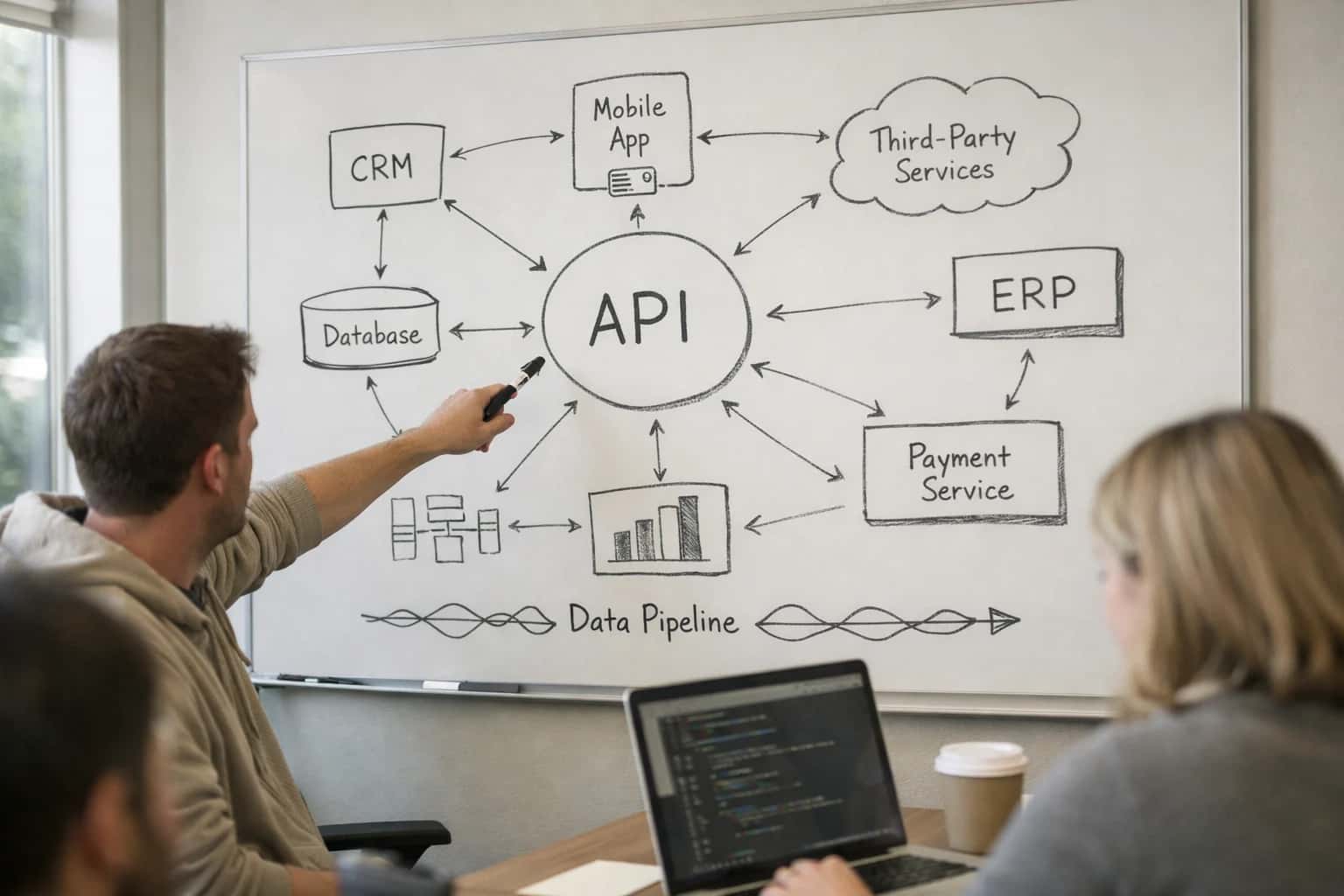
ARCHITECTING AI FOR GEOSPATIAL OPERATIONS
Where AI Fits into Public Sector GIS Workflows
Integrating AI with Geographic Information Systems (GIS) transforms static maps into intelligent, predictive engines for planning, public works, and emergency response.
High-value use cases center on predictive modeling and automated insight generation:
- Predictive Infrastructure Maintenance: Analyze historical break/fix data from an asset management system (e.g., Infor EAM) with pipe age and soil data from the GIS to predict water main failure risk and automatically generate prioritized work orders.
- Automated Land-Use Review: For a new development application, an AI agent can pull the parcel geometry, overlay zoning layers, setback rules, and environmental constraints to generate a preliminary compliance report, reducing planner review time.
- Dynamic Emergency Response: During an incident, AI can ingest real-time weather, traffic camera, and social media data, geocode it, and overlay it on the operational map to predict fire spread or flood impact, automatically updating resource dispatch in a public safety system like Tyler Incode.
- Constituent Service Automation: A citizen reports a pothole via a 311 chatbot. The AI uses the described location to find the exact street segment in the GIS, checks recent work orders, and either creates a new case or provides a status update, all within the same interaction.
A production rollout requires a middleware layer—often an integration platform like SAP BTP or Infor OS—to orchestrate between the GIS, ERP data, and AI models. Governance is critical: all AI-generated map annotations or feature modifications should be logged with an audit trail, and sensitive geospatial data requires strict RBAC. Start with a pilot workflow, such as automating the classification of satellite imagery for code enforcement (e.g., identifying unpermitted structures), where the AI's output is a draft layer for human review before any official action is taken. This controlled approach builds trust and demonstrates value before scaling to mission-critical predictions.
ARCHITECTING INTELLIGENT GEOSPATIAL WORKFLOWS
Primary GIS and ERP Integration Surfaces
Connecting GIS Asset Layers to ERP Work Orders
Integrate AI to analyze geospatial asset condition data (from platforms like Esri ArcGIS or Hexagon) with ERP maintenance schedules (in Infor EAM or SAP EAM). An AI agent can ingest sensor telemetry, historical failure data, and visual inspection reports from the GIS to predict asset health. It then automatically generates and prioritizes preventive work orders in the ERP, considering crew location, parts inventory, and budget codes from the financial system.
Key Integration Points:
- GIS Feature Service (REST API) for asset geometry and attributes.
- ERP Work Order API (SOAP/REST) for creation and updates.
- ERP Inventory Module for spare parts availability checks.
- Example: A predicted water main break risk score from the GIS triggers a preemptive work order in Tyler Munis or Infor CloudSuite, with recommended crew dispatch based on live vehicle GPS.
PREDICTIVE MODELING & OPERATIONAL INTELLIGENCE
High-Value AI + GIS Use Cases for Government
Integrating AI with Geographic Information Systems (GIS) transforms static maps into dynamic decision engines. By connecting AI models to geospatial data layers and core ERP workflows, agencies can predict service demand, optimize resource allocation, and automate response planning.
01
Predictive Infrastructure Maintenance
AI models analyze historical GIS asset data (pavement condition, pipe age, inspection logs) alongside weather and usage patterns to predict failure risk scores for roads, water mains, and bridges. These scores automatically generate prioritized work orders in the CMMS/EAM (like Infor EAM or IBM Maximo) and update capital planning dashboards.
Reactive -> Proactive
Maintenance mode
02
Dynamic Emergency Response Routing
During incidents, AI integrates real-time GIS data (traffic, road closures, weather) with ERP resource locations (fire stations, available units) and historical response times. It calculates optimal dispatch and routing in seconds, pushing updated ETA and resource assignments directly to CAD/RMS and field service platforms like Tyler Incode.
Seconds, not minutes
Routing calculation
03
Zoning & Permit Risk Forecasting
For planning departments, AI analyzes GIS parcel data, historical permit approvals, environmental layers, and community feedback to predict potential conflicts or delays for new development applications. This forecast is attached to the case in permitting software (like Tyler EnerGov), flagging high-risk reviews for early intervention and setting realistic applicant timelines.
1-2 week lead time
Conflict identification
04
Public Health & Social Services Hotspot Analysis
AI clusters and correlates disparate GIS data—demographics, disease rates, 311 service requests, park locations—to identify underserved areas or emerging public health risks. These insights trigger automated workflows in case management systems to allocate outreach teams or update resource planning in performance management platforms.
Batch -> Real-time
Insight generation
05
Environmental Compliance & Monitoring
AI processes satellite imagery, sensor data (air/water quality), and permit GIS layers to automatically detect deviations from environmental regulations, such as unauthorized land disturbance or effluent outliers. Alerts and preliminary evidence packages are routed to compliance officers in systems like Infor Public Sector or SAP S/4HANA for investigation.
Continuous monitoring
Compliance coverage
06
Optimized Field Service Scheduling
For public works and inspections, AI ingests GIS work order locations, technician skill sets, traffic patterns, and permit/appointment windows to dynamically schedule and sequence daily routes. Optimized schedules sync to field service management (FSM) platforms and mobile devices, reducing drive time and missed appointments.
15-20% reduction
Drive time
PRACTICAL IMPLEMENTATION PATTERNS
Example AI-GIS Integrated Workflows
These workflows demonstrate how to connect AI agents and models to geospatial data layers and public sector ERP systems for predictive planning, automated response, and operational intelligence.
Trigger: Scheduled batch job or new inspection data ingested into the Enterprise Asset Management (EAM) system.
Context/Data Pulled:
- Asset condition history and work orders from the EAM (e.g., Infor EAM, IBM Maximo).
- Real-time sensor data (e.g., pipe pressure, road surface imagery) from IoT platforms.
- Historical weather and environmental data.
- Parcel and critical infrastructure layers from the GIS (e.g., road centerlines, water main networks, bridge locations).
Model or Agent Action:
- A machine learning model analyzes the combined dataset to predict failure risk scores and remaining useful life for each asset segment.
- An AI agent ranks assets by risk, projected cost of failure, and proximity to high-impact zones (schools, hospitals).
System Update or Next Step:
- The agent creates prioritized work orders with recommended maintenance types in the EAM system via API.
- It updates the GIS layer with new risk scores and predicted maintenance dates for visualization.
- A summary report is generated for public works directors via the ERP reporting module.
Human Review Point: Capital planning teams review the AI-generated priority list and budget projections before finalizing the annual maintenance schedule.
ORCHESTRATING GEOSPATIAL INTELLIGENCE
Implementation Architecture: Data Flow & APIs
A practical architecture for connecting AI models to GIS layers and ERP workflows to enable predictive public sector operations.
The integration is built on a three-layer data flow connecting your geographic information system (GIS)—such as Esri ArcGIS, QGIS, or a custom platform—to your public sector ERP (e.g., Tyler Munis, SAP Public Sector, Infor EAM) via a central AI orchestration service. The first layer ingests real-time and historical GIS data feeds—parcel boundaries, infrastructure sensor locations, flood zones, traffic patterns, and land use maps—through GIS REST APIs or webhooks. This spatial data is vectorized, enriched with temporal context, and stored in a vector database alongside relevant ERP records like work orders from Tyler EnerGov, asset maintenance histories from Infor EAM, or citizen service requests from a CRM. This creates a unified 'context layer' where location, asset data, and operational history are semantically linked.
The second layer is the AI model orchestration, where specific workflows are triggered. For predictive public works maintenance, a model analyzes GIS sensor data (e.g., pipe pressure from a SCADA feed mapped in GIS) against ERP work order history to predict failure likelihood and automatically generates a prioritized work order in the CMMS module. For emergency response, an AI agent monitors real-time GIS data (weather layers, traffic camera feeds) and cross-references ERP data on resource locations (from fleet management) and staff certifications (from HCM) to suggest optimal resource dispatch, pushing alerts to field service management platforms. All model inferences are logged with the source GIS coordinates and linked ERP record IDs for full auditability.
The final layer handles action and governance. Approved AI recommendations are executed via the ERP's or specialized platform's API. For example, a predicted high-risk inspection site from the model is converted into a scheduled inspection in Tyler EnerGov via its POST /inspections API, with the GIS parcel ID attached. Conversely, outcomes from field workflows (like a completed repair logged in the ERP) are fed back into the vector database to retrain and improve the predictive models. This closed-loop flow is managed with strict RBAC, ensuring, for instance, that a planning department model can suggest zoning changes but only trigger official reviews in the legislative management system after human approval.
INTEGRATION PATTERNS
Code & Payload Examples
Synchronizing Geospatial & Operational Data
A foundational integration pattern involves creating a bi-directional sync between your GIS platform (e.g., ArcGIS, QGIS) and your public sector ERP (e.g., Tyler Munis, SAP Public Sector). This ensures asset locations, parcel data, and service request coordinates are available for AI analysis.
A typical workflow uses a scheduled job to extract updated GIS features (like new permits, work orders, or asset inspections) and pushes them as enriched records to the ERP. The payload includes the geometry (often as GeoJSON or WKT), associated metadata, and a link back to the GIS source.
json{ "sync_event": "work_order_created", "erp_record_id": "WO-2024-58741", "gis_feature_id": "public_works.manholes.1023", "geometry": { "type": "Point", "coordinates": [-105.270546, 40.014984] }, "attributes": { "work_type": "inspection", "priority": "high", "assigned_crew": "Crew B", "last_inspection_date": "2023-11-15" }, "timestamp": "2024-05-15T14:30:00Z" }
This unified data layer is critical for training predictive models and powering spatial queries within agent workflows.
AI-POWERED GEOSPATIAL INTELLIGENCE
Realistic Operational Impact & Time Savings
How integrating AI with GIS and ERP data transforms planning, public works, and emergency response workflows.
| Workflow | Before AI | After AI | Notes |
|---|---|---|---|
Capital Project Site Selection | Weeks of manual data aggregation from spreadsheets, GIS layers, and budget systems | Days of AI-assisted analysis with unified data views and predictive scoring | AI ranks sites based on cost, community impact, and infrastructure readiness from connected systems |
Pavement Condition Forecasting | Annual visual surveys; reactive repair scheduling based on age | Quarterly predictive scoring using traffic, weather, and historical GIS data | AI models prioritize segments for maintenance, extending asset life and optimizing budgets |
Emergency Response Resource Dispatch | Manual coordination using static maps and radio calls during events | Dynamic routing and staging based on real-time traffic, weather, and asset GIS feeds | AI recommends optimal unit locations, reducing response times for fire/EMS |
Zoning & Land Use Application Review | Planner manually cross-references parcel maps, ordinances, and past decisions | AI pre-screens applications, flags non-compliance against GIS overlays and code | Planner reviews AI-generated summary and exceptions, cutting initial review time by 60% |
Utility Outage Impact Analysis | Crews dispatched based on outage calls; customer impact estimated hours later | AI instantly models outage radius on GIS, predicts affected critical facilities & population | Enables proactive public communication and prioritizes restoration for hospitals/schools |
Environmental Permit Compliance Monitoring | Quarterly manual checks of permit sites against GIS boundaries and regulations | Continuous AI monitoring of satellite/ sensor data against permit GIS layers | Automated alerts for potential violations, allowing proactive intervention |
Public Works Work Order Prioritization | First-in, first-out or supervisor gut-feel based on citizen calls | AI scores and queues work orders using GIS asset criticality, location clustering, and risk data | Optimizes crew routes and addresses highest-risk infrastructure issues first |
ARCHITECTING FOR PUBLIC TRUST AND OPERATIONAL RESILIENCE
Governance, Security & Phased Rollout
Integrating AI with public sector GIS and ERP data requires a deliberate approach to security, transparency, and controlled adoption.
Start with a sandboxed, read-only integration layer. Initial AI agents should connect to staging copies of your GIS layers (e.g., parcel data, infrastructure networks, zoning maps) and related ERP records (e.g., work orders from Tyler EnerGov, asset records from Infor EAM) via secure APIs. This phase focuses on retrieval-augmented generation (RAG) for Q&A and analysis without executing transactions, allowing you to validate accuracy, establish prompt guardrails for spatial queries, and audit all AI-generated insights against source data.
Implement a multi-tiered approval workflow for AI-driven actions. Before an AI recommendation—like a predictive maintenance schedule for water mains or a high-priority code enforcement case—triggers a work order in your CMMS or updates a case status, it should route through a configured approval chain in your core ERP or workflow engine. For example, a flood risk prediction model could generate a draft inspection plan in SAP Digital Manufacturing or Tyler EnerGov, but require a public works supervisor's review before dispatching crews. This human-in-the-loop control is critical for public accountability and operational safety.
Phase rollout by data domain and user role. Begin with low-risk, high-ROI internal use cases: an AI copilot for planners that queries zoning maps and permit history to answer development questions. Next, expand to field operations, providing technicians with a mobile agent that overlays live sensor data with historical maintenance records from IBM Maximo or Infor EAM. Finally, consider controlled external applications, such as a public-facing chatbot that explains floodplain regulations by referencing authoritative GIS layers, with all responses logged and traceable back to the source ordinance.
Governance must be baked into the integration architecture. Every AI interaction with GIS/ERP data should be logged with a full audit trail: the prompt, the data sources retrieved (e.g., specific parcel IDs, work order numbers), the generated response, and the end-user. These logs should feed into your existing security information and event management (SIEM) platform. Access for AI agents must follow the same role-based access control (RBAC) principles as human users, ensuring they only retrieve data permissible for the requesting department or individual, enforced at the API gateway level.
Enabling Efficiency, Speed & Accuracy
Intelligent Analysis, Decision & Execution
We build AI systems for teams that need search across company data, workflow automation across tools, or AI features inside products and internal software.
Talk to Us
Search across company data
Give teams answers from docs, tickets, runbooks, and product data with sources and permissions.
Useful when people spend too long searching or get different answers from different systems.
Enterprise searchRAGPermissions
Read more
Automate internal workflows
Use AI to route work, draft outputs, trigger actions, and keep approvals and logs in place.
Useful when repetitive work moves across multiple tools and teams.
AI agentsWorkflow automationGovernance
Read more
Add AI to products and internal tools
Build assistants, guided actions, or decision support into the software your team or customers already use.
Useful when AI needs to be part of the product, not a separate tool.
AI integrationDecision supportModel routing
Read moreGIS + ERP INTEGRATION
Frequently Asked Questions
Practical questions for architects and agency leaders planning AI integrations that connect geospatial intelligence with core public sector platforms.
A production integration typically uses a secure API orchestration layer. The pattern involves:
- Authentication & RBAC: AI services authenticate via service principals (OAuth2 client credentials, API keys) scoped to read-only or specific write permissions in both the GIS platform (e.g., ArcGIS Online/Enterprise, QGIS Server) and the ERP (e.g., Tyler Munis, SAP Public Sector).
- Data Access Layer: Build lightweight microservices or use an integration platform (like SAP BTP, Infor OS) to query APIs. For GIS, this fetches feature layers (parcels, infrastructure, zoning). For ERP, this pulls related records (work orders, permits, asset registers).
- Context Assembly: The orchestration layer joins the spatial and operational data into a single context payload for the AI model, often using a common key like parcel ID, asset ID, or address.
- Secure Model Endpoint: The enriched payload is sent to a secured, private endpoint hosting the AI model (e.g., Azure OpenAI, Anthropic Claude, or a custom geospatial model). All traffic stays within the agency's cloud or data center.
- Audit Logging: Every data fetch and model call is logged with user/service context for compliance (public records, FOIA).
This approach avoids direct database connections and leverages existing, governed APIs.

About the author
Prasad Kumkar
CEO & MD, Inference Systems
Prasad Kumkar is the CEO & MD of Inference Systems and writes about AI systems architecture, LLM infrastructure, model serving, evaluation, and production deployment. Over 5+ years, he has worked across computer vision models, L5 autonomous vehicle systems, and LLM research, with a focus on taking complex AI ideas into real-world engineering systems.
His work and writing cover AI systems, large language models, AI agents, multimodal systems, autonomous systems, inference optimization, RAG, evaluation, and production AI engineering.
LinkedIn
Limited slotsGet a Free AI Consultation
Partnered with leading AI, data, and software stack.





How We Work
Custom AI workflows for your Business
One-fit-all AI don't work for modern businesses. At Inferensys, we aim to understand your business & custom requirements; which we use to define most efficient agentic workflows, the data, and the tools for your business.
01
Review the use case
We understand the task, the users, and where AI can actually help.
Read more02
Pick the right approach
We define what needs search, automation, or product integration.
Read more03
Build the first useful version
We implement the part that proves the value first.
Read more04
Improve from there
We add the checks and visibility needed to keep it useful.
Read moreThe first call is a practical review of your use case and the right next step.
Talk to Us