AI integration connects to three primary surfaces within public sector procurement software: the sourcing and RFP module, the contract lifecycle management (CLM) layer, and the supplier/vendor management hub. For sourcing, AI agents can ingest historical RFPs, bid documents, and evaluation criteria to draft new solicitations, ensuring compliance with boilerplate language and past successful structures. Within the CLM, integration points are typically the document repository API and the clause library, where AI performs risk assessment by comparing new contract language against approved templates and flagged terms. The supplier management module provides the data foundation—vendor profiles, past performance scores, and compliance certifications—enabling AI to score responsiveness and automate initial vendor qualification checks.

Integration
AI Integration for Public Sector Procurement Software
Where AI Fits in Public Sector Procurement
Integrating AI into procurement platforms like SAP Ariba and Jaggaer requires a targeted approach to data, workflow, and governance.
A production implementation is typically wired through a middleware layer (like an integration platform or custom service) that sits between the procurement platform and the AI model APIs. This layer handles secure API calls to the procurement system's REST/SOAP endpoints for document retrieval and update, manages the prompt orchestration and context window for the LLM, and enforces role-based access control (RBAC) to ensure AI suggestions are only visible to authorized buyers and contract officers. High-value workflows include automated bid tabulation summarization, where AI extracts key pricing and compliance data from vendor submissions into a standardized scorecard, and intelligent invoice routing, where AI classifies incoming invoices against contract line items and purchase orders before pushing them into the approval queue.
Rollout should prioritize a single, high-volume workflow—such as RFP drafting or contract risk review—in a pilot department. Governance is critical: all AI-generated outputs must be flagged as drafts for human review, with a full audit trail logging the original source documents, the AI prompt, and the final human-edited version stored back in the procurement system. This controlled, phased approach allows procurement teams to build trust in the AI's assistance while maintaining strict oversight over public spending and compliance, turning weeks-long manual reviews into same-day initial drafts.
Key Integration Surfaces in Procurement Platforms
Automating the Solicitation Lifecycle
AI integration for public sector procurement begins in the sourcing modules where solicitations are created and managed. Key surfaces include the RFP/RFQ drafting interface, vendor registration portals, and the bid response management system.
Integration Points:
- RFP Drafting Assist: Connect LLMs to the document editor to generate boilerplate sections, compliance clauses, and evaluation criteria based on historical data and procurement type.
- Vendor Responsiveness Analysis: Ingest and analyze vendor proposal documents (PDFs, Word files) submitted via the platform's file upload API. Use NLP to score responses against mandatory requirements and flag non-responsive bids automatically.
- Bid Evaluation Workflow: Integrate AI scoring outputs directly into the platform's evaluation scorecard or custom object, providing evaluators with a ranked shortlist and summary of key differentiators.
This layer reduces the cycle time for complex solicitations from weeks to days and ensures a consistent, auditable evaluation process.
High-Value AI Use Cases for Government Procurement
Practical AI integration patterns for public sector procurement platforms that automate manual reviews, enhance vendor intelligence, and embed compliance directly into sourcing workflows.
Automated RFP & Solicitation Drafting
Integrate LLMs with your procurement platform's document management module to generate first drafts of RFPs, RFQs, and IFBs. The AI pulls from past successful solicitations, current boilerplate clauses, and specific project requirements entered by a buyer, reducing drafting time from days to hours.
Vendor Responsiveness & Risk Analysis
Connect AI agents to vendor performance databases, SAM.gov, and submitted proposal documents. Analyze past performance, financial stability, and compliance history to automatically score vendor risk and responsiveness for evaluators, flagging high-risk bids before committee review.
Intelligent Bid Evaluation & Tabulation
Implement an AI layer atop your eSourcing module to extract and normalize key data points (price, MWBE status, delivery timeline) from heterogeneous vendor response documents. Automatically populate evaluation matrices, highlight non-compliant bids, and generate a consolidated tabulation report for the procurement team.
Contract Clause Extraction & Obligation Tracking
Integrate document intelligence AI with your Contract Lifecycle Management (CLM) module or repository. Automatically extract key clauses (termination, renewal, SLAs) and payment milestones from executed contracts, creating structured obligation records that trigger alerts in the procurement system for monitoring.
Spend Classification & Maverick Buying Detection
Deploy AI models on the procure-to-pay data stream to continuously classify unstructured spend descriptions and detect purchases outside of contracted channels. Integrate findings back into the platform's analytics module to alert managers and guide suppliers to preferred contracts.
Vendor Inquiry & Support Automation
Deploy a secure AI chatbot, integrated via API with your supplier portal's backend. It answers FAQs on bid deadlines, submission requirements, and portal navigation using the platform's knowledge base and bid documents, freeing procurement staff from routine vendor support.
Example AI-Augmented Procurement Workflows
These workflows illustrate how AI agents and automation can be integrated into platforms like SAP Ariba and Jaggaer to augment, not replace, existing procurement processes. Each pattern connects to specific system APIs, data objects, and approval surfaces.
Trigger: A procurement officer initiates a new sourcing event for a category (e.g., IT hardware).
Context/Data Pulled: The AI agent accesses:
- Historical RFP templates and awarded contracts from the CLM system.
- Supplier performance data and risk scores from the vendor master.
- Internal budget codes and compliance requirements from the ERP.
- Public market data on commodity pricing and availability via integrated data feeds.
Model/Agent Action: Using a structured prompt, the LLM generates a first-draft RFP document. It:
- Populates standard boilerplate clauses.
- Tailors technical specifications based on the category.
- Inserts relevant compliance language (e.g., Buy American Act, cybersecurity standards).
- Proposes evaluation criteria weighted based on historical success factors.
- Generates a shortlist of pre-qualified suppliers from the vendor pool.
System Update/Next Step: The draft RFP is saved as a new document in the sourcing platform's workspace, tagged for review by the procurement officer. The agent logs all data sources used for auditability.
Human Review Point: The officer reviews, edits, and approves the AI-generated draft before publication to suppliers.
Implementation Architecture: Connecting AI to Procurement Systems
A technical blueprint for integrating AI agents and copilots into SAP Ariba, Jaggaer, and other public sector procurement suites.
Effective AI integration connects to the procurement platform's core data objects and automation surfaces. For SAP Ariba, this typically means interacting with the Sourcing Project, Contract, Supplier Profile, and Invoice APIs to read and write data. In Jaggaer, integration focuses on the Sourcing Event, Supplier Qualification, and PunchOut modules. The AI layer acts as a middleware service, listening to webhooks for new RFx postings, contract submissions, or invoice exceptions, and then calling LLM APIs or internal models to process the associated documents and data.
Implementation follows a phased, workflow-specific approach. A common starting point is automated RFP drafting: an AI agent is triggered when a procurement officer initiates a new sourcing project. It pulls requirements from a template library and past similar projects, uses an LLM to generate a first draft, and posts it back to the Sourcing Project for review. For vendor responsiveness analysis, a separate agent monitors incoming supplier proposals, uses NLP to extract key commitments, pricing terms, and exceptions, and creates a comparative summary in a Supplier Bid Analysis object, reducing manual review from hours to minutes. Contract risk assessment workflows connect to the CLM module; an AI service analyzes uploaded contract PDFs against a clause library, flags non-standard terms, and suggests redlines, with all actions logged in the contract's audit trail for compliance.
Rollout requires careful governance. AI agents should operate under service accounts with role-based access control (RBAC) scoped to specific procurement functions. All AI-generated content—draft RFPs, analysis summaries, risk scores—must be flagged as such within the platform and require a human-in-the-loop approval step before final submission or award. The integration architecture should include a fallback queue for low-confidence AI outputs and a feedback loop where officer overrides train future model performance. This controlled approach allows agencies to realize operational gains—like same-day RFP turnaround instead of next-week—while maintaining strict oversight over public spending.
Code and Payload Examples
Automating Solicitation Workflows
Integrate AI to draft RFPs, analyze vendor responses, and score proposals by connecting to the procurement platform's Solicitation and VendorResponse APIs. A common pattern uses an event-driven webhook to trigger AI analysis when a response deadline passes.
Example Workflow:
- Webhook from procurement platform sends a payload with vendor response document IDs.
- Integration service fetches documents via
GET /api/v1/solicitations/{id}/responses. - AI pipeline extracts key criteria (pricing, compliance, technical approach) and scores against a weighted rubric.
- Scores and summary insights are posted back to the platform, updating the
EvaluationScoreobject for reviewer dashboards.
This reduces evaluation time from weeks to days and ensures consistent, auditable scoring.
Realistic Time Savings and Operational Impact
This table illustrates the tangible efficiency gains and operational improvements achievable by integrating AI agents with public sector procurement platforms like SAP Ariba and Jaggaer. Metrics are based on typical workflows for state and local government procurement offices.
| Procurement Workflow | Before AI Integration | After AI Integration | Implementation Notes |
|---|---|---|---|
RFP/RFQ Drafting | 2-3 days of manual research and writing | 1-2 hours for AI-assisted drafting and compliance checks | AI pulls from past RFPs and boilerplate; legal and procurement officer review remains essential |
Vendor Responsiveness Analysis | Manual review of 50+ proposal documents | AI pre-scores and summarizes top 10-15 proposals for evaluators | Reduces evaluator fatigue; human committee makes final selection |
Contract Risk Assessment | Ad-hoc review by legal, sporadic clause checks | Automated initial scan for non-standard terms and compliance flags | Flags high-risk sections for attorney review; integrates with CLM platform |
Spend Category Classification | Monthly batch uploads and manual coding | Real-time classification as invoices and POs are processed | Improves accuracy of spend analytics for budget forecasting |
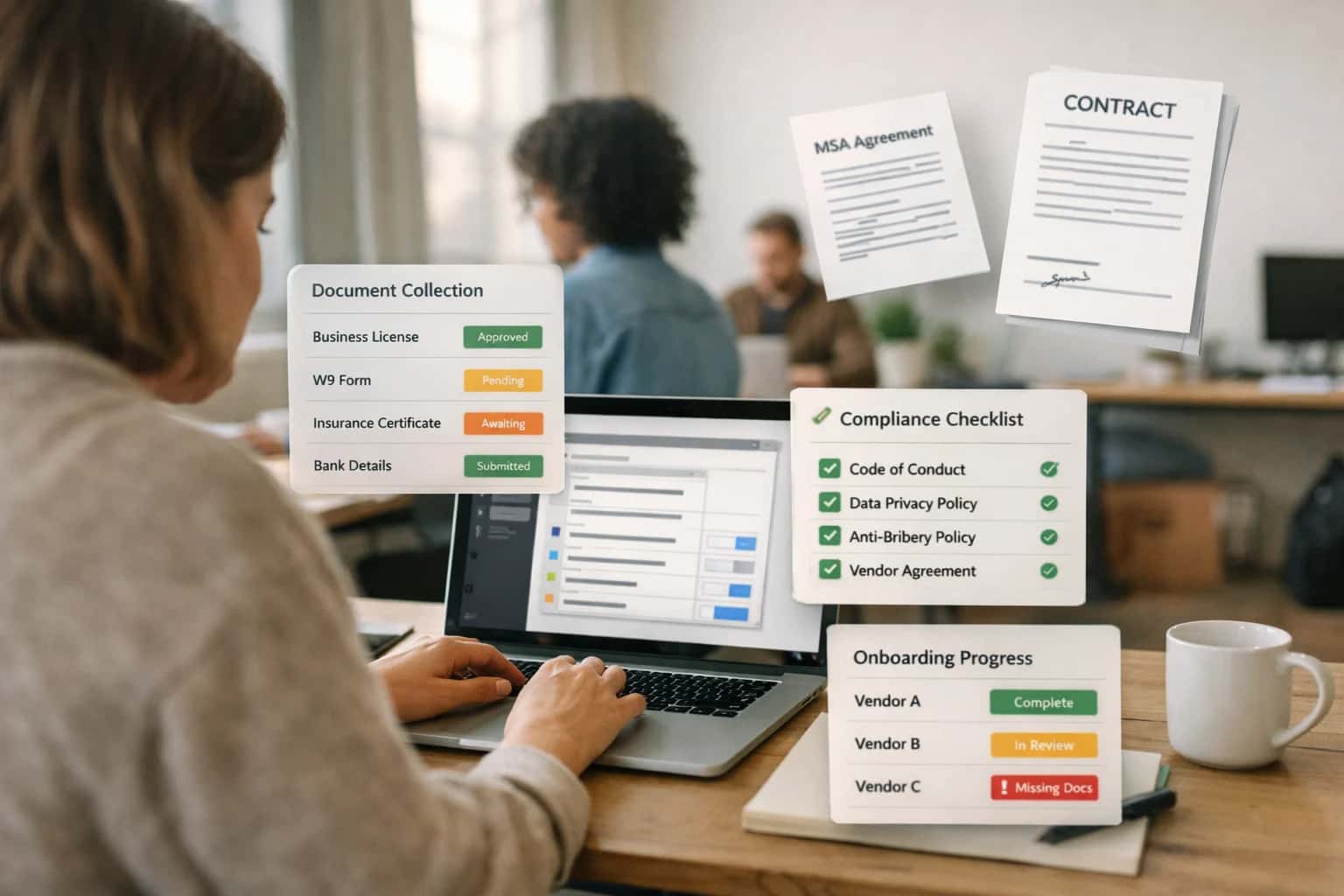
Vendor Onboarding & Due Diligence | 1-2 week manual collection and verification | AI automates data aggregation and initial risk scoring in 1-2 days | Accelerates process; procurement specialist reviews AI-generated summary |
Purchase Requisition Intake & Routing | Manual triage and email-based approvals | AI classifies request, suggests approvers, and auto-populates fields | Cuts intake-to-PO cycle time by 30-50%; handles high-volume, low-value requests |
Sole Source Justification Drafting | Hours of manual documentation assembly | AI assembles relevant past justifications and regulatory citations in minutes | Ensures consistency and compliance; requires manager sign-off |
Governance, Security, and Phased Rollout
Implementing AI in government procurement demands a security-first, phased approach that aligns with public sector IT governance.
AI integration for platforms like SAP Ariba or Jaggaer must be architected within the agency's existing security and data governance framework. This means implementing AI agents as microservices that authenticate via the platform's native APIs (e.g., Ariba APIs, cXML) and operate within defined RBAC boundaries. All AI-generated outputs—such as draft RFPs or vendor risk scores—should be treated as recommendations, requiring human review and approval within the procurement workflow before any system-of-record update is committed. Audit logs must capture the AI's input data, the prompt used, the generated output, and the final human action to ensure full traceability for compliance audits.
A phased rollout is critical for managing risk and building institutional trust. Start with a read-only pilot focused on analysis and summarization, such as using AI to review historical bid responses for common vendor questions or to summarize lengthy contract documents for procurement officers. This phase validates the technology without touching live transactions. The next phase introduces assistive writing, where AI drafts RFP sections or evaluation summaries that a specialist reviews and edits within the procurement platform. The final, controlled phase enables transactional assistance, such as AI-powered initial vendor responsiveness scoring that populates a field in the sourcing event, triggering a standard workflow for officer validation.
Governance extends to the AI models themselves. For public sector use, models should be deployed in a sovereign cloud or the agency's own IL5/IL6-compliant environment, with all data processed in-region. Implement a prompt management layer to ensure standardized, unbiased instructions for tasks like clause analysis. Regular evaluations against procurement fairness guidelines are required. By treating AI as a governed component within the existing procurement software stack—not a replacement—agencies can achieve operational gains in speed and analysis while maintaining the rigorous controls demanded by public accountability and fund stewardship. For a deeper technical blueprint, see our guide on AI Integration with SAP Business Technology Platform for Public Sector.
Enabling Efficiency, Speed & Accuracy
Intelligent Analysis, Decision & Execution
We build AI systems for teams that need search across company data, workflow automation across tools, or AI features inside products and internal software.
Talk to Us
Search across company data
Give teams answers from docs, tickets, runbooks, and product data with sources and permissions.
Useful when people spend too long searching or get different answers from different systems.

Automate internal workflows
Use AI to route work, draft outputs, trigger actions, and keep approvals and logs in place.
Useful when repetitive work moves across multiple tools and teams.

Add AI to products and internal tools
Build assistants, guided actions, or decision support into the software your team or customers already use.
Useful when AI needs to be part of the product, not a separate tool.
Frequently Asked Questions
Common technical and operational questions for integrating AI into platforms like SAP Ariba, Jaggaer, and Ivalua to automate procurement workflows.
Secure integration follows a layered API and data sync pattern, avoiding direct database access.
- Authentication & Authorization: Use the procurement platform's OAuth 2.0 or API key system. AI service principals are created with role-based access control (RBAC), scoped to read-only or specific write permissions (e.g.,
vendor.read,contract.read,rfp.draft). - Data Synchronization: For RAG and analysis, relevant data is synced to a secure vector database via:
- Scheduled API Pulls: For master data (vendors, contracts, commodity codes).
- Event-Driven Webhooks: For real-time workflows (new RFP published, bid submitted, contract executed). Example payload for a new RFP webhook:
json{ "event": "rfp.published", "rfp_id": "PR-2024-0456", "title": "Annual IT Hardware Refresh", "category": "Technology", "publish_date": "2024-05-15T10:00:00Z", "document_urls": ["https://procure.example.com/rfp/PR-2024-0456.pdf"] } - Orchestration Layer: A middleware service (often on BTP, Azure, or AWS) manages the flow: receives webhook, fetches additional context via API, calls the AI model, and posts results back to the procurement system via a controlled API endpoint.

About the author
Prasad Kumkar
CEO & MD, Inference Systems
Prasad Kumkar is the CEO & MD of Inference Systems and writes about AI systems architecture, LLM infrastructure, model serving, evaluation, and production deployment. Over 5+ years, he has worked across computer vision models, L5 autonomous vehicle systems, and LLM research, with a focus on taking complex AI ideas into real-world engineering systems.
His work and writing cover AI systems, large language models, AI agents, multimodal systems, autonomous systems, inference optimization, RAG, evaluation, and production AI engineering.
Partnered with leading AI, data, and software stack.





How We Work
Custom AI workflows for your Business
One-fit-all AI don't work for modern businesses. At Inferensys, we aim to understand your business & custom requirements; which we use to define most efficient agentic workflows, the data, and the tools for your business.
01
Review the use case
We understand the task, the users, and where AI can actually help.
Read more02
Pick the right approach
We define what needs search, automation, or product integration.
Read more03
Build the first useful version
We implement the part that proves the value first.
Read more04
Improve from there
We add the checks and visibility needed to keep it useful.
Read moreThe first call is a practical review of your use case and the right next step.
Talk to Us