AI integration for public libraries focuses on three primary surfaces within the Integrated Library System (ILS) stack: the public-facing discovery layer (OPAC), the staff-facing back-office modules, and the community engagement platforms. The goal is to inject intelligence at these key interaction points—using APIs, webhooks, and middleware—to enhance services powered by your existing data in systems like Sierra, Alma, Polaris, or Evergreen. This means your core catalog, patron records, and circulation data remain the system of record, while AI adds a responsive, intelligent layer on top.

Integration
AI Integration for Government Library Systems
A practical blueprint for adding AI to public library Integrated Library Systems (ILS) to automate cataloging, power virtual reference assistants, and deliver personalized reading recommendations.
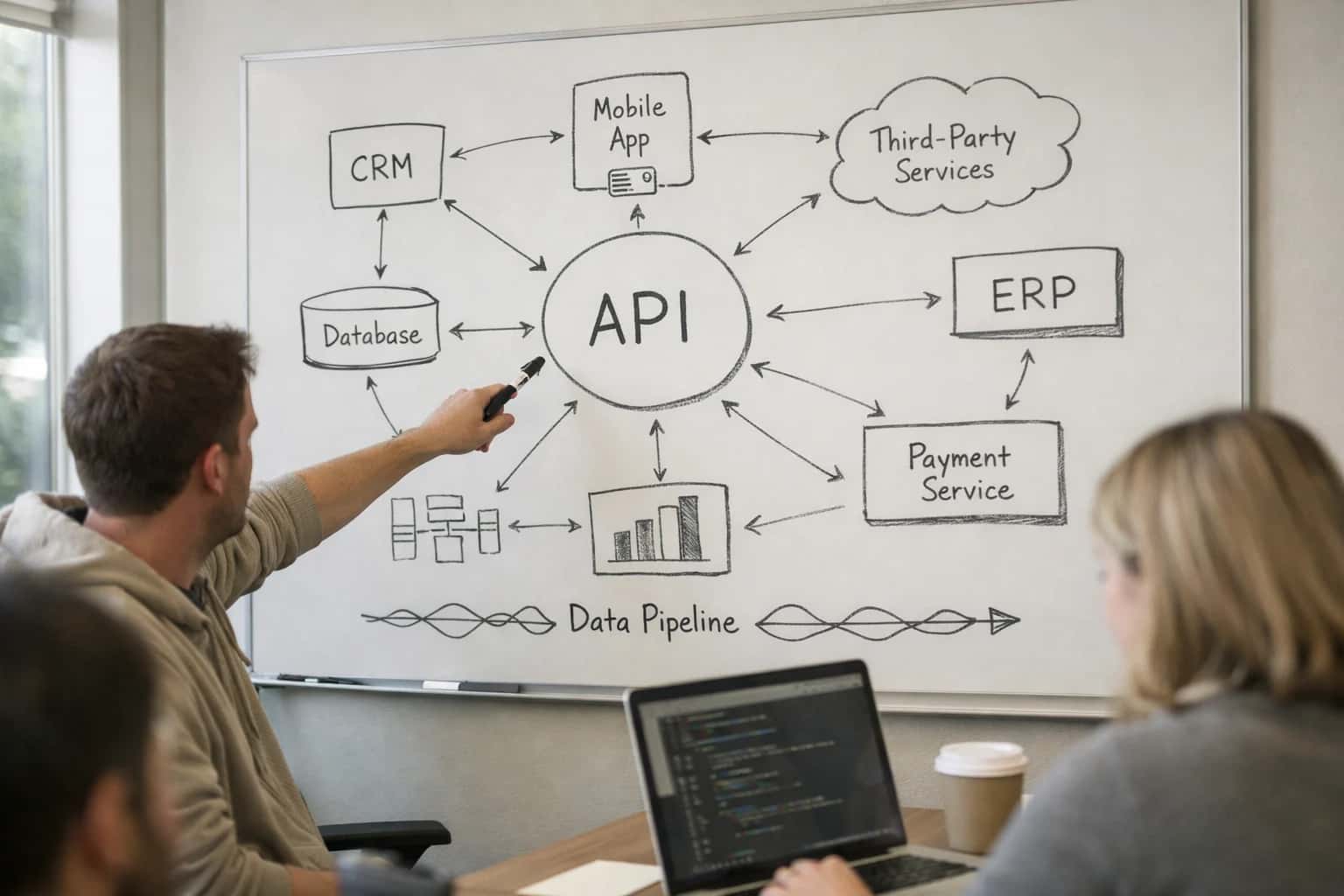
ARCHITECTURE FOR INTEGRATED LIBRARY SYSTEMS
Where AI Fits in the Public Library Tech Stack
A practical blueprint for embedding AI into core library workflows without replacing your existing ILS.
For the discovery layer, AI can be integrated via the OPAC's API or a middleware proxy to power semantic search beyond basic keywords, provide personalized reading recommendations based on checkout history, and enable a virtual reference assistant that answers questions about library holdings, hours, and policies. In back-office workflows, AI agents can connect to the ILS's acquisition and cataloging modules to suggest subject headings, automate metadata enrichment for digital collections, and triage inter-library loan requests. For community and outreach, integration with event management and newsletter platforms allows for automated program summarization, personalized event suggestions, and dynamic content generation for social media.
A production rollout typically involves a secure orchestration layer (like a microservice on your library's infrastructure) that brokers requests between the ILS APIs, your vectorized knowledge bases (e.g., policy documents, local history archives), and AI models. Governance is critical: all AI interactions should be logged, patron data must be anonymized for training where used, and human librarians retain final approval over AI-generated content or recommendations. Start with a pilot in a single, high-impact area like reference Q&A or recommendation engines, measure engagement and staff time saved, and then expand to cataloging support or analytics workflows.
WHERE TO CONNECT AI AGENTS AND WORKFLOWS
Key Integration Surfaces in the Library ILS
Core Patron Services and Transaction Automation
The patron and circulation module is the primary system of record for user accounts, checkouts, holds, and fines. This is the ideal surface for AI-driven personalization and service automation.
Key Integration Points:
- Patron API: Connect AI to fetch user profiles, reading history, and preferences to power personalized recommendation engines.
- Circulation Transactions: Use webhooks on checkout/return events to trigger AI workflows, such as suggesting similar titles or notifying of related library programs.
- Fine and Fee Management: Integrate AI chatbots to handle common inquiries about fines, explain policies, and guide users through payment workflows via the ILS's payment gateway.
Example Workflow: An AI agent monitors the holds_queue table. When a popular title has a long waitlist, it automatically generates and posts a curated list of "Read-Alike" available titles to the library's digital bulletin board, driving immediate circulation.
INTEGRATING WITH LIBRARY MANAGEMENT SYSTEMS (ILS)
High-Value AI Use Cases for Public Libraries
Integrating AI directly into your Integrated Library System (ILS) like Sierra, Alma, or Polaris enables personalized patron services, operational automation, and data-driven collection management without disrupting core workflows.
01
Personalized Reading Recommendation Engine
Connect an AI agent to the ILS patron and circulation APIs to analyze reading history, holds, and ratings. The agent generates personalized, explainable recommendations surfaced in the online catalog, email newsletters, or a dedicated patron portal, moving beyond simple "similar item" algorithms.
1 sprint
Pilot integration
02
Virtual Reference & FAQ Assistant
Deploy a secure chatbot on the library website, integrated via API with the ILS for real-time hold status, due dates, and catalog searches. Ground the AI in library policy documents and local knowledge bases to answer hours, program details, and digital resource questions, reducing call volume to staff.
Batch -> Real-time
Patron query resolution
03
Automated Cataloging & Metadata Enrichment
Integrate an AI pipeline into the acquisitions and cataloging workflow. For new items, the system can generate consistent summary abstracts, suggest subject headings, and flag potential duplicates by analyzing title pages and publisher data, reducing manual data entry for technical services staff.
Hours -> Minutes
Record enhancement
04
Intelligent Collection Analysis & Weeding
Connect AI analytics to circulation, in-house use, and ILL data within the ILS. The system identifies collection gaps, underperforming titles, and trending subjects, generating data-backed reports for selectors. It can also suggest weeding candidates based on condition, copyright date, and usage patterns.
05
Program Planning & Community Insight Agent
Analyze anonymized circulation trends, event registration data, and community demographic information to recommend relevant program topics, optimal scheduling, and target audiences. The AI can draft program descriptions and marketing copy for staff review, aligning offerings with community interests.
06
Accessibility & Inclusion Workflows
Implement AI tools to automatically generate alt-text for digital archive images and transcribe audio/video from local history collections. Integrate these outputs back into the digital asset management system or discovery layer, making special collections more accessible and searchable.
INTEGRATION PATTERNS
Example AI-Powered Library Workflows
These concrete workflows demonstrate how AI agents and copilots can be integrated into your existing Integrated Library System (ILS) to augment staff capabilities and improve patron services without a platform replacement.
Trigger: A patron logs into the library portal or mobile app.
Context/Data Pulled: The system retrieves the patron's historical checkouts, current holds, rated items, and declared interests from the ILS patron database.
Model/Agent Action: An AI agent analyzes the patron's profile and compares it against:
- The library's full catalog metadata (genre, author, subject headings).
- Circulation trends and popularity data.
- Semantic analysis of book summaries and reviews.
The agent generates a shortlist of 5-7 highly personalized recommendations, including a one-sentence justification for each (e.g., "Because you enjoyed Project Hail Mary, you might like this recent hard sci-fi novel with a similar focus on problem-solving and isolation.").
System Update/Next Step: The recommendations are displayed on the patron's portal dashboard. Clicking a recommendation deep-links directly to the ILS catalog record to place a hold.
Human Review Point: Library staff can review aggregate recommendation analytics to identify collection gaps or adjust the underlying model's weighting (e.g., promote diverse authors).
BUILDING A PRODUCTION-READY AI LAYER FOR LIBRARY OPERATIONS
Implementation Architecture: Connecting AI to the ILS
A practical blueprint for integrating AI agents, copilots, and RAG systems with your Integrated Library System (ILS) without disrupting core operations.
A production AI integration for a government ILS like SirsiDynix Symphony, Ex Libris Alma, or Polaris requires a layered architecture that respects the system's data model and user workflows. The integration typically connects at three key points: 1) The Patron Services API for real-time interactions like recommendations and virtual reference, 2) The Bibliographic Metadata Layer (MARC records, holdings data) for automated cataloging support and enrichment, and 3) The Circulation & Acquisitions Module for workflow automation around holds, renewals, and collection development. This is achieved by deploying a middleware agent orchestration platform (like a secure cloud service or on-prem container) that brokers requests between the ILS's APIs and AI models, ensuring all transactions are logged, auditable, and fall back to human staff when confidence is low.
For a personalized reading recommendation agent, the architecture ingests real-time patron check-out history, hold requests, and declared interests via the ILS API. This data is vectorized and matched against a continuously updated embedding of your collection's metadata (title, author, subject headings, summaries). The AI agent doesn't need direct write access to patron records; it calls a secure endpoint you expose, which then uses the ILS's standard create-recommendation-list or add-to-saved-searches API. For cataloging support, a separate pipeline monitors incoming publisher ONIX feeds or donation spreadsheets. An AI model suggests subject headings, genre classifications, and authority control matches, presenting them to catalogers within their existing OCLC Connexion or MarcEdit workflow via a sidebar app, reducing repetitive data entry from hours to minutes per batch.
Rollout should follow a phased, branch-testing approach. Start with a non-transactional virtual reference assistant powered by a RAG system over your library's policy documents, local history archives, and FAQ. This agent, integrated into your website or a kiosk, uses the ILS API only to search the catalog and return live availability—a low-risk starting point. Governance is critical: all AI-generated cataloging suggestions must require human librarian approval before writing to the MARC record, and all patron-facing interactions must include a clear "escalate to staff" option. Implement strict RBAC so AI agents have only the minimum necessary API permissions (e.g., read-patron-history, search-catalog, create-ticket). This architecture ensures AI augments the ILS, creating a more responsive and intelligent library service while maintaining the security, privacy, and integrity of your core system. For related architectural patterns, see our guides on [/integrations/government-erp-platforms/ai-integration-for-government-document-management-systems](AI for Government Document Management) and [/integrations/enterprise-content-management-platforms](AI for Enterprise Content Management).
INTEGRATION PATTERNS FOR LIBRARY MANAGEMENT SYSTEMS
Code and Payload Examples
Connecting to Patron and Circulation Data
Integrating AI with the patron and circulation modules of an ILS (like Sierra, Alma, or Polaris) enables personalized experiences. The core pattern involves querying the ILS API for a patron's loan history, holds, and reading preferences, then using this data to ground AI recommendations.
A typical integration fetches patron data via a secure API call, often requiring an API key and patron ID. The response payload includes structured data about checked-out items, genres, and authors. This data is then formatted into a context window for an LLM to generate personalized reading suggestions or series completion notices.
Example API Call Flow:
- Authenticate with ILS API using OAuth or API key.
- Retrieve patron's current loans and last 50 historical loans.
- Extract ISBNs, titles, subjects, and authors.
- Send structured list to LLM with a prompt for recommendations.
- Return AI-generated suggestions, optionally enriched with cover art from a service like Open Library.
AI FOR PUBLIC LIBRARY OPERATIONS
Realistic Time Savings and Operational Impact
How AI integration for library management systems (ILS) changes staff workflows and patron experience. Metrics are directional estimates based on typical implementations.
| Workflow / Metric | Before AI Integration | After AI Integration | Implementation Notes |
|---|---|---|---|
Personalized Reading Recommendations | Manual, infrequent staff picks or basic genre lists | Dynamic, patron-specific suggestions generated from borrowing history and reviews | Integrates with ILS patron and circulation APIs; human curation remains for featured lists |
Cataloging & Metadata Enrichment | Manual entry and subject tagging by librarians | AI-assisted title summarization, subject suggestion, and duplicate detection | Works within cataloging module; librarian reviews and approves all AI suggestions |
Virtual Reference & FAQ Handling | Staff answers repetitive questions via email, phone, or desk | AI chatbot handles 40-60% of common inquiries (hours, renewals, catalog search) 24/7 | Integrates with ILS public API and knowledge base; complex queries escalated to staff |
Collection Analysis & Weeding | Manual review of circulation reports and physical condition | AI-prioritized lists for potential de-accession based on usage, condition, and gaps | Pulls data from ILS reports; final decisions require librarian assessment |
Program Registration & Room Booking | Manual form processing and calendar management | Automated waitlist management and personalized program reminders via patron preferences | Connects to events module; reduces administrative calls and no-shows |
Acquisitions & Demand Forecasting | Historical trends and vendor lists guide purchasing | Predictive modeling for high-demand titles and genre trends informs budget allocation | Analyzes circulation, holds, and regional data; integrates with acquisitions workflow |
Accessibility & Alternate Format Requests | Manual process to locate and order large print or audio | AI identifies available alternate formats across consortium and automates request workflow | Leverages Z39.50 and consortium APIs; speeds fulfillment for patrons with print disabilities |
ENSURING TRUST AND SUSTAINABLE IMPACT
Governance, Security, and Phased Rollout
A practical framework for deploying AI in public library systems with appropriate controls, data privacy, and community trust.
Integrating AI into a library's Integrated Library System (ILS) like Sierra, Alma, or Polaris requires a governance-first approach. Start by defining clear data boundaries: AI agents should only access patron records, catalog metadata, and circulation data via secure, read-only APIs for tasks like personalized recommendations. Sensitive data like juvenile records, fines, or interlibrary loan requests should be masked or excluded. All AI-generated outputs, such as reading lists or reference answers, must be presented as suggestions with clear disclaimers and a path to human librarian review, maintaining the library's role as a trusted information curator.
A phased rollout minimizes risk and builds institutional confidence. Phase 1 focuses on non-transactional, high-impact areas: deploy a virtual reference assistant on the library website, powered by a RAG system over the library's public FAQ, policy documents, and curated community resource guides. This agent answers hours-of-operation questions and basic research queries without touching patron data. Phase 2 introduces AI into the catalog via a semantic search and discovery layer, connecting to the ILS's public OPAC API to improve search beyond traditional keywords. Phase 3, after validating accuracy and patron feedback, integrates a personalized recommendation engine using anonymized circulation trends to suggest titles via the patron's online account portal.
Security is paramount. AI tool calls to the ILS must use service accounts with principle of least privilege access, logged alongside traditional ILS audit trails. For public-facing chatbots, implement a content filter to block inappropriate generation and a human-in-the-loop escalation workflow that creates a ticket in the library's help desk system (like a Jira Service Management or Zendesk integration) when a query is too complex. All training data for local models must be scrubbed of Personal Identifiable Information (PII). A successful rollout includes staff training for librarians to understand, oversee, and correct the AI tools, ensuring technology augments rather than replaces human expertise.
Enabling Efficiency, Speed & Accuracy
Intelligent Analysis, Decision & Execution
We build AI systems for teams that need search across company data, workflow automation across tools, or AI features inside products and internal software.
Talk to Us
Search across company data
Give teams answers from docs, tickets, runbooks, and product data with sources and permissions.
Useful when people spend too long searching or get different answers from different systems.
Enterprise searchRAGPermissions
Read more
Automate internal workflows
Use AI to route work, draft outputs, trigger actions, and keep approvals and logs in place.
Useful when repetitive work moves across multiple tools and teams.
AI agentsWorkflow automationGovernance
Read more
Add AI to products and internal tools
Build assistants, guided actions, or decision support into the software your team or customers already use.
Useful when AI needs to be part of the product, not a separate tool.
AI integrationDecision supportModel routing
Read moreAI INTEGRATION FOR LIBRARY SYSTEMS
Frequently Asked Questions
Practical questions and answers for integrating AI into library management systems (ILS) like Sierra, Alma, Polaris, and Evergreen to enhance patron services and operational efficiency.
AI reading recommendations are built by connecting to your ILS's patron transaction APIs and catalog data. The typical integration flow is:
- Data Extraction: A secure service (often a scheduled job) pulls anonymized patron check-out history, holds, and ratings from the ILS database or via APIs like SIP2 or NCIP.
- Vectorization & Model Training: This data is used to create vector embeddings for books (based on metadata, summaries, subjects) and build collaborative filtering or content-based recommendation models.
- Real-time API: The trained model is hosted as an API. When a patron logs into the library portal, the portal calls this recommendation API with the patron's ID.
- ILS Context: The API fetches the patron's current context from the ILS (e.g., checked-out items) and returns personalized recommendations, which are displayed in the OPAC (Online Public Access Catalog) or a dedicated patron app.
Key Integration Points:
- ILS Patron API / Database (read-only, anonymized)
- MARC record export or OAI-PMH feed for catalog data
- OPAC/Discovery layer (e.g., Encore, Enterprise) for injecting recommendation widgets
Governance: Patron privacy is paramount. Data is anonymized for training, and recommendations are computed in a secure environment, never storing sensitive patron profiles long-term in the AI system.

About the author
Prasad Kumkar
CEO & MD, Inference Systems
Prasad Kumkar is the CEO & MD of Inference Systems and writes about AI systems architecture, LLM infrastructure, model serving, evaluation, and production deployment. Over 5+ years, he has worked across computer vision models, L5 autonomous vehicle systems, and LLM research, with a focus on taking complex AI ideas into real-world engineering systems.
His work and writing cover AI systems, large language models, AI agents, multimodal systems, autonomous systems, inference optimization, RAG, evaluation, and production AI engineering.
LinkedIn
Limited slotsGet a Free AI Consultation
Partnered with leading AI, data, and software stack.





How We Work
Custom AI workflows for your Business
One-fit-all AI don't work for modern businesses. At Inferensys, we aim to understand your business & custom requirements; which we use to define most efficient agentic workflows, the data, and the tools for your business.
01
Review the use case
We understand the task, the users, and where AI can actually help.
Read more02
Pick the right approach
We define what needs search, automation, or product integration.
Read more03
Build the first useful version
We implement the part that proves the value first.
Read more04
Improve from there
We add the checks and visibility needed to keep it useful.
Read moreThe first call is a practical review of your use case and the right next step.
Talk to Us