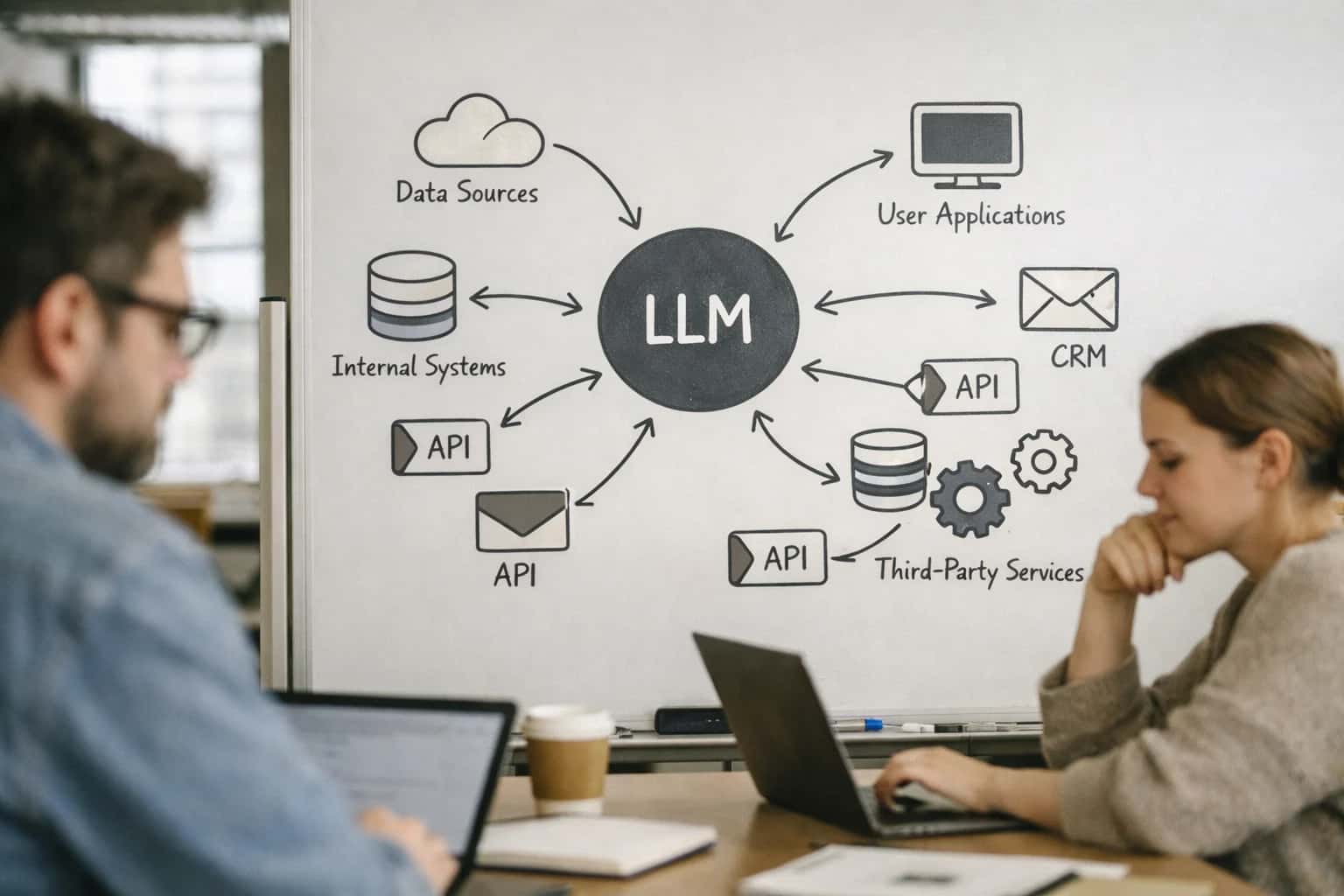
AI integration targets Zuper's payment objects and workflows at three key surfaces: the Invoice API, the Payment Gateway webhook, and the Customer 360 data model. The goal is to inject intelligence between a completed work order and a settled payment. This means listening for events like invoice.created or payment.failed and triggering AI agents that can generate dynamic payment links, analyze failure reasons, or evaluate customer credit for flexible terms—all without manual back-office intervention.

Integration
AI Integration for Zuper Payments
A technical blueprint for embedding AI into Zuper's payment workflows to automate collections, personalize terms, and reduce days sales outstanding (DSO) for field service businesses.
ARCHITECTURE AND ROLLOUT
Where AI Fits into Zuper's Payment Workflow
A technical blueprint for integrating AI agents into Zuper's payment processing to automate collections, reduce failed transactions, and personalize customer terms.
A production implementation typically involves a middleware service (hosted on your infrastructure or a secure cloud) that subscribes to Zuper's webhooks. For example, on a payment.failed event, an AI agent can be triggered to:
- Analyze the decline code and customer payment history.
- Decide on a retry strategy (e.g., immediate retry with a different card on file, or schedule a follow-up SMS).
- Draft and send a personalized communication to the customer via Zuper's messaging channels. Similarly, post-service, an agent can use the job details and customer profile to automatically generate a payment link with the optimal payment method pre-selected, reducing friction and accelerating cash flow.
Rollout should be phased, starting with non-critical workflows like automated payment link generation for repeat customers. Governance is critical: all AI-generated communications and payment decisions should be logged in a dedicated audit trail, and high-value or exception cases should be routed for human review within Zuper's interface. This approach allows you to capture efficiency gains—converting invoices to cash in hours instead of days—while maintaining control and compliance. For a deeper dive into connecting AI to Zuper's core platform, see our guide on AI Integration with Zuper.
PAYMENTS AUTOMATION
Key Zuper APIs and Modules for AI Integration
Automate Post-Service Collections
The Payment Links API is the primary surface for AI-driven payment automation. After a work order status changes to Completed, an AI agent can call this API to generate and send a secure, itemized payment link via SMS or email. This eliminates the manual step of creating and sending invoices.
Key integration points:
- Trigger on
WorkOrderstatus update webhooks. - Use the API to create a link tied to the specific job and customer record.
- Embed dynamic data like final total, tax, and a breakdown of parts/labor.
- The AI can personalize the message, referencing the service performed and offering flexible payment options (e.g., 'Pay in full' vs. 'Set up a plan').
This enables same-day invoicing instead of next-day, accelerating cash flow.
PAYMENT WORKFLOW AUTOMATION
High-Value AI Use Cases for Zuper Payments
Integrate AI directly into Zuper's payment processing to automate manual tasks, reduce failed transactions, and improve cash flow for field service businesses.
01
Automated Payment Link Generation
Trigger the creation and delivery of secure payment links immediately upon work order completion. AI reviews the job details, applies correct pricing and tax rules from Zuper, and sends a personalized link via SMS or email. Eliminates manual invoice generation and follow-up calls.
Same day
Payment collection
02
Intelligent Failed Payment Recovery
Deploy AI agents to manage failed or declined card-on-file transactions. The system analyzes the decline reason, checks for updated customer payment methods within Zuper, and orchestrates a personalized retry sequence via the customer's preferred channel. Dramatically reduces manual collections effort.
Batch -> Real-time
Recovery workflow
03
Dynamic Payment Plan Analysis
For larger tickets, AI analyzes the customer's payment history within Zuper and external credit signals to generate and present compliant, pre-approved payment plan options at checkout. Increases close rates on high-value jobs by offering flexible terms.
1 sprint
Implementation
04
Fraud & Anomaly Detection
Integrate AI models with Zuper's payment gateway webhooks to screen transactions in real-time. Flags unusual patterns (e.g., high-value first-time customer, mismatched billing info) for review before processing, reducing chargebacks and fraud losses. Adds a security layer without disrupting checkout.
05
Cash Flow Forecasting & Dunning
AI aggregates Zuper payment data, scheduled jobs, and historical trends to predict weekly cash flow. Automatically triggers prioritized collection workflows for overdue accounts and suggests optimal times to contact customers based on past behavior. Provides actionable insights for the finance team.
Hours -> Minutes
Forecast generation
06
Unified Payment Reconciliation
Connect Zuper payments to accounting platforms like QuickBooks or Xero. AI matches incoming bank deposits to Zuper invoices, flags discrepancies, and auto-categorizes expenses. Eliminates end-of-month reconciliation headaches for bookkeepers. Learn more about our approach to Field Service Financial Integrations.
ZUPAYMENTS
Example AI-Powered Payment Workflows
These workflows demonstrate how to embed AI agents into Zuper's payment lifecycle to automate collections, reduce administrative overhead, and improve cash flow. Each flow connects to Zuper's APIs, uses AI for decision-making, and updates records automatically.
Trigger: A work order status changes to Completed in Zuper.
AI Agent Action:
- The agent calls Zuper's API to fetch the work order details, final invoice amount, and customer contact info.
- It cross-references the customer's payment history and any active service agreements.
- Using a configured prompt, the agent generates a personalized payment request message (e.g., "Hi [Name], your service for [Job #] is complete. Click here to securely pay $[Amount]. Thank you for your business!").
- The agent calls a payment gateway API (e.g., Stripe, Square) to create a unique, secure payment link for the exact invoice amount.
System Update:
- The payment link and a record of the sent message are logged to a custom object in Zuper linked to the work order.
- The payment link is dispatched via the customer's preferred channel (SMS via Twilio, email via Zuper's comms, or posted to the customer portal) using Zuper's outbound messaging APIs.
- The work order is tagged with
Payment_Pending.
Human Review Point: The message template and payment gateway logic are configured and audited during implementation. The agent's actions are logged for compliance.
SECURE, AUDITABLE PAYMENT ORCHESTRATION
Implementation Architecture: Data Flow & Guardrails
A production-ready blueprint for connecting AI to Zuper's payment workflows, ensuring secure data handling and automated financial operations.
A robust AI integration for Zuper Payments is built on a secure middleware layer that orchestrates data between Zuper's core objects—Work Orders, Invoices, and Customer records—and external AI services and financial systems. The typical flow is triggered by a work_order.status change to 'Completed'. An event webhook or a scheduled job from your middleware (e.g., n8n, Make, or a custom service) fetches the finalized invoice data, including line items, customer contact, and total amount. This payload is enriched with historical payment data from Zuper and, if configured, a soft credit check via a sanctioned API. The enriched context is then sent to an LLM orchestration platform (like CrewAI or a custom agent) with strict instructions to generate a personalized payment message and a secure payment link, which is posted back to Zuper's API for attachment to the customer record and automated dispatch.
Critical guardrails must be engineered into this flow. All AI interactions with PII or payment data should occur through a zero-retention proxy that strips sensitive identifiers before processing and uses ephemeral sessions. Payment link generation must call the actual payment gateway API (e.g., Stripe, Square) directly from your secure middleware, not the LLM. Implement a human-in-the-loop approval step for any payment plan suggestions or credit decisions before communication is sent, configurable within Zuper as a task for the accounts team. Furthermore, all actions—link generation, message sends, retry logic triggers—must write an immutable audit log to a separate system, tagging the source Zuper work order ID for full traceability.
Rollout should follow a phased, role-based access control (RBAC) strategy. Start with a pilot on a specific service line or geographic territory, limiting AI-triggered communications to customers with a history of on-time payments. Use Zuper's built-in reporting to monitor key metrics like payment link click-through rate and time-to-pay against a control group. Governance requires regular reviews of the AI-generated communication templates for compliance and tone, and establishing clear escalation paths for customer inquiries. This architecture turns Zuper from a system of record into an intelligent payment operations engine, reducing manual follow-up from days to minutes while maintaining financial control and customer trust.
AI-ENHANCED PAYMENT WORKFLOWS
Code Patterns and API Payload Examples
Triggering Automated Payment Links
After a work order is marked completed in Zuper, an AI agent can analyze the job details, parts used, and labor hours to generate a final invoice amount. It then calls Zuper's API to create a secure, one-time payment link and dispatches it via the customer's preferred channel (SMS, email, portal). This pattern reduces the invoice-to-cash cycle from days to minutes.
Example API Payload to Zuper:
jsonPOST /api/v1/payment_links { "work_order_id": "WO-78910", "amount": 425.75, "currency": "USD", "customer_id": "CUST-12345", "description": "Final invoice for AC repair service", "expiry_hours": 72, "metadata": { "technician_id": "TECH-88", "priority_customer": true } }
The AI agent can personalize the accompanying message based on service history, improving payment likelihood.
AI-ENHANCED PAYMENT OPERATIONS
Realistic Time Savings and Business Impact
How AI integration transforms manual, reactive payment workflows in Zuper into automated, proactive revenue operations.
| Payment Workflow | Before AI (Manual) | After AI (Automated & Assisted) | Key Notes & Impact |
|---|---|---|---|
Payment Link Generation | Manual creation post-service completion, often delayed until next business day | Triggered automatically upon work order completion, sent within minutes | Accelerates cash flow; reduces Days Sales Outstanding (DSO) by 1-2 days on average |
Failed Payment Retry Logic | Manual review of daily/weekly reports; ad-hoc follow-up calls/emails | AI-driven analysis of failure reason; automated, personalized retry sequence over 5 days | Recaptures 15-25% of initially failed payments without staff intervention |
Customer Credit & Terms Analysis | Manual review of payment history or external credit checks for large jobs only | Automated analysis of internal payment history & external data signals for all jobs; suggests secure terms | Reduces bad debt risk; enables dynamic terms for reliable customers, improving win rates |
Invoice & Payment Reconciliation | Manual matching of bank deposits to Zuper invoices, often during month-end close | AI matches payments to invoices automatically; flags discrepancies for review | Saves 4-8 hours per week for bookkeeping; ensures real-time financial accuracy |
Personalized Payment Follow-up | Generic payment reminder emails/SMS sent to all overdue accounts | Segmented, personalized messaging based on customer value, history, and preferred channel | Improves customer experience; increases on-time payment rate by 10-20% for targeted segments |
Payment Plan Creation & Management | Manual spreadsheet calculations and agreement drafting for distressed accounts | AI suggests viable plan options based on customer's payment capacity; automates agreement generation and tracking | Turns potential write-offs into recovered revenue; reduces administrative burden by 75% |
Cash Flow Forecasting | Static reports based on booked jobs and historical averages | Dynamic forecasts incorporating AI-predicted payment dates, failure probabilities, and seasonal trends | Provides finance teams with 85%+ accurate 30-day cash flow visibility for better planning |
OPERATIONALIZING AI FOR FINANCIAL WORKFLOWS
Governance, Security, and Phased Rollout
A practical approach to deploying AI in Zuper's payment module with security, oversight, and controlled adoption.
Integrating AI into Zuper's payment workflows requires careful handling of sensitive financial data. Implementation typically involves creating a secure middleware layer that sits between Zuper's APIs and the AI model provider (e.g., OpenAI, Anthropic). This layer is responsible for tokenizing or redacting sensitive information like full credit card numbers before sending payloads for analysis, logging all AI interactions for audit trails, and enforcing role-based access controls (RBAC) so only authorized users can trigger or modify AI-driven payment actions. Key Zuper objects like Payment, Invoice, and Customer records are accessed via webhooks or scheduled syncs to provide the AI with context for tasks like credit analysis or retry logic.
A phased rollout is critical for managing risk and proving value. Phase 1 often starts with a single, high-impact use case like automated payment link generation. After a service is marked complete in a Zuper work order, an AI agent can be triggered to draft a personalized payment message, generate a secure link via Zuper's payment gateway, and SMS/email it to the customer—all without dispatcher intervention. This can be piloted with a small team of trusted technicians and a subset of customers. Phase 2 introduces AI-driven failed payment retry logic, where the system analyzes failure reasons (e.g., insufficient funds vs. expired card) and, based on customer payment history, automatically schedules a retry for an optimal future date or escalates to a collections workflow.
Governance is built around human-in-the-loop checkpoints, especially for higher-risk actions. For example, an AI recommendation to adjust payment terms based on a customer's credit score analysis should require manager approval within Zuper before being applied. All AI-generated outputs, such as payment plan suggestions or dunning communication drafts, should be clearly flagged in the UI. Regular monitoring of key metrics—like reduction in Days Sales Outstanding (DSO), payment success rate, and customer satisfaction scores related to billing—helps validate the integration's ROI and guides further investment. This controlled, metrics-driven approach ensures the AI augments your team's efficiency without introducing unmanaged financial or reputational risk.
Enabling Efficiency, Speed & Accuracy
Intelligent Analysis, Decision & Execution
We build AI systems for teams that need search across company data, workflow automation across tools, or AI features inside products and internal software.
Talk to Us
Search across company data
Give teams answers from docs, tickets, runbooks, and product data with sources and permissions.
Useful when people spend too long searching or get different answers from different systems.
Enterprise searchRAGPermissions
Read more
Automate internal workflows
Use AI to route work, draft outputs, trigger actions, and keep approvals and logs in place.
Useful when repetitive work moves across multiple tools and teams.
AI agentsWorkflow automationGovernance
Read more
Add AI to products and internal tools
Build assistants, guided actions, or decision support into the software your team or customers already use.
Useful when AI needs to be part of the product, not a separate tool.
AI integrationDecision supportModel routing
Read moreAI INTEGRATION FOR ZUPER PAYMENTS
Frequently Asked Questions
Practical questions and workflow blueprints for integrating AI into Zuper's payment processing to automate collections, reduce manual follow-up, and improve cash flow.
This workflow reduces the time between job completion and invoice payment from days to minutes.
- Trigger: A work order is marked
Completedin Zuper, triggering a webhook to your AI integration layer. - Context Pulled: The AI agent retrieves the work order details, customer record, and any pre-approved quote or estimate from Zuper's API.
- AI Agent Action: Using a configured LLM, the agent generates a personalized payment message and a secure, itemized payment link via your payment gateway (e.g., Stripe, PayPal). It includes:
- A clear summary of services rendered.
- Applicable taxes and discounts.
- A direct, one-click payment URL.
- System Update: The payment link and a record of the communication are logged back to the Zuper customer record. The invoice status in Zuper is updated to
Sent. - Human Review Point: For invoices over a configurable threshold (e.g., $5,000), the system can be set to route the generated message and link to a manager for approval before sending.
Payload Example (to Payment Gateway):
json{ "customer_id": "cus_zuper_12345", "amount": 1250.75, "description": "Service #WO-2024-5678: AC Repair & Maintenance", "metadata": { "zuper_work_order_id": "WO-2024-5678", "technician": "Jane Smith", "line_items": ["Freon recharge", "Filter replacement"] } }

About the author
Prasad Kumkar
CEO & MD, Inference Systems
Prasad Kumkar is the CEO & MD of Inference Systems and writes about AI systems architecture, LLM infrastructure, model serving, evaluation, and production deployment. Over 5+ years, he has worked across computer vision models, L5 autonomous vehicle systems, and LLM research, with a focus on taking complex AI ideas into real-world engineering systems.
His work and writing cover AI systems, large language models, AI agents, multimodal systems, autonomous systems, inference optimization, RAG, evaluation, and production AI engineering.
LinkedIn
Limited slotsGet a Free AI Consultation
Partnered with leading AI, data, and software stack.





How We Work
Custom AI workflows for your Business
One-fit-all AI don't work for modern businesses. At Inferensys, we aim to understand your business & custom requirements; which we use to define most efficient agentic workflows, the data, and the tools for your business.
01
Review the use case
We understand the task, the users, and where AI can actually help.
Read more02
Pick the right approach
We define what needs search, automation, or product integration.
Read more03
Build the first useful version
We implement the part that proves the value first.
Read more04
Improve from there
We add the checks and visibility needed to keep it useful.
Read moreThe first call is a practical review of your use case and the right next step.
Talk to Us