Integrating AI into Zuper means connecting to its core operational surfaces: the Dispatch Board, Work Order objects, Customer Portal, and Mobile Field App. The goal is to augment, not replace, these modules. For dispatchers, AI acts as a co-pilot analyzing real-time technician location, skill, parts inventory on the truck, and historical job data to recommend optimal assignments, reducing manual drag-and-drop. For the work order lifecycle, AI can be triggered via Zuper's webhooks or API to auto-populate fields from customer emails, IoT sensor alerts, or portal submissions, turning intake into a zero-touch process for service coordinators.

Integration
AI Integration with Zuper
A technical blueprint for embedding AI into Zuper's modern service platform to automate dispatch, empower technicians, and enhance customer self-service.
ARCHITECTURE & ROLLOUT
Where AI Fits into Zuper's Field Service Stack
A practical blueprint for embedding AI agents, automation, and intelligence into Zuper's modern service platform without disrupting existing operations.
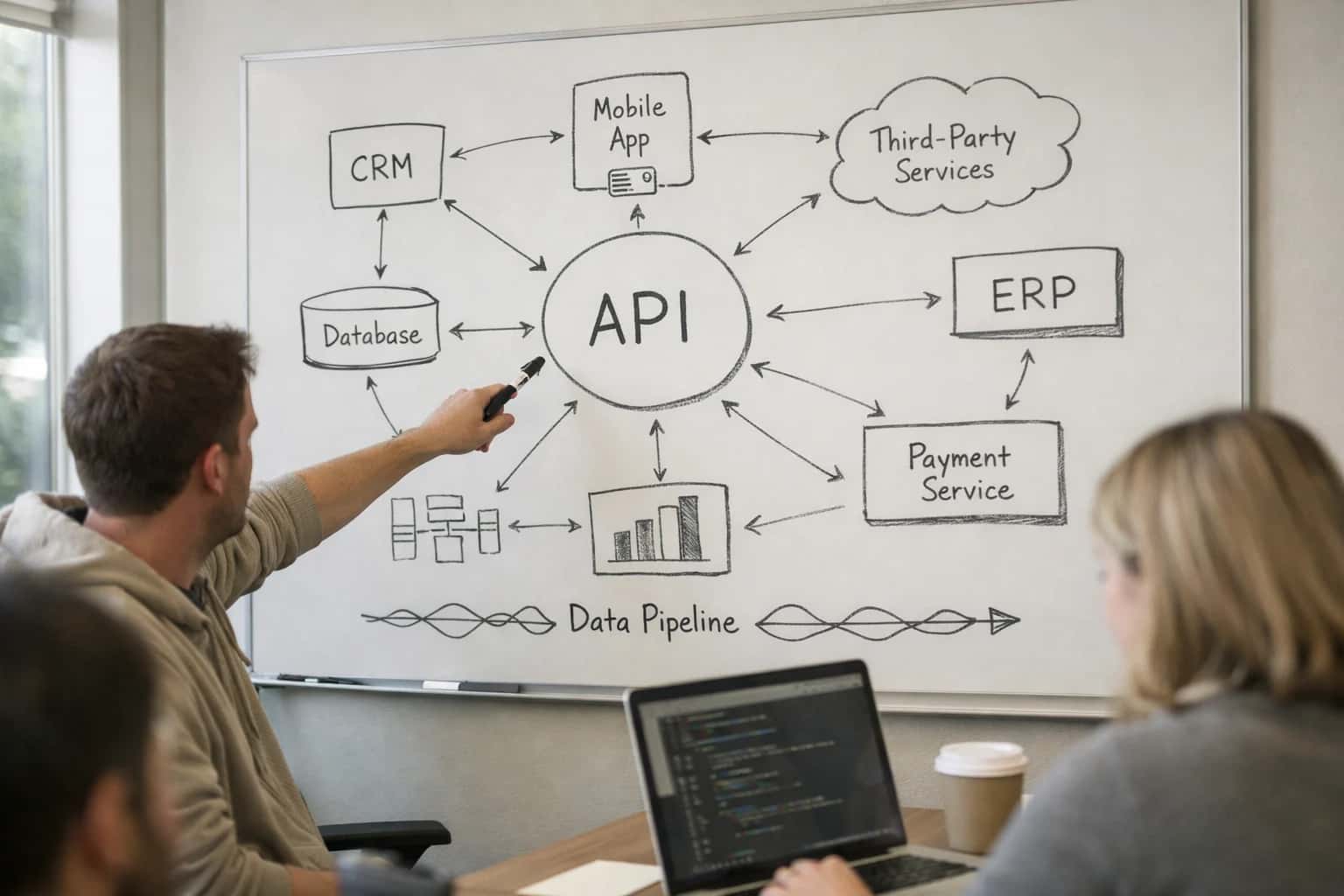
Implementation typically involves a middleware layer (like a secure cloud function or container) that sits between Zuper's REST API and your chosen LLM (e.g., OpenAI, Anthropic). This layer handles authentication, data mapping, and prompt engineering specific to Zuper's data model—such as enriching a Job record with predictive duration or suggested parts before it hits the dispatch queue. For field technicians, an AI agent can be embedded within the Zuper mobile app (via a secure web view or custom tab) to provide instant, offline-capable access to manuals, SOPs, and interactive checklists using Retrieval-Augmented Generation (RAG) on your company knowledge base, all without leaving the job context.
Rollout should be phased, starting with a single high-impact workflow like automated customer communications from the portal or intelligent scheduling for a pilot team. Governance is critical: all AI-generated dispatches or notes should be logged in Zuper's custom objects with a human-in-the-loop approval flag for the first 30-90 days. This ensures accuracy and builds trust before moving to fully automated modes for low-risk, repetitive tasks. The end state is a tightly integrated system where AI handles the routine—scheduling, data entry, initial triage—freeing your team to manage exceptions, complex jobs, and customer relationships.
WHERE TO CONNECT AI AGENTS AND WORKFLOWS
Key Zuper Modules and Surfaces for AI Integration
The Core Optimization Layer
Zuper's scheduling engine is the primary surface for AI-driven efficiency gains. Integration points include the dispatch board API, resource (technician) objects, and job/work order records. AI can be applied to:
- Dynamic Scheduling: Ingest real-time data (traffic, weather, parts inventory) via webhooks to suggest optimal appointment slots and technician assignments, aiming to maximize first-time fix rates.
- Intelligent Dispatching: Use ML models on historical job data (duration, skill requirements) to predict task complexity and auto-assign jobs, balancing workload across teams.
- Exception Handling: Build AI agents that monitor the schedule for conflicts (e.g., technician delays, customer cancellations) and automatically propose rescheduling options to dispatchers via in-app alerts or Slack integrations.
Implementation typically involves a middleware service that polls or receives webhooks from Zuper, runs optimization logic, and posts updates back via the Zuper REST API.
INTEGRATION PATTERNS
High-Value AI Use Cases for Zuper
Practical AI integrations for Zuper's modern service platform, designed to automate manual workflows, enhance dispatcher and technician productivity, and improve customer self-service—without replacing your core system.
01
Intelligent Dispatch & Scheduling
Integrate AI algorithms with Zuper's dispatch APIs to optimize daily routes. Considers real-time traffic, technician skill certifications, parts inventory on the truck, and job priority to dynamically sequence and assign jobs, reducing drive time and increasing first-time fix rates.
Hours -> Minutes
Daily planning
02
Customer Portal AI Assistant
Embed a secure AI chatbot into Zuper's customer portal using its webhook APIs. Enables 24/7 self-service for common inquiries, intelligent appointment booking/rescheduling, and real-time job status updates. Reduces call volume for service coordinators.
Batch -> Real-time
Customer support
03
Mobile Technician Copilot
Build an offline-capable AI assistant within the Zuper mobile app. Uses RAG on your internal knowledge base (manuals, SOPs) to provide contextual, step-by-step guidance. Supports hands-free voice notes, photo-based part identification, and automated work order updates.
1 sprint
Pilot deployment
04
Automated Work Order Creation
Connect AI to Zuper's work order APIs to automate intake from multiple sources. Process customer emails, IoT sensor alerts, and transcribed phone calls. AI extracts key details (issue, location, asset) and creates a pre-populated work order, slashing manual data entry.
Same day
Intake processing
05
Predictive Parts & Inventory
Integrate AI with Zuper's inventory module and supplier catalogs. Analyzes scheduled jobs, historical parts usage, and truck stock levels to forecast needs and generate automated reorder lists. Optimizes van stock to minimize emergency runs and excess inventory.
Batch -> Real-time
Stock forecasting
06
AI-Powered Service Reporting
Augment Zuper's reporting suite with natural language querying. Service managers can ask, "Show me jobs with low margins last month" or "Predict next week's demand." AI generates dynamic insights and predictive dashboards from work order and asset data.
Hours -> Minutes
Insight generation
PRACTICAL IMPLEMENTATION PATTERNS
Example AI-Powered Workflows for Zuper
These workflows demonstrate how to connect AI agents and automations to Zuper's core modules—Scheduling, Work Orders, Customer Portal, and Mobile App—to reduce manual work, improve first-time fix rates, and enhance customer experience.
Trigger: A customer visits the Zuper customer portal to book a service.
AI Agent Action:
- A conversational AI chatbot (embedded in the portal) engages the customer to understand the service need (e.g., "AC not cooling").
- Using Retrieval-Augmented Generation (RAG) on your company's service catalog and historical work orders, the agent asks clarifying questions (model, symptoms, error codes).
- The agent calls Zuper's Scheduling API, factoring in:
- Predicted Job Duration: Based on similar historical jobs.
- Technician Skill & Certification: Matches required skills from the service catalog.
- Parts Availability: Checks real-time inventory levels for likely required parts.
- Customer Location & Preferred Time Windows.
System Update:
- The AI agent presents 2-3 optimized time slots to the customer within the portal.
- Upon customer selection, a work order is auto-created in Zuper with a pre-populated Problem Description, Suggested Parts List, and Estimated Duration.
- The assigned technician receives a notification in the Zuper mobile app with the enriched work order context.
Human Review Point: For complex or high-value jobs (e.g., commercial equipment), the system can flag the created work order for a service coordinator's review before final dispatch.
CONNECTING AI TO ZUPER'S CORE WORKFLOWS
Implementation Architecture: Data Flow and APIs
A practical blueprint for integrating AI agents and automation into Zuper's service platform, focusing on secure data flow and API orchestration.
A production-ready AI integration for Zuper is built on its robust REST API, which exposes key objects like WorkOrders, Appointments, Assets, Customers, and Technicians. The core pattern involves setting up a middleware layer—often a cloud function or containerized service—that acts as an orchestration hub. This layer subscribes to Zuper webhooks for events like workorder.created or appointment.updated, processes the payload with an AI agent (e.g., for triage or scheduling), and uses the Zuper API to write back enriched data, create follow-up tasks, or update records. For example, an incoming customer portal request can trigger a webhook; the AI service analyzes the description, checks the asset history, and automatically creates a pre-populated work order with suggested skill requirements and parts.
For latency-sensitive use cases like dispatch optimization or mobile copilots, the architecture often incorporates a real-time component. Zuper's APIs for live technician location (TechnicianLocation) and schedule (ScheduleBoard) can be polled or streamed to an external AI routing engine. The AI service processes this data alongside external feeds (traffic, weather) and pushes optimized sequences or real-time ETA adjustments back to Zuper's dispatch console via PATCH requests. For the technician copilot, a secure, offline-capable edge agent on the Zuper mobile app can call a Retrieval-Augmented Generation (RAG) service. This service queries a vector database indexed with your company's knowledge base (manuals, SOPs) and uses the context to answer technician questions via the app, logging all interactions back to the work order notes.
Governance and rollout require careful planning. Implement API rate limiting and retry logic to respect Zuper's limits. All AI-generated content or decisions should be logged to a separate audit trail with traceability back to the source prompt and data. For phased rollouts, use feature flags in your middleware to control which AI modules (e.g., scheduling, triage, reporting) are active for specific teams or service lines. Start with a pilot on a single workflow, such as automating work order categorization from the customer portal, before expanding to complex dispatch logic. This controlled approach allows you to measure impact on key Zuper metrics like First-Time Fix Rate or Technician Utilization before scaling.
ZUPER INTEGRATION PATTERNS
Code and Payload Examples
Intelligent Dispatch Payload
Integrating an AI optimization service with Zuper's dispatch APIs allows for dynamic job assignment. A typical workflow involves fetching pending jobs and available technicians, running an optimization algorithm, and posting the assignments back to Zuper.
Example API Payload for Job Assignment:
jsonPOST /api/v1/dispatch/assign { "job_id": "JOB-78910", "technician_id": "TECH-456", "assigned_time": "2023-10-26T14:30:00Z", "estimated_duration_minutes": 90, "optimization_metadata": { "drive_time_minutes": 22, "skill_match_score": 0.95, "predicted_on_time_probability": 0.88 } }
This payload enriches the standard assignment with AI-derived metadata for auditability and continuous learning, enabling dispatchers to understand the 'why' behind each recommendation.
AI INTEGRATION FOR ZUPER
Realistic Time Savings and Operational Impact
A practical comparison of manual vs. AI-assisted workflows across key Zuper modules, based on typical implementations for mid-sized service businesses.
| Workflow / Module | Manual Process | AI-Assisted Process | Implementation Notes |
|---|---|---|---|
Service Request Triage & Dispatch | Dispatchers manually review calls/forms, match skills, check location (~15-20 min/job) | AI scores urgency, suggests best-fit technician, auto-creates draft dispatch (~2-3 min/job) | Human dispatcher approves all suggestions; integrates with Zuper's Jobs API and Technician objects |
Customer Self-Scheduling via Portal | Customer calls/emails; coordinator finds slot, calls back, manually books (~10-15 min/booking) | AI chatbot handles inquiry, checks real-time calendar/parts, books slot instantly (~1 min/booking) | Uses Zuper's public APIs for scheduling and Customer Portal; requires grounding in service catalog |
Work Order Documentation & Notes | Technician types notes post-job; coordinator reviews, clarifies missing details (~20-30 min/job) | AI drafts notes from technician voice dictation/photos; flags inconsistencies for review (~5 min/job) | Leverages Zuper Mobile App SDK; AI runs post-job, not in real-time, for quality control |
Preventive Maintenance Scheduling | Coordinator manually reviews asset lists and contract dates, schedules batch calls (~4-6 hours/month) | AI analyzes asset history/usage, predicts optimal PM dates, creates and routes schedule drafts (~1 hour/month) | Integrates with Zuper's Assets and Recurring Jobs modules; outputs require manager sign-off |
Parts Inventory Replenishment | Warehouse manager checks stock weekly, places orders based on gut feel, risks over/under-stocking | AI forecasts usage from scheduled jobs, auto-generates PO suggestions for low-stock items | Connects to Zuper's Inventory API and vendor catalogs; approvals remain manual for large orders |
Post-Service Invoice Generation | Back office reviews work order, manually applies pricing, creates invoice, sends to customer (~15 min/invoice) | AI auto-populates invoice from completed job data, applies pricing rules, sends for approval (~3 min/invoice) | Uses Zuper's Invoicing API; integrates with QuickBooks/Xero; human reviews complex jobs |
Customer Follow-up & Review Solicitation | Coordinator sends templated emails/SMS a few days after job completion; low response rates | AI sends personalized messages based on job type/customer, analyzes sentiment, routes low scores | Built on Zuper's Customer Communication APIs; uses CRM data for personalization |
ARCHITECTING A CONTROLLED DEPLOYMENT
Governance, Security, and Phased Rollout
A practical guide to implementing AI in Zuper with proper controls, security, and a phased rollout to manage risk and maximize value.
Integrating AI into Zuper's operational workflows requires a security-first architecture that respects data boundaries and user permissions. Core considerations include:
- API Security & RBAC: All AI calls should use scoped API tokens with permissions limited to specific Zuper objects (e.g.,
WorkOrders,Customers,Assets). AI agents must operate within the same role-based access controls (RBAC) as human users to prevent data leakage. - Data Flow Governance: Sensitive customer PII or technician location data should be pseudonymized or filtered before processing by external LLMs. For high-security use cases, a private inference endpoint or on-premise model deployment is recommended.
- Audit Trails: Every AI-generated action—from a suggested dispatch change to an auto-populated work order field—must be logged in Zuper's audit system or a separate immutable log, tagged with the initiating agent, prompt, and source data for full traceability.
A successful rollout follows a phased, value-driven approach, not a big-bang replacement of existing processes.
- Phase 1: Augmented Intelligence (Weeks 1-4): Deploy a read-only copilot for dispatchers and service coordinators. This agent analyzes Zuper's dispatch board and work order history to suggest optimizations (e.g., "Consider swapping Tech A and B to reduce drive time by 45 min") but requires human approval and manual execution within Zuper. This builds trust and validates the AI's reasoning without disrupting operations.
- Phase 2: Assisted Automation (Months 2-3): Activate controlled write-backs for high-confidence, low-risk tasks. Examples include: AI automatically generating a first draft of a work order from a customer portal submission, or sending a pre-approved SMS reminder for a scheduled appointment. These actions should be configured with approval queues in Zuper for any exception or low-confidence score.
- Phase 3: Conditional Autonomy (Months 4+): Enable full automation loops for specific, well-defined workflows, such as automated rescheduling of jobs due to technician unavailability, or dynamic rerouting based on live traffic and parts inventory on the van. These workflows must have clearly defined circuit breakers—human-in-the-loop escalation paths triggered by SLA breaches or anomaly detection.
Governance is sustained through continuous evaluation and feedback loops. Establish a cross-functional AI steering committee (Ops, IT, Security) to review performance metrics (e.g., AI suggestion acceptance rate, time-to-dispatch) and audit logs monthly. Implement a prompt registry and version control for all AI agents interacting with Zuper to manage drift and ensure consistency. Finally, plan for a rollback protocol; any AI-driven module should have a manual fallback mode that allows teams to operate using Zuper's native interfaces if needed, ensuring business continuity is never compromised.
Enabling Efficiency, Speed & Accuracy
Intelligent Analysis, Decision & Execution
We build AI systems for teams that need search across company data, workflow automation across tools, or AI features inside products and internal software.
Talk to Us
Search across company data
Give teams answers from docs, tickets, runbooks, and product data with sources and permissions.
Useful when people spend too long searching or get different answers from different systems.
Enterprise searchRAGPermissions
Read more
Automate internal workflows
Use AI to route work, draft outputs, trigger actions, and keep approvals and logs in place.
Useful when repetitive work moves across multiple tools and teams.
AI agentsWorkflow automationGovernance
Read more
Add AI to products and internal tools
Build assistants, guided actions, or decision support into the software your team or customers already use.
Useful when AI needs to be part of the product, not a separate tool.
AI integrationDecision supportModel routing
Read moreIMPLEMENTATION
Frequently Asked Questions
Common questions from technical leaders and service operations managers planning AI integrations for Zuper's modern service platform.
A production integration requires a secure, governed connection to Zuper's REST APIs. The standard pattern involves:
- Service Account & OAuth 2.0: Create a dedicated service account in Zuper with scoped permissions (e.g.,
workorders:readwrite,customers:read). Use OAuth 2.0 client credentials flow for server-to-server authentication. - API Gateway Layer: Route all AI agent calls through a lightweight API gateway (e.g., Kong, AWS API Gateway). This layer handles:
- Rate limiting to respect Zuper's API quotas.
- Request/response logging for audit trails.
- Optional payload transformation.
- Secure Context Passing: The AI agent's context (like a work order ID) should be passed via internal identifiers, never PII in prompts. Use Zuper's internal GUIDs to retrieve records.
- Zero Data Persistence: By default, the AI service should not persist Zuper data. Session data is cached ephemerally and purged after the workflow completes. All actions are executed via API calls, leaving Zuper as the system of record.
Example secure payload for an agent fetching work order context:
json{ "action": "get_workorder_context", "parameters": { "zuper_workorder_id": "WO_7f4b2a1c" } }

About the author
Prasad Kumkar
CEO & MD, Inference Systems
Prasad Kumkar is the CEO & MD of Inference Systems and writes about AI systems architecture, LLM infrastructure, model serving, evaluation, and production deployment. Over 5+ years, he has worked across computer vision models, L5 autonomous vehicle systems, and LLM research, with a focus on taking complex AI ideas into real-world engineering systems.
His work and writing cover AI systems, large language models, AI agents, multimodal systems, autonomous systems, inference optimization, RAG, evaluation, and production AI engineering.
LinkedIn
Limited slotsGet a Free AI Consultation
Partnered with leading AI, data, and software stack.





How We Work
Custom AI workflows for your Business
One-fit-all AI don't work for modern businesses. At Inferensys, we aim to understand your business & custom requirements; which we use to define most efficient agentic workflows, the data, and the tools for your business.
01
Review the use case
We understand the task, the users, and where AI can actually help.
Read more02
Pick the right approach
We define what needs search, automation, or product integration.
Read more03
Build the first useful version
We implement the part that proves the value first.
Read more04
Improve from there
We add the checks and visibility needed to keep it useful.
Read moreThe first call is a practical review of your use case and the right next step.
Talk to Us