Integrating AI into your Salesforce Field Service customer portal means connecting large language models (LLMs) and retrieval-augmented generation (RAG) systems directly to your Service Cloud data model. The primary surfaces for integration are the Experience Cloud site pages, Lightning Web Components, and the underlying Salesforce Objects like WorkOrder, Case, Asset, and ServiceAppointment. AI agents can be embedded as chat widgets or proactive assistants that query these objects via Salesforce's REST and GraphQL APIs to deliver contextual, real-time information to customers without agent intervention.

Integration
AI Integration for Salesforce Field Service Customer Portal
Architect AI-powered self-service in Salesforce Experience Cloud to deflect calls, automate issue diagnosis, and provide accurate repair ETAs using customer history and RAG.
ARCHITECTURE BLUEPRINT
Where AI Fits in Your Salesforce Field Service Portal
A technical guide to embedding AI-driven self-service into Salesforce Experience Cloud for field service operations.
High-value use cases for this integration include:
- Automated Issue Diagnosis: An AI agent uses RAG on your knowledge base (
Knowledge__kav) and historical work orders to guide customers through troubleshooting steps before creating a case. - Intelligent Appointment Scheduling: An AI copilot accesses the
ServiceResourceandSchedulingPolicyobjects to suggest available time slots based on technician skill, location, and parts inventory, pushing updates directly to theServiceAppointment. - Dynamic ETA and Status Updates: By monitoring the
ServiceAppointmentstatus and integrating with real-time location data, an AI workflow can generate proactive, natural-language updates for the portal, reducing inbound status calls. - Personalized Repair History & Recommendations: An AI service queries the
Assetand relatedWorkOrderhistory to provide a summarized service timeline and suggest preventive maintenance contracts or part replacements.
A production implementation typically involves a middleware layer (often built with Node.js or Python) hosted on a platform like Heroku or AWS. This layer:
- Securely brokers calls between the Experience Cloud front-end and LLM APIs (like OpenAI or Anthropic), enforcing Salesforce session authentication.
- Orchestrates RAG queries against a vector database (e.g., Pinecone) populated with your Salesforce knowledge articles, work order notes, and asset manuals.
- Executes governed write-backs to Salesforce via the API for actions like case creation or appointment booking, often with a human-in-the-loop approval step for high-risk changes.
- Maintains audit trails by logging all AI interactions to a custom
AI_Interaction__cobject for compliance and continuous model evaluation.
Rollout should start with a single, high-volume workflow—like portal-based scheduling—deployed to a pilot customer segment. This allows for monitoring accuracy, measuring deflection rate, and tuning prompts before expanding to more complex diagnostic or financial interactions.
WHERE AI CONNECTS TO THE CUSTOMER PORTAL
Key Integration Surfaces in Salesforce Experience Cloud & FSL
Experience Cloud Sites & Communities
The primary surface for AI is the customer-facing portal built on Experience Cloud. This is where AI-driven self-service agents are embedded to handle common inquiries without human intervention.
Key integration points include:
- Site Login & Authentication: AI agents must respect Salesforce user sessions and portal licenses, accessing data via the authenticated user's context.
- Community Pages & Components: Embed AI chat widgets, virtual assistants, or dynamic content components (like "Diagnose My Issue") into standard or custom Lightning pages.
- Knowledge Base Integration: AI agents use Salesforce Knowledge articles as a primary source for RAG (Retrieval-Augmented Generation), grounding responses in approved company documentation. The integration must handle article visibility, versions, and language settings.
- Case Creation APIs: When an AI interaction escalates, the agent should seamlessly create a Salesforce Case or Work Order, pre-populating fields from the conversation history.
Implementation typically involves custom Apex REST endpoints or callable methods to broker between the Experience Cloud front-end and external AI services, ensuring data security and governor limits are respected.
SALESFORCE EXPERIENCE CLOUD
High-Value AI Use Cases for the Service Portal
Transform your Salesforce Field Service customer portal from a static information hub into an intelligent, self-service engine. These AI integration patterns leverage Experience Cloud data and workflows to deflect calls, accelerate resolutions, and build customer trust.
01
Intelligent Issue Diagnosis & Triage
Deploy a conversational AI agent that guides customers through a structured diagnostic flow. Using RAG on your Service Cloud Knowledge and historical work order data, it asks clarifying questions, suggests likely causes, and provides step-by-step self-fix instructions. For unresolved issues, it auto-creates a pre-populated work order with the diagnosed symptoms and recommended parts.
20-40% Deflection
Tier 1 Support Calls
02
Personalized Repair History & Proactive Alerts
Build an AI-powered dashboard that synthesizes a customer's Asset records, past WorkOrders, and ProductConsumptions. It provides a plain-language summary of service history, highlights recurring issues, and surfaces upcoming preventive maintenance. The AI can trigger automated portal notifications or email alerts for recommended service based on asset usage or model-specific failure patterns.
Batch -> Real-time
Insight Delivery
03
Dynamic, Accurate ETA Generation
Integrate AI models with your ServiceAppointment and Resource data to provide live, accurate ETAs. The system analyzes real-time factors like technician location (via Field Service Mobile), traffic, part availability in the van (ProductItem), and average job duration for the work type. Customers see a countdown in the portal, and the AI automatically sends SMS updates if the ETA changes by more than 15 minutes.
70% Reduction
Where's My Tech?' Calls
04
Automated Photo-Based Part Identification
Enable customers to upload a photo of a broken component. A vision AI model, trained on your parts catalog and historical job photos, identifies the likely Product2 item. It cross-references with the customer's installed assets, checks warranty status, shows local inventory, and can initiate a quote or replacement part request—all within the portal workflow.
Hours -> Minutes
Part Identification
05
Smart Scheduling & Rescheduling Assistant
Move beyond a simple calendar picker. An AI scheduling agent considers ServiceTerritory capacity, required Skill and Certification matches, parts logistics, and customer priority (from Account or Contract SLAs). It offers intelligent, conflict-free time slots. For rescheduling, it predicts cancellation likelihood and proactively suggests alternative slots to preserve capacity.
1-2 Day Lead Time
Typical Reduction
06
Post-Service Invoice Explanation & Dispute Resolution
After a job closes, present an AI-generated, plain-language summary of the Invoice. It explains line items (labor, parts, travel) by referencing the completed WorkOrderLineItem and ServiceReport. For disputes, an AI agent can analyze the claim against work notes and photos, suggest resolutions (e.g., discount, re-visit), and route complex cases to a human—reducing AR days and improving satisfaction.
Same Day
Dispute Triage
IMPLEMENTATION PATTERNS
Example AI-Powered Portal Workflows
These workflows illustrate how to embed AI agents and automations into Salesforce Experience Cloud portals for field service, turning static self-service into intelligent, proactive customer support. Each pattern connects to core Salesforce objects like Cases, WorkOrders, Assets, and ServiceAppointments.
Trigger: A customer submits a new request via the portal's "Get Help" form or chatbot.
Context Pulled: The AI agent retrieves the customer's account record, linked Assets, and recent ServiceAppointment history using the logged-in user's context and a Salesforce SOQL query.
Agent Action:
- A RAG-enhanced LLM analyzes the customer's natural language description (e.g., "my furnace is making a loud rattling noise and not heating") against a vectorized knowledge base of service manuals, common issues, and historical work orders.
- The agent classifies the likely problem (e.g., "blower motor bearing failure"), suggests required parts (from the Product2 object), and estimates standard labor hours.
- It drafts a complete WorkOrder record with:
Subject: AI-generated summary ("Furnace blower motor diagnosis & replacement")Description: Detailed notes from the analysisSuggested_Parts__c(custom field): A list of recommended Product IDsPriority: Set based on issue severity and asset criticality
System Update: The drafted WorkOrder is created in a "Pending Review" status. An automated Flow notifies the dispatch team and pre-reserves the suggested parts in inventory. The portal displays a confirmation to the customer: "We've diagnosed your issue and are preparing a repair plan. A dispatcher will contact you within 1 hour to schedule."
BUILDING AI INTO THE EXPERIENCE CLOUD PORTAL
Implementation Architecture: Data Flow & Integration Points
A practical blueprint for wiring AI agents, RAG, and workflow automation into Salesforce Experience Cloud for field service self-service.
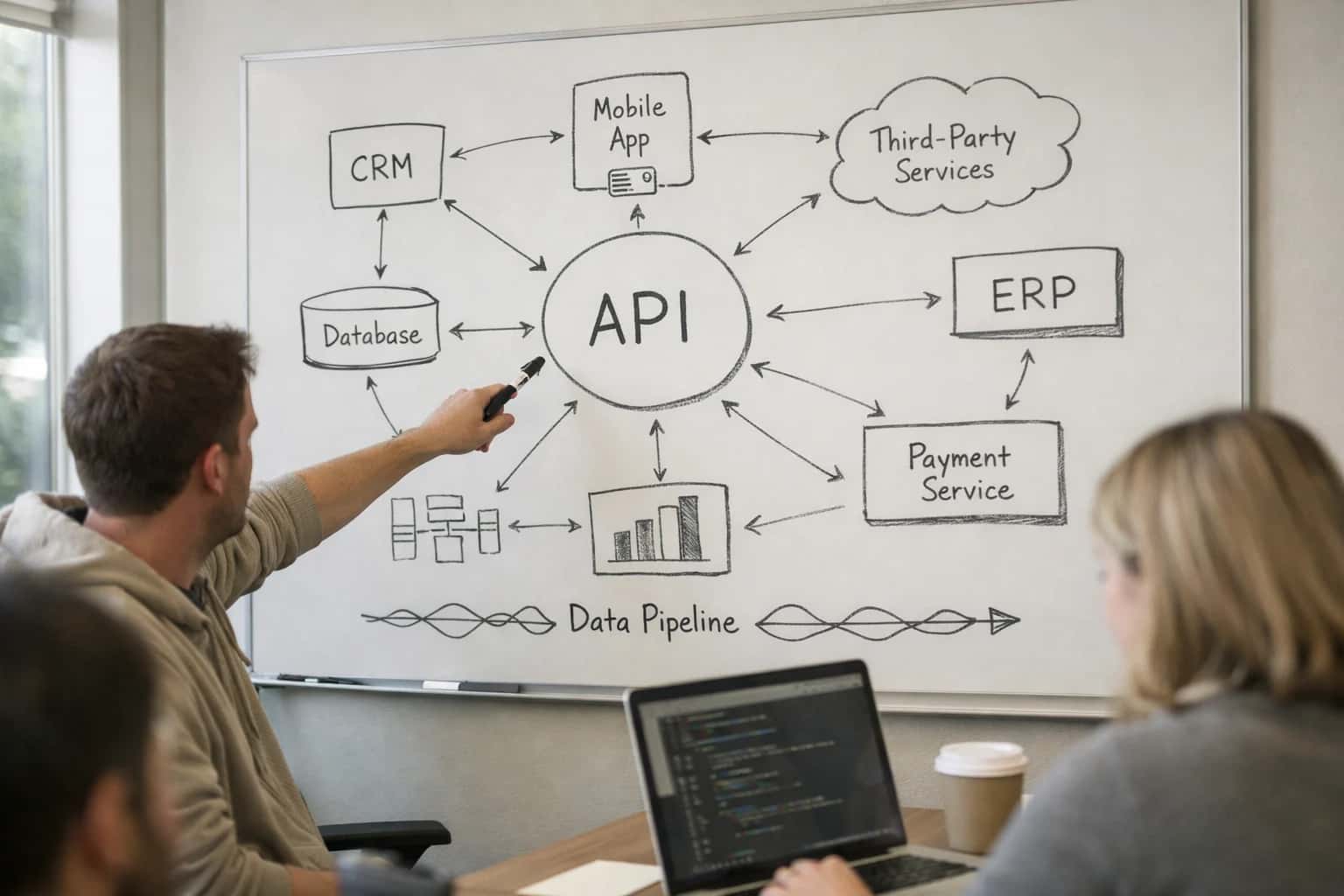
The integration architecture connects three core layers: the Salesforce Experience Cloud portal, your AI service layer (hosting agents and RAG), and Salesforce Field Service (FSL) data. Key integration points are the Experience Cloud site's Apex controllers and Lightning Web Components (LWCs) for the front-end, which call secure, authenticated APIs to your external AI service. This AI service, in turn, queries Salesforce via the Composite REST API or Bulk API to access FSL objects like WorkOrder, ServiceAppointment, Asset, and ServiceResource to ground responses in live customer data, service history, and technician schedules.
A typical diagnostic workflow begins when a customer describes an issue in the portal. The request is routed to an AI orchestration agent via a secure endpoint. This agent uses a RAG pipeline against a vector store populated with your company's knowledge base (manuals, troubleshooting guides, historical repair notes) and enriched with the customer's specific asset history from Salesforce. The agent can then generate a step-by-step self-resolution guide or, if a service visit is needed, initiate a workflow automation by creating a draft WorkOrder and ServiceAppointment in Salesforce via the API, presenting the customer with available time slots pulled from the ServiceResource and Scheduling Policy objects.
For governance and rollout, implement the AI layer as a separate, scalable service (e.g., using AWS Lambda or Azure Functions) to maintain isolation from the core CRM. Use Salesforce Platform Events or Outbound Message workflows to push real-time status updates (e.g., technician dispatch, ETA changes) back to the portal, keeping the customer loop closed. Critical for success is implementing a human-in-the-loop review for AI-generated recommendations before they create costly dispatches, and building robust audit trails by logging all AI interactions and decisions as custom AI_Interaction__c records in Salesforce for compliance and continuous model improvement.
IMPLEMENTATION PATTERNS
Code & Payload Examples
Embedding a Contextual AI Assistant
Integrate an AI chatbot directly into the Salesforce Experience Cloud portal to handle common customer inquiries. The agent uses RAG on your service knowledge base and the customer's specific asset history to provide accurate self-service.
Key integration points are the portal's Visualforce page or Lightning Web Component for the UI, and Salesforce Apex REST endpoints to securely fetch customer context (like WorkOrder, Asset, and Case records) for the AI session. The AI service calls back to update records, such as creating a new Case if the issue escalates.
javascript// Example payload from portal to your AI service { "portalSessionId": "a0x3h00000ABCDE", "contactId": "0033h00000XYZ789", "message": "My AC is making a buzzing noise. What could it be?", "context": { "recentWorkOrders": ["WO-001234", "WO-001198"], "primaryAssetId": "02i3h00000LMN456" } }
AI-POWERED CUSTOMER SELF-SERVICE
Realistic Time Savings & Operational Impact
How AI integration transforms key workflows within a Salesforce Experience Cloud portal for field service, reducing manual effort and improving customer satisfaction.
| Portal Workflow | Before AI | After AI | Implementation Notes |
|---|---|---|---|
Issue Diagnosis & Triage | Customer calls support; agent manually asks questions (~15-20 min) | AI chatbot guides customer through interactive diagnosis (~3-5 min) | RAG on service manuals & historical tickets; routes complex cases to human agent |
Service History Lookup | Customer emails request; agent searches Salesforce and replies (~10 min) | Customer queries portal chatbot for instant, summarized history (~1 min) | Securely surfaces related Work Orders, Assets, and Notes via API; enforces data visibility rules |
Accurate ETA Generation | Dispatcher manually estimates based on schedule and calls customer (~8-12 min) | AI analyzes live technician location, traffic, and job complexity for auto-ETA (~1 min) | Integrates with Salesforce Maps & Field Service Gantt; updates portal in real-time |
Appointment Scheduling/Rescheduling | Phone tag or email exchange to find mutual availability (~20-30 min) | AI assistant presents available slots and books directly in Salesforce (~2 min) | Respects technician skills, parts inventory, and SLA windows; sends calendar invites |
Post-Service Follow-up & Feedback | Manual email or call campaign days after job completion | AI triggers personalized check-in & feedback request via portal immediately post-job | Automates Net Promoter Score (NPS) collection; routes negative sentiment to account manager |
Simple Part Ordering & Status | Customer calls parts desk; agent checks inventory and creates sales order (~15 min) | Customer self-serves via portal with AI-guided catalog and real-time stock levels (~3 min) | Integrates with Inventory objects; creates Product Consumptions for technician van stock |
Document Retrieval (Manuals, Invoices) | Customer submits ticket; agent locates and emails PDF (~10-15 min) | AI-powered semantic search finds and serves relevant documents from portal (~1 min) | Indexes files from Salesforce Files, Content, and external DMS; enforces sharing settings |
Initial Implementation & Rollout | Custom portal dev: 3-6 months for basic features | AI integration phase: 4-8 weeks added to portal project | Leverages Experience Cloud APIs; focuses on high-impact workflows first; includes prompt tuning & testing |
ARCHITECTING FOR ENTERPRISE ADOPTION
Governance, Security, and Phased Rollout
A practical blueprint for deploying AI in a customer-facing portal with control, compliance, and clear ROI.
Integrating AI into a Salesforce Experience Cloud portal for field service requires a security-first architecture that respects customer data boundaries. This means implementing a governed API layer where AI agents act as a controlled intermediary between the portal and core systems like ServiceAppointment, WorkOrder, and Asset objects. All AI-generated responses—such as diagnostic suggestions or repair history summaries—should be grounded in the customer's own service data via a Retrieval-Augmented Generation (RAG) pattern, preventing hallucinations. Access is enforced through Salesforce's native sharing rules and permission sets, ensuring a customer using the portal can only retrieve information about their own assets and appointments. All AI interactions should be logged as FeedItem or custom audit objects, creating a transparent trail for compliance and continuous improvement.
A phased rollout is critical for managing risk and demonstrating value. Start with a contained pilot focusing on a single, high-volume use case, such as automated appointment rescheduling or visual part identification via uploaded photos. Deploy the AI features behind a feature flag in Experience Cloud, targeting a specific customer segment or service region. In this phase, implement a human-in-the-loop review where complex AI-generated actions (like creating a new WorkOrder) are presented as drafts for a dispatcher to approve via a Lightning component or Slack alert. Measure success through portal engagement metrics, deflection rates for common calls, and customer satisfaction scores (CSAT) from post-interaction surveys.
For enterprise-wide deployment, establish a centralized AI governance board comprising IT security, service operations, and legal stakeholders. This team oversees the prompt library, model versioning (e.g., switching from GPT-4 to a fine-tuned, internal model), and the expansion of AI capabilities to more sensitive workflows like warranty validation or estimate generation. The final architecture should include real-time monitoring and fallback procedures. If the AI service is unavailable or confidence scores are low, the portal should gracefully degrade to standard forms or a "request a callback" option, ensuring service continuity. This controlled, iterative approach de-risks the investment and builds organizational trust in AI as a reliable extension of your field service team.
Enabling Efficiency, Speed & Accuracy
Intelligent Analysis, Decision & Execution
We build AI systems for teams that need search across company data, workflow automation across tools, or AI features inside products and internal software.
Talk to Us
Search across company data
Give teams answers from docs, tickets, runbooks, and product data with sources and permissions.
Useful when people spend too long searching or get different answers from different systems.
Enterprise searchRAGPermissions
Read more
Automate internal workflows
Use AI to route work, draft outputs, trigger actions, and keep approvals and logs in place.
Useful when repetitive work moves across multiple tools and teams.
AI agentsWorkflow automationGovernance
Read more
Add AI to products and internal tools
Build assistants, guided actions, or decision support into the software your team or customers already use.
Useful when AI needs to be part of the product, not a separate tool.
AI integrationDecision supportModel routing
Read moreAI INTEGRATION FOR SALESFORCE FIELD SERVICE CUSTOMER PORTAL
FAQ: Technical & Commercial Considerations
Practical questions for teams evaluating AI-driven self-service for Salesforce Experience Cloud portals in field service.
A secure integration requires a layered approach, treating the AI as a privileged system user within your Salesforce org.
Primary Architecture:
- Service Account & Named Credential: Create a dedicated Salesforce integration user with a permission set granting read-only access to the specific objects needed (e.g.,
WorkOrder,Asset,ServiceAppointment,Case). Store its credentials in a Salesforce Named Credential for secure, server-to-server OAuth 2.0 flows. - Contextual Data Query: Your AI agent's backend (hosted on your infrastructure) uses this credential to query Salesforce via the SOAP or REST API. Queries should be scoped to the logged-in portal user's context using
WITH SECURITY_ENFORCEDand field-level security. - RAG Grounding: For knowledge retrieval (e.g., manuals, FAQs), implement a Retrieval-Augmented Generation (RAG) pipeline. Sync approved knowledge articles (
Knowledge__kav) or documents from Salesforce to a secure vector database (like Pinecone or Weaviate). The agent queries this indexed knowledge, not Salesforce directly, for generative responses.
Security Mandates:
- Zero PHI/PII in Prompts: Never pass raw customer names, addresses, or asset serial numbers into the LLM prompt. Use anonymized record IDs or hashed references.
- Audit Trail: Log all AI-generated responses and link them back to the portal user session and source records in Salesforce, using a custom
AI_Interaction__cobject. - Response Validation: Implement a lightweight post-generation check against a deny-list of terms or a secondary model to flag potentially incorrect or hallucinated information before display.

About the author
Prasad Kumkar
CEO & MD, Inference Systems
Prasad Kumkar is the CEO & MD of Inference Systems and writes about AI systems architecture, LLM infrastructure, model serving, evaluation, and production deployment. Over 5+ years, he has worked across computer vision models, L5 autonomous vehicle systems, and LLM research, with a focus on taking complex AI ideas into real-world engineering systems.
His work and writing cover AI systems, large language models, AI agents, multimodal systems, autonomous systems, inference optimization, RAG, evaluation, and production AI engineering.
LinkedIn
Limited slotsGet a Free AI Consultation
Partnered with leading AI, data, and software stack.





How We Work
Custom AI workflows for your Business
One-fit-all AI don't work for modern businesses. At Inferensys, we aim to understand your business & custom requirements; which we use to define most efficient agentic workflows, the data, and the tools for your business.
01
Review the use case
We understand the task, the users, and where AI can actually help.
Read more02
Pick the right approach
We define what needs search, automation, or product integration.
Read more03
Build the first useful version
We implement the part that proves the value first.
Read more04
Improve from there
We add the checks and visibility needed to keep it useful.
Read moreThe first call is a practical review of your use case and the right next step.
Talk to Us