AI integration connects directly to the core data objects and workflows within the VelocityEHS Training module. The primary surfaces are the Training Matrix, Employee Profile (with job roles, locations, and certifications), and Course Library. An AI agent acts on this data through VelocityEHS APIs to automate three high-value workflows: 1) Automated Assignment: Parsing new hire data or role changes to assign required curricula from the matrix, 2) Gap Analysis: Continuously comparing employee training records against the matrix and regulatory libraries to identify lapses or upcoming expirations, and 3) Content Routing: Tagging and retrieving relevant training materials (SDS briefings, procedure updates) based on an employee's specific hazards and tasks.

Integration
AI Integration with VelocityEHS Training Compliance
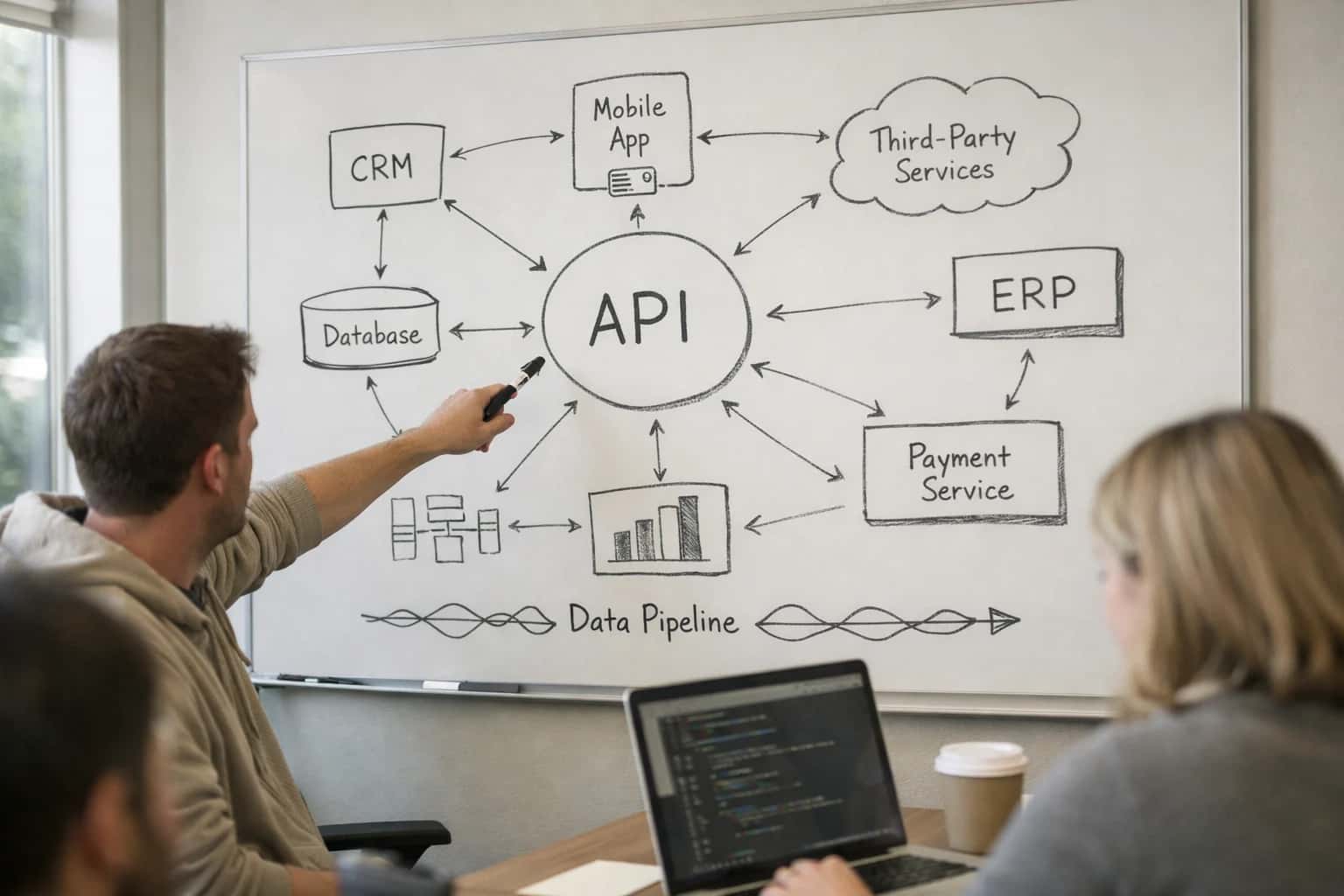
Where AI Fits into VelocityEHS Training Management
Integrating AI into VelocityEHS transforms static training matrices into dynamic, predictive systems that manage compliance and build competency.
A production implementation typically uses a middleware layer (like an event queue or webhook listener) that sits between VelocityEHS and the AI model. When a change event occurs in VelocityEHS—a new employee added, a job role updated, a training completed—it triggers the AI agent. The agent evaluates the event against the training rules, historical compliance data, and even external regulatory updates, then calls back into VelocityEHS via its REST API to create assignments, send notifications via the Action Tracking system, or update the Compliance Calendar. This keeps the system of record intact while adding intelligence to its operations. For governance, all AI-generated assignments and recommendations should be logged with an audit trail and, for critical roles, be routed through a manager approval step within the existing VelocityEHS workflow.
Rollout should be phased, starting with automated expiration alerts and renewal assignments—a low-risk, high-volume task that delivers immediate administrative relief. The next phase introduces predictive gap analysis, using AI to forecast skill shortages based on project pipelines or regulatory changes. The final phase enables personalized learning paths, where the AI suggests supplemental courses beyond core compliance to address individual or site-specific risk patterns. This staged approach de-risks the integration, allows for tuning of the AI's logic, and demonstrates tangible ROI at each step, from reducing manual tracking hours to improving audit readiness.
Key Integration Surfaces in VelocityEHS Training Module
Automating Role-Based Curriculum Assignment
The Training Matrix is the core object for mapping employees to required courses based on job role, location, department, and equipment. AI integration here automates assignment logic that would otherwise require manual rule maintenance.
Key AI Use Cases:
- Dynamic Assignment: Parse job descriptions, hazard assessments, and regulatory change logs to automatically add or remove training requirements from employee matrices.
- Gap Analysis: Continuously compare an employee's completed training against their matrix to generate personalized "to-do" lists and forecast organizational skill gaps.
- Prerequisite Checking: Ensure training dependencies (e.g.,
Hazard CommunicationbeforeChemical-Specific Training) are enforced during auto-assignment.
Integration typically occurs via the Training Management API to programmatically read and update matrix records, using AI to determine the delta between current state and required state.
High-Value AI Use Cases for Training Compliance
Transform static training matrices into dynamic, intelligent systems. These AI use cases automate the most manual and high-risk aspects of managing training compliance within VelocityEHS, ensuring the right people are trained on the right topics at the right time.
Automated Role-Based Curriculum Assignment
AI analyzes employee job codes, department, location, and asset exposure to automatically assign required training curricula from the VelocityEHS library. Eliminates manual matrix management and ensures new hires or transferred employees are immediately compliant.
Predictive Lapse & Renewal Forecasting
Continuously monitors training expiration dates against work schedules and trainer availability. AI predicts which employees are at risk of a lapse and proactively generates renewal assignments and schedules, preventing costly compliance gaps before they occur.
Competency Gap Analysis & Prescriptive Learning
Goes beyond completion tracking. AI correlates training records with incident, audit, and observation data to identify skill gaps contributing to real-world issues. Recommends and assigns specific micro-training or refresher courses to target those gaps.
Intelligent Training Content Tagging & Retrieval
Automatically ingests and tags new training materials (videos, docs, SCORM modules) with metadata on hazards, regulations, roles, and equipment. Enables semantic search for trainers and powers AI-driven content recommendations for personalized learning paths.
AI-Powered Training Effectiveness Reporting
Moves beyond completion rates. AI analyzes assessment scores, feedback, and post-training performance data to generate executive reports on training ROI. Identifies which courses are most effective and which need redesign, linking training investment to safety outcomes.
Contractor & Visitor Compliance Orchestration
Integrates with the VelocityEHS Contractor Management module. When a contractor is scheduled for site work, AI automatically checks their training credentials against site-specific requirements. Triggers automated workflows to assign missing training or escalate for approval before access is granted.
Example AI-Driven Training Workflows
These workflows demonstrate how AI agents integrate directly with VelocityEHS Training Compliance modules to automate manual processes, personalize learning paths, and proactively manage enterprise-wide skill gaps. Each flow is triggered by system events and executes actions via the VelocityEHS API.
Trigger: A new employee record is created in the integrated HRIS (e.g., Workday) or manually entered into VelocityEHS.
AI Agent Action:
- The agent calls the VelocityEHS API to retrieve the employee's job title, department, location, and any associated risk profiles.
- It cross-references this data against a configured Training Matrix Rules Engine (maintained in the AI system) that maps roles, sites, and hazards to required curricula.
- The agent generates a personalized training plan, considering:
- Mandatory corporate and site-specific inductions.
- Role-specific technical and safety procedures (e.g., forklift operation for warehouse roles, lab safety for R&D).
- Prerequisite sequencing for multi-module courses.
System Update: The agent uses the VelocityEHS API to: - Enroll the employee in the identified courses. - Set due dates based on hire date and policy (e.g., "complete within 30 days"). - Assign the curriculum to the employee's training profile.
Human Review Point: The hiring manager receives a notification with the auto-assigned plan for final approval or modification before assignments are locked.
Implementation Architecture: Data Flow & System Wiring
A production-ready integration connects AI agents to VelocityEHS's training data model, automates assignment logic, and surfaces skill gaps through governed workflows.
The integration architecture centers on the Training Management module's core objects: the Employee record, Training Curriculum, Training Matrix (defining role-based requirements), and Completion records. AI agents interact via VelocityEHS's REST API to read matrix rules, employee job codes, and completion history. A primary orchestration agent uses this data to execute a rules engine that identifies employees with lapsed, missing, or soon-to-expire training based on regulatory intervals and internal policy. For new hires or role changes, a separate provisioning agent analyzes the employee's assigned Job Title and Department against the matrix to generate a personalized curriculum assignment payload, which is posted back to the API to create pending training tasks in the user's queue.
High-impact workflows are automated through this wiring. For example, an AI-driven gap analysis agent runs nightly, querying all matrices against completion data. It generates a report of enterprise-wide skill deficiencies, clusters them by department or site, and posts summary findings to a dedicated Compliance Dashboard or triggers alerts in connected systems like Microsoft Teams via webhook. Another agent handles exception management: when a required course is unavailable or a regulatory change invalidates a current requirement, the agent suggests equivalent training, logs the justification in a custom AI_Override object with audit trails, and can initiate a manager approval workflow within VelocityEHS before updating the employee's record.
Rollout is phased, starting with a read-only observation phase where AI agents analyze data but do not write back, allowing validation of assignment logic against historical decisions. Governance is enforced through a prompt management layer that codifies business rules (e.g., "prioritize OSHA 30-hour for supervisors in construction divisions") and a human-in-the-loop approval step for the first 90 days on all auto-assignments. The system is designed to fail gracefully: if the AI service is unavailable, a fallback batch job uses the last known logic to maintain operations, ensuring training compliance workflows are never blocked. This architecture turns the static training matrix into a dynamic, self-optimizing system that reduces administrative workload from days to hours while providing auditable, data-driven insights into organizational competency.
Code & Payload Examples
Automated Curriculum Assignment
Trigger a training assignment when an employee's role changes or a new compliance requirement is identified. This API call uses the VelocityEHS API to create a training record, linking it to a specific curriculum based on the employee's job code and location.
pythonimport requests # Define the payload for auto-assigning training assignment_payload = { "employeeId": "EMP-2024-78910", "jobCode": "CHEM-PROCESS-OP", "siteId": "SITE-US-TX-01", "curriculumId": "CURR-HAZCOM-2024", "dueDate": "2024-12-31", # Calculated based on policy "assigner": "AI_Training_Agent", "metadata": { "trigger": "role_change", "ai_reasoning": "Role requires annual HAZCOM refresher per 29 CFR 1910.1200.", "priority": "high" } } # POST to VelocityEHS Training API response = requests.post( 'https://api.velocityehs.com/v1/training/assignments', json=assignment_payload, headers={'Authorization': 'Bearer YOUR_API_KEY'} ) if response.status_code == 201: print(f"Training assigned: {response.json()['assignmentId']}") else: print(f"Assignment failed: {response.text}")
This pattern automates what is typically a manual, error-prone process of matching job codes to required training matrices.
Realistic Time Savings & Operational Impact
How AI integration transforms manual, reactive training management into a proactive, data-driven competency assurance program within VelocityEHS.
| Workflow / Metric | Before AI | After AI | Impact & Notes |
|---|---|---|---|
Training Matrix Assignment | Manual review of job codes, locations, and regulatory lists (2-4 hours per role) | AI-driven role-to-curriculum mapping in minutes | Eliminates human error in assignment; ensures consistency across sites and job families. |
Gap Identification & Renewal Tracking | Monthly or quarterly spreadsheet audits to flag expiring certifications | Real-time dashboard with predictive alerts for lapses 30-60 days out | Shifts from reactive compliance chasing to proactive planning; prevents work stoppages. |
New Hire & Role Change Onboarding | Manual checklist review by HR/manager to assign required trainings | Automated training plan generation triggered by HRIS integration events | Reduces time-to-productivity for new employees; ensures compliance from day one. |
Audit Evidence Compilation | Manual gathering of completion certificates, rosters, and training records (days) | AI-curated evidence package auto-generated for selected employees/timeframe | Cuts audit preparation from days to hours; improves accuracy and reduces stress. |
Enterprise Skill Gap Analysis | Annual survey or manual correlation of training data to incident trends | Continuous analysis linking competency data to safety observations and incident root causes | Provides data-driven insights for training program investment; targets real operational risks. |
Regulatory Change Impact Assessment | Manual review of new regulations to determine affected roles and curricula | AI parses regulatory text, maps to existing training library, flags gaps | Reduces assessment time from weeks to days; ensures training content stays current. |
Training Content Discovery & Tagging | Manual keyword search in content library; inconsistent metadata | Semantic search and auto-tagging of modules based on learning objectives and hazards | Improves content reuse; helps managers quickly find relevant training for specific hazards. |
Governance, Security & Phased Rollout
A production-ready AI integration for VelocityEHS Training Compliance requires deliberate controls, data security, and a phased rollout to manage risk and demonstrate value.
Start with a sandbox and pilot group. We typically implement the AI integration first in a non-production VelocityEHS sandbox environment. The initial pilot focuses on a single, high-impact training curriculum (e.g., 'Lockout-Tagout for Maintenance Technicians') and a controlled user group. This allows us to validate the AI's assignment logic, test the API connections for Training Profiles and Employee Records, and gather feedback on the generated training plans and gap analyses without affecting live operations.
Governance is built into the data flow and prompts. All AI-generated outputs—like a suggested training matrix or a competency gap summary—are treated as recommendations. The system is configured to route these to a designated training administrator for review and approval within VelocityEHS before any automated assignments are made. The AI's reasoning is logged in an audit trail, linking the suggested action to the specific employee data points and business rules that triggered it. API calls between our secure inference layer and VelocityEHS use OAuth 2.0 and are scoped to the minimum necessary permissions for reading employee/job role data and creating training assignments.
Phased expansion follows a clear risk/value matrix. After a successful pilot, the rollout progresses by: 1) Expanding Curricula: Adding more complex, role-based curricula. 2) Expanding User Groups: Rolling out to additional departments or sites. 3) Activating Automation: Moving from administrator-approved suggestions to fully automated assignments for low-risk, high-volume training requirements. Each phase includes a review of accuracy rates, user feedback, and operational impact. This controlled approach builds organizational trust, ensures compliance, and allows you to scale the AI's responsibility in line with its proven performance.
Enabling Efficiency, Speed & Accuracy
Intelligent Analysis, Decision & Execution
We build AI systems for teams that need search across company data, workflow automation across tools, or AI features inside products and internal software.
Talk to Us
Search across company data
Give teams answers from docs, tickets, runbooks, and product data with sources and permissions.
Useful when people spend too long searching or get different answers from different systems.

Automate internal workflows
Use AI to route work, draft outputs, trigger actions, and keep approvals and logs in place.
Useful when repetitive work moves across multiple tools and teams.

Add AI to products and internal tools
Build assistants, guided actions, or decision support into the software your team or customers already use.
Useful when AI needs to be part of the product, not a separate tool.
Frequently Asked Questions
Common technical and operational questions about integrating AI agents and automation into VelocityEHS Training Compliance workflows.
This workflow uses AI to map job roles, locations, and risk profiles to required training, reducing manual assignment by administrators.
- Trigger: A new employee is added to the HRIS, a job role changes in VelocityEHS, or a new regulatory requirement is identified.
- Context Pulled: The AI agent queries the VelocityEHS API for the user's profile (job title, department, site) and cross-references the internal training matrix and compliance rules library.
- Agent Action: A rules-based LLM agent interprets the requirements. For example:
IF role = 'Lab Technician' AND site = 'CA Plant' THEN assign courses: [Chemical Safety (HAZCOM), Lab Standard, Site-Specific Emergency Procedures]. - System Update: The agent calls the VelocityEHS Training API to enroll the employee in the identified courses and sends a notification to the employee and their manager.
- Human Review Point: Supervisors receive a dashboard of all auto-assignments for the week with an option to override or add supplemental training based on local knowledge.

About the author
Prasad Kumkar
CEO & MD, Inference Systems
Prasad Kumkar is the CEO & MD of Inference Systems and writes about AI systems architecture, LLM infrastructure, model serving, evaluation, and production deployment. Over 5+ years, he has worked across computer vision models, L5 autonomous vehicle systems, and LLM research, with a focus on taking complex AI ideas into real-world engineering systems.
His work and writing cover AI systems, large language models, AI agents, multimodal systems, autonomous systems, inference optimization, RAG, evaluation, and production AI engineering.
Partnered with leading AI, data, and software stack.





How We Work
Custom AI workflows for your Business
One-fit-all AI don't work for modern businesses. At Inferensys, we aim to understand your business & custom requirements; which we use to define most efficient agentic workflows, the data, and the tools for your business.
01
Review the use case
We understand the task, the users, and where AI can actually help.
Read more02
Pick the right approach
We define what needs search, automation, or product integration.
Read more03
Build the first useful version
We implement the part that proves the value first.
Read more04
Improve from there
We add the checks and visibility needed to keep it useful.
Read moreThe first call is a practical review of your use case and the right next step.
Talk to Us