AI connects to VelocityEHS SDS Management primarily through its API layer and document upload workflows. The integration targets three core surfaces: 1) the SDS document repository, where AI parses uploaded PDFs; 2) the chemical inventory module, where extracted data auto-populates fields like CAS numbers, hazard classifications, and precautionary statements; and 3) the training and communications tools, where AI generates role-specific briefings and safe work instructions. This turns a static document library into a dynamic, queryable system of record for chemical safety.

Integration
AI Integration with VelocityEHS SDS Management
Automate the ingestion, parsing, and classification of Safety Data Sheets (SDS) within VelocityEHS using AI to extract hazard statements, populate chemical inventories, and generate compliance-ready briefings.
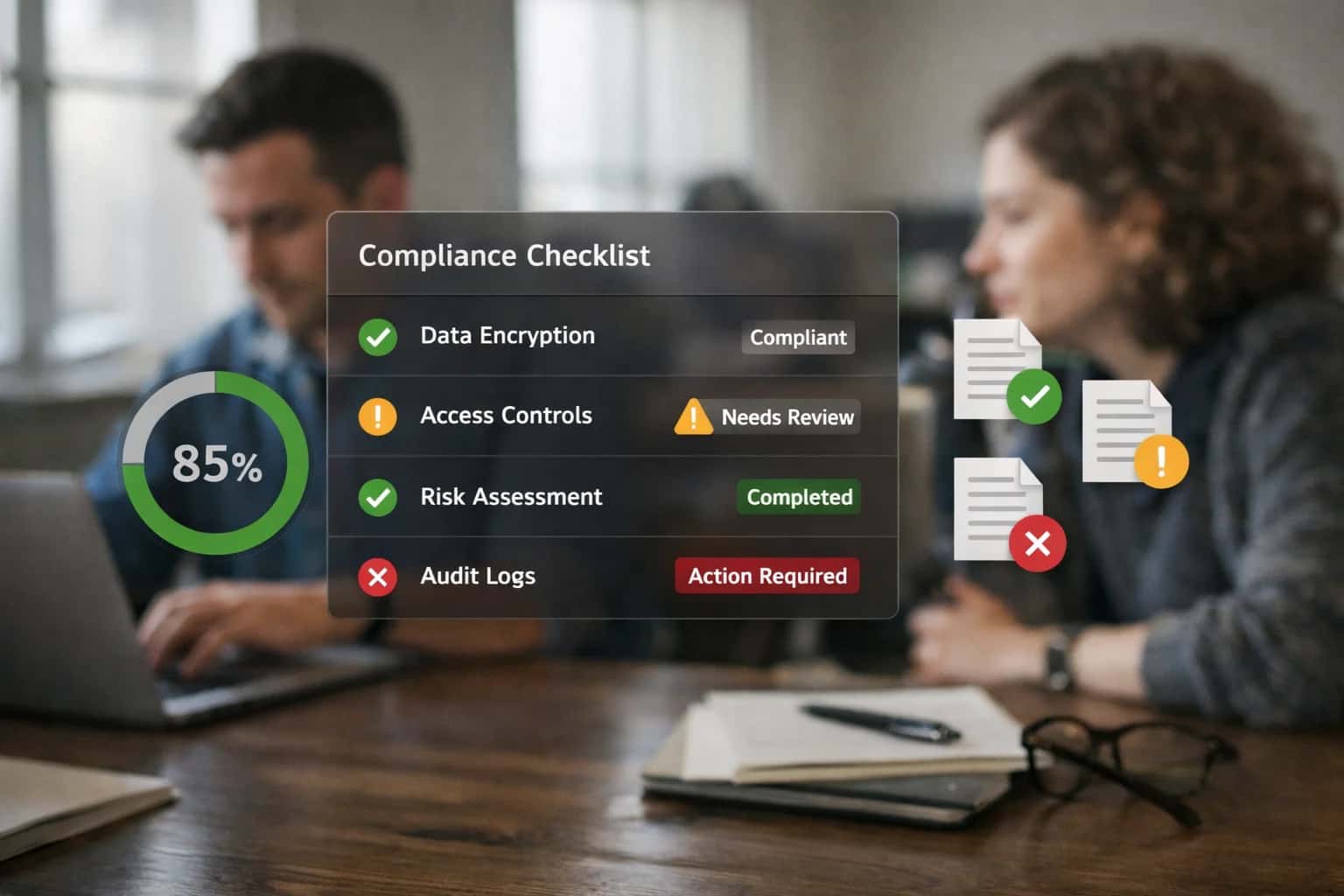
ARCHITECTURE AND IMPLEMENTATION
Where AI Fits into VelocityEHS SDS Management
Integrating AI into SDS management automates the extraction of critical hazard data, transforms chemical inventories into searchable knowledge bases, and accelerates safety communications.
A production implementation typically involves a secure pipeline: SDS uploads trigger a webhook to an AI processing service. Using a combination of vision models for document structure and specialized NLP for chemical nomenclature, the system extracts key data points (e.g., GHS pictograms, Section 8 exposure controls). This structured payload is posted back to VelocityEHS via API, updating the chemical record. For employee briefings, a RAG (Retrieval-Augmented Generation) pipeline queries the enriched inventory and SDS library to draft context-aware safety summaries, which can be routed for supervisor review before publication in VelocityEHS's communication channels.
Rollout and governance are critical. Start with a pilot for a specific site or chemical family. Implement a human-in-the-loop review step for all AI-extracted data before it updates the master inventory, ensuring accuracy. Audit trails should log the source (original SDS section) for every AI-populated field. This integration reduces the manual data entry burden from hours per SDS to minutes, improves the consistency of hazard communication, and ensures chemical safety information is actionable and immediately accessible for EHS teams and frontline workers. For related architectural patterns, see our guide on AI Integration for Cority Chemical Management.
AI-POWERED WORKFLOW AUTOMATION
Key Integration Surfaces in VelocityEHS SDS Management
Automating the First Mile of Chemical Data
The primary surface for AI integration is the SDS document ingestion pipeline. This involves intercepting uploaded PDFs—whether from vendors, internal scans, or regulatory sources—before they enter the main SDS library.
AI Workflow:
- Extract all text, tables, and hazard symbols from the unstructured PDF.
- Use a fine-tuned LLM or specialized model to identify and normalize key fields: product identifier, supplier details, hazard classifications (GHS), precautionary statements (P-, H- codes), and composition.
- Validate extracted data against regulatory lists (e.g., OSHA HazCom, REACH) and flag discrepancies for review.
This automation populates the VelocityEHS chemical inventory with structured, searchable data, eliminating hours of manual entry per sheet and reducing transcription errors.
VELOCITYEHS INTEGRATION
High-Value AI Use Cases for SDS Management
Transform manual, error-prone Safety Data Sheet workflows into automated, intelligent processes. These AI-powered patterns connect directly to VelocityEHS modules to extract critical data, populate inventories, and generate actionable outputs.
01
Automated SDS Ingestion & Data Extraction
AI parses uploaded SDS PDFs to extract key fields—chemical names, CAS numbers, hazard classifications, and precautionary statements—directly into the VelocityEHS chemical inventory. This eliminates manual data entry, reduces errors, and ensures inventory accuracy for compliance audits.
Hours -> Minutes
Per SDS
02
Intelligent Hazard Communication Briefings
Generates role-specific employee safety briefings and right-to-know sheets by synthesizing extracted hazard data, recommended PPE, and first-aid measures. Briefings are auto-formatted and can be pushed to the VelocityEHS training module for assignment and tracking.
Same day
Briefing generation
03
Chemical Risk Summarization & Prioritization
AI analyzes the aggregated SDS data across the inventory to create a unified risk profile. It flags high-hazard chemicals, identifies usage locations, and suggests control measures, populating the VelocityEHS risk register for proactive management.
Batch -> Real-time
Risk visibility
04
Automated Tier II / Form R Reporting Prep
Dramatically accelerates mandatory regulatory reporting (e.g., EPA Tier II, Form R). AI validates inventory thresholds, applies correct reporting codes, and auto-populates report drafts within VelocityEHS, ready for final review and submission.
1 sprint
Report preparation
05
Spill Response & Emergency Action Plan Integration
Links extracted chemical data to VelocityEHS emergency response modules. AI auto-generates chemical-specific spill response checklists (including PPE, containment, cleanup) and updates emergency action plans, ensuring responders have instant, accurate guidance.
06
Supplier SDS Compliance Monitoring
Monitors the SDS library for gaps and expirations. AI identifies missing SDSs for purchased chemicals, flags outdated documents, and can auto-generate requests to suppliers via integrated workflows, maintaining a continuously compliant SDS repository.
SDS MANAGEMENT AUTOMATION
Example AI-Augmented Workflows
These workflows illustrate how AI integrates directly into VelocityEHS SDS Management to automate manual data entry, enhance chemical risk understanding, and ensure compliance data is actionable and up-to-date.
Trigger: A new Safety Data Sheet (PDF or scanned image) is uploaded to the VelocityEHS SDS Management module via its API, a vendor portal integration, or a user upload.
AI Action:
- The document is routed to an AI processing pipeline.
- A vision/OCR model extracts all text, tables, and pictograms.
- A fine-tuned LLM or specialized NLP model identifies and classifies key fields:
- Product/Manufacturer Details: Product name, manufacturer, CAS numbers.
- Hazard Classification: GHS hazard statements (H-codes), signal words, hazard pictograms.
- Precautionary Statements: Precautions (P-codes), first-aid measures, fire-fighting measures.
- Exposure Controls/PPE: Recommended personal protective equipment, occupational exposure limits.
- The model outputs a structured JSON payload.
System Update: The payload is posted back to the VelocityEHS API, auto-populating the corresponding chemical inventory record. The original SDS is attached, and the AI-extracted fields are tagged for easy audit and verification.
Human Review Point: A designated EHS specialist receives a notification to review the AI-populated record. The interface highlights extracted fields for quick validation, allowing them to approve, correct, or flag for deeper review.
FROM SDS UPLOAD TO ACTIONABLE INVENTORY
Implementation Architecture & Data Flow
A production-ready AI integration for VelocityEHS SDS Management connects document ingestion, AI extraction, and system-of-record updates into a single automated workflow.
The integration is triggered when a new Safety Data Sheet (SDS) PDF is uploaded to the VelocityEHS document repository or arrives via a vendor portal. An event-driven webhook or a scheduled batch job sends the document to a secure AI processing pipeline. Here, a vision-language model (VLM) performs layout-aware extraction, identifying key sections like Section 2 (Hazard Identification), Section 4 (First-Aid Measures), and Section 7 (Handling and Storage). The AI doesn't just perform OCR; it understands the structured format of an SDS to pull out specific hazard statements (H-codes), precautionary statements (P-codes), signal words, and chemical identifiers (CAS numbers).
Extracted data is validated against a rules engine (e.g., checking for mandatory fields) and formatted into a payload that maps directly to VelocityEHS's Chemical Inventory and SDS Library data models. The system then uses the VelocityEHS API to create or update the chemical record, populating fields for Product Identifier, Hazard Classification, Storage Requirements, and PPE Recommendations. For high-hazard chemicals, the workflow can automatically generate a draft Employee Briefing document in the associated training module, flagging it for review by the site EHS manager. All AI actions and data mutations are logged with a full audit trail, linking the original SDS, the AI-extracted JSON, and the final system record.
Rollout is typically phased, starting with a human-in-the-loop review stage where AI suggestions are presented in a side-panel for a technician to approve or correct before system update. This builds confidence and improves the model. Governance is critical: the AI's confidence scores for each extracted field determine whether an item is auto-populated or flagged for manual review. Over time, the system learns from corrections, reducing the review burden. This architecture ensures data flows from unstructured document to structured, actionable inventory in hours instead of days, while maintaining the data integrity and compliance rigor required for chemical management.
IMPLEMENTATION PATTERNS
Code & Payload Examples
Ingesting and Parsing SDS PDFs
The first step is to extract structured hazard data from unstructured Safety Data Sheet PDFs. This typically involves a multi-stage pipeline: document upload, OCR for scanned sheets, and LLM extraction of key fields. The extracted data is then mapped to the VelocityEHS chemical inventory schema.
Example Python workflow for batch ingestion:
python# Pseudocode for SDS processing pipeline from inference_systems import DocumentProcessor, LLMExtractor # 1. Upload SDS to secure storage sds_pdf = upload_to_blob("sds_bucket", file_path) # 2. Extract text (with OCR fallback) text_content = extract_text(sds_pdf, use_ocr=True) # 3. LLM extraction with structured schema extraction_prompt = """Extract from the SDS: chemical name, CAS number, hazard statements (H-codes), precautionary statements (P-codes), signal word, pictograms. Return as JSON.""" structured_data = LLMExtractor.call( model="gpt-4o", prompt=extraction_prompt, document_text=text_content ) # 4. Validate and prepare for VelocityEHS API chemical_payload = { "chemicalName": structured_data["chemical_name"], "casNumber": structured_data["cas_number"], "hazardStatements": structured_data["hazard_statements"], # Array "ghsClassification": map_to_ghs(structured_data["pictograms"]) }
This payload is then posted to the VelocityEHS Chemical Inventory API to create or update records.
AI-POWERED SDS MANAGEMENT
Realistic Time Savings & Operational Impact
This table illustrates the operational impact of integrating AI into VelocityEHS SDS workflows, focusing on realistic time savings and process improvements for EHS teams.
| Metric | Before AI | After AI | Notes |
|---|---|---|---|
SDS Ingestion & Key Data Extraction | Manual review (15-30 min per SDS) | Automated extraction (2-5 min per SDS) | AI parses PDFs for hazards, PPE, first aid; human validation of high-risk entries. |
Chemical Inventory Population | Manual data entry from SDS to inventory | Auto-population of inventory fields | Reduces errors and ensures SDS data syncs directly to the chemical register. |
Employee Briefing / Right-to-Know Sheet Generation | Manual drafting for each chemical or process | Automated draft generation from SDS data | Creates consistent, regulation-aware drafts for review by the site safety officer. |
Hazard Communication (HazCom) Audit Preparation | Manual compilation of SDS binders and labels | Automated gap reports and label data export | AI identifies missing SDSs, expired documents, and inconsistencies for proactive resolution. |
Regulatory Change Impact Assessment | Manual review of updates against SDS library | Flagged SDSs requiring review based on regulatory text | AI cross-references chemical inventories with regulatory updates (e.g., OSHA, GHS revisions). |
Emergency Response Plan Reference Updates | Manual search for relevant SDSs during plan reviews | AI-suggested SDS links based on plan content and site inventory | Ensures response plans reference the most current SDS data for critical chemicals. |
Supplier SDS Request & Follow-up | Manual email tracking and reminder cycles | Automated request workflows with status tracking | AI can draft initial requests and escalate based on configured SLAs, reducing admin chase time. |
IMPLEMENTING AI IN A REGULATED ENVIRONMENT
Governance, Security & Phased Rollout
A secure, governed approach to deploying AI for SDS management within VelocityEHS.
Integrating AI into your VelocityEHS SDS Management module requires a security-first architecture that respects the sensitivity of chemical data and regulatory obligations. Our implementations typically use a secure API gateway to broker calls between VelocityEHS and the AI service, ensuring all data in transit is encrypted and access is controlled via service principals with least-privilege permissions. Extracted hazard statements and chemical properties are written back to specific SDS record fields or related Chemical Inventory objects via VelocityEHS's APIs, maintaining a full audit trail of all AI-generated data modifications for compliance reviews.
We recommend a phased rollout to manage risk and build organizational trust. Phase 1 often starts with a pilot on a controlled subset of SDS documents (e.g., new vendor submissions) where AI performs extraction but a human reviewer validates every output before data is committed. Phase 2 introduces confidence scoring; only high-confidence extractions auto-populate fields, while low-confidence results are routed to a review queue. Phase 3 expands to bulk historical SDS processing and integrates AI-generated briefings into the Training Management module, with governance rules ensuring briefings are flagged for supervisor approval before dissemination to employees.
Governance is embedded in the workflow. You can configure rules to prevent AI from overwriting manually entered data, set field-level edit permissions, and use VelocityEHS's native reporting to monitor AI-assisted processing volumes and accuracy rates over time. This controlled, incremental approach de-risks the integration, aligns with EHS management system principles, and delivers measurable value at each step—from reducing manual data entry to accelerating employee access to critical safety information.
Enabling Efficiency, Speed & Accuracy
Intelligent Analysis, Decision & Execution
We build AI systems for teams that need search across company data, workflow automation across tools, or AI features inside products and internal software.
Talk to Us
Search across company data
Give teams answers from docs, tickets, runbooks, and product data with sources and permissions.
Useful when people spend too long searching or get different answers from different systems.
Enterprise searchRAGPermissions
Read more
Automate internal workflows
Use AI to route work, draft outputs, trigger actions, and keep approvals and logs in place.
Useful when repetitive work moves across multiple tools and teams.
AI agentsWorkflow automationGovernance
Read more
Add AI to products and internal tools
Build assistants, guided actions, or decision support into the software your team or customers already use.
Useful when AI needs to be part of the product, not a separate tool.
AI integrationDecision supportModel routing
Read moreIMPLEMENTATION DETAILS
Frequently Asked Questions
Common technical and operational questions about integrating AI agents and RAG workflows into VelocityEHS SDS Management to automate chemical data extraction, inventory updates, and safety communications.
The integration uses a multi-step RAG (Retrieval-Augmented Generation) pipeline to process SDS documents within VelocityEHS.
- Trigger & Ingestion: A new SDS PDF is uploaded to a designated VelocityEHS library or via the chemical inventory module. A webhook or scheduled job triggers the AI workflow.
- Document Parsing: The PDF is processed using a vision-capable model or specialized parser to extract raw text, tables, and hazard symbols from all 16 sections.
- Structured Chunking: The text is intelligently chunked by SDS section (e.g., Section 2: Hazards Identification, Section 4: First-Aid Measures). Each chunk is embedded and stored in a vector database (like Pinecone or Weaviate) linked to the chemical record.
- Agentic Query & Extraction: A configured AI agent uses pre-built prompts to query the vector store. For example:
python
# Example prompt for hazard extraction system_prompt = "Extract all hazard statements (H-codes) and precautionary statements (P-codes) from Section 2 of the SDS. Return as a structured JSON." - Validation & Mapping: Extracted data (e.g., CAS number, hazard classifications, PPE requirements) is mapped to the corresponding fields in the VelocityEHS chemical inventory object via its REST API.
- Human-in-the-Loop (Optional): For low-confidence extractions or critical fields, the system can flag the record for a quick review by an EHS specialist within the VelocityEHS UI before final population.

About the author
Prasad Kumkar
CEO & MD, Inference Systems
Prasad Kumkar is the CEO & MD of Inference Systems and writes about AI systems architecture, LLM infrastructure, model serving, evaluation, and production deployment. Over 5+ years, he has worked across computer vision models, L5 autonomous vehicle systems, and LLM research, with a focus on taking complex AI ideas into real-world engineering systems.
His work and writing cover AI systems, large language models, AI agents, multimodal systems, autonomous systems, inference optimization, RAG, evaluation, and production AI engineering.
LinkedIn
Limited slotsGet a Free AI Consultation
Partnered with leading AI, data, and software stack.





How We Work
Custom AI workflows for your Business
One-fit-all AI don't work for modern businesses. At Inferensys, we aim to understand your business & custom requirements; which we use to define most efficient agentic workflows, the data, and the tools for your business.
01
Review the use case
We understand the task, the users, and where AI can actually help.
Read more02
Pick the right approach
We define what needs search, automation, or product integration.
Read more03
Build the first useful version
We implement the part that proves the value first.
Read more04
Improve from there
We add the checks and visibility needed to keep it useful.
Read moreThe first call is a practical review of your use case and the right next step.
Talk to Us