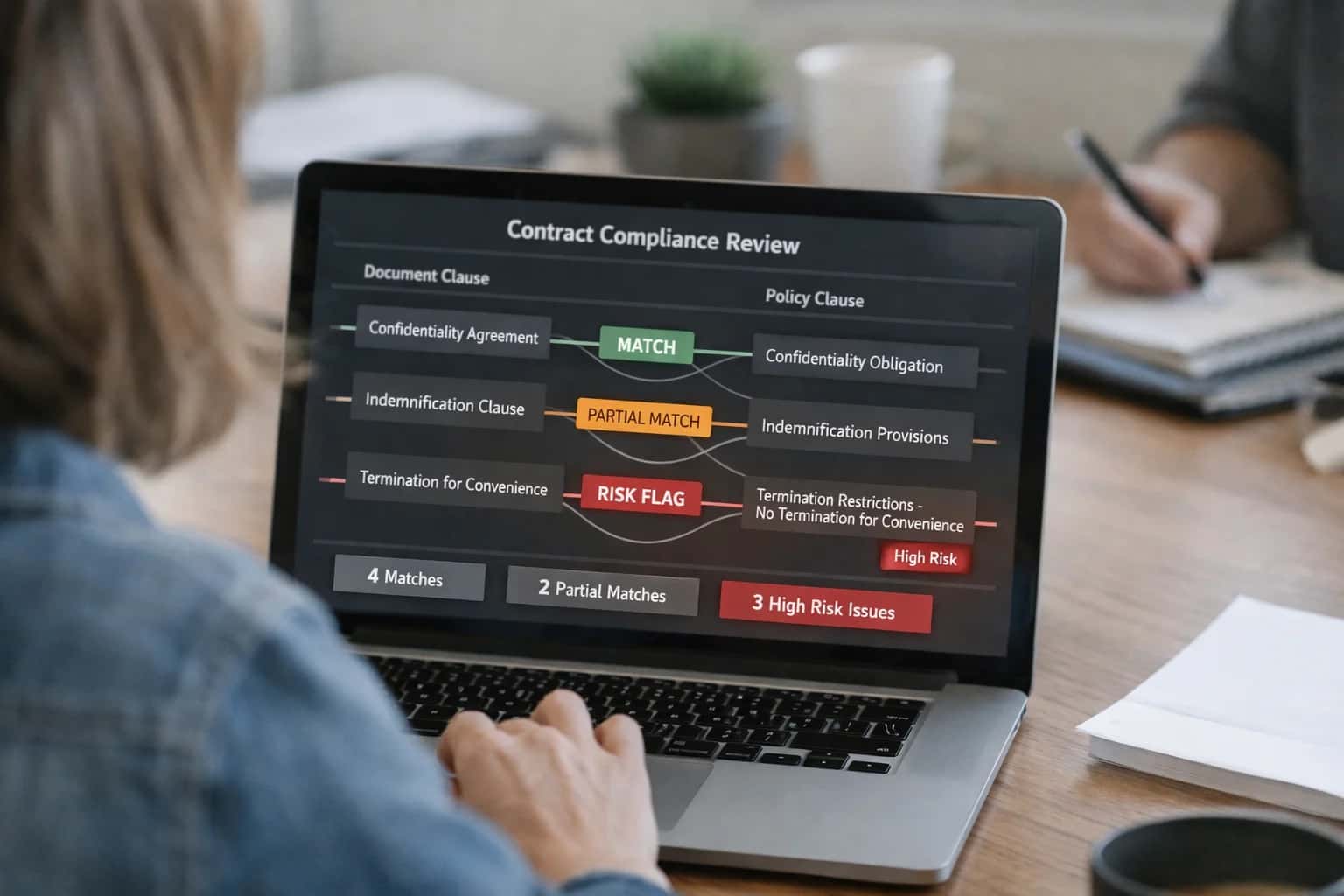
AI integration for Cority contractor compliance targets three primary surfaces: the Contractor Onboarding module for initial qualification, the Compliance Tracking objects for ongoing verification, and the Incident Management system for real-time performance monitoring. The integration typically connects via Cority's REST API to inject AI-generated summaries, risk scores, and automated checks into contractor records, qualification workflows, and site access approvals. For example, an AI agent can be triggered upon a new contractor submission to automatically ingest and summarize their safety statistics, insurance certificates, and past audit reports—populating key fields and flagging potential gaps for human review.

Integration
AI Integration for Cority Contractor Compliance
Add AI to Cority's contractor management workflows to automate onboarding verification, monitor safety performance, and reduce manual review by 60-80%.
ARCHITECTURE AND ROLLOUT
Where AI Fits in Cority Contractor Management
A practical guide to integrating AI into Cority's contractor management workflows for onboarding, verification, and performance monitoring.
In production, this is implemented as a secure middleware layer that sits between Cority and your chosen LLM (e.g., OpenAI, Anthropic). When a contractor record is created or updated, a webhook fires to a queue. An orchestration agent retrieves the record, calls external APIs (e.g., ISNetworld, Avetta) for verification data, uses an LLM to analyze narrative fields in past incident reports, and generates a consolidated risk profile. This profile is written back to a custom object in Cority, and a business rule can update the contractor's status (e.g., PENDING_REVIEW, APPROVED, HIGH_RISK). Key governance controls include audit logging of all AI actions, a human-in-the-loop approval step for high-risk classifications, and regular drift checks on the LLM's scoring consistency against historical contractor performance data.
Rollout should be phased, starting with AI-assisted document verification to reduce manual data entry during onboarding, then expanding to predictive risk scoring based on real-time site incident rates. The final phase often involves automatic alerting to site managers when a contractor's live performance metrics (like near-miss reports or safety observation trends) deviate from their approved profile. This approach turns Cority from a static repository into a dynamic, intelligence-driven system for contractor governance, helping safety officers move from periodic audits to continuous, data-informed oversight. For related architectural patterns, see our guides on AI Integration for Cority Incident Management and AI Integration with VelocityEHS Contractor Management.
CONTRACTOR COMPLIANCE
Cority Modules and Touchpoints for AI Integration
Automating Contractor Pre-Qualification
AI can integrate with Cority's Contractor Management and Vendor Qualification modules to automate the initial screening and risk assessment of new contractors. The workflow typically involves:
- Document Intelligence: An AI agent ingests contractor-submitted documents (insurance certificates, safety statistics, training records) via Cority's document management APIs. It extracts key data points like policy limits, EMR rates, and expiration dates.
- Risk Scoring: Using extracted data and historical performance from similar contractors in Cority, the AI generates a dynamic risk score. This score can auto-populate fields in the contractor record and trigger specific qualification workflows (e.g., "High Risk" flags for manual review).
- Automated Follow-ups: For incomplete submissions or nearing expirations, AI can orchestrate automated email or system alert workflows via Cority's notification engine, pulling from the
ContractorandCompliance Taskobjects.
This reduces manual data entry and review from days to hours, ensuring only vetted contractors proceed to site-specific onboarding.
CORITY INTEGRATION PATTERNS
High-Value AI Use Cases for Contractor Compliance
Integrating AI into Cority's Contractor Management modules automates the manual, high-volume tasks of onboarding, monitoring, and compliance verification, shifting focus from data collection to risk mitigation and performance oversight.
01
Automated Contractor Onboarding & Prequalification
AI agents ingest contractor-submitted documents (insurance certificates, safety stats, training records) via Cority's portal or email. NLP extracts key dates, coverage limits, and EMR rates, auto-populating the contractor profile and flagging discrepancies or expirations for review. This turns a multi-day manual review into a same-day qualification process.
Days -> Hours
Onboarding cycle
02
Real-Time Site Access & Badge Compliance
Integrate AI with Cority's site access logs and training records. An AI workflow cross-references a contractor's scheduled work with their current site-specific training, medical fitness, and permit requirements. It automatically approves badge requests or blocks access, notifying the contractor and site supervisor of missing prerequisites before they arrive at the gate.
Pre-emptive
Compliance check
03
Dynamic Risk Scoring & Tiered Oversight
An AI model continuously scores contractor risk by analyzing Cority data: incident rates (TRIR, DART), inspection findings, CAPA closure rates, and near-miss reports. High-risk contractors are automatically flagged for increased audit frequency and require manual approval for high-hazard work, enabling a risk-based oversight model.
Proactive
Risk management
04
Automated Post-Incident Contractor Analysis
When an incident involving a contractor is logged in Cority, an AI agent immediately triggers. It analyzes the contractor's historical performance data, similar past incidents, and crew composition to draft a preliminary causal analysis. It also checks for pattern violations across sites, accelerating the investigation and supporting data-driven decisions about contractor suspension or retraining.
Accelerated
Investigation start
05
Intelligent Audit & Inspection Scheduling
Move beyond calendar-based audits. AI analyzes Cority data—contractor risk score, work volume, past audit findings, and upcoming project criticality—to generate an optimized, dynamic audit schedule. It assigns the appropriate audit checklist and recommends auditors based on contractor trade and past performance, maximizing oversight efficiency.
Optimized
Resource allocation
06
Contractor Performance & Bidder Pre-Screening
For procurement and bidding workflows, an AI agent synthesizes a contractor's entire Cority history into a concise performance summary. It highlights safety trends, compliance adherence, and key strengths/weaknesses. This summary can be automatically attached to RFPs or bid packages within integrated systems like SAP Ariba or Coupa, ensuring safety is a quantified factor in sourcing decisions.
Data-Driven
Sourcing input
CORITY CONTRACTOR COMPLIANCE
Example AI-Automated Workflows
These workflows illustrate how AI agents and automations connect directly to Cority's contractor management modules, turning manual checks into real-time, data-driven processes. Each flow is triggered by a system event and results in an update to contractor records, tasks, or dashboards.
Trigger: A new contractor is added to the Cority vendor master list or a contractor requests access to a site via a portal.
AI Agent Actions:
- Data Aggregation: The agent calls external APIs (e.g., ISNetworld, Avetta, Veriforce) and internal systems to pull the contractor's safety statistics (TRIR, EMR), insurance certificates, and training certifications.
- Compliance Scoring: Using predefined rules and LLM analysis of certificate wording, the agent calculates a real-time risk score. It flags expired documents, insufficient coverage limits, or poor historical performance.
- System Update: The agent writes the score, a summary of findings, and the verification status directly to the contractor's profile in Cority. It automatically:
- Approves low-risk contractors and triggers site-access workflows.
- Creates a Corrective Action task in Cority for medium-risk contractors, requesting specific documents.
- Escalates high-risk contractors to the EHS manager for review, populating a review queue with the agent's analysis.
Human Review Point: Final approval for high-risk contractors and any exceptions to automated rules.
CONTRACTOR ONBOARDING AND MONITORING
Implementation Architecture: Data Flow and Guardrails
A production-ready AI integration for Cority Contractor Management connects to core data objects, orchestrates verification workflows, and enforces safety governance.
The integration architecture centers on Cority's Contractor Management module, specifically the Contractor and Contractor Project objects. An AI agent, triggered via a webhook upon record creation or update, orchestrates a multi-step verification workflow. It first extracts key fields—company name, insurance certificate IDs, OSHA 300A log data, and project scope—and calls external APIs (e.g., ISNetworld, Veriforce, direct insurer portals) to validate credentials and pull safety performance metrics like Total Recordable Incident Rate (TRIR) and Experience Modification Rate (EMR). The agent then analyzes this data against your site's predefined safety thresholds, automatically populating a Contractor Risk Score field and flagging high-risk contractors for manual review.
For ongoing monitoring, the system establishes a real-time data pipeline. It ingests daily feeds of site access logs, work order completions, and new incident reports from integrated systems. An AI model continuously analyzes this data, correlating contractor activity with safety events. If a contractor's site-specific incident rate spikes or a near-miss is reported, the agent automatically triggers a Management of Change (MOC) workflow within Cority, notifying the site EHS manager and potentially suspending the contractor's access badge until a review is complete. All AI-generated scores, flags, and recommendations are written back to auditable custom fields in Cority, maintaining a full lineage for compliance audits.
Governance is baked into the workflow. Before any automated action (like flagging a contractor as 'non-compliant'), the system routes the recommendation through a configurable approval step, which can be based on role (e.g., Project Manager) or risk level. All AI interactions are logged in a separate Audit Trail object, capturing the source data, the model's reasoning, and the human-in-the-loop decision. This ensures accountability and allows for continuous model refinement based on override patterns. The rollout is typically phased, starting with AI-assisted verification for new contractor onboarding before expanding to real-time performance monitoring for active projects.
AI INTEGRATION FOR CONTRACTOR COMPLIANCE
Code and Payload Examples
Automating Contractor Pre-Qualification
This workflow uses AI to analyze contractor-submitted documents (safety statistics, insurance certificates, training records) against your Cority compliance rules. The AI extracts key data, verifies validity, and flags discrepancies for human review before the contractor record is created or updated in Cority's Contractor Management module.
Example JSON Payload for AI Analysis Request:
json{ "workflow": "contractor_pre_qualification", "contractor_name": "ABC Construction Inc.", "documents": [ { "type": "insurance_certificate", "url": "https://storage.example.com/certs/abc-insurance-2024.pdf", "metadata": { "upload_date": "2024-05-15", "uploaded_by": "procurement_user_123" } }, { "type": "safety_statistics", "url": "https://storage.example.com/stats/abc-osha-300a-2023.pdf", "metadata": { "year": "2023", "upload_source": "vendor_portal" } } ], "compliance_ruleset_id": "cority_rule_std_na_2024q2", "callback_url": "https://your-app.example.com/api/cority/contractor/onboarding/callback" }
The AI service returns a structured assessment, which your integration layer uses to auto-populate fields in Cority's contractor object and trigger approval workflows.
AI-ASSISTED CONTRACTOR MANAGEMENT
Realistic Time Savings and Business Impact
How AI integration transforms manual, reactive contractor compliance workflows into proactive, data-driven operations within Cority.
| Workflow / Metric | Before AI (Manual Process) | After AI (Assisted Process) | Implementation Notes |
|---|---|---|---|
Contractor Pre-Qualification Review | 2-4 hours per contractor for document collection and manual verification | 30-45 minutes with AI-assisted document extraction and scoring | AI extracts key data from insurance certificates and safety stats; human reviews flagged exceptions |
Safety Performance Monitoring | Monthly manual report compilation from disparate sources | Real-time dashboard with automated anomaly alerts | AI continuously ingests incident data from contractor sites and Cority records to calculate dynamic rates |
Site-Specific Orientation & Training | Generic, one-size-fits-all packet for all site entrants | Personalized briefing generated from site hazards and contractor's work scope | AI cross-references contractor trade, site risk assessments, and permit requirements |
Compliance Document Renewal Tracking | Spreadsheet reminders; often reactive after expiration | Proactive 30/60/90-day alerts with auto-generated renewal request drafts | AI parses document expiry dates and triggers Cority workflow tasks for vendor managers |
Incident Investigation Support (Contractor-Related) | Manual correlation of contractor history with incident details | Automated contractor profile summary appended to incident report | Upon incident log, AI instantly retrieves contractor's past performance, training, and permits for investigator context |
Audit Evidence Preparation | Days of manual gathering and organizing contractor files for external audits | Hours with AI-generated compliance packet per contractor or site | AI queries Cority for all contractor-related records, compliance status, and training completions for a defined audit period |
Annual Contractor Performance Review | Subjective scoring based on limited recent memory or major events | Data-driven scorecard with trends on safety, responsiveness, and compliance | AI aggregates yearly metrics, analyzes trends, and drafts narrative summaries for vendor management review |
ENSURING CONTROLLED DEPLOYMENT FOR CONTRACTOR SAFETY
Governance, Security, and Phased Rollout
A practical guide to implementing AI for contractor compliance in Cority with a focus on risk management, data security, and incremental value delivery.
A production AI integration for Cority Contractor Compliance must be architected with strict data governance from the start. This means defining clear access controls at the contractor, project, and site levels within Cority's data model, ensuring AI agents and workflows only interact with records for which they are authorized. All AI-generated outputs—such as risk scores, verification summaries, or performance alerts—should be written back to dedicated, auditable custom objects or notes fields, creating a transparent lineage from source data (e.g., contractor-submitted insurance certificates, past incident logs from the Cority Incident module) to AI-assisted decision. API calls to external LLMs for document analysis or statistical modeling should be logged, with sensitive contractor PII or proprietary safety data anonymized or redacted before processing.
A phased rollout is critical for adoption and risk mitigation. Start with a pilot focused on automated document verification, using AI to extract and validate key fields from contractor-submitted safety statistics and certificates of insurance against predefined rules. This delivers immediate value by reducing manual review from hours to minutes for each new contractor onboarding. Phase two introduces real-time performance monitoring, where the AI system correlates live data—such as new incidents logged in Cority involving the contractor or findings from site inspections—with the contractor's profile to generate proactive risk alerts for EHS managers. The final phase integrates predictive analytics, using historical contractor performance data across projects to model and flag high-risk contractors before mobilization, enabling preemptive interventions.
Security is paramount when integrating external AI models with sensitive EHS data. Implement a secure proxy layer that handles all communication between Cority and AI services, enforcing encryption, rate limiting, and payload validation. For workflows involving document analysis, consider a hybrid approach where initial processing is done by a hosted LLM, but any final decisions or classifications are routed through a rules engine or require human-in-the-loop approval within the Cority workflow. This ensures compliance with internal policies and provides a crucial control point. Regular audits of the AI system's outputs for bias or drift, especially in contractor scoring, are essential to maintain fairness and program integrity. For related architectural patterns, see our guide on AI Integration for Cority Incident Management, which shares similar data governance foundations.
Enabling Efficiency, Speed & Accuracy
Intelligent Analysis, Decision & Execution
We build AI systems for teams that need search across company data, workflow automation across tools, or AI features inside products and internal software.
Talk to Us
Search across company data
Give teams answers from docs, tickets, runbooks, and product data with sources and permissions.
Useful when people spend too long searching or get different answers from different systems.
Enterprise searchRAGPermissions
Read more
Automate internal workflows
Use AI to route work, draft outputs, trigger actions, and keep approvals and logs in place.
Useful when repetitive work moves across multiple tools and teams.
AI agentsWorkflow automationGovernance
Read more
Add AI to products and internal tools
Build assistants, guided actions, or decision support into the software your team or customers already use.
Useful when AI needs to be part of the product, not a separate tool.
AI integrationDecision supportModel routing
Read moreCORITY CONTRACTOR COMPLIANCE
Frequently Asked Questions
Common questions about integrating AI into Cority's contractor management modules to automate onboarding, verification, and performance monitoring.
This workflow uses an AI agent to ingest and evaluate contractor submissions against your safety and insurance requirements.
- Trigger: A new contractor record is created in Cority's Contractor Management module, or a contractor submits a pre-qualification packet via a connected portal.
- Context/Data Pulled: The agent extracts key documents (e.g., insurance certificates, EMR/TRIR history, safety program manuals) from the submission and retrieves the site-specific safety requirements from Cority.
- Model/Agent Action: An LLM (like GPT-4) reviews the documents:
- Extracts and validates insurance types, limits, and expiration dates.
- Summarizes the contractor's safety statistics and compares them to your thresholds.
- Assesses the safety manual for required elements (e.g., fall protection, LOTO procedures).
- System Update: The agent populates a structured evaluation in a custom Cority object or updates the contractor record with:
- A compliance score (e.g., 85% Complete).
- Flagged deficiencies (e.g., "General Liability insurance expires in 30 days").
- Recommended approval status (Approve, Review, Reject).
- Human Review Point: The flagged record is routed to the appropriate EHS or procurement manager for final approval, reducing their review time from hours to minutes.

About the author
Prasad Kumkar
CEO & MD, Inference Systems
Prasad Kumkar is the CEO & MD of Inference Systems and writes about AI systems architecture, LLM infrastructure, model serving, evaluation, and production deployment. Over 5+ years, he has worked across computer vision models, L5 autonomous vehicle systems, and LLM research, with a focus on taking complex AI ideas into real-world engineering systems.
His work and writing cover AI systems, large language models, AI agents, multimodal systems, autonomous systems, inference optimization, RAG, evaluation, and production AI engineering.
LinkedIn
Limited slotsGet a Free AI Consultation
Partnered with leading AI, data, and software stack.





How We Work
Custom AI workflows for your Business
One-fit-all AI don't work for modern businesses. At Inferensys, we aim to understand your business & custom requirements; which we use to define most efficient agentic workflows, the data, and the tools for your business.
01
Review the use case
We understand the task, the users, and where AI can actually help.
Read more02
Pick the right approach
We define what needs search, automation, or product integration.
Read more03
Build the first useful version
We implement the part that proves the value first.
Read more04
Improve from there
We add the checks and visibility needed to keep it useful.
Read moreThe first call is a practical review of your use case and the right next step.
Talk to Us